
Too late to learn a language after 30? Adult neuroplasticity and the critical-period myth
The critical period myth scares adults out of starting. Science says useful L2 learning stays open after 30; nativelike accent is the harder piece. Adult advantages, plain neuroplasticity, and an honest reading loop.
You turned 30. Or 35. Maybe 45. Somewhere between morning coffee and a language-app ad, the thought creeps in: It's too late for me.
You've heard the story a thousand times. Kids are sponges. There's a "critical period" that slams shut around puberty. After that, the adult brain is locked out.
No - it is not too late to learn a language after 30. The critical period hypothesis grew mainly from first-language development and pathology studies, then got oversold for everyday second-language goals. Adult brains stay plastic. Vocabulary, useful grammar for work and life, and reading comprehension stay open. Nativelike accent is often harder after childhood - and for most goals, being clearly understood matters more than sounding native.
Hours and method shape your path more than your birthday. What follows is the science spine: where the myth came from, how adult brains differ, what actually blocks people after 30, and a simple 15-minute reading loop that fits real life.
Where did the critical-period myth come from?
Here's the simple version of a theory that got stretched far past its original job.
In 1967, linguist Eric Lenneberg described a critical period for language. His work sat mainly in first-language development and recovery after brain injury. He was not writing a rule that says "adults cannot learn Spanish for work."
Pop science and marketing later flattened a soft idea into a cliff at puberty: window closed, give up. Apps and headlines repeated the cliff until it felt like common knowledge.
What large modern work suggests is more careful. Hartshorne and colleagues (2018, Cognition, a very large learner sample often cited around ~669,000 participants) reported that grammar learning ability declines gradually with age of onset. Starting young helps toward native-like outcomes, especially with long exposure. That is a high bar. It does not mean adults cannot build useful grammar, vocabulary, and comprehension for life and work.
Other research lines (Birdsong and related reviews, carefully hedged) note that some adults reach very high proficiency on many measures. Individual differences are large. Miracle stories are not science.
So the useful picture for this article is one metaphor: a gentle slope, not a cliff. The slope is steepest for nativelike phonology and accent. Vocabulary, literacy, comprehension, and work-ready grammar stay open when you put in hours and good input.
Age pressure is uneven across skills - not a single locked door.
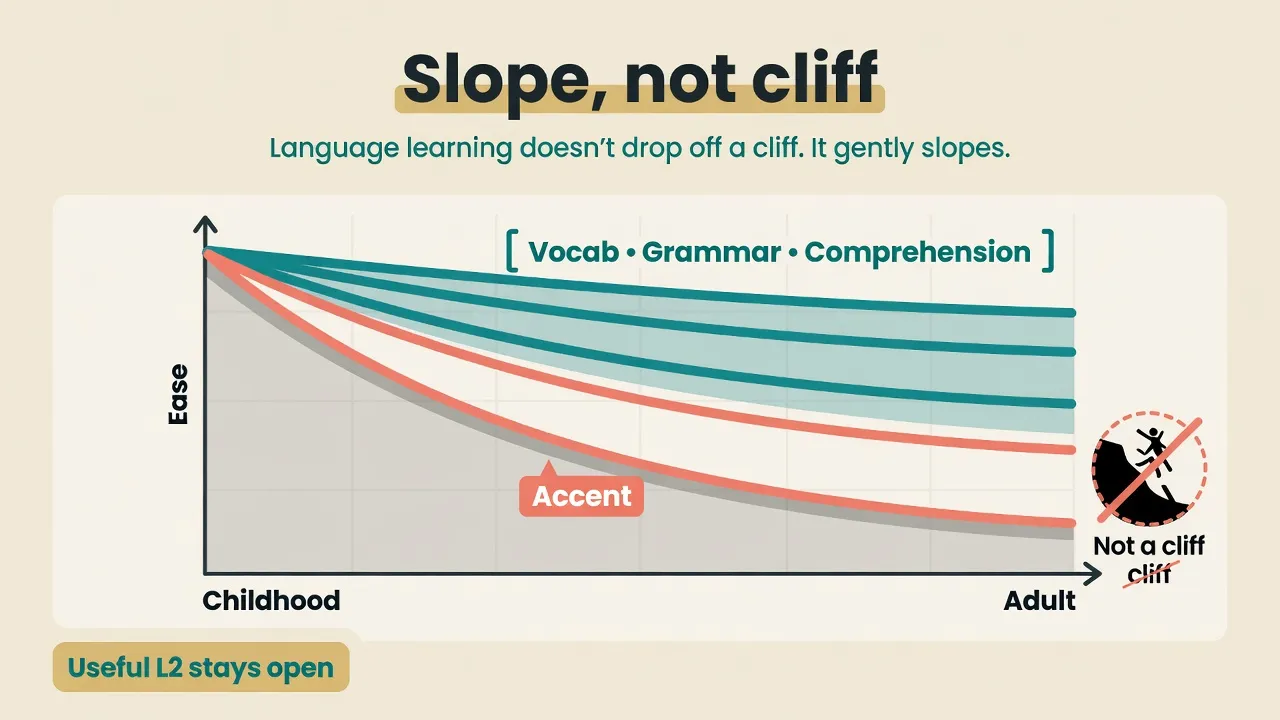
| Skill | Age pressure after childhood | What "good enough" usually means |
|---|---|---|
| Nativelike accent / phonology | Often steeper slope | Clear, understandable speech beats a native ceiling for most goals |
| Grammar useful for work and life | Gentle decline; still learnable | Patterns you can use, not exam-perfect every clause |
| Vocabulary | Stays open with exposure | Words from topics you actually read and need |
| Reading comprehension | Stays open; literacy transfers | Follow articles, email, news, books with support |
| Writing for real tasks | Stays open with practice | Clear messages; polish comes with feedback and time |
Is the adult brain worse - or just different?
Kids are not magic sponges with empty calendars. Adults are not broken hardware.
Children often get massive unstructured hours. They play, listen, fail, and try again for years. They usually have no job, no mortgage, and low social cost for mistakes. Immersion is the default, not a weekend plan.
Adults bring something else: a fully developed cognitive architecture. Your prefrontal tools for pattern work, strategy, and self-correction are online. You already own tens of thousands of concepts in your first language. Learning a second language is often mapping new labels onto ideas you already have - not building the ideas from zero.
| Kids often have | Adults often have |
|---|---|
| Massive unstructured hours | Fully developed pattern tools and strategy |
| Low ego cost of mistakes | L1 concepts, domain knowledge, top-down guesswork |
| Immersion by default | Literacy transfer (you already know how to read) |
| No job or mortgage | Chosen goals (career, family, travel) when content is real |
Different architecture needs adult-interest input, not a demand to become a child again. When materials ignore that, adults quit from boredom and ego strain - and then blame "age."
Why do beginner materials fail adults?
Flashcard apps teach la manzana with a picture of an apple. Textbooks walk you through booking a hotel room for three chapters.
If you are a 35-year-old analyst, a 42-year-old engineer, or a 50-year-old teacher, that mismatch hurts. You already know what an apple is. You need to operate near your intellectual level in a new language, with enough scaffolding that you do not drown.
The competence gap is real: content treats you like a cognitive child while your brain wants adult topics. Many adults abandon courses not because biology failed, but because the path insulted their attention.
What helps is a simple idea popularized by work in the comprehensible-input tradition (Krashen and others): you need input you can mostly follow, about things you care about, with just enough unknown language to grow. In plain words: real topics plus support, not endless kindergarten dialogues.
That is why reading adult-interest texts (graded at first, then richer) is a strong fit after 30. You use literacy you already have. You choose topics from work, news, hobbies, or family life. Day-to-day strategy lists live elsewhere; this article owns the science why.
Neuroplasticity in plain English
Neuroplasticity is the brain's ability to reorganize and form new connections across the lifespan. Older textbooks often implied the brain was "fixed" after childhood. That absolute story does not match modern evidence.
A careful classic example: London taxi drivers who trained on the city's complex street map showed measurable changes in the hippocampus, a region tied to spatial memory (Maguire and colleagues). The point is not "taxis equal languages." The point is that intensive, meaningful practice can reshape relevant systems well into adulthood.
Research has also reported structural and functional differences linked to bilingual experience and late second-language learning, including notes on grey-matter measures in language-related regions. Treat those findings as soft support for capacity, not as a free coupon for perfect outcomes. Study designs, ages, and measures vary.
Plasticity is capacity, not a finish line. You still need hours, sleep, and input at the right level. The adult brain can reorganize for language work; it will not do that work for you while you only watch motivational videos.
What advantages do adults actually have?
Your adult brain brings tools kids do not have yet. Use them instead of fighting them.
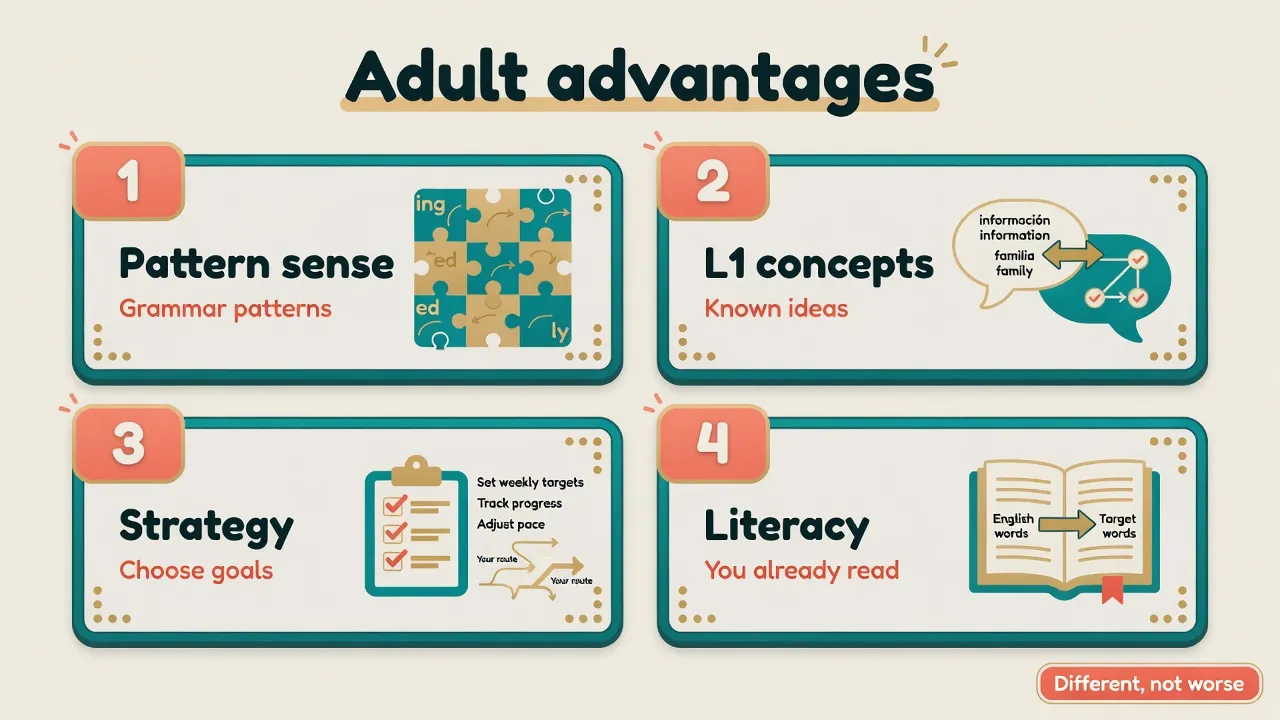
Pattern recognition
Your mature pattern systems help you notice grammar and word families on purpose. Classic work in structured settings (Snow and Hoefnagel-Höhle, 1978, often cited) found that older learners can make strong early gains on morphology, syntax, and vocabulary compared with younger children in the same program. That is about early structured gains, not a lifetime ceiling promise.
L1 concepts and cognates
You already know the world. When you read a sentence about markets in Spanish, you often know what the sentence should mean before every word is clear. That top-down guesswork is a real adult tool.
Take a line like: "La inflación interanual alcanzó el 3,2%, superando las expectativas del mercado." An adult who already understands inflation can parse the frame even with gaps. Explaining year-over-year inflation to a six-year-old, in any language, is a different job.
Cognates help English speakers with Spanish, French, or Italian - and false friends still exist. Use the boost; do not trust every similar-looking word.
Metalinguistic awareness
You can name subjects, tense, and clauses. Those labels are tools. They speed study when you meet a pattern twice and decide to notice it. They do not replace input hours.
Literacy transfer
You already know how to read: decode, scan, reread hard sentences, guess from context. A child learning a new language often learns literacy and the language at once. You mainly need the new language forms (and practice if the writing system is new).
Strategy and motivation
You can choose materials, goals, and schedule. Career, travel, family, and curiosity are adult fuels. Voluntary learning sticks better when the content is real. Motivation dies fast if the path only offers toy dialogues.
None of these advantages cancel the need for contact with the language. They change how you should train: adult interest, clear goals, efficient sessions.
What really blocks adults after 30?
What usually stops adults after 30 is life design, not a sealed neural window.
| Obstacle | Fix direction |
|---|---|
| Time scarcity | Short daily sessions. Efficient input beats long empty drills. See the 15-minute rule for daily vocabulary. |
| Ego / beginner identity | Start with adult-interest texts early. Private reading lowers public shame. |
| Consistency | Build the habit on content you already care about: work news, hobbies, stories you chose. |
| Perfectionism | Prefer understandable speech and finished pages over perfect form. Related: fear of mistakes and perfectionism. |
Time is the honest hard one. You cannot copy a child's immersion hours. You can protect a small daily block and make those minutes dense with meaning.
Ego is quieter and just as strong. Feeling like a beginner after years of competence stings. Reading interesting text privately is one way to practice without performing for a classroom on day one.
Perfectionism pretends to be high standards. Often it is fear. Clear communication and steady pages beat waiting until every ending is flawless.
None of these need a miracle product. They need a method that respects adult attention - and enough honesty to stop blaming age for a calendar problem.
What about accent - the one place age often bites?
This is the one place age often bites. Say it cleanly, then put it in proportion.
For many people, nativelike accent and fine phonology are harder after childhood. That is real research territory, not personal failure. The phonological system becomes less flexible for a lot of learners.
Most goals do not need a native ceiling. They need intelligibility: people understand you at work, on travel, with friends. A slight foreign accent does not block reading, writing, or most professional communication.
Ear training while you read (for example listening to text-to-speech on passages you already understand) can help awareness. It is practice, not a magic accent eraser.
Brief cultural note, not a promise: many public figures built careers while speaking a second language with a clear non-native accent. Communication carried the load; perfect sound did not have to.
If accent polish is a personal goal, treat it as optional craft on top of useful skills - not as the scoreboard that proves you "failed" after 30.
A 15-minute adult reading loop
Science without a next step is only reassurance. Here is a tiny loop that fits adult time.
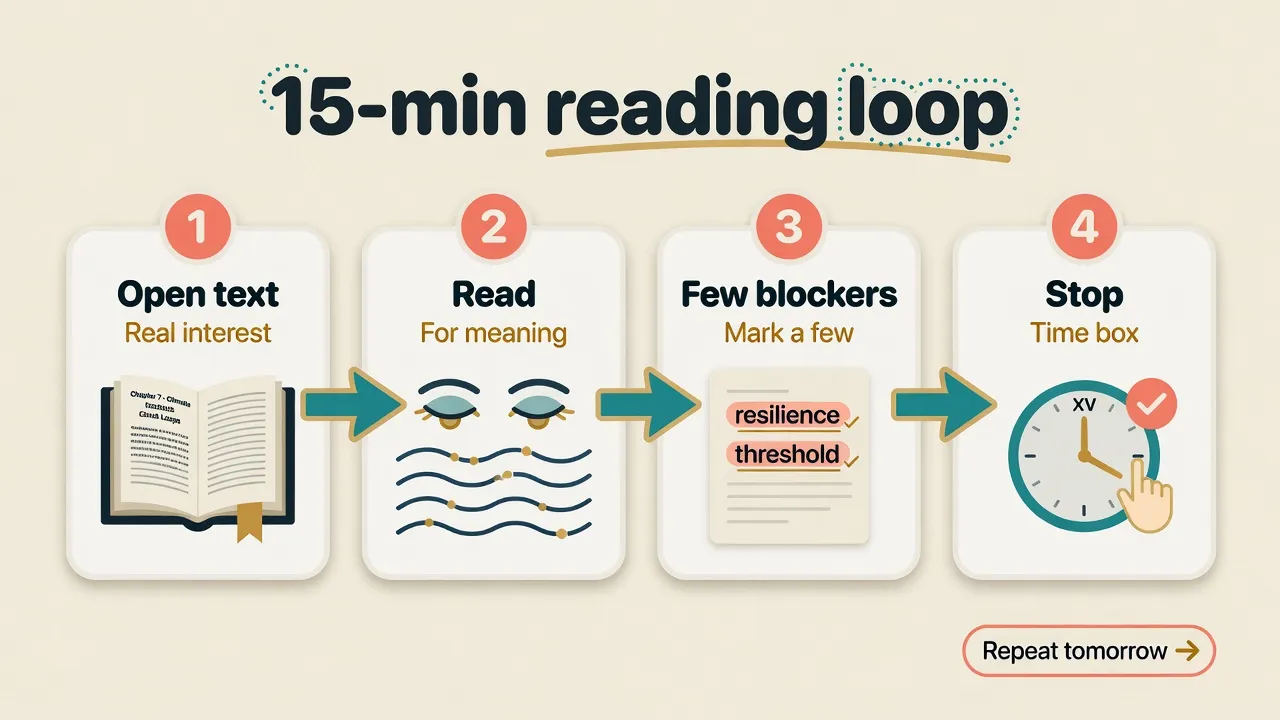
- Open a graded text or your own EPUB at interest level - not kindergarten apple drills if you can avoid them.
- Read for meaning. Tap only a few blockers so the story or article still moves.
- Stop on time. Fifteen minutes is a real session. Ending on purpose protects the habit.
- Repeat tomorrow. Hours compound. A tool only cuts dictionary friction; it does not invent contact time.
Explicit limit: reading loads the vocabulary and comprehension tank. Speaking still needs separate practice - conversation, shadowing, tutors, meetings, or whatever matches your goal.
If week one feels huge, shrink the loop, not the honesty. One clean session most days beats a heroic weekend that never returns.
For a fuller practical checklist (harder/easier splits, strategy lists, app vs reading tradeoffs), use the sister article Is it too late to learn languages after 30?. This piece stays on critical-period science, adult advantages, and the reading-as-input path.
How MovaReader fits (honest, late, soft)
If the science lands, the practical question is simple: how do you get comprehensible input at adult interest level without drowning in the dictionary?
MovaReader is built for that reading path. Free graded articles you can open today, click-to-translate on words so friction drops while you stay in the text, and room to upload your own EPUB or files you already own. Freemium gives about 20 word translations per day. When volume grows, Reader is €1/month. Pro is €5/month for trainers (phrases, typing, and related tools). Hours are still yours. Reading loads vocabulary and comprehension; speaking still needs separate practice. This is not a free CEFR exam and not a full bilingual tutor.
- Browse free articles
- Sample Spanish A2 · English A2
- Pricing: freemium · Reader €1 · Pro €5
- How to use · Language map (soft level bands)
- Demos: type training · phrase typing
Start with one honest session. Keep the science careful and the tool claims modest.
FAQ
Is it too late to learn a language after 30, 40, or 50?
No. Useful second-language learning stays open well past 30. Progress speed tracks hours of good input, method fit, and consistency more than birthday. At 50+, you may have fewer free hours and more fatigue - plan short daily sessions - but the brain does not slam shut. Accent may stay non-native; reading, writing, and clear communication still move with practice.
Does the critical period hypothesis mean adults cannot learn a second language?
No. The classic idea (often tied to Lenneberg) was built mainly around first-language development and pathology, then over-applied to everyday L2 goals. Large modern work (Hartshorne et al. 2018, Cognition, huge learner sample) points to a gradual change in how easily people hit native-like grammar, not a hard ban on adult learning. Adults remain good learners for useful work and life goals. Slope, not cliff - steepest for nativelike accent.
Why do kids seem to learn languages faster?
Kids often get massive unstructured hours and low social cost of mistakes. They are not always faster at conscious grammar or early vocabulary in structured settings. Adults bring pattern recognition, L1 concepts, literacy, and strategy - tools that can speed early structured gains when the materials match adult interest. The unfair comparison is "full immersion childhood" versus "two exhausted evening apps."
Will I always have a foreign accent if I start late?
Often a non-native accent is more likely if you start after childhood - and that is usually fine. Most work, travel, and social goals need intelligibility, not a native ceiling. Accent work is optional polish. It does not block reading, writing, or clear professional speech. Do not treat a slight accent as proof you failed the language.
Can reading alone make me good enough for work?
Reading is excellent for vocabulary, grammar patterns, and comprehension - the tank that makes work email and meetings less empty. It will not replace speaking and listening practice on its own. For work, combine adult-interest reading with talk (colleagues, tutors, shadowing, meetings). "Good enough for work" is a range of skills and hours, not a single finish line sold in a month.
What should an adult do in the first week?
Keep week one small and honest:
- Pick one clear goal (for example, read work news or simple articles in the target language).
- Open graded text or an easy interesting piece - not kindergarten drills only.
- Run the 15-minute loop: open → read for meaning → few look-ups → stop.
- Repeat most days; skip guilt about perfect speaking on day three.
- For a fuller practical checklist, use the sister post on strategies after 30 - this article owns the science why.
No miracle plan. Hours start compounding when the content respects your adult brain. If you want a gentle first reading ladder, how to start reading in English is a soft next step for English learners.
Age is not the wall. Method, hours, and input that respects adult interest are.
Remember the slope: nativelike accent may stay harder; vocabulary, reading, writing, and clear speech stay open with practice. Keep sessions short enough to repeat. Keep materials adult enough to care about.
One 15-minute read today is a better vote than another year of "too late" stories. Browse the free article library when you want friction low - and keep the science honest on the way.
Learn languages by reading!
Try MovaReader for just €1 — read texts with instant translation and interactive vocabulary training.
Free plan: 20 word translations/day and unlimited listening. Pro (€5/mo) unlocks full trainers.