
I. Aspecto físico de la República Argentina, y caracteres, hábitos e ideas que engendra
. , , . , , , . , .
A political essay-biography for C1
Domingo Faustino Sarmiento, 1921
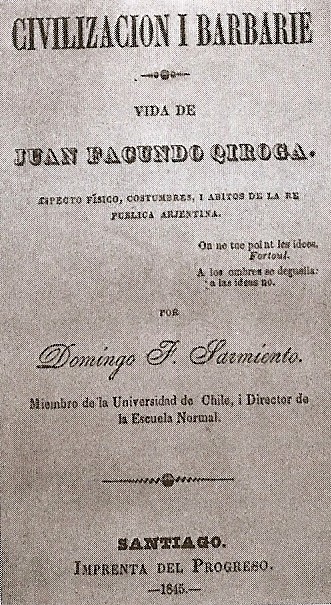
Domingo Faustino Sarmiento’s complete essay-biography of 1845, not an adaptation and not a novel (the printed edition behind this text is from 1921). In the catalog it is C1: about 90,400 words and 30 words per sentence on average. 16 chapters: an introduction and three parts on the pampa and the gauchos, the life of the caudillo Facundo Quiroga, and the Argentina of Rosas; part two reads like a story, while the first chapter of part one and the last of part three are the hardest.
Earlier
At B2 sentences of 30 to 40 words will get lost in chains of subordinate clauses, and the political and historical vocabulary (caudillo, barbarie) will need a dictionary.
B2This text
You can manage it at C1: part two reads as a story, and the essay parts one and three can be read slowly, translating whole sentences where the period is longest.
Check this passageWith room to spare
At C2 the book reads freely; only the political rhetoric of the nineteenth century and the words of the Argentine countryside slow you down.
Start readingThe average sentence has 30 words, and about one word in eight has 9 letters or more (12.1%). Sentence length alone would not make it C1: it is below the two C2 books of the catalog, Don Quijote with 43 words per sentence and Paradise Lost with 38, but above every other C1 book, where sentences run 15 to 26 words. Long words sit well above the C1 line of one in ten. The difficulty is uneven: part two, the life of Quiroga, averages about 28 words per sentence, and chapters IV and VI of that part are the lightest, at 22 and 24; part three averages about 34, and its last chapter 39. Hence C1, at its upper edge. This is the catalog’s assessment, not a certificate.
Librería La Facultad, 1921. Project Gutenberg
Sarmiento writes in exile in Chile in 1845, and the book is both a portrait and an argument. It opens with an introduction that summons the ghost of Facundo Quiroga, the caudillo of La Rioja, and asks what his violence says about the country. Part one describes the pampa, the types of gaucho (the tracker, the guide, the outlaw, the singer), the village store and the revolution of 1810. Part two follows Quiroga from his childhood in the province through his rise as a commander of the countryside and the civil wars. Part three turns to the government of Rosas and the future of the republic. How Quiroga’s story ends is not revealed here.
I. Aspecto físico de la República Argentina, y caracteres, hábitos e ideas que engendra
. , , . , , , . , .
I. Infancia y juventud de Juan Facundo Quiroga
, , . , , . . , , , , , . .
Choose an underlined word.
The long sentence about the territory rests on one verb: la tierra que queda... es el territorio que se llamó Provincias Unidas del Río de la Plata. Everything between la tierra and es is a list of boundaries (the Andes to the west, the Atlantic and the Río de la Plata to the east). Then en la que aún se derrama sangre means “in which blood is still being shed”: Sarmiento says people are fighting even over what to call the country, República Argentina or Confederación Argentina.
Travesía is not just a crossing here: the text defines it in the same sentence as a desert stretch with no water at all (por su falta completa de agua). An aljibe is a well or cistern, and chifles are horn flasks for carrying water: sin prever sus chifles de suficiente cantidad de agua means “without providing their horn flasks with enough water” (prever stands here for “to provide”). In the last sentence, Debían alcanzarlo states the plan: the two companions were to catch up with him once they had stolen horses.
The book stays free on every plan. Reader, €1 a month, removes the daily limit on words and sentences.
€1 a month
In chapter I the sentence about the territory stretches over several asides, so translating the whole sentence in Reader helps you see the main clause, for example in “en la que aún se derrama sangre por denominarlo República Argentina o Confederación Argentina”.
ReaderIt is the original, not a learner’s abridgement: Sarmiento’s complete text, the introduction and all three parts (16 chapters in the contents). The reader follows the Buenos Aires edition of Librería La Facultad, 1921 (Biblioteca Argentina), from Project Gutenberg. The editor’s preface and the appendix of documents are left out, and the introduction, which that edition prints in its appendix, is placed first, as in the 1845 first edition. It is an essay-biography, not a novel.
Facundo has no audiobook on MovaReader: here the book is read on screen. The translation appears when you tap a word, and you will need it most for countryside and period words such as travesía, aljibe or presuntos.
Yes, with the Reader plan. It helps most in the long periods of parts one and three, for example “en la que aún se derrama sangre por denominarlo República Argentina o Confederación Argentina”, and in the last chapter, which averages 39 words per sentence. Without the plan, single words are translated up to the daily limit.
The whole book takes about 15-25 hours: the pace of someone reading with translation of new words, slower than a native speaker’s. Chapters run from about 2,600 to 10,100 words, so the shortest make an evening and the longest two or three.
Part two, the life of Quiroga, runs at about 28 words per sentence and reads as a story; chapters IV and VI of that part are the lightest, at 22 and 24 words. The heaviest are chapter I of part one (37 words) and the last chapter of part three (39). So the book does not even out: the density returns in the essay parts.
Yes. Once you sign in, the reader keeps your last place and the words you opened, so you can come back to the book every evening where you left off. Any of the 16 chapters also opens from the contents on this page, for example the introduction or chapter I of part two, the childhood of Quiroga.

