
I. Capítulo 1
18 . , . , , , , , , , , , . , .
, .
A war novel of the 1808-09 siege, for B2
Benito Pérez Galdós, 1901
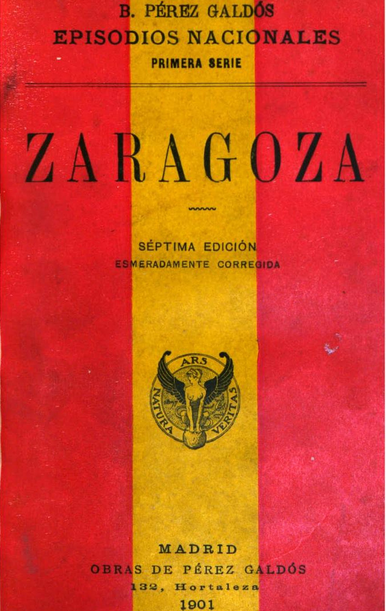
Benito Pérez Galdós’s novel in the complete original text of the 1901 edition, not an adaptation. In the catalog it is B2: about 65,300 words and 18 words per sentence on average. 31 chapters in which the young Gabriel Araceli tells of the second siege of Zaragoza in 1808-09; chapters 4, 8 and 11 have the longest sentences, and the last chapters read most easily.
Earlier
At B1 the sentences of chapters 4, 8 and 11, at 29 to 33 words each, will be slow going, as will the vocabulary of the siege (brechas, tapia, aspillerada) and old forms like apoyábanse.
B1This text
You can manage it at B2: Gabriel’s narration is lively and the dialogues have short lines, while the long battle sentences can be read with word translation and, where needed, whole-sentence translation.
Check this passageWith room to spare
At C1 the novel reads freely; only the longest sentences of chapters 4, 8 and 11 and the military detail slow you down.
Start readingThe average sentence has 18 words, and one word in eleven has 9 letters or more (9.3%). That sits just below the point where the catalog starts to count a book as C1, which is a long word every tenth word or more often: Trafalgar, the first book of the same series, is C1 at 24 words per sentence and 9.9% long words, while Marianela and Doña Perfecta by the same author, at 15 words, and Misericordia, at 18, are B2. The difficulty is uneven: chapters 1-23 average about 20 words per sentence, with peaks of about 33 in chapter 8, 30 in chapter 11 and 29 in chapter 4, while chapters 24-31 drop to about 14. Battle descriptions, the names of military units and the 1901 spelling (á, ó, fué) add work, but livelier chapters such as 2, 5 and 29 keep the book within B2. This is the catalog’s assessment, not a certificate.
Obras de Pérez Galdós, 1901. Project Gutenberg
On an evening in December 1808 the narrator, the young Gabriel Araceli, reaches Zaragoza with three fellow fugitives who escaped from a column of prisoners, just as the city is about to face the French army. Penniless, he is taken in by the family of the merchant José Montoria, whose son Agustín, destined for the Church, is in love with Mariquilla, the daughter of the miser tío Candiola. While bombs fall on the city, hunger spreads and the defenders hold the walls, the two young men take part in the defence and the love affair has to be kept hidden. How the siege and the love story end is not revealed here.
I. Capítulo 1
18 . , . , , , , , , , , , . , .
, .
XVII. Capítulo 17
, , . , . , , .
, . , .
Choose an underlined word.
This 1901 edition prints the preposition a as á and the conjunction o as ó (“avistamos á Zaragoza”), and fué keeps an accent that modern spelling drops. Read them as a, o and fue: they are the same words, only the spelling is older.
Galdós often opens a sentence with the verb and puts the pronoun after it: “Apoyábanse en el molino” means “Se apoyaban en el molino”. When you meet such a form, move the pronoun in front of the verb in your head and the sentence becomes ordinary Spanish.
The book stays free on every plan. Reader, €1 a month, removes the daily limit on words and sentences.
€1 a month
In the French assault of chapter 17 one long sentence runs on through “arrojando sobre ella masas de carne y haciendo pasar la columna viva sobre los cadáveres de la muerta”: translating the whole sentence in Reader helps you keep the thread.
ReaderIt is the original, not a learner’s abridgement: Benito Pérez Galdós’s complete novel (1874), all 31 chapters, taken from the Project Gutenberg text. The reader follows the 1901 seventh edition, printed in Madrid for Obras de Pérez Galdós, which keeps the spelling of its time (á, ó, fué, ví).
Zaragoza has no audiobook on MovaReader: here the novel is read on screen. The translation appears when you tap a word, and you will need it most for the vocabulary of war and siege, such as aspillerada or tapia.
Yes, with the Reader plan. In this novel it helps most in the long sentences of battle and bombardment, for example the one in chapter 17 that begins “Por fin, contra la brecha del centro”. Without the plan, single words are translated up to the daily limit.
The whole novel takes about 11-18 hours: the pace of someone reading with translation of new words, slower than a native speaker’s. Chapters run from about 1,000 to 4,300 words, so one or two make an evening.
It gets easier toward the end. Chapters 1-23 average about 20 words per sentence, with peaks in chapters 4, 8 and 11 (29 to 33), while chapters 24-31 drop to about 14. Chapters 2, 5 and 29 are lighter even in the first part.
Yes. Once you sign in, the reader keeps your last place and the words you opened, so you can come back to the novel every evening where you left off. Any of the 31 chapters also opens from the contents on this page.

