Curated Resources
Best Spanish Books for Absolute Beginners (A1-A2): A Finishable Ladder
A finishable A1 to A2 reading ladder for absolute beginners: free graded texts, short A1 readers, early A2 steps, what to postpone and signs you are ready to move up.
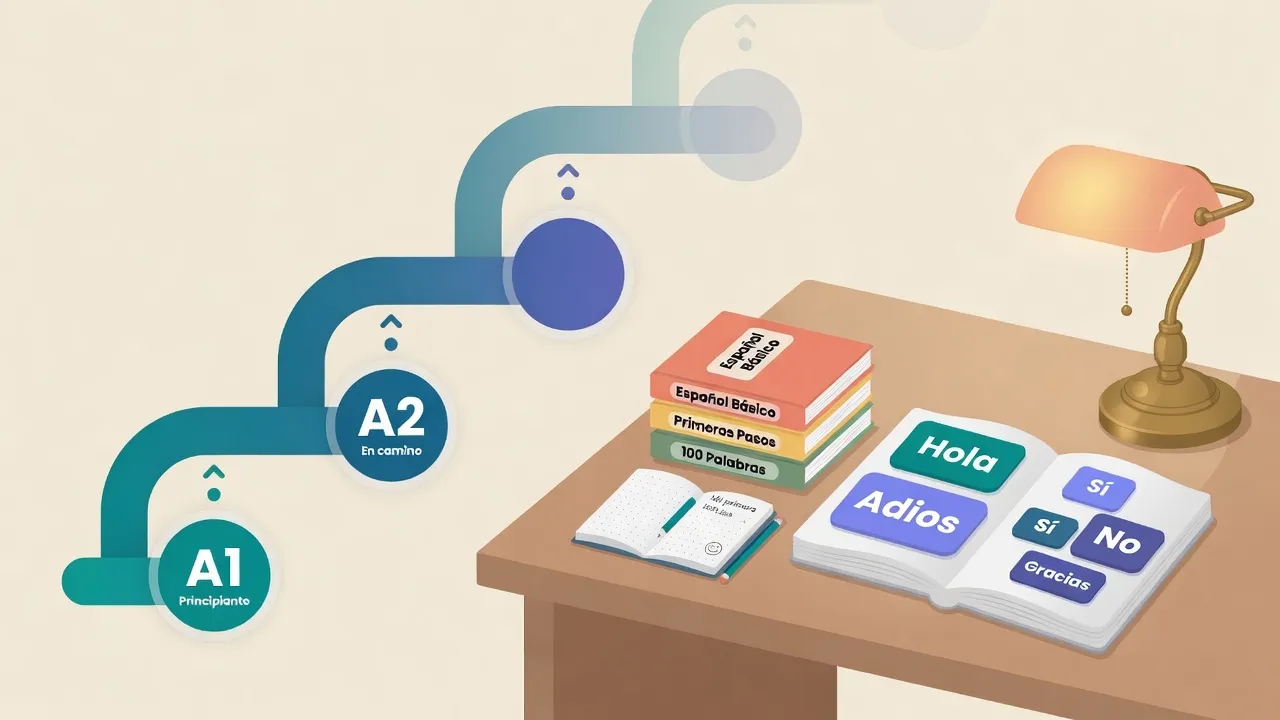
You open a list of the best Spanish books for absolute beginners and the first titles feel... wrong. El Principito. Harry Potter in Spanish. A thick grammar stack sold as "reading practice." Maybe a kids classic that looks cute but still leaves you stuck on every line.
If you are near zero, you do not need prestige. You need a path you can finish.
Here is the simple version. For absolute beginners, "best books" is not famous classics on day one. It is a finishable ladder: ultra-short free graded stories, then short learner readers (A1), then slightly longer early-A2 chapters - always material you mostly understand. Skip El Principito, unadapted novels, and grammar textbooks sold as reading practice until easier rungs feel doable. Below: stages, start-now titles and free samples, a postpone list, simple climb rules, and when to graduate to an A2-B1 finish list.
What this guide covers:
- The A1 to A2 ladder (stages and goals)
- Start-now materials: free graded shorts, short A1 books, early A2 steps
- A postpone list (great later, wrong first)
- How to climb without burnout (~80% rule, short sessions)
- When to graduate to easier novels
- How to use free samples and your own legal books
If you only need a pure day-one A1 decision tree, start with our sister post on easy Spanish books for A1 beginners. When this ladder feels easy, the graduate list is our easiest Spanish books for A2-B1.
What does "best" mean for absolute beginners?
For absolute beginners, best means finishable at your stage. Not "native from page one." Not the most famous cover on the shelf.
Reading books and study books are different jobs. A grammar course (Practice Makes Perfect, Complete Spanish, and similar) can help you study. It is not extensive reading. Extensive reading is stories and short chapters you mostly understand while the language soaks in.
One more note: CEFR labels on learner books (A1, A2) are soft publisher or teacher estimates. Use them as a compass, not a court ruling. If you want a rough sense of where your vocabulary sits, the language map can help.
| Prestige pick (day one) | Finishable pick (absolute beginner) |
|---|---|
| El Principito original, unadapted YA, grammar stack sold as "reading" | Free graded A1 short → ultra-short learner novella → ELE A1 easy reader |
Finishability beats famous titles. One short story you complete beats five "serious" novels you abandon on page twelve.
The A1 to A2 reading ladder (stages)
Think of absolute-beginner Spanish reading as a ladder, not a shopping list. Climb one rung at a time. The goal is finishes that build confidence, not a famous cover on day one.
Here is the full ladder at a glance - free graded first, then short A1, then early A2, then graduate:
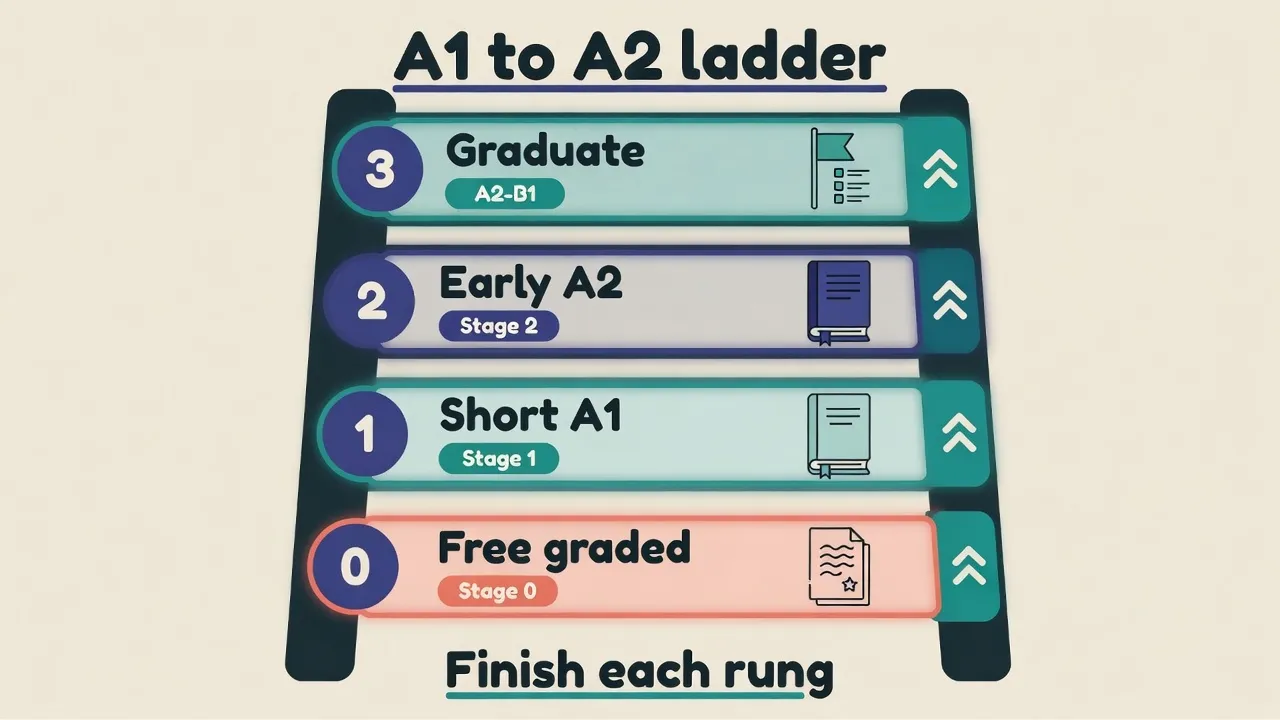
| Stage | Soft band | What you read | Goal |
|---|---|---|---|
| 0 | Ultra-start | Free graded shorts (A1-tagged) | First finishes; confidence |
| 1 | Solid A1 | Short learner novellas / ELE easy readers | Daily pages without panic |
| 2 | High A1 / early A2 | Longer short stories / simple chapter books | Stamina + slightly denser vocab |
| 3 | Graduate | Sister A2-B1 finish list | Real "easy novels" after the ladder |
How do you know you are ready for the next rung?
Use signals, not a calendar promise:
- You finish Stage N without quitting mid-story most days.
- A random page feels about 80% clear (gist). Look-ups are blockers, not every line.
- Dialogue and repeated plot words start feeling familiar.
Still stuck on "what is my first book ever?" Stay with the pure A1 sister guide. This post owns the full climb into early A2.
What should absolute beginners read first?
Named, finishable materials - not vague advice like "just read children's books." Below is a start-now path you can actually use this week.
Stage 0: free graded shorts you can try today
Start free. Short. Legal. Zero buy pressure.
Free graded A1 samples on the site are ideal first finishes. They feel CEFR-tagged, they end before panic sets in, and you can try more than one without spending money. Browse the full free library in all articles, or go deeper on method in free graded Spanish readers online and graded Spanish stories by CEFR.
Try any of these A1 samples:
| Story | Soft band | Start tip |
|---|---|---|
| Mi día en el parque | A1 | Park-day vocab; great first full finish |
| El lápiz mágico de Sofía | A1 | Short story arc; light magic-schoolkid tone |
| Jugar al fútbol | A1 | Sport and play words; very concrete |
| En el aeropuerto | A1 | Travel frames; high-frequency travel Spanish |
| Ir de compras con mamá | A1 | Shopping + family; everyday phrases |
| La comida española | A1 | Food culture; useful concrete nouns |
| La Merienda | A1 | Snack / social routine; short win |
| El juego del escondite | A1 | Kids-game plot; clear actions |
Pick one today. Finish it. That single win matters more than browsing ten "best books" lists.
Stage 1: short A1 learner books and ELE easy readers
Once free A1 shorts feel easy, move to a short learner book you buy or borrow (paper or a legal EPUB you own). These are not native literature. That is the point.
¡Hola, Lola! (Juan Fernández)
Soft level: true A1 / ultra-short learner novella (a frequent pick on beginner lists).
Why finishable: very short, written for learners, and popular with people starting from zero.
Watch-out: thin plot by design - treat it as a confidence builder, not a literary novel.
Start tip: one sitting, or two sessions of 10-15 minutes. If you finish without panic, stay in this ultra-short zone a bit longer.
El sombrero (common beginner reader listings)
Soft level: A1-oriented short reader (editions and publishers vary - check the level tag).
Why finishable: short controlled prose; many beginner lists treat it as a true first reader.
Watch-out: confirm you have a learner edition, not dense public-domain Spanish with a similar title.
Start tip: try 3-5 pages. If the gist holds without every-word lookup, keep going.
ELE easy series (pick one book, not the whole catalogue)
Series like Un día en…, true Lola Lago A1 titles, Gael / 24 horas en español-style easy readers, and other Difusión / SGEL / Edelsa / Edinumen easy readers work when the spine really says A1.
Why finishable: controlled vocab, short chapters, often glossary or audio support.
Watch-out: series jump A1 to A2 without warning. Check the level tag on the book you hold, not only the series name.
Start tip: finish one full short book. Do not start three half-reads.
Paid beginner packs (label them clearly)
Paco Ardit-style Spanish Novels / Beginner Bundles and Ana Martín graded collections are paid learner series. Levels vary by title. They can be finish-oriented, but they are not free novels in an app library. Buy or borrow; then open a file you own if you use a reader tool.
Grammar stacks (Madrigal, Practice Makes Perfect, Complete Spanish) stay in the study pile. They are not Stage 1 extensive reading.
For a deeper pure-A1 first-book decision tree, use easy Spanish books for A1 beginners. This guide keeps moving up the ladder.
Stage 2: early A2 (still the beginner path, not prestige)
Early A2 still belongs on this absolute-beginner ladder. Pages get longer. Vocab range grows. Language stays learner-friendly when you choose well.
Good Stage 2 types:
- Longer learner short-story collections (Olly Richards-style short stories are a known format type - useful even when a site also sells a course)
- Slightly longer graded chapter books with a real early-A2 feel
- Travel learner plots such as Viaje a Madrid / Los Viajes de Marta-style books when the edition really matches the level
Still not (without a heavy hedge): unadapted Manolito Gafotas, the original El Principito as "easy A2 day one," Harry Potter in Spanish, or Penguin parallel classics as an absolute-zero path.
When Stage 1 finishes feel comfortable, try a free A2 taste: Aprendiendo a reciclar en casa. You want "hard but doable," not opaque. That feeling is a graduation signal, not a failure.
What should you postpone?
Great books later. Wrong first finish kills the habit.
Here is the split: finishable now on the left, prestige and myths on the right.
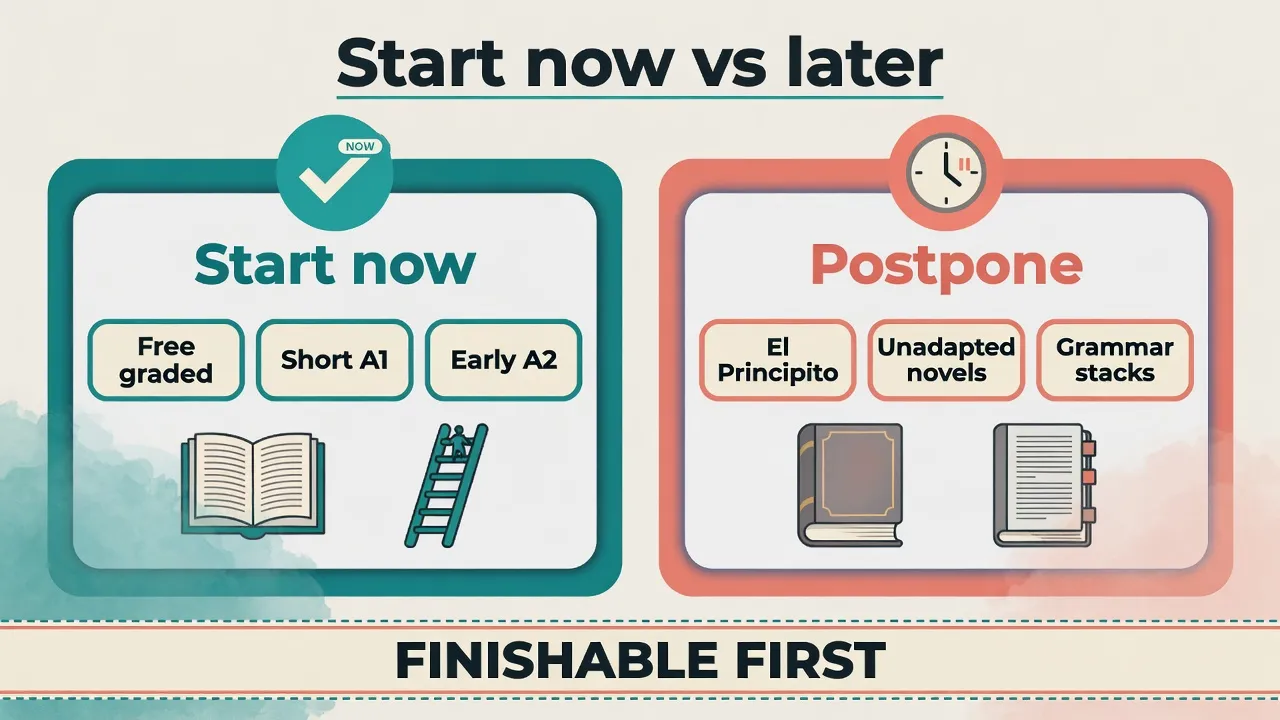
Classics and "easy" myths
| Title / type | Why postpone | Soft later band (hedge) |
|---|---|---|
| El Principito original | Literary simplicity is not beginner Spanish | A2-B1 goal after controlled rungs |
| Unadapted Manolito Gafotas | Colloquial density, culture jokes | High A2 / solid B1 for many |
| Harry Potter (Spanish) / dense YA bestsellers | Vocab load + length | B1+ for many; not absolute beginner |
| Unadapted native bestsellers sold as "beginner" | Marketing is not CEFR | After Stage 2 finishes |
| Penguin parallel classics as day-one path | Parallel can help some later; not absolute-zero default | Optional later scaffold, not Stage 0 |
Kids track and study books sold as reading
Kids books (Dr Seuss / Cat-in-the-Hat style bilingual mash-ups) can give tiny confidence wins. They are optional, not the whole adult strategy. Adult-oriented graded texts and learner novellas usually match adult goals and tone better. Mix is fine; kids-only is not required.
Grammar stacks are study books. Poetry and dense classics are enrichment later. None of these are the core extensive-reading ladder for absolute beginners.
If you are still pure zero and want a longer postpone decision tree, the A1 beginners sister post goes deeper without pulling you into early A2 too soon.
How do you climb without burning out?
The ladder only works if you stay on it. Method matters as much as titles.
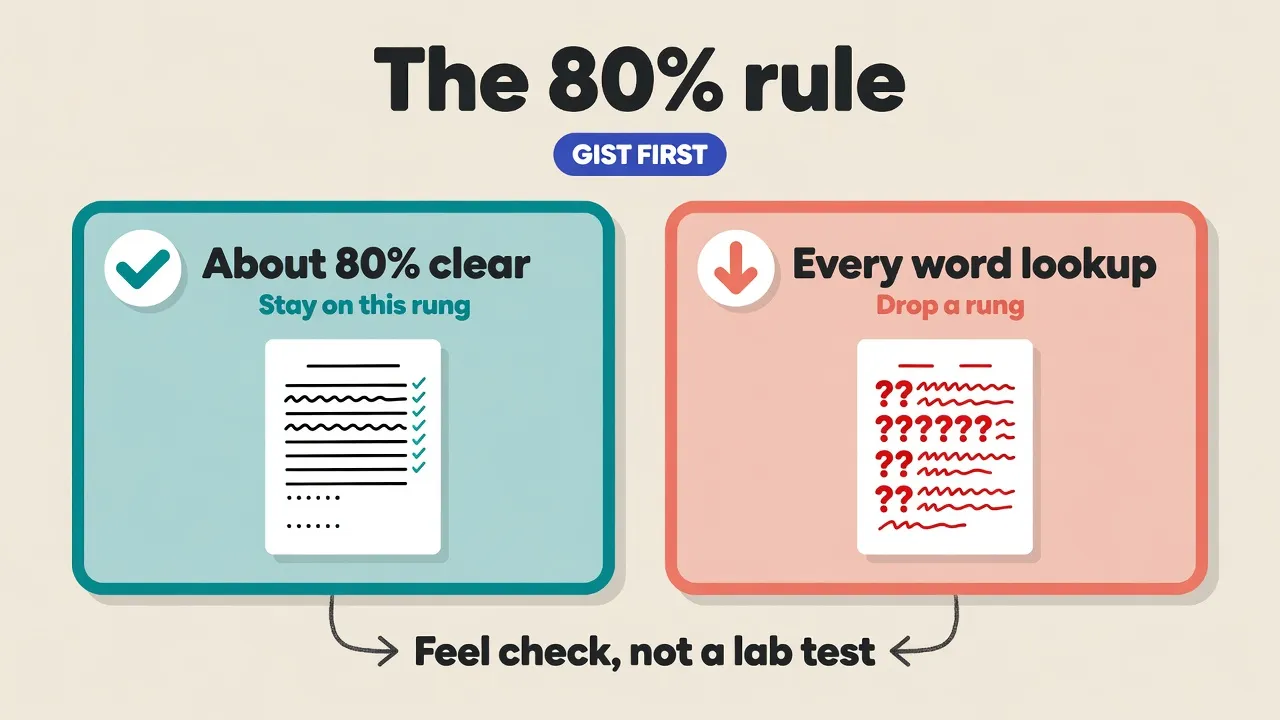
The ~80% rule (gist first)
Open a random page. Can you follow the gist without translating every word?
- Stay when about 80% feels clear.
- Drop a rung when every sentence is a lookup wall.
This is a feel check, not a lab instrument. Trust the pattern over a few sessions.
Short daily sessions beat hero weekends
Ten to twenty minutes daily beats a heroic Saturday that ends in guilt. Stopping mid-chapter is fine. One story finished is worth more than five abandoned "serious" novels.
Look up blockers, not every unknown word
A simple session loop:
- Read a paragraph once without stopping.
- Mark only sentence blockers (words that kill the meaning).
- Check those blockers.
- Reread the paragraph.
- Save 3-10 useful chunks - not 40 isolated words.
Free graded + one short book (week sketch)
Most days: free A1 samples.
Two days: your chosen short Stage 1 reader (paper or legal EPUB).
Light phrase review when something useful sticks.
That mix builds finishes without turning reading into a dictionary sport.
When should you graduate to A2-B1 books?
Graduation is a set of signals, not a certificate:
- Stage 2 finishes feel comfortable most days.
- You want plot pull more than ultra-controlled vocab.
- The free A2 sample Aprendiendo a reciclar en casa feels hard but doable, not opaque.
- You are curious about longer easy novels.
When those line up, leave this beginner ladder and open the graduate list: top easiest Spanish books for A2-B1 you can actually finish. That sister post owns the finishable A2-B1 novel/reader spine. We will not paste their full top-10 here.
Optional check-in: glance at the language map for a rough vocab feel. It will not certify your level.
Suggested order if you feel lost
Path A (safest absolute zero)
- Free A1 articles (Stage 0 samples above).
- One ultra-short learner novella (¡Hola, Lola!-type).
- One ELE A1 easy reader series book.
- Early A2 short-story collection or longer graded chapter book.
- Graduate sister A2-B1 list.
Path B (you already did the pure A1 sister list)
- Confirm Stage 1 finishes feel easy.
- Jump to Stage 2 early A2.
- Sample article 1209.
- Graduate to the A2-B1 finish list.
Only need "what is my first book ever?" Stay with easy Spanish books for A1 beginners.
How to use MovaReader
MovaReader helps you read Spanish with support, then turn blockers into practice. Free graded Spanish texts are Stage 0 of this ladder. The book catalog adds A1 retellings of familiar tales, such as Caperucita Roja and El ratoncito Pérez, where you tap a word to see its translation. Short learner books and commercial novels stay your legal EPUB or paper copy. The app does not host full commercial bestsellers free by default.
A simple loop:
- Warm up on free graded texts in all articles (for example Mi día en el parque or En el aeropuerto).
- When you pick a short Stage 1-2 reader, open a file you own or borrow legally - see how to use.
- Tap only blockers, not every unknown word.
- Train a small phrase set with the free Spanish vocabulary trainer and/or everyday Spanish phrases practice (full trainers when you want more).
- Know the free plan limits: about 20 word translations per day. Unlimited reading translations are Reader (~€1/month). Full trainers are Pro (~€5/month). Details: pricing.
What MovaReader does not do:
- Host full commercial novels (El Principito, Harry Potter, unadapted natives) free by default
- Host full paid ELE series or Juan Fernández / Paco Ardit books as free in-app novels
- Replace legal buy or borrow
- Turn a hard novel into A1 with UI magic
Tools reduce friction. Register when you want a full account; free graded samples work as a start either way.
FAQ
What Spanish book should I read first as an absolute beginner?
Start with a free graded A1 short (park, airport, shopping - real samples on the site), then an ultra-short learner novella (¡Hola, Lola!-type) or a true ELE A1 easy reader. That is a first finish, not El Principito on day one. If you only need a pure A1 decision tree, use the sister post for A1 beginners.
Is El Principito A1 / good for absolute beginners?
The original is literary-simple, not beginner Spanish. Short chapters help later; abstract lines still block absolute beginners. Finish controlled A1 and early-A2 rungs first. Treat El Principito as a later goal, not proof you can "read Spanish."
Are children's books better than graded readers for adults?
Kids books can help for tiny confidence wins. Adult-oriented graded texts and learner novellas usually fit adult goals and tone better. A mix is fine; a kids-only track is optional, not mandatory. Use the ~80% gist rule either way.
How long before I can read a full Spanish book?
It depends on hours and consistency, not a calendar promise. Many people need weeks to months of short finishes before a full easy novel feels good. Use stage signals (finishes without quitting, ~80% gist, sample A2 feels doable) - not a fixed week count.
What is the difference between A1 and A2 reading materials?
A1: very short, high control, confidence first. Early A2: longer pages, wider vocab, still learner-friendly. Graduation is stamina + gist, not perfection or a certificate. Soft CEFR labels are publisher or learner estimates.
Should I buy books or start free?
Start free graded samples to learn your rung. Buy or borrow short learner books once free finishes feel easy. Commercial novels and paid ELE series are copies you own or borrow; MovaReader does not host commercial novels free by default. Free path first; paid tools only if daily translation budget or trainers are the bottleneck (~20 free word translations/day; Reader ~€1; Pro ~€5).
Next steps
The best Spanish "book" for an absolute beginner is not a famous cover. It is the next finishable rung.
Today:
- Open one free A1 sample - try Mi día en el parque or En el aeropuerto.
- Plan one Stage 1 short reader you can buy or borrow this week.
- Stay on free graded and short A1 until the ~80% rule says climb.
If you are still pure zero, use easy Spanish books for A1 beginners. When Stage 2 feels comfortable, graduate with easiest Spanish books A2-B1. For method depth, keep free graded Spanish readers online and graded stories by CEFR nearby - and use the language map only as a compass.
One finish at a time. The ladder is short enough to climb.
Keep reading with translations inside the text
With a free account, an unknown word translates with one tap, and the words you are learning wait for you in the trainer.
Free account: 7 days of Pro, then 20 word translations a day or a paid plan.