How to Stop Translating in Your Head (5 Steps, Not Magic)
The inner translator is a double-processing habit, not low talent. Five practical steps via reading, chunks, and light practice - with honest freemium limits and no fluency button.
You hear a question in English. Your brain rebuilds it in your first language. You craft a perfect answer there, hunt for words, then push everything back into English. By the time you are ready to speak, the conversation has already moved on.
That lag is familiar - and it is not proof you are bad at languages. It is the inner translator: meaning takes a detour through your first language before English. Conversation feels slower, stress rises, and simple replies cost more energy than they should.
Here is the simple version. Translating in your head is a normal stage, not a talent verdict. You weaken that extra layer with enough easy reading and listening (a mental stock of ready phrases - call it pattern exposure), whole phrase chunks instead of isolated word cards, and light practice like short shadowing and ready answers. Not a purity war. Not a week of magic.
Below: why the habit costs time, what pattern exposure really is, what helps and what does not, L1-bridge vs direct retrieval, five practical steps, and where tools fit without fake promises.
Why does the inner translator slow you down?
The inner translator is not low talent. It is an extra layer between meaning and speech.
Translation is not the same as meaning
English words rarely map one-to-one onto your first language. They live in collocations, tone, and context.
If you only learned daunting as a single first-language label, the loop often goes: see daunting → find the L1 tag → only then rebuild the sentence. That works in a dictionary. In conversation it is expensive.
A better path: meet daunting in a few real situations (a hard task, an interview, a first day at work) until the feeling lands as "hard + a bit scary + maybe I cannot handle it," not as a single native word alone.
The extra step costs time
Live talk does not wait for "heard → L1 → rebuild → speak." Even when every step is correct, you still lag behind people who pull a ready phrase.
Translation is allowed as a spare tool. The problem starts when it stays the only way you understand and answer.
Textbooks teach assemble, not retrieve
Many learners can build a sentence from rules, yet freeze when they need a block ready to go: I'm not sure, That makes sense, Could you say that again? Ready blocks cut the need for word-by-word rebuilds under pressure.
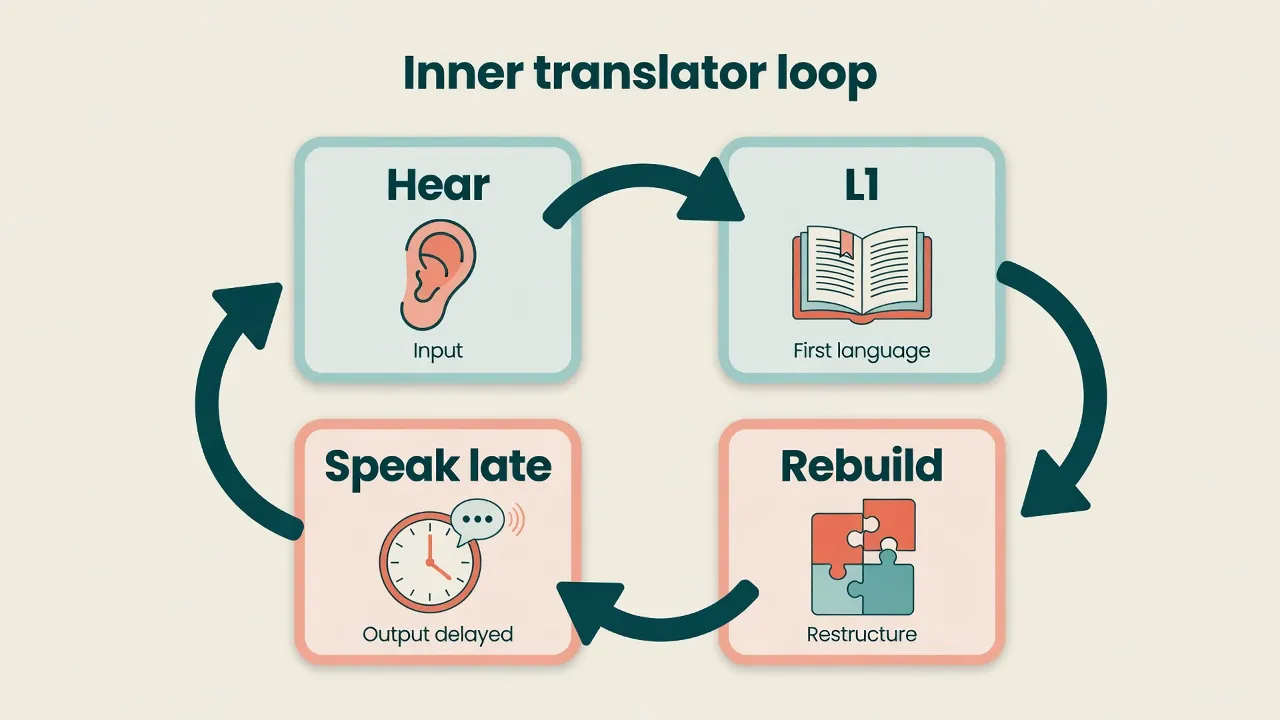
Here is the loop that keeps the habit strong:
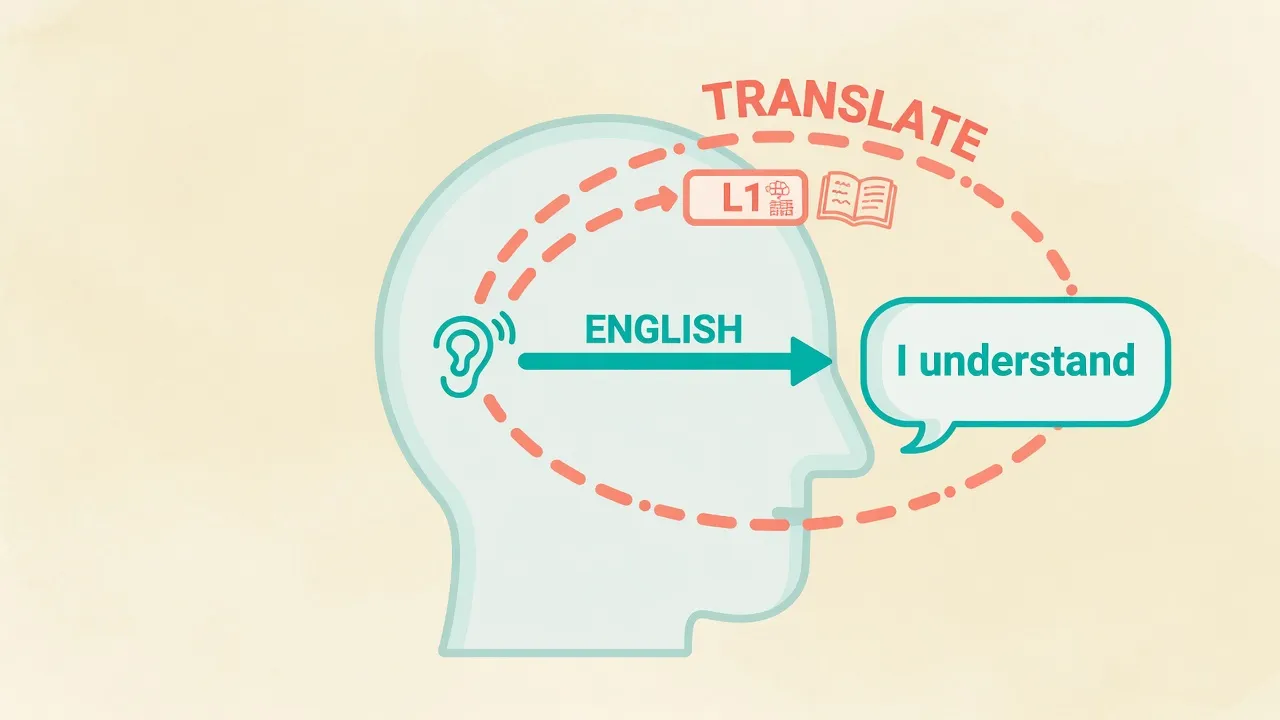
Input lands, L1 rebuilds meaning, you reconstruct English, lag and stress rise, and you lean harder on the L1 bridge next time. Breaking the loop is less about willpower and more about growing another path.
What is pattern exposure?
Pattern exposure (a mental inventory of ready phrases) is a stock of correct phrases and structures built through regular reading and listening you mostly understand. Not talent magic. Volume of good input, plus a bit of active use.
When it grows:
- you recognize "I've seen this pattern"
- you build fewer sentences word by word
- you feel "that doesn't sound right" without naming a rule
That inventory is the quiet foundation of thinking in English for ordinary moments. Graded texts near your level help it grow; a language map can orient which phrases and bands you are collecting. Reading that actually sticks is also covered in how reading accelerates English learning.
What actually helps (and what does not)?
Not every popular tip weakens the inner translator. Some feed it.
Helps
- Comprehensible input at a level you mostly understand without a dictionary
- Phrases in context, not isolated flashcard words
- Short self-talk about simple actions (micro labels)
- Shadowing (rhythm occupies the brain; less room for L1 rebuild)
- Monolingual glosses when ready (daunting = making you feel slightly worried about whether you can do it)
Does not help (or helps weakly)
- Thousands of "word = translation" pairs with no sentences
- Series only with first-language subtitles sold as "English input"
- "In 30 days you will think only in English" promises
- Shame for every internal translation (stage, not verdict)
If a tip only grows your L1 dictionary, it rarely trains direct retrieval. If it puts whole phrases in your ear and mouth at a level you can follow, it usually helps.
L1-bridge path vs direct retrieval
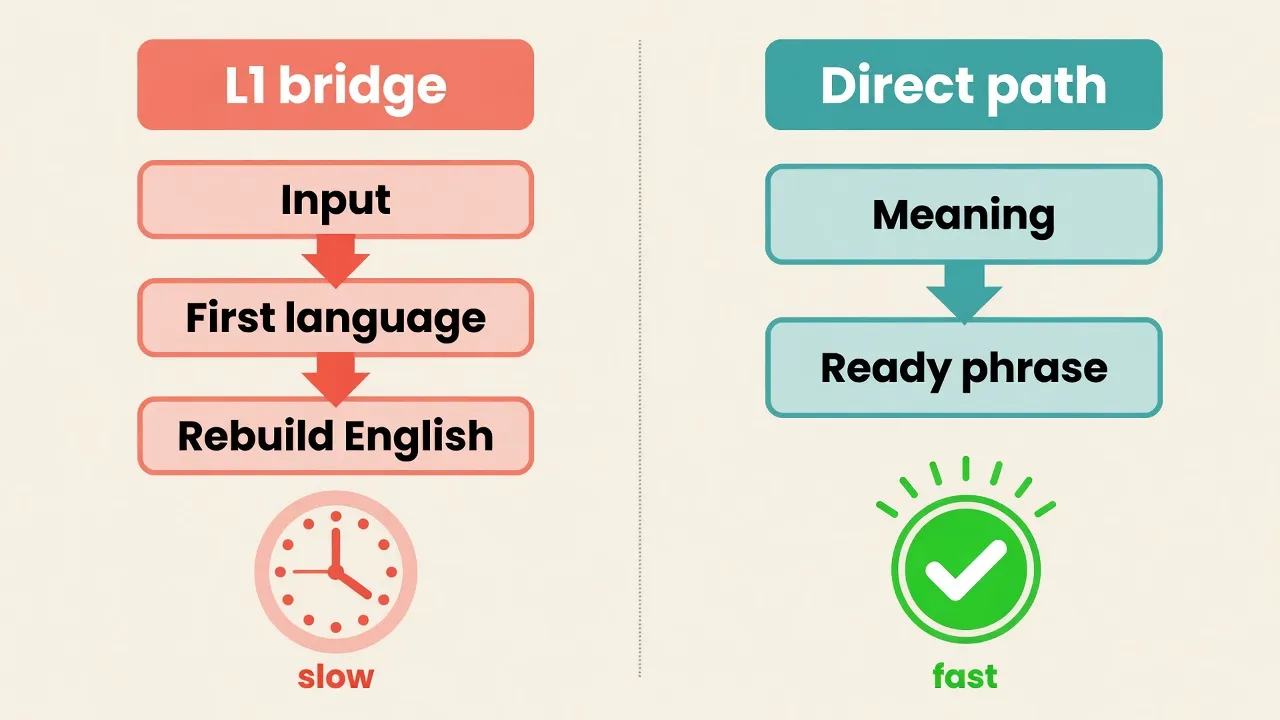
Same brain, two routes. The goal of this article is more direct retrieval, not a purity ban on your first language.
| Path | What happens | Cost | When useful |
|---|---|---|---|
| L1-bridge | hear/see → first language → rebuild target language | Slow; unnatural chunks; lag under pressure | Beginners; complex ideas; emergency meaning rescue |
| Direct retrieval | situation/meaning → ready phrase | Faster; more natural rhythm | Daily situations after enough input + phrase inventory |
Translation stays a spare tool. The problem is when the L1 bridge is the only path for ordinary moments like I'm late or Could you repeat that?
Five practical steps (no heroics)
Small habits, not a personality transplant or a 30-day challenge.
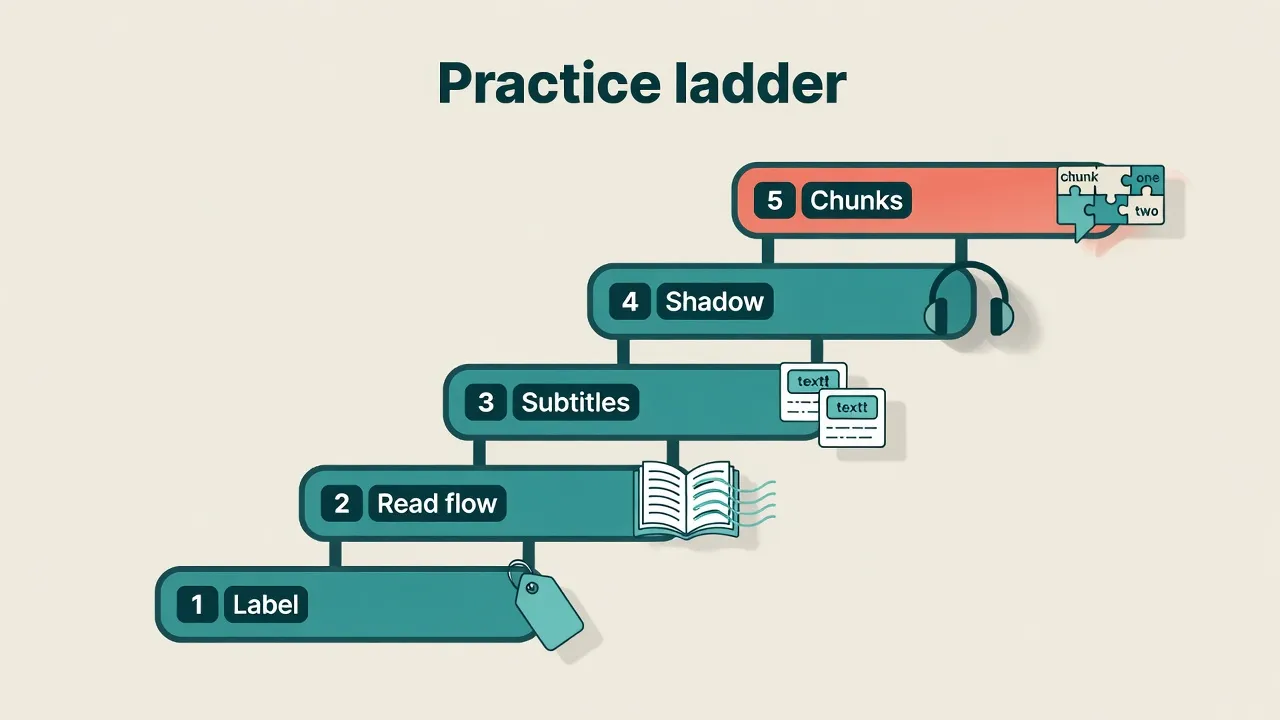
1. Start with objects and simple situation labels
You do not need to "think like a native" by Friday. Start tiny:
- cup of coffee → cup, coffee, hot
- leaving the house → I'm late, I need to leave, Where are my keys?
Goal: situation → English label without a long first-language bridge. Two or three labels a day already count.
2. Read so you stay in English
Competitors say "immersion." Here is an executable session:
- Read a full paragraph without stopping every word.
- Mark only sentence-breakers (words that kill the whole line).
- Look those up.
- Reread the paragraph.
- Save 3-8 phrases, not 40 isolated words.
Soft rule: if you understand less than about ~70% of a page, the text is too hard. You train decoding, not thinking. Step down level instead of punishing yourself. The 5-finger rule for book level and adapted vs original books help when a page feels like a wall.
Try lighter material first:
3. Subtitles: ease off first-language captions gradually
Not "from tomorrow forever":
- if you follow about ~80%+, English captions are fair
- if you follow about ~50%, simplify the material; do not punish yourself with "pure" English
Reading plus listening links form and sound. Useful, and still not a full replacement for live speech.
4. Shadowing for 5-10 minutes
- Read a short bit silently.
- Play the audio (on MovaReader, freemium listening is often unlimited).
- Repeat near-simultaneously with the speaker.
- Chase phrase rhythm, not perfection.
While you shadow, the brain often has less room for a full L1 rebuild. That is why short daily runs beat heroic once-a-month sessions.
5. Speak ready blocks
Instead of assembling I / would / like / to / ask / about... from scratch under pressure, train whole phrases:
- Could you repeat that?
- What I mean is...
- I'm not sure, but...
- That sounds good.
A short correct phrase now beats a perfect sentence after twenty seconds of silence. Practice on the phrase typing demo, the type training demo, or trainers once phrases come from your own reading. Moving chunks from recognition into use is also the theme of passive to active vocabulary.
Mini checklist for today
- 2-3 micro labels today
- one near-level paragraph with blockers-only lookup
- 3-8 saved phrases
- 5-10 min shadow
- one ready block said out loud
Fifteen to twenty minutes of text you mostly understand beats a heroic "think only English" day that collapses tomorrow.
Where MovaReader fits (honest)
Tools reduce friction while you build direct paths. They do not install "think in English" with a button.
MovaReader is built for reading that grows phrase links: graded texts near your level, click-to-translate blockers only (so you stay in English instead of a lookup loop), optional audio for short shadowing, and later phrase/type trainers when you want active use of saved chunks.
| Need | Realistic plan |
|---|---|
| Test reading + blocker discipline without commitment | Freemium (~20 word translations/day; listening often unlimited) |
| Daily page volume + dictionary without flow breaks | Reader €1/mo |
| Phrase / type trainers for active chunk practice | Pro €5/mo |
Practical loop:
- Take free graded texts in All Articles, starting with the EN A2 sample.
- Click blockers only, not every unknown adjective.
- Upload a legal EPUB you own when you want a longer book; How to use covers the flow.
- Save a few phrases; train later, not after every paragraph.
- Check limits and plans on Pricing: freemium about ~20 word translations/day with listening often unlimited; Reader €1/mo for volume reading without constant flow breaks; Pro €5/mo for full trainers.
What the product does not do:
- replace live conversation or speaking partners
- guarantee the inner translator vanishes forever
- host unlimited commercial novels as a free default Chapter 1
- require Pro just to start the reading habit
- promise "think only in English in 30 days"
Today path that stays honest:
- EN A2 article
- one paragraph: meaning first, blockers only, reread, save 3-8 phrases
- optional 5 minutes of shadowing with freemium audio
- one ready block on demo phrase typing or demo type training
- still say one short answer out loud to a human or a voice note - the app does not do that for you
FAQ
Can you fully stop translating in your head?
Mostly no, and that is fine. Even strong speakers may bridge complex ideas through their first language. The goal is not purity. The goal is that everyday situations go direct more often, while L1 stays a spare tool for hard ideas - not the only path for I'm late and Could you repeat that?
How long until English feels more "direct"?
Think months of regular input + short practice, not a one-week transformation. Timeline depends on level, volume of easy reading and listening, and how often you reuse ready phrases. Pattern exposure grows with input you actually understand, not with shame or a countdown challenge.
Should I ban bilingual dictionaries completely?
No. At A1-A2 a bilingual gloss often saves the sentence. The trap is translating every unknown word. Prefer blockers only, and add simple EN-EN glosses for words you almost know when you are ready (daunting = making you feel slightly worried about whether you can do it).
Does Anki help?
Yes if cards are phrases from your reading, not 2000 isolated "word = translation" pairs. Phrase cards support direct retrieval. Deck volume alone rarely kills the inner translator, because isolated words still invite L1 rebuilds under pressure.
What if I start translating again mid-conversation?
Simplify the answer. A short correct phrase now beats a perfect sentence after 20 seconds of silence. Later, while reading, collect ready blocks for those situations (What I mean is..., I'm not sure, but..., That sounds good.) and train them lightly so the next time has a direct path. If perfectionism freezes you, fear of mistakes is a useful sibling read.
Is it normal - do bilinguals still translate?
Yes, it is a normal stage, and even advanced users may translate for dense or technical ideas. Mental translation is not a talent test. Reduce dependence for daily speech with easy input, chunks, and light output practice; keep L1 as emergency scaffolding, not as proof you "failed."
Can I practice this on free MovaReader?
Yes for the habit loop. Freemium supports graded reading with about ~20 word translations/day and listening often unlimited on free - which fits blocker discipline and short shadowing. High daily page volume usually wants Reader at €1/mo. Pro at €5/mo is for full phrase/type trainers when you move chunks into active use. Details stay on Pricing. Reading still does not replace live speaking with humans.
Next steps
The inner translator is a double-processing habit, not a verdict. You weaken it with easy regular input, phrases over isolated words, short shadowing and self-talk, and fewer "every word" stops.
Today: 15-20 minutes on a text you mostly understand, a few ready blocks out loud, and one ordinary answer said simply. Open All Articles if you want a graded place to start.
You do not need to "kill" translation this week. You need more direct paths for ordinary moments. Tools help the habit; speech with people still has to happen later.
Learn languages by reading!
Try MovaReader for just €1 — read texts with instant translation and interactive vocabulary training.
Free plan: 20 word translations/day and unlimited listening. Pro (€5/mo) unlocks full trainers.