Curated Content
Readlang vs LingQ vs MovaReader: Which Reading Tool Fits You
Three tabs open, one decision: which reading tool becomes home? Readlang, LingQ and MovaReader compared by job, free plan limits, prices and who should pick which.
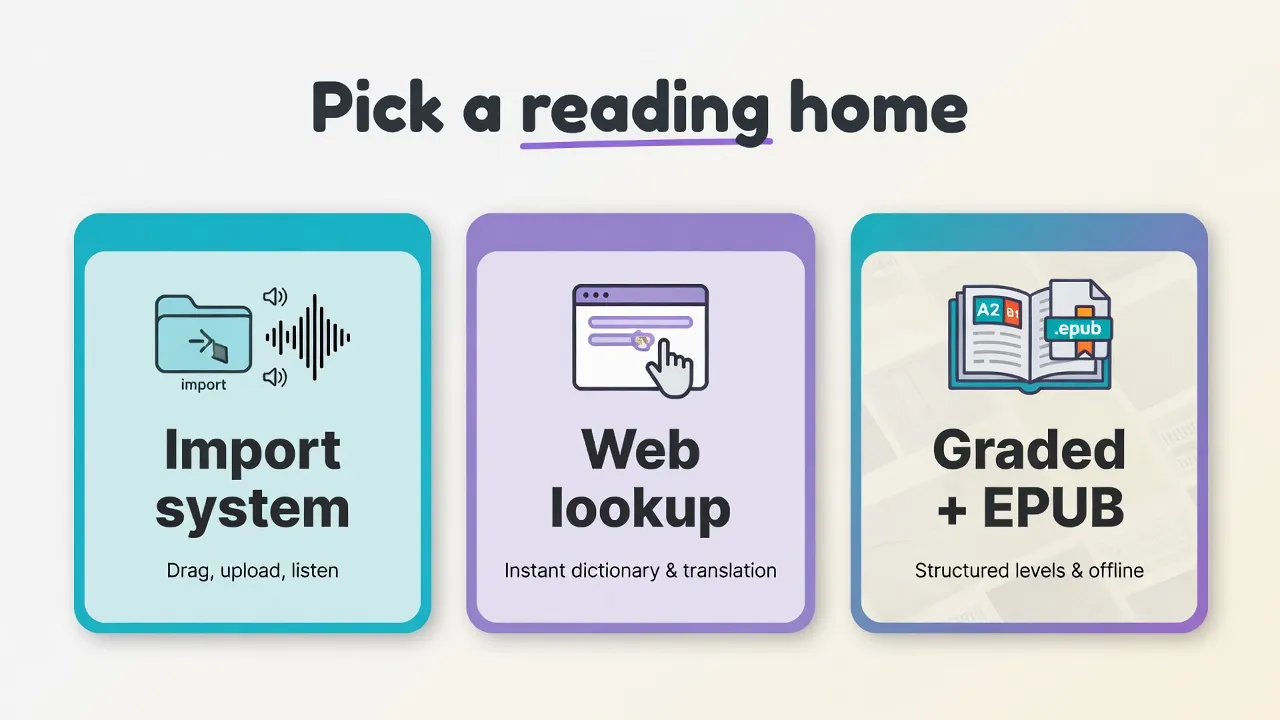
You have three tabs open: LingQ, Readlang, maybe MovaReader. One free plan looks tight. Another sticker price makes you flinch. A third promises graded texts, and you are not sure that is "serious" enough. You are not hunting streak badges. You want one primary reading home - a place where lookup feels natural and you actually finish pages.
If you typed Readlang vs LingQ, or LingQ vs Readlang, you are asking the same job question, not two different wars.
Here is the plain answer.
Pick Readlang if your input already lives in browser tabs (news, blogs, hobby sites) and you want the lightest click-translate layer. Pick LingQ if you will actually import a lot of content and want multi-language known-word tracking as a daily system. Pick MovaReader if you want a free graded path in English or Spanish first, then your own legal EPUB, with a small price ladder (20 translations/day free, Reader €1, Pro €5 for trainers). Same skill - extensive reading - different default rails. Test free tiers for seven days before you pay any of them.
If that already matches your week, stop scrolling and test that tool free for a week.
A few ground rules:
- MovaReader prices and free plan limits here are our own; confirm live pricing.
- LingQ and Readlang features and prices are public or typical bands as of 2026-08-13. Vendors change; verify on their sites before you subscribe.
- Three jobs, one primary home. Not a victory speech.
Want a free graded feel first? Spanish A1, A2. Browse all articles. Pricing: pricing.
Below: one-sentence jobs, a fair feature table, who should pick or skip each tool, price bands to re-check, workflow recipes, combine rules, a decision flow, and FAQ.
One-sentence summary of each
Same neighborhood - learn by reading with lookups. Three different default jobs.
| Tool | One-sentence job |
|---|---|
| LingQ | Import and consume lots of content across languages while tracking known/unknown words. |
| Readlang | Click-translate web (and library) reading with light friction for online articles. |
| MovaReader | Read free graded articles (EN + ES path) + upload files you own, free daily translations, optional trainers. |
If that table already matches your week, you can stop here and test that tool free for seven days.
Here is the same idea as a map: import system, web layer, graded texts plus your own EPUB.
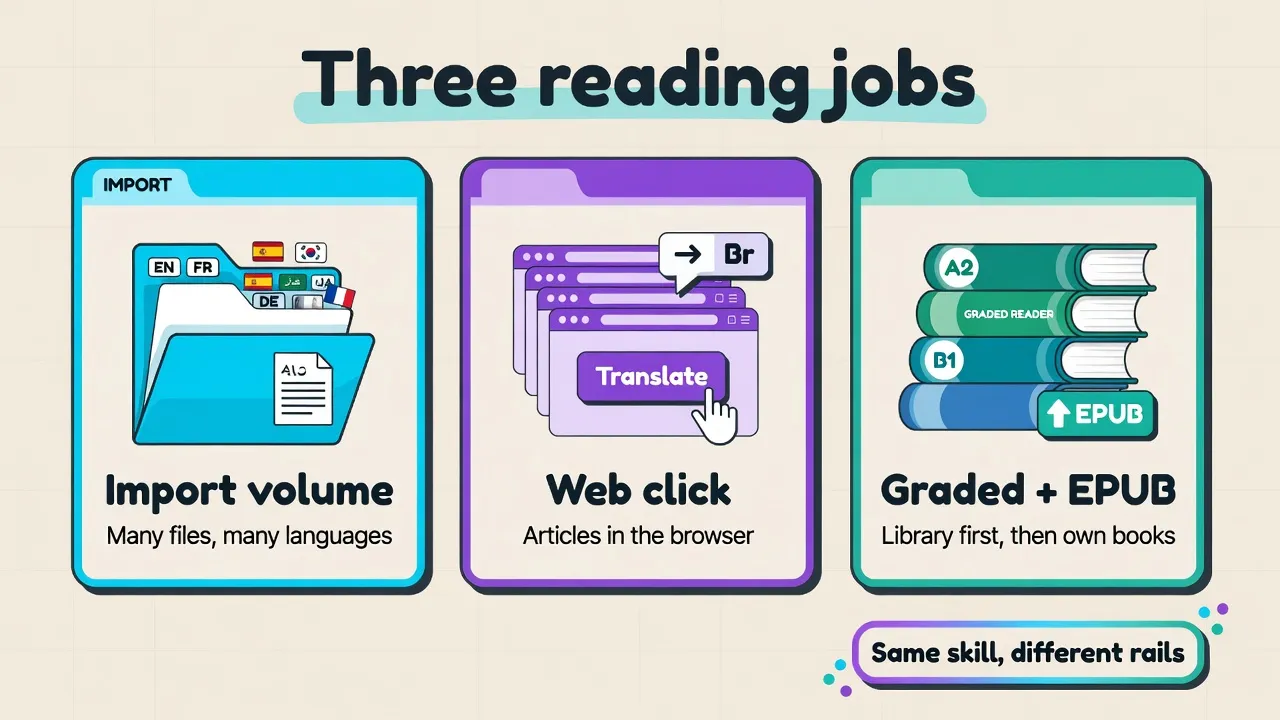
Three lanes, not one podium. Hire the job you will actually do most days.
Side-by-side feature table
Competitor cells show typical public positioning, not a warranty. MovaReader cells come from our own product.
| Dimension | LingQ (typical) | Readlang (typical) | MovaReader |
|---|---|---|---|
| Primary content | Imports + platform library | Web pages + reading library | Free graded article library (EN + ES + supported) |
| User files / books | Import workflows text/audio | Web-centric; check current file options | Upload EPUB/files you own |
| Commercial novels hosted | Not a free novel store | Not a free novel store | No by default |
| Click lookup | Yes | Yes | Yes (click-to-translate) |
| Known-word tracking culture | Strong identity | Lighter save/review | Reading + save useful phrases |
| Audio / listening | Often central | Depends on source | Unlimited listening on free use (within product) |
| Trainers / production | Review queues (tier-dependent) | Word/phrase review (tier-dependent) | Full trainers on Pro; demos: type training, phrase typing |
| Languages | Many languages (strength) | Multiple (check list) | Graded library languages + your uploads - EN+ES reading path, not a polyglot empire claim |
| Free tier usefulness | Limited but trialable (20 saves / 5 imports / 1 playlist public snapshot) | Strong for light web (unlimited single-word; phrase caps) | Graded library + 20 translations/day + unlimited listening |
| Paid entry | Premium EUR €14.99/mo or US ~$15/mo band (verify) | Premium $6/mo or $48/yr (verify) | Reader €1 unlimited translations |
| Best psychological fit | "I will import hours of input" | "I already read target-language tabs daily" | "I need graded EN/ES now + own EPUB later + a tiny price ladder" |
Live MovaReader free also includes 1 word-typing run a day, 1 phrase-typing run a day, and 1 external URL parse a day.
Deep dives: who should pick which
Tables show the spine. This section is the human part: strengths, friction, and when to pick or skip each.
LingQ
Strengths. Built for volume. If you believe in massive input, LingQ's culture and tooling match that story. Strong for polyglots who bounce languages. Import plus audio workflows make podcasts and transcripts first-class. Known/unknown word marking gives a visible progress metric - motivating if you do not over-trust the number.
Weaknesses. Cost can add up if you need full features long term. On 2026-08-13, Premium opened at €14.99 a month (about $15 in public US figures); verify before you subscribe. Metrics can become a game: chasing "known words" instead of finishing meaningful texts. Setup friction is real - imports, lesson creation, and library navigation take learning time. Not always the cheapest path if you only need graded English or Spanish shorts this month.
Pick LingQ if:
- You will actually import content weekly
- You study two or more languages with the same method
- You like stats and review queues
- Budget allows a recurring subscription after free trial limits
Skip (for now) if:
- You only want free A1-A2 graded articles this month
- You hate configuring imports
- You mainly need one cheap EPUB reader for a single file
Readlang
Strengths. Excellent mental model: read the real web, click what blocks you. Low ceremony for news, blogs, and hobby sites. Good for dead-time sessions - coffee queue, five-minute breaks. Saves the words and phrases you actually met, which beats random flashcard decks.
Weaknesses. Web-first design may be weaker for offline long novels (confirm current offline or file support). Free limits and paid features change; light users may never notice, heavy users will. Easy to over-click and turn reading into dictionary tourism. Less of a guided graded pathway than a dedicated learner library.
Pick Readlang if:
- Your input is mostly online articles you already open
- You want the lightest path from tab to lookup to save
- You already have content sources and do not need an in-app graded curriculum
Skip (for now) if:
- You are A1 and still need tightly controlled graded text
- Your main materials are Kindle-only or paper books
- You want built-in full trainers as the center of the product
MovaReader
Strengths. Free graded library you can start without importing anything (all articles). Click-to-translate while reading. Clear free plan: 20 word translations per day, unlimited listening on free use within the product. Free also includes 1 word-typing run a day, 1 phrase-typing run a day, and 1 external URL parse a day. Cheap unlimited lookups: Reader €1. Pro €5/mo if you want full trainers after saving phrases. Upload EPUB or files you own when you graduate from graded texts (how to use). What it does not do: host free modern bestsellers in-app.
Weaknesses. Not a multi-decade polyglot import ecosystem like LingQ's public reputation. Not primarily a browser extension for arbitrary web pages (that job is closer to Readlang). Library is graded articles, not a mirror of Amazon's novel catalog. Free translation cap is real: heavy lookup days will push you toward Reader.
Pick MovaReader if:
- You want graded English or Spanish (or supported languages) first
- You later want to read your own legal EPUB with the same lookup habit
- You prefer a small, clear price ladder
- You want optional phrase and word trainers without switching apps
Skip (for now) if:
- You need ten languages in one known-word database tomorrow
- You only read random web pages and want an extension-first workflow
- You expect free modern bestsellers in-app
If your job is graded English or Spanish first, then a legal EPUB you own - not a full import stack and not browser-only tabs - MovaReader sits in that cell. We do not host commercial novels by default, and reading alone will not finish spoken practice. Speaking still needs real conversation when that is the goal.
Pricing comparison
Public and typical bands as of 2026-08-13. Vendors change. Confirm on their sites before you subscribe. MovaReader figures are our own; still confirm live pricing.
| LingQ | Readlang | MovaReader | |
|---|---|---|---|
| Free usefulness | Tight: 20 saves, 5 import lessons, 1 playlist (verify signup table) | Strong for light web: unlimited single-word; 10 phrase translations/day; 10 context explains/day (verify) | Graded library + 20 translations/day + unlimited listen; also 1 word-typing + 1 phrase-typing + 1 URL/day |
| Paid entry | EUR €14.99/mo or €119.99/yr; US public ~$15/mo or ~$120/yr (geo may differ) (verify) | Premium $6/mo or $48/yr (verify) | Reader €1 unlimited translations |
| Higher tier | EUR Plus €26.99/mo or €239.99/yr; US ~$30/mo class (verify) | Plus $15/mo or $120/yr (verify) | Pro €5/mo full trainers |
| How to decide | Pay if imports + review become weekly habit | Pay if free phrase/explain caps block real reading | Pay if 20/day is the actual bottleneck |
Live pricing also lists AI Plus at €12.99/mo (Pro plus unlimited URL parse and 50 AI generations a month).
Rule: do not pay any of them on day one. Prove a 7-day reading streak on free tiers first.
Here is the same comparison as a price ladder. LingQ entry is a ~$15 / €15-class band depending on geo; verify live.
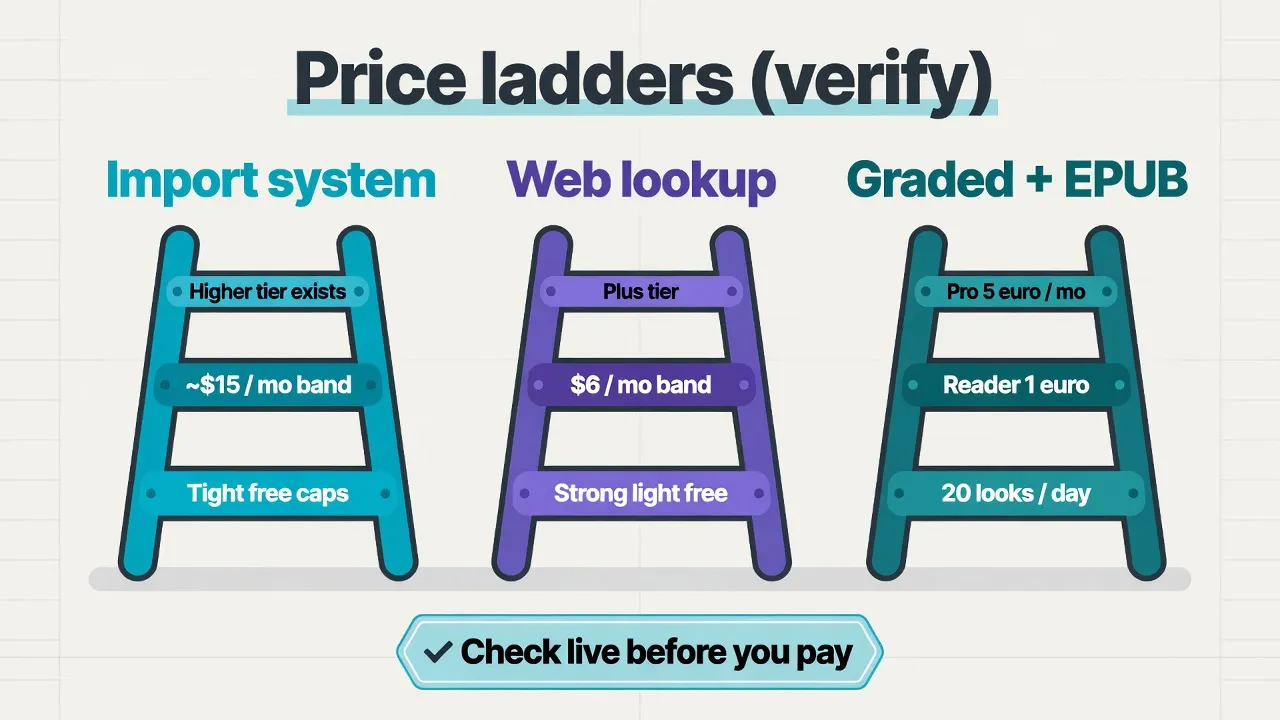
MovaReader details live on pricing. Re-open LingQ's signup table and Readlang's pricing page before any card goes in.
Workflow recipes (same learner, three tools)
Imagine a B1 learner - Spanish as L2 in this example; the logic travels for English as L2 too - who wants news or articles plus one book. Same skill: extensive reading. Three content rails.
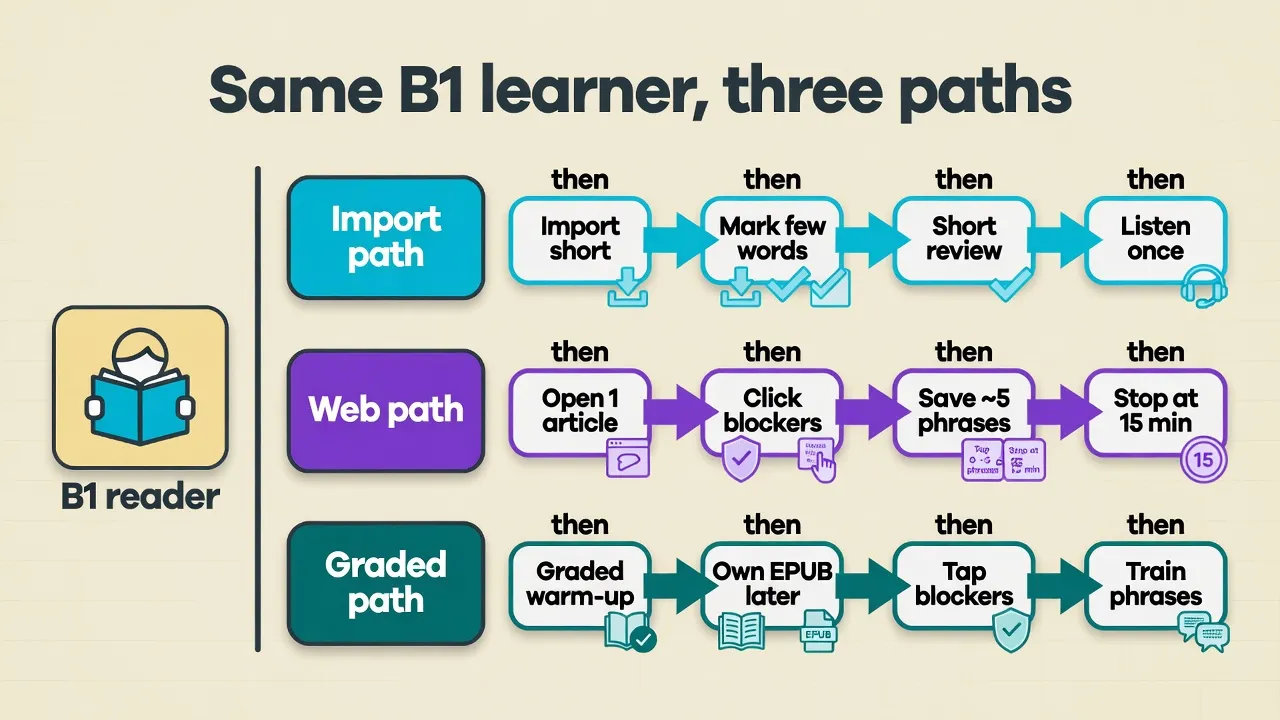
If they choose LingQ
- Import a short transcript or lesson daily.
- Mark unknowns sparingly.
- Review a short queue, not 200 items.
- Listen once after the first read.
If they choose Readlang
- Open one article they already care about.
- Click only sentence blockers.
- Save about five phrases.
- Stop after about 15 minutes even if curious.
If they choose MovaReader
- Warm up on a graded article: Spanish A2.
- Later upload an EPUB they own (how to use).
- Tap blockers only; stay on the free plan or use Reader €1 if needed.
- Train a few saved phrases on type training, phrase typing, or Pro trainers.
Same skill. Different default rails. The win is finishing pages, not collecting tools.
Can you combine them?
Yes, carefully - and with one primary lookup home.
- Readlang + paper or Kindle book is common: web lookups by day, paper by night.
- MovaReader graded days + Kindle novel nights works well when you want structure and then longer authentic pages.
- LingQ imports + a separate graded library works if you avoid triple subscriptions.
Combining three paid plans is almost always waste. Pick one primary paid home. Upgrade the tool that already became daily habit - not the one with the loudest feature list.
Still shopping outside this triad? A broader peer list lives on LingQ alternatives (wider map, not this three-way deep dive).
Decision flowchart
Hire by job, not brand prestige. Walk the questions in order.
- Is your content mostly web articles you already open? Try Readlang free first.
- Else: do you want multi-language import + known-word tracking as a daily system? Trial LingQ.
- Else: do you want graded English or Spanish now + own EPUB later with a tiny price ladder? Start MovaReader free library.
- If free plan caps annoy you after a real habit, upgrade that same tool. Do not brand-hop out of impatience.
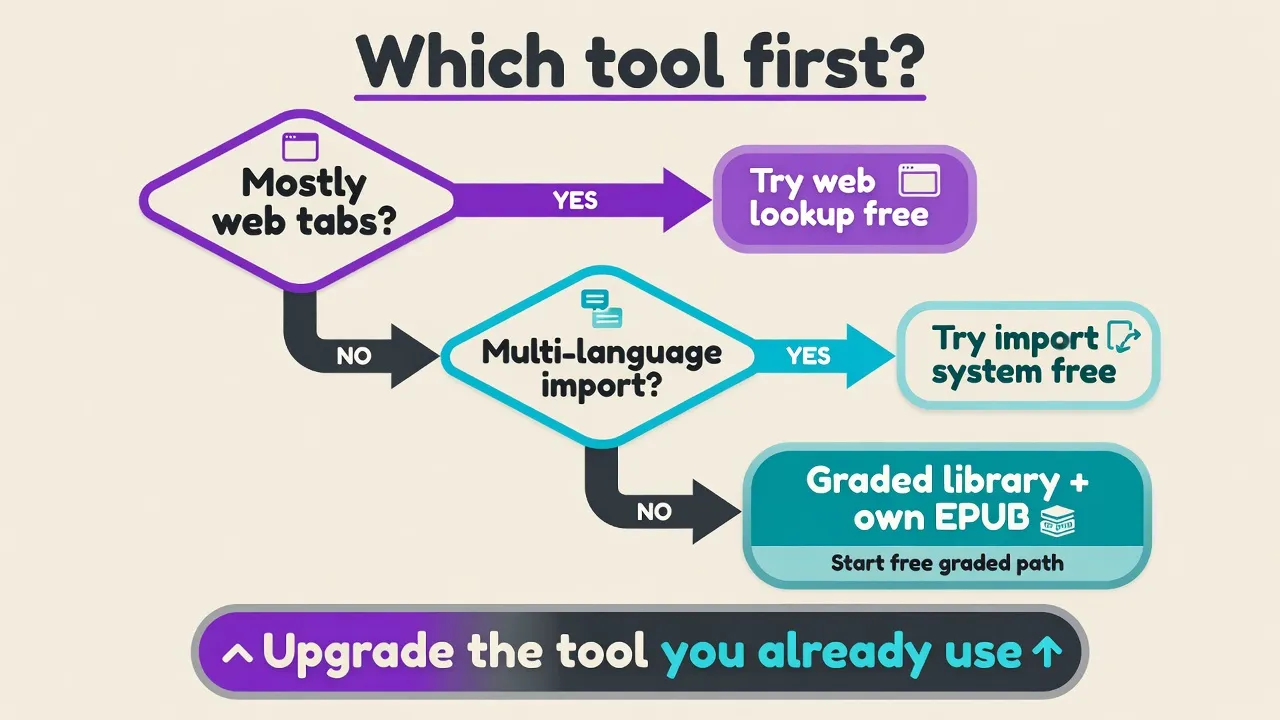
Four questions, one primary home. Free minutes beat feature mythology.
FAQ
People type Readlang vs LingQ and LingQ vs Readlang as if they were different wars. They are the same job question. "Better" follows the week you will actually live, not the brand.
Is LingQ better than Readlang?
It depends on workflow, not brand prestige. For high-volume multi-language import and known-word tracking, LingQ is often the broader system. For quick web reading in tabs you already open, Readlang is often the lighter layer. "Better" follows the job you will actually do most days.
Is Readlang better than LingQ?
It depends on workflow, not brand prestige. For quick web reading in tabs you already open, Readlang is often the lighter layer. For high-volume multi-language import and known-word tracking, LingQ is often the broader system. "Better" follows the job you will actually do most days.
Is MovaReader a LingQ clone?
No. LingQ's public identity is broad import plus known-word tracking across many languages. MovaReader is a reading-first product: free graded path (English and Spanish among supported library languages), uploads of files you own, free daily word translations, and optional trainers at Reader and Pro prices. Same neighborhood (learn by reading with lookups), different rails.
Which is cheapest long term?
It depends on tier, how many languages you study, and how many hours you actually read. MovaReader's Reader €1 and Pro €5 ladder is unusually low-cost if that job matches you. Readlang's public band is often $6/mo or $48/yr as of 2026-08-13 (verify). LingQ opened at €14.99/mo or €119.99/yr in EUR; the US public band is about $15/mo or $120/yr (verify; region and promos move numbers). Compare cost per hour you actually read, not sticker shock alone. Re-check each vendor before you subscribe.
Can I use these instead of classes - for speaking and homework?
They can replace a lot of homework-style input: reading, listening, and lookup. They do not automatically replace conversation practice, feedback on speaking, or a full curriculum if you need certification prep. If speaking is the goal, pair any reading tool with real speaking practice. A reading app alone will not finish that work.
Do any of them include free commercial novels?
No - do not expect free modern bestsellers as a default library. Use legal sources: buy, borrow, public domain, or free graded content. MovaReader does not host licensed commercial novels by default. Upload files you own (EPUB and similar) when you want longer authentic books (how to use).
What should absolute beginners choose?
Start with graded texts, not raw web news. Free A1-A2 graded articles beat importing random internet text on day one. On MovaReader, try Spanish A1, Spanish A2, or browse all articles. If you later want a rough CEFR vocab path, peek at the language map. Readlang and LingQ still work later once short graded pages feel easy.
Can I use Readlang and LingQ together?
Yes, carefully. Some people use Readlang for live web tabs and LingQ for imported audio or text libraries. Still pick one primary paid home so you do not pay for three tools out of impatience.
Final takeaway
- LingQ if you are an importer and multi-language volume reader.
- Readlang if the target language already lives in your browser tabs.
- MovaReader if you want free graded EN/ES reading, a clear free plan, cheap unlimited translations (Reader €1), trainers (Pro €5), and uploads of files you own.
Test with real minutes, not feature mythology.
- Free graded sample (English and/or Spanish) → all articles
- Optional demos → type training, phrase typing
- EPUB path → how to use
- Pay only if the free cap is the real bottleneck → pricing
- Still shopping a wider list? → LingQ alternatives
Upgrade the tool that already became home.
Keep reading with translations inside the text
With a free account, an unknown word translates with one tap, and the words you are learning wait for you in the trainer.
Free account: 7 days of Pro, then 20 word translations a day or a paid plan.