Curated Content
Best Apps to Learn a Language by Reading (2026)
Reading as the method, not streak games. A 2026 shortlist of tools for graded texts, web articles, Kindle books and your own EPUB, and how to pick one.
You open another "best language app 2026" list and the same names appear: Duolingo, Babbel, Pimsleur. Streaks, gems, a few minutes of audio. Those tools are fine for other jobs. They will not sit with you through a novel chapter, a news tab, or a story you actually want to finish.
If you came here for the best apps to learn a language by reading, you want a reader. Long-form text. Tap a word that blocks you. Keep going. That is a different aisle from streak games.
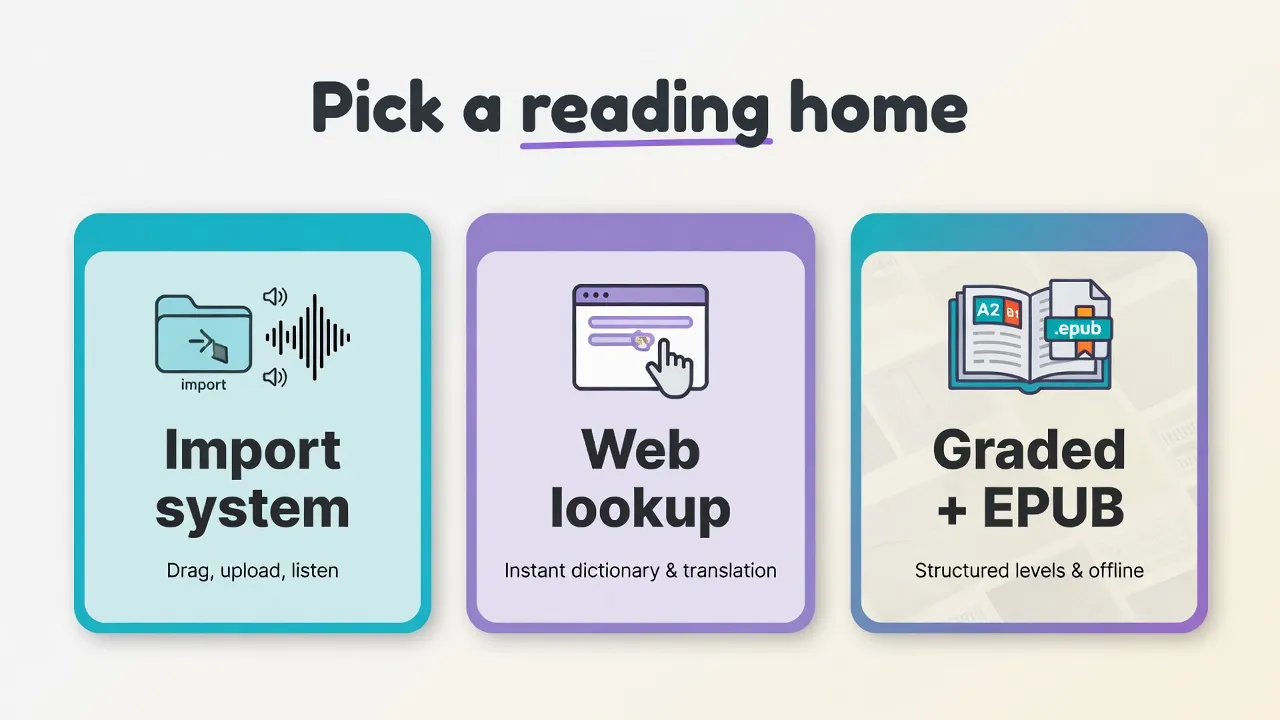
There is no universal number-one reading app. Pick by content home: graded shorts, open web, Kindle books you buy, or an EPUB you already own. LingQ is the import platform; Readlang is the browser layer; Beelinguapp is early bilingual stories; Kindle plus a dictionary wins for legal commercial books; MovaReader is free graded English or Spanish plus cheap lookup on your files. Duolingo is a streak game, not a novel or news reader.
MovaReader is one option in that set. Free graded English and Spanish, about 20 word translations a day, and later an EPUB you already own. It does not host commercial novels. It is not a multi-language import stack. Details: pricing.
LingQ, Readlang, Beelinguapp, Kindle, and Language Reactor change their features and prices. Treat those rows as typical public positioning. Check the vendor before you pay.
Want a feel for free graded English or Spanish? Try a Spanish A2 sample or a Spanish A1 warm-up. Browse all articles if you want more levels. Those are examples of a graded path, not the whole shortlist.
If that already matches your week, stop scrolling and test that free tier for seven days.
Below: quick picks, a use-case map, a feature table, short notes on each tool, a five-minute choose path, narrower sibling guides, pricing, a 15-minute loop, and FAQ.
Quick picks: which tool first?
If you are comparing the best language learning apps for reading, match the tool to this week's text, not to a generic crown.
| Your situation | Start with | Why |
|---|---|---|
| A1-A2, short finishable texts (EN/ES) | Graded library (e.g. MovaReader free) or Beelinguapp-style parallel | High comprehension, low quit rate |
| Open web / articles you already read | Readlang | Fast click-translate on tabs you already open |
| Import lots of real content (web, ebook, audio) | LingQ | Import volume + known-word tracking |
| Parallel stories + audio, early confidence | Beelinguapp | Side-by-side + karaoke-style listen |
| Commercial novels you buy or already own | Kindle + dictionary | Legal books; tap-to-define |
| Own EPUB, cheap lookup, EN/ES | MovaReader Reader path after freemium | Your files; test the flow free first |
| Netflix / YouTube subtitles | Language Reactor (adjacent, not a novel app) | Dual subs; wrong primary if you want a book |
There is no single winner. The best pick is the one you open daily on text you care about.
The category is wider than five logos. Short-story apps (Readle, Langster), big libraries (EWA), adapted bestsellers (Eppika, iOS), and other 2026 self-lists (Lingo7, Language Lit, LingoBlend) show up in search. Still filter by content home.
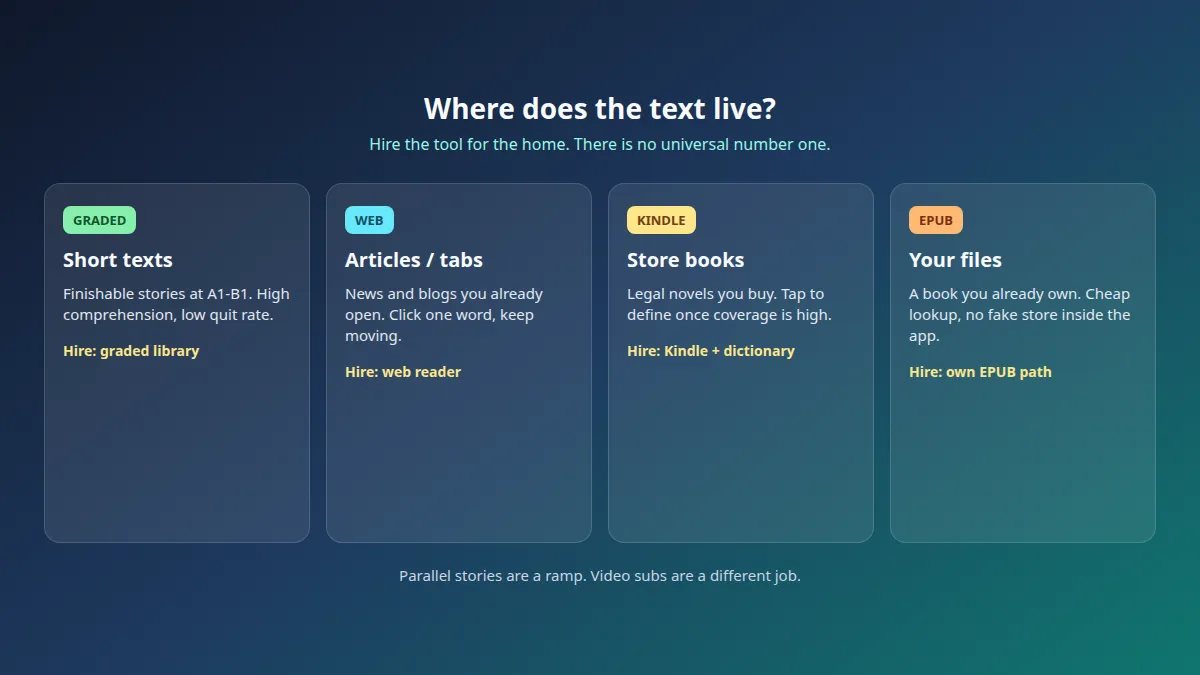
Four homes, one map: graded text, open web, Kindle books, your own EPUB.
Comparison table (reading-focused)
Other apps are described the way they present themselves publicly. Verify on the vendor site before you buy. For MovaReader, see current pricing.
| Tool | Content model | Lookup / loop | Audio | Import | Best for | Weak for |
|---|---|---|---|---|---|---|
| LingQ | Import + community / graded library; 50+ languages | Known-word stats, queues | Strong listen+read | High (web, ebook, audio, YouTube) | High-volume import, many languages | Steep UI; tight free; not beginner-native-text friendly |
| Readlang | Web Reader + light files | Click-translate; flashcards from lookups | Source-dependent | Light (web-first; EPUB/txt check vendor) | Cheap lean web reading | Thin built-in library; mobile often dinged |
| Beelinguapp | Curated parallel stories / news + music | Side-by-side; easy to stay on L1 | Karaoke-style audio | Weak / none for own novels | Beginner bilingual on-ramp | No own-file novel; L1 crutch |
| Kindle + dictionary | Store + sideload (device-dependent) | Tap-to-define; highlights | Limited (not a language loop) | Sideload, not a full import stack | Legal commercial novels at B1+ | No SRS; no unknown-word map; needs high coverage |
| MovaReader | Free graded EN/ES + own EPUB | Click-to-translate; phrases; Pro trainers | Listening on library texts | Own files you upload | Graded EN/ES + cheap EPUB lookup | Not multi-language import; not Kindle store; no hosted commercial novels |
| Language Reactor (adjacent) | Netflix / YouTube dual subs | Click-translate; often export to Anki | Video/subs | N/A (player layer) | Subtitle input | Not long-form reading |
Difficulty still beats logo. A C1 novel at A2 still hurts, no matter whose name is on the app.
Deep notes on each option
The table is the map. These notes are the feel of each tool: what it is for, what breaks, and when to pick it without guilt.
LingQ (import-first)
LingQ sells a simple public job: learn from real books, podcasts, movies, and TV. Import what you care about. Track known words. It is not a gem game, and that is the point.
Hire it when you will actually import. Many languages. Listen-plus-read volume. A known-word count that some people find motivating if they do not worship the number.
Watch the steep interface. The free tier is typically tight (verify). Paid plans cause price anxiety for a reason; check the vendor, do not treat any blog as a sticker warranty. Taps often feel dictionary-like. Native novels at A1-A2 still hurt.
Fair line: this is the category-defining import tool. Not a villain. If you will feed it real input most weeks, it often wins that cell. We do not pretend otherwise.
Readlang (web-first)
Readlang's public line is "learn a language reading what you love." Click a word. Get a translation. The Web Reader lives where your articles already live.
Hire it for open web. News tabs. Hobby blogs. The cheapest lean reader when you do not want a new library to manage. Typical free single-word lookups are generous; phrase and AI layers often cap on free. Verify, because those caps move.
Watch-outs: it is web-first, more PWA than a polished native app. The built-in library is thin next to LingQ. Mobile reading gets dinged a lot on Reddit. If your evenings are novels on a couch, this may not be home.
Fair line: hire it for tabs you already open. That is a real job.
Beelinguapp (parallel + audio)
Beelinguapp is parallel stories and news, plus music and audiobooks. Karaoke-style audio. A curated shelf, not your hard drive.
Hire it for an early confidence week. Side-by-side text lowers panic at A1-A2. You can hear the line while you see it. Generic lists in Spanish and Ukrainian often file it here, and they are not wrong for that ramp.
Watch-outs: own-file import is weak or missing. It is easy to glue your eyes to the first-language column and never leave. Some listen-first lists file it under audio, which tells you the real pull.
Rule: do not stay on the first-language column forever. Parallel text is a ramp, not a forever home.
Kindle + dictionary (underrated stack)
People searching for the best apps to read books in a foreign language often skip this stack because Kindle is "not a language app." That is the point. It is how you legally read commercial novels you buy or already own.
Learn a language with Kindle when coverage is already high. B1 and up, unabridged. Tap-to-define. Offline dictionaries. Store books plus sideload, depending on the device. Real chapters. Real page turns.
Watch-outs: no spaced-repetition loop, no unknown-word map, limited audio as a language system. You should already follow most of the page. If every line is a wall, you hired the wrong home this month.
This is how you read books you buy. MovaReader is not a Kindle store.
MovaReader (graded EN/ES + own EPUB)
What it does: a free graded library in English and Spanish, click-to-translate, about 20 word translations a day on freemium, Reader €1 when you need more volume on longer texts or your own files, Pro €5/mo for trainers when recognition is not enough, and EPUB uploads you already own.
What it does not do: a multi-language import stack, a Kindle store, hosted commercial novels, or French and German as a core path. Product languages stay English and Spanish.
The best fit is graded shorts plus cheap lookup on files you own. Strong there. Weak at import-anything and store novels. If that is your week, start free. If import volume or a store novel is the week, pick the peer that owns that job.
A free path you can try today:
- Spanish A1 warm-up
- Spanish A2 sample
- Browse the free graded library
- How to use when you want to open an EPUB you own
- Peek at phrase typing or type training if you want a trainer preview
- Pricing only if the free lookup cap is a real block
Language Reactor (adjacent, short)
Language Reactor sits on Netflix and YouTube with dual subtitles and click-translate. Some 2026 reading lists rank it on this query. Say so, then bound it: it is a video and subtitle layer, not a novel or news reader. Hire it when the input is an episode. Do not hire it as your book home.
How to choose
Answer these in order. Five minutes. Your content home answers the first two.
- What will you read this week? A graded short, an article, a parallel story, or a novel you own?
- Where does the text live? App library, browser, Kindle, an EPUB on disk, or a video player?
- What breaks the habit? Price, a steep interface, boring text, or tapping every word?
- Do you need production practice, or is recognition enough this month?
Here is the same idea as a hire board: content home on the left, tool on the right. Parallel stories, heavy import, and video sit as extra rows beside the four-home map.
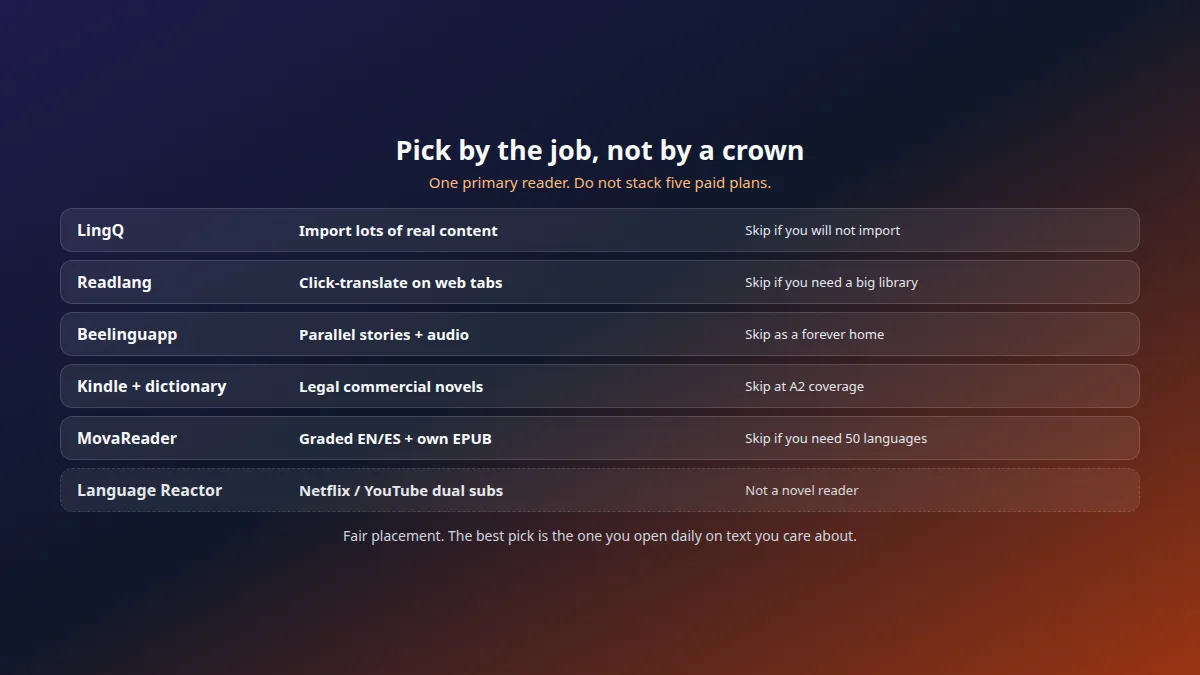
| Job this week | Hire |
|---|---|
| Finishable graded shorts (EN/ES) | MovaReader free library |
| Browser articles you already open | Readlang |
| Import web / ebook / audio at volume | LingQ |
| Parallel stories + karaoke audio | Beelinguapp |
| Legal commercial novel | Kindle + dictionary |
| Own EPUB, cheap lookup | MovaReader Reader after freemium |
| Netflix / YouTube dual subs | Language Reactor (adjacent) |
Hire one primary reader. Do not stack five paid plans that all do "lookup, sort of." One home you open beats a folder of unused subscriptions.
Need a narrower guide?
You already have a pick-by-job answer. These four siblings go deeper on jobs this post must not steal.
Learning Spanish as the whole project? Use the Spanish reading shortlist.
Need the full three-way on LingQ, Readlang, and MovaReader? That lives in LingQ vs Readlang vs MovaReader.
Leaving LingQ and want a map of exits? See the LingQ alternatives guide.
Want tutors, games, or courses too, not only reading? Start from the English-by-goal post.
Pricing in 2026
Language apps love annual discount banners. A few plain rules help more, especially if you are hunting the best free app to learn a language by reading.
Pay after a real free habit. Seven days on a free tier is a better test than a feature matrix. Prefer free modes that still let you read, not modes that only let you browse a paywall.
One paid reading tool plus free content beats five overlapping subscriptions. Upgrade the home you already open.
MovaReader's ladder is small on purpose: freemium (about 20 translations a day) to Reader €1 for more volume to Pro €5/mo for trainers. That is a low-risk upgrade when lookups or trainers are what actually blocks you. Confirm figures on pricing.
Peer free tiers may be enough if their caps match your volume. What their free tiers usually offer:
| Tool | What free still lets you read (typical / product) |
|---|---|
| LingQ | Free tier exists; limits often tight for heavy import (verify) |
| Readlang | Often generous on single-word lookups; phrase/AI caps may apply (verify) |
| Beelinguapp | A curated slice of stories and audio; best material often paid (verify) |
| Kindle | App free; books and loans cost money |
| Language Reactor | Core player often free; extra layers may cost (verify) |
| MovaReader | Free graded EN/ES library + about 20 word translations a day |
Do not treat any blog's competitor sticker as permanent. Vendors change. Check their site before you subscribe.
Method that matters more than the logo
Apps cut lookup friction. They do not create the habit. The loop below works in any of the tools above.
A coffee-break loop: followable text, blockers only, phrases, a short reread, fifteen minutes.
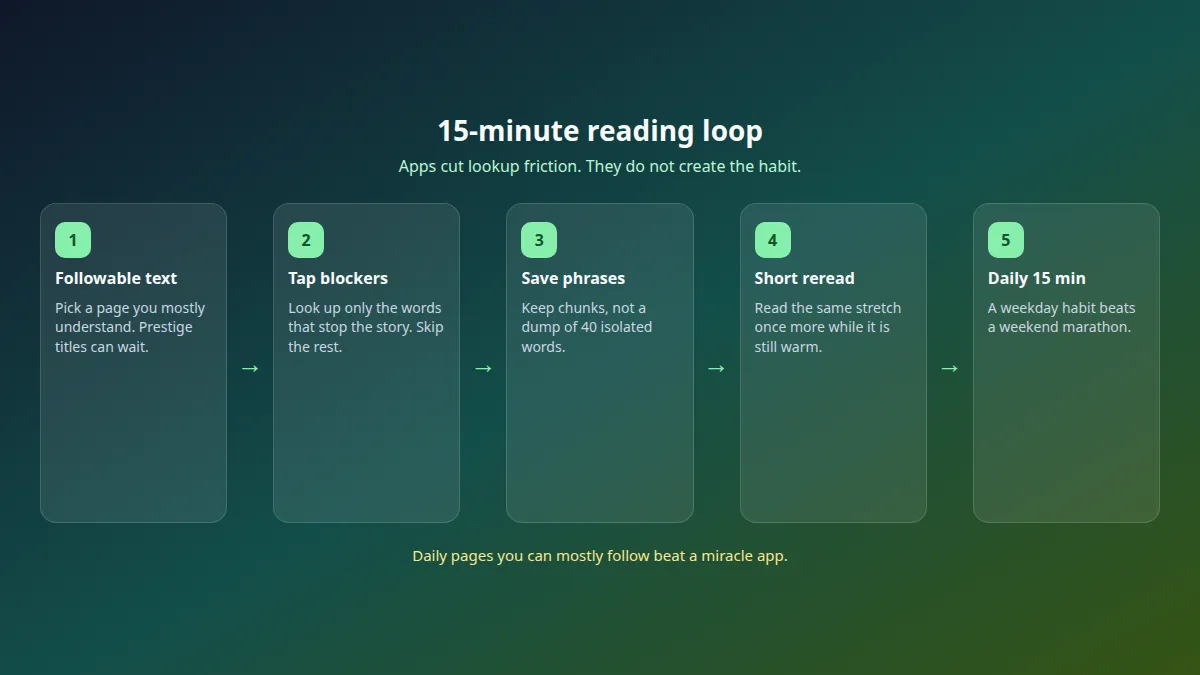
- Pick text you can mostly follow. Prestige titles can wait. If every sentence is a wall, the book is the problem, not your willpower.
- Look up blockers only. The word that stops the sentence. Not every adjective you could save.
- Save phrases, not forty isolated words. Chunks travel. Word dumps rot.
- Reread a short stretch. The second pass is where the page starts to feel like a page.
- Daily 15 minutes beats a weekend marathon. Show up small. Repeat tomorrow.
Spaced repetition is review, not reading. If you export cards, do it after you have actually read.
Want a rough sense of level? The language map gives a quick orientation.
FAQ
What is the best app to learn a language by reading?
There is no universal number one. Pick by content home: graded shorts, open web, Kindle books you buy, an EPUB you already own, or parallel stories. LingQ is the import platform; Readlang is the browser layer; Beelinguapp is early bilingual stories; Kindle plus a dictionary wins for legal commercial books; MovaReader is free graded English or Spanish plus cheap lookup on your files. The best pick is the one you open daily on text you care about.
Is Duolingo a reading app?
No. It is a streak and drill app. Useful as optional warm-up; it does not replace long-form reading of novels, news, or stories. Do not confuse it with Duolingo ABC, which is kids English literacy, not a foreign-language reader.
LingQ or Readlang?
LingQ if you will import a lot and want known-word tracking across many languages. Readlang if your input already lives in browser tabs. Try one week on each free tier, then stay with the home you actually open. The full three-way sits in the sibling guide linked above.
What is the best free app to learn a language by reading?
It depends on where the text lives. Free graded English and Spanish libraries (including MovaReader articles) still let you read. Readlang free is often enough for light web. LingQ and Beelinguapp free tiers only if their caps match your volume. Verify each vendor, because free limits change.
Can I learn a language just by reading?
Reading is strong input. It does not replace speaking practice. Daily pages you can mostly follow beat a miracle app. Pair any reader with real conversation when speaking is the goal.
Kindle vs a language reader?
Kindle plus a dictionary wins for legal commercial novels once coverage is high. A language reader wins for graded text, unknown-word maps, import, or cheap lookup on your EPUB. Many people use Kindle at night and a reader for weekday shorts.
A short takeaway
- Graded libraries when you need finishable wins (English and Spanish path here).
- Web readers when the article tab is the content.
- Kindle for books you buy.
- Own EPUB plus cheap lookup when the file is already yours.
- Import platforms when you will actually import.
- Parallel text as a ramp, not a forever home.
- Reactor for video, not novels.
Next steps, if you want to try the graded path or your own file:
- Spanish A2 sample and A1 warm-up as graded examples
- All articles
- How to use for an EPUB you own
- Phrase demo and type training
- Language map for orientation only
- Pricing only after a free habit
Keep reading with translations inside the text
With a free account, an unknown word translates with one tap, and the words you are learning wait for you in the trainer.
Free account: 7 days of Pro, then 20 word translations a day or a paid plan.