Curated Content
Which Borges Story Should You Read First in Spanish?
Start Borges with El Sur, not the famous labyrinth. A clear first-story pick for solid B2 toward C1, when to choose a puzzle instead, and how to read one dense story without homework mode.
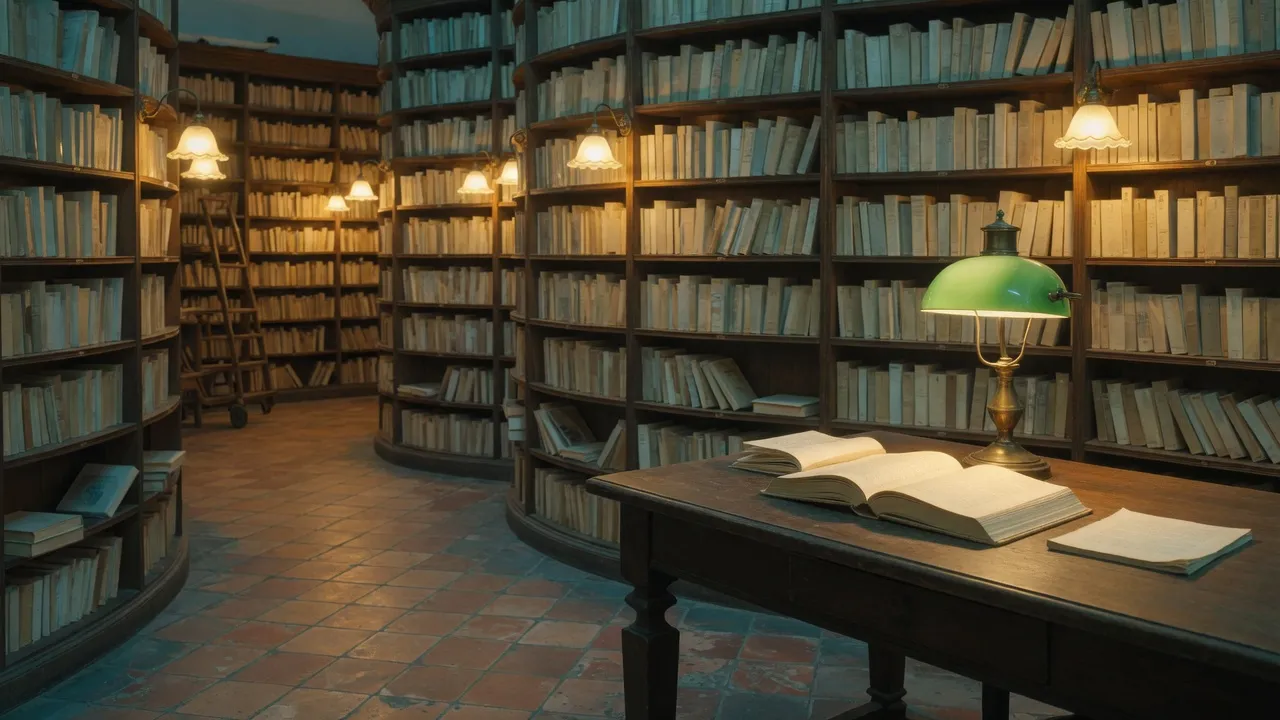
You buy Ficciones or Labyrinths because the name is famous. Two pages of Tlön later, the dictionary has eaten the story. Lists say start with El Aleph. You came for a labyrinth and got a lecture on imaginary encyclopedias.
You are still a solid B2 reader. The problem is not "you cannot read Spanish." The problem is prestige order. Famous is not the same as first.
You need one story with a body you can follow. Human spine first. The maze can wait.
Quick answer: start with El Sur
Start with El Sur. For most learners at a solid B2 working toward C1, it is the best first Borges story in Spanish: a plot you can follow (illness, a train south, a knife). Pages are short; the Spanish is dense. Skip the story El Aleph and skip Ficciones page 1 (Tlön). Save the labyrinth until you can retell one story.
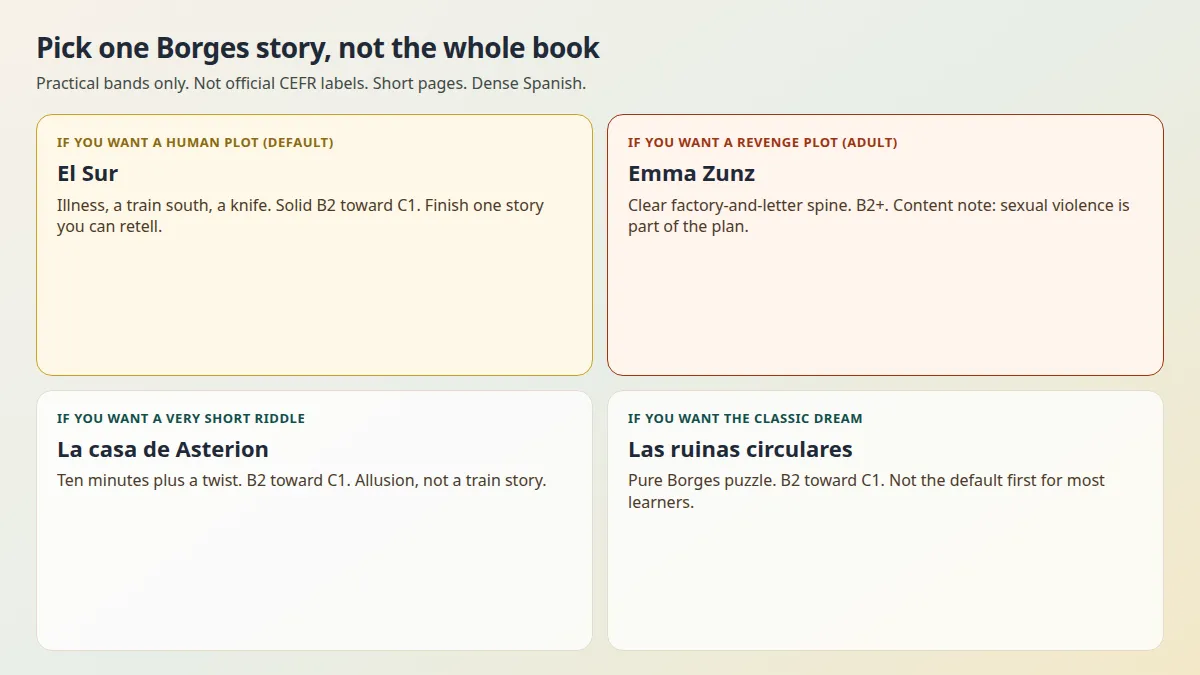
If you want a different kind of Borges:
| If you want | Start with | Practical band |
|---|---|---|
| A human plot first (default) | El Sur | solid B2 toward C1 |
| Revenge plot, adult | Emma Zunz | B2+ (content note) |
| A very short riddle | La casa de Asterión | B2 toward C1 |
| The classic dream puzzle | Las ruinas circulares | B2 toward C1 (not default) |
These bands are a practical compass. Edition, notes, and habits change how hard the same story feels.
Four first-story doors, one glance:
Keep scrolling for why El Sur works, why fame is a bad first story, when another tale (including Emma Zunz, with a plain content note) is a better door, a learner ladder, what makes Argentine literary Spanish dense, and a 15-25 minute loop that does not turn the page into homework.
This page owns which Borges story first for Spanish as a second language. Same "which first" shape as our Márquez first book and Allende first book posts. Different author. Different default. A story, not a complete-works catalog.
Why El Sur is the right first Borges story
Think of El Sur as the best first story with a followable plot. Not the only valid door. Not easy Spanish because the booklet is thin.
The surface is simple enough to hold when a sentence breaks. Juan Dahlmann, a Buenos Aires librarian with a romantic idea of the Argentine south, gets hurt. He spends time in a clinic. He takes a train south. He ends in a knife fight that may be real, or a dying dream of one. Illness, train, knife. That is a body you can retell.
That design is kind to second-language readers. When a rare word or a gaucho echo goes fuzzy, you still know who moved and what is at stake. You are not rebuilding an invented planet from footnotes on page two.
El Sur is also the last story in Ficciones, in the Artificios half of the book. Open it there and you are not opening the collection at Tlön. In the prologue to Ficciones, Borges called it "acaso mi mejor cuento" (perhaps his best story). That is his taste, not a level stamp. It does tell you the tale mattered to him as a story, not only as a puzzle.
The dream-versus-real ending is the point, not a fail. You can follow the bones and still feel the ending wobble. That wobble is Borges. It is not proof you "missed" the Spanish.
Choose El Sur first if you can usually:
- follow a short literary narrative with help
- tolerate unknowns and keep moving when a name or country echo is fuzzy
- finish one dense story rather than binge a famous collection
Do not choose it because "Borges is easy if the story is short." Six or twelve pages can still pack rare words, allusions, and a south that is half landscape, half myth. Choose it for a human plot, a finishable length, and Spanish that is dense but holdable.
A few watch-outs, said plainly. The south carries a Martín Fierro shadow. The clinic and the knife both feel real until they may not. The prose is still literary Argentine Spanish, not a classroom reader. "Deceptively complex" is a fair label for the ending. None of that cancels the spine.
Fame is not a first story
Prestige lists sell a book. Learners need a story they can finish and retell. Those are different jobs.
Do not start with the story El Aleph
El Aleph is a masterpiece. It is also a language dump. A point that contains every other point. An infinite-list passage. Rare words stacked on vision stacked on Buenos Aires private jokes.
Save it last. Not because it is "bad for learners." Because it asks you to hold a cosmos before you have held one man on a train.
Do not open Ficciones at page 1
Page 1 is Tlön, Uqbar, Orbis Tertius. Long. Citation-heavy. A weak human plot. You get invented encyclopedias, a planet made of ideas, and a tone that assumes you enjoy footnotes as entertainment.
This is a documented place learners get lost. Reddit threads say it with more feeling: lost after page 2. That is not a character flaw. That is the wrong first story.
Ficciones the book is a native and shop default. You need a story, not the table of contents. Flip to Artificios. Open El Sur.
Labyrinths / El Aleph the collection is prestige, not a warm-up
English Labyrinths and "short story" lists that drop El Aleph under beginner-friendly fiction are doing fame equals first. Refuse that dump.
La biblioteca de Babel is a famous idea with almost no human plot. Infinite hexagons. Almost nobody to care about. After El Sur, not before.
Native Penguin and newspaper paths serve people who already live in Spanish. This page serves students. A complete-works shelf is a fine later hunger. It is a poor first sitting.
When another Borges story is a better first pick
The default is not a law. Match the story to how you like to read.
Emma Zunz if you want a revenge plot (adult)
Factory. A letter. A plan. The plot arrives fast. If you want immediacy more than a train and a mythic south, this is the strongest plot alternative.
It is not the default. It is not friendly. It is not a safe classroom first.
Content note: the plot includes sexual violence as part of Emma's revenge plan. Name it. Do not call the story easy, cute, or light practice. Adult readers only. If that content is a reason to pass, stay with El Sur or try La casa de Asterión.
La casa de Asterión if you want ten minutes and a twist
One of his shortest. First person. A house that is also a riddle. The ending turns on a myth you may already know.
Good if you want about ten minutes and a puzzle with a pulse. Bad if you wanted a human train story and a south you can picture.
Las ruinas circulares if you already want the dream
This is the classic "pure Borges" branch. A man tries to dream another man into being. Puzzle, not spine. Some literary guides start here.
Offer it if you came for the dream on purpose. Do not take it as our first pick for most learners at a solid B2 toward C1. Short pages. Still dense. Weaker human plot to grab when a sentence breaks.
Next-up after one win
Keep this short. After one story you can retell:
- Funes el memorioso: a memory curse. The idea is followable. The words stay rare.
- La muerte y la brújula: a detective plot helps. Names and pattern-play stay dense.
Then, if you are hooked, the puzzle shelf. Not before you have one finished story in your pocket.
A learner order (not canon order)
English prestige lists and "greatest hits" shelves are not learner order. Here is a route that works for many readers at a solid B2 working toward C1.
Human plot first. Famous labyrinth last:
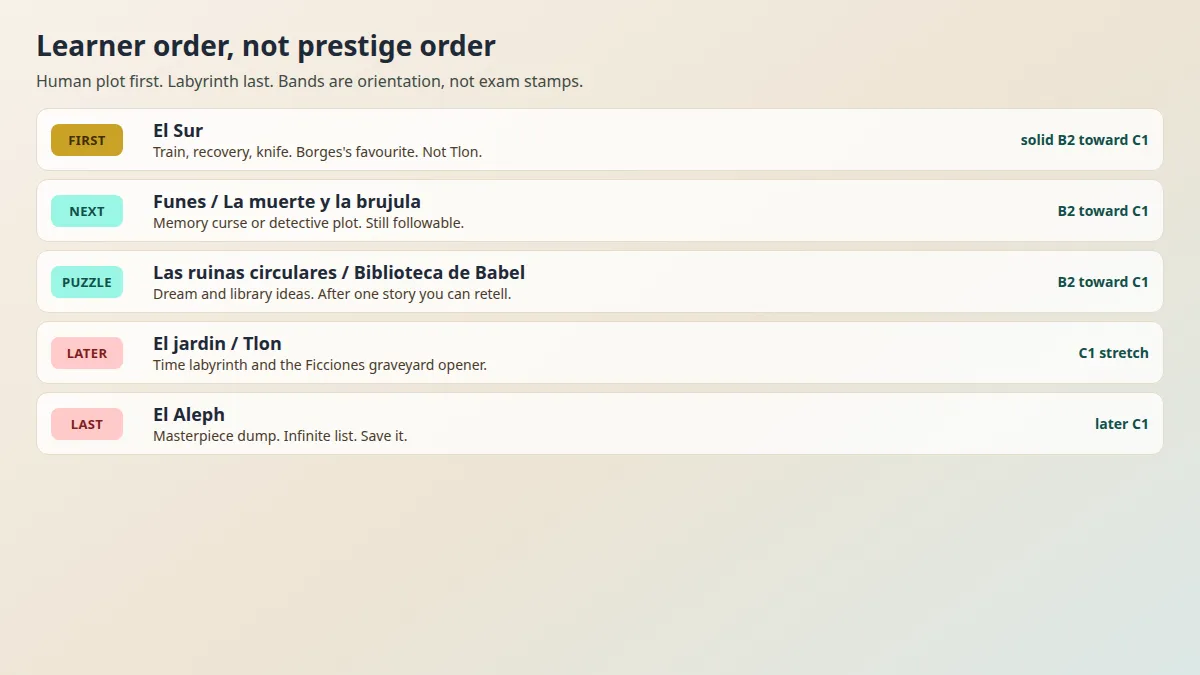
- El Sur - default first (solid B2 toward C1)
- Emma Zunz - plot alternative (content note) or skip
- La casa de Asterión - very short / riddle
- Funes el memorioso, La muerte y la brújula - next human or clearer plot
- Las ruinas circulares, then La biblioteca de Babel - puzzle once hooked
- El jardín de senderos que se bifurcan, then Tlön, Uqbar, Orbis Tertius - later dense
- El Aleph (the story) - last prestige
Skip steps. Skip Emma Zunz if the content is a no. Finish one story you can retell. That beats a famous collection you quit on page 2.
Do not lead with El libro de arena or Historia universal de la infamia as the thesis of your first month. Optional later. Early poetry (Fervor de Buenos Aires) is a different hunger. Off this page.
A few later doors, said in one breath. La biblioteca de Babel: famous idea, almost no human plot. El jardín de senderos que se bifurcan: spy plus time labyrinth; after a warmer story. Tlön: opens Ficciones; long; citation-heavy. The story El Aleph: masterpiece dump. Ficciones, El Aleph, and Labyrinths as whole books: shop defaults. Learners who start at page 1 of Ficciones often stop.
Permission is part of the method. You are not failing Borges if you refuse the wrong first page.
Short is not easy: what makes Borges dense
Six to fifteen pages still pack rare words, invented citations, and literary Argentine Spanish. Short is a session length. It is not a difficulty discount.
The realistic band for this page is solid B2 toward C1. Not B1. Not "Borges is B2 official." A B2 reading club can work through selected late shorts with a teacher. That is guidance in a room. It is not a label you can stamp on Ficciones.
An ELE worksheet on a tiny late microtext is also not proof the canon is B1. Classroom slices and complete stories are different animals. If you are still building B1 reading stamina, start on the B1 Spanish book list. Come back to Borges when a short literary plot usually holds.
A note on register, because this trips people. Borges is formal, precise, sometimes a little archaic. Buenos Aires geography sits in the nouns. Martín Fierro and the south-as-myth sit in the shadows. This is not street vos slang. It is not Spain classroom Spanish either.
If you want the wider variety question (Rioplatense literary versus Spain classroom), that lives on Latin American vs Spain Spanish: what to read first. This page only needs you to know: the Spanish is Argentine and literary. Budget for that. Do not expect Madrid textbook warmth.
If what you actually want is living contemporary prose, not a canon sitting, step sideways to modern Spanish bestsellers at B2. Borges will still be on the shelf when you want him.
If the page is all idea and no plot
After two pages, ask three plain questions:
- Can I say who did what, even roughly?
- Are unknowns occasional, or is every sentence a wall?
- Do I still want the next page?
Productive: you follow the scene and miss detail. Keep going.
Too hard right now: you cannot name the action. Stop.
That stop is a level signal, not a character flaw. Do not binge the rest of the collection to "push through." Pushing through Tlön teaches you that you hate Borges. It does not teach you Spanish.
Warm up on adapted Spanish, then return to one story. The gap between adapted text and originals is covered in adapted vs original books. If you like a quick "is this page too hard?" check, pair the questions above with the 5-finger rule for choosing book level.
The useful part is a small loop, not a heroic weekend.
One sitting, one story, no homework mode:
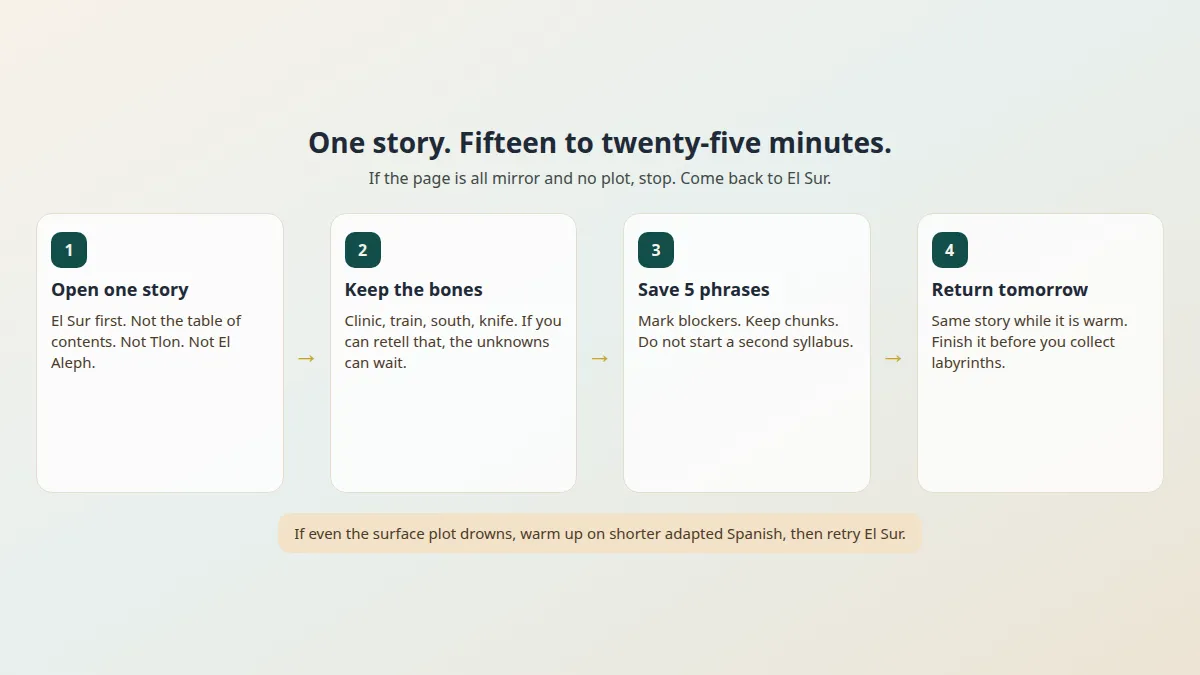
- Read 15-25 minutes without a dictionary at every line.
- Mark only words or phrases that block the scene.
- After: keep up to five useful expressions.
- Write a two-sentence retell (Spanish or your language).
- Return tomorrow while the story is warm.
Value lives in following one dense story. It dies when every page is a translation drill. Rare words and invented citations are normal. You do not need every citation to retell El Sur.
If you use a tool, tap the words that block the scene and return to the story fast. Plan numbers sit just below.
If El Sur still feels too hard
That is normal at the edge of B2. You are not failing literature.
- Warm up on free adapted Spanish so plot-following feels automatic again.
- Retry two pages of El Sur with the 15-25 minute loop.
- Or take the ten-minute door: La casa de Asterión.
- When you want the original in an app, upload a legal EPUB you own. Borges collections usually mean buy or borrow.
A calm tool path (and a legal copy)
If the page is all idea and no plot, stop. Warm up on the free adapted Spanish library, then return to one story (El Sur, or the decision-table row that matched you).
MovaReader is built for tap-translate on the page you are actually reading. The free plan gives about 20 word translations per day. Reader is 1 EUR/mo when you want more translation volume. Pro is 5 EUR/mo when you want the full practice trainers.
For Borges, upload a legal EPUB you own (bought or borrowed where allowed). Full Borges collections are commercial books, so they are not in the app.
The language map shows orientation ranges. Pricing in one place: about 20 translations/day · Reader 1 EUR/mo · Pro 5 EUR/mo. Adapted warm-up: all articles.
The real win is one story you can retell tomorrow.
FAQ
Real questions people ask after they open the wrong first page.
Can a B1 learner read Borges in Spanish?
Rarely as a first original. The realistic band here is solid B2 toward C1, not B1. If the plot is lost every sentence, warm up on adapted Spanish, then return to one story. Do not treat an ELE microtext worksheet as proof Ficciones is B1.
Why not start Ficciones at the first story?
Story 1 is Tlön, Uqbar, Orbis Tertius: long, allusive, weak human plot. A common place learners get lost after a page or two. Ficciones the book is a native and shop default. Open El Sur instead (Artificios, late in the book). Learners need a story, not the table of contents.
Is El Sur easier than Las ruinas circulares?
For most second-language readers, yes on followability: a human plot (illness, train, knife) versus a dream-puzzle. Neither is "easy Spanish." Ruinas is the classic puzzle branch, not our default. Short pages are still dense.
Should I look up every word in Borges?
No. Mark blockers only. Keep up to five phrases after the sitting. Dictionary-every-line kills the story. Rare words and invented citations are normal. You do not need every citation to retell El Sur.
Should I read Borges in English first, then in Spanish?
Optional taste pass. It does not replace Spanish reading. If you do it, still start the Spanish pass with El Sur, not El Aleph, and not Ficciones page 1.
Ficciones or El Aleph: which collection first for learners?
Neither collection as a binge. One story: El Sur (in Ficciones). Save the story El Aleph last. Books are shop defaults. This page picks a story.
Open El Sur, not the famous labyrinth
Default pick for most readers at a solid B2 working toward C1: open El Sur. If the decision table pointed you to a revenge plot, a ten-minute riddle, or the classic dream, start with that row instead. Run the two-page test. Keep the 15-25 minute loop. Warm up on adapted Spanish when the page is all idea and no plot.
El Aleph waits.
Next steps:
- Open El Sur (or the decision-table row that matched you)
- Two-page test + 15-25 min loop
- If no plot: adapted Spanish · adapted vs original · 5-finger check
- Not B1 yet: Spanish books at B1
- Register: Latin American vs Spain Spanish
- Sister first-books: Márquez · Allende
- Want modern prose: B2 bestsellers
- Tools: pricing · language map · all articles
Keep reading with translations inside the text
With a free account, an unknown word translates with one tap, and the words you are learning wait for you in the trainer.
Free account: 7 days of Pro, then 20 word translations a day or a paid plan.