Life in Spain
Spain Traffic Fines and Penalty Points 2026: Amounts, Tables, Rules
Every Spanish traffic fine and penalty point in one place, as of October 2026: the legal amounts, the official speeding table, 8 vs 12 points, drink-drive limits and how to recover points.
A speed camera letter from the DGT, a Guardia Civil checkpoint on the motorway, a ticket under the wiper: if you drive in Spain long enough, a fine will find you. The good news is that the Spanish system is predictable. Amounts and points are written into the law, and you can know them before you ever see a radar flash. This guide sets them out as of October 2026.
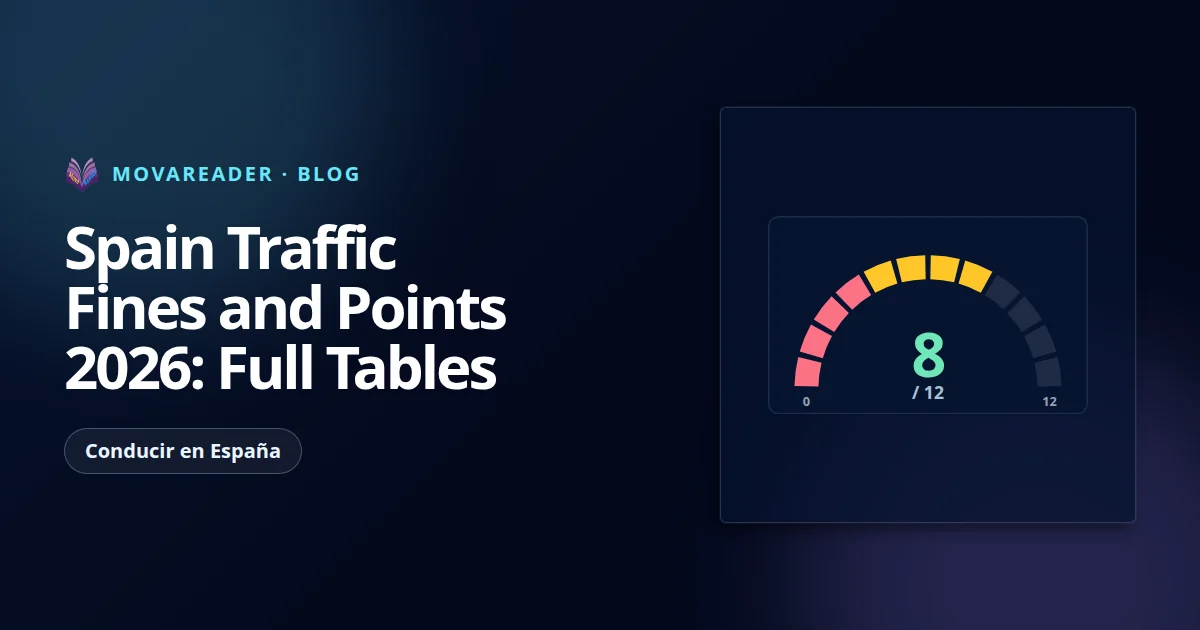
In short. Spanish traffic offences are minor (up to 100 EUR), serious (200 EUR) or very serious (500 EUR), and speeding has its own scale from 100 to 600 EUR. Pay within 20 calendar days and the fine is halved, but you still lose the points. Most drivers hold 12 points, new drivers and those who re-qualified after losing every point start with 8, and the ceiling is 15. Points come back after two years without offences, or through a course.
The three classes of offence and what they cost
Spain's road traffic act, the Ley sobre Tráfico (LSV, Royal Legislative Decree 6/2015), sorts infracciones (offences) into three classes. Each has a fixed base fine (article 80), which can be raised by up to 30 % for danger, repeat offending and circumstances (article 81).
| Class | Spanish term | Fine | Typical examples |
|---|---|---|---|
| Minor | leve | up to 100 EUR | unpaid toll, cycling without lights, breaches the law does not list as serious |
| Serious | grave | 200 EUR | phone use, red light, STOP sign, seatbelt, tailgating, parking in a bus lane |
| Very serious | muy grave | 500 EUR | reckless driving (conducción temeraria), wrong-way driving, alcohol over the limit, street racing |
A few special amounts are worth knowing:
- 1,000 EUR for drugs in the system, and for alcohol when you are over double the limit or were already fined for alcohol in the previous year (article 80.2.a).
- 6,000 EUR for a radar jammer, an inhibidor de radar (article 80.2.c).
- Double or triple the original fine when the registered keeper does not truthfully name the driver: double if the original offence was minor, triple if it was serious or very serious (article 80.2.b).
The most dangerous behaviour goes beyond fines altogether and becomes a criminal offence, a delito; more on that below.
The 50 % early payment discount
Once you are notified of a denuncia (the ticket or charge), you have 20 calendar days, días naturales, weekends and public holidays included, to choose:
- Pay early with a 50 % discount, pronto pago. The case closes the day you pay, you waive the right to contest it, and the points are deducted all the same (LSV article 94).
- Contest it by filing alegaciones (written objections) with evidence. You lose the discount: if you lose, you pay 100 %. You can then lodge a recurso de reposición (administrative appeal) within one month.
Practical points from the DGT's own fine payment page:
- DGT fines cannot be paid in instalments or deferred. An unpaid final fine passes to the tax agency (AEAT), which collects it with a 20 % surcharge.
- You can pay online, in the miDGT app, by phone on 060, at CaixaBank branches and ATMs, or in cash at a Correos post office.
- The fine may come from the DGT, a town hall or a regional authority. Always pay or appeal with whoever issued it.
Notices arrive by post or in the Dirección Electrónica Vial (DEV), the DGT's free electronic mailbox. A DEV notice left unopened for 10 calendar days counts as delivered. If you cannot be found at home, the notice is published in the BOE, the official gazette. And the DGT never sends fines by email: a message with a "fine" and a payment link is a scam.
Tourists and non-residents pay on the spot
If you cannot prove legal residence in Spain, the officer sets the fine there and then and asks you to pay it immediately, by card or in cash, still with the 50 % reduction. If you do not, the vehicle is immobilised wherever the officer indicates (LSV article 87.5). For a visitor in a hire car, this is the most likely way to meet a Spanish fine. Residents should carry their residence card (TIE) along with the licence.
The points licence: 8, 12 and 15
Spain uses a permiso por puntos, a points-based licence. Points belong to the driver, not to a licence category: one balance covers all your licences (LSV article 63).
| Situation | Points |
|---|---|
| General rule | 12 |
| Licence held for three years or less (unless you hold another licence that old) | 8 |
| New licence after losing every point | 8 |
| Driver on 8 points after two years without losing points | 12 |
| Bonus: three years without offences | +2 (14) |
| Bonus: three more years without offences | +1 (15, the maximum) |
Points are taken when the penalty becomes final, firme, for example on the day you pay early. You cannot lose more than 8 points in a single day from several offences, unless one of them is among the gravest: very serious speeding, alcohol, drugs, refusing a test, reckless driving, wrong-way driving, racing, a radar jammer or professional driving-time breaches (article 64.4). Then you lose every point that applies.
Check your balance in the miDGT app or on the DGT e-office.
Points per offence (anexo II)
This follows annex II of the LSV as worded by Law 18/2021, in force since 21 March 2022 and unchanged as of October 2026. The full text is in the consolidated LSV on boe.es.
| Points | Offence |
|---|---|
| 6 | Alcohol over 0.50 mg/l in breath (new and professional drivers: over 0.30) |
| 6 | Drugs in the system; refusing an alcohol or drug test |
| 6 | Reckless driving, wrong-way driving, unauthorised racing |
| 6 | Radar jammer; exceeding driving time or cutting rest by more than 50 % |
| 6 | Holding a mobile phone while driving |
| 6 | Overtaking a cyclist dangerously or without 1.5 m clearance |
| 6 | Throwing objects that can cause fires or accidents |
| 4 | Alcohol over 0.25 up to 0.50 mg/l (new and professional: over 0.15 up to 0.30) |
| 4 | Right of way, STOP, give way, red light |
| 4 | Dangerous overtaking or overtaking with poor visibility |
| 4 | Ignoring signs or officers' instructions |
| 4 | Not keeping a safe distance |
| 4 | No seatbelt, child seat or helmet, or using them wrongly |
| 4 | Driving without the right licence class or while suspended |
| 4 | Reversing on a motorway or dual carriageway |
| 3 | Illegal U-turn |
| 3 | Headphones; phone wedged in a helmet; handling a satnav or a mounted phone |
| 3 | Radar detector |
| 2-6 | Speeding, per the anexo IV table |
The phone rule surprises many British drivers: holding it costs 6 points, tapping a phone in a cradle 3, and the fine is 200 EUR either way.
Speeding fines: the anexo IV table
Speeding has its own grid in annex IV of the LSV. The amount and the points depend on the limit and on the speed the radar recorded, and the same grid applies to average speed cameras over a tramo (section).
Towns and low limits (km/h):
| Fine and points | Limit 20 | 30 | 40 | 50 |
|---|---|---|---|---|
| 100 EUR, 0 points | 21-40 | 31-50 | 41-60 | 51-70 |
| 300 EUR, 2 points | 41-50 | 51-60 | 61-70 | 71-80 |
| 400 EUR, 4 points | 51-60 | 61-70 | 71-80 | 81-90 |
| 500 EUR, 6 points | 61-70 | 71-80 | 81-90 | 91-100 |
| 600 EUR, 6 points (very serious) | 71-80 | 81-90 | 91-100 | 101-110 |
Open roads (km/h):
| Fine and points | 60 | 70 | 80 | 90 | 100 | 110 | 120 |
|---|---|---|---|---|---|---|---|
| 100 EUR, 0 points | 61-90 | 71-100 | 81-110 | 91-120 | 101-130 | 111-140 | 121-150 |
| 300 EUR, 2 points | 91-110 | 101-120 | 111-130 | 121-140 | 131-150 | 141-160 | 151-170 |
| 400 EUR, 4 points | 111-120 | 121-130 | 131-140 | 141-150 | 151-160 | 161-170 | 171-180 |
| 500 EUR, 6 points | 121-130 | 131-140 | 141-150 | 151-160 | 161-170 | 171-180 | 181-190 |
| 600 EUR, 6 points (very serious) | 131-140 | 141-150 | 151-160 | 161-170 | 171-180 | 181-190 | 191-200 |
Above the last row it is a crime: more than 60 km/h over the limit in town, more than 80 km/h over it outside (Criminal Code article 379). In a 50 zone that means 111 km/h; on a 120 motorway, 201 km/h.
Worked examples:
- 125 km/h on a 90 road: 300 EUR and 2 points (150 EUR if paid early).
- 75 km/h in a 50 zone: 300 EUR and 2 points.
- 135 km/h on a 120 motorway: 100 EUR, no points.
One exception: on motorway approaches to cities with limits below 100 km/h, the fine follows the posted limit, but points and criminal consequences apply only above 100 km/h and as if the limit were 100. The limits themselves, by road and vehicle, are covered in the speed module of the Conducir en España course.
Drink and drug driving
Alcohol limits are set by article 20 of the Reglamento General de Circulación (General Traffic Regulations), and they apply to cyclists too. They are lower than in England and Wales.
| Driver | Blood | Breath |
|---|---|---|
| General limit | 0.5 g/l | 0.25 mg/l |
| New drivers (first 2 years) and professional drivers | 0.3 g/l | 0.15 mg/l |
| Result (breath, general limit) | Consequence |
|---|---|
| Over 0.25 up to 0.50 mg/l | 500 EUR and 4 points |
| Over 0.50 up to 0.60 mg/l | 1,000 EUR (over double the limit) and 6 points |
| Over 0.60 mg/l (or 1.2 g/l in blood) | Criminal offence in every case |
| Second alcohol offence within a year | 1,000 EUR |
| Drugs in the system | 1,000 EUR and 6 points |
| Refusing the test | Criminal offence: 6 months to 1 year in prison and a ban of over 1 and up to 4 years |
Every driver stopped by an officer must take the test, and so must anyone involved in an accident. Refusing is punished more harshly than failing. Below 0.60 mg/l you can still be prosecuted for driving under the influence if you show clear signs of it.
As of October 2026, Parliament is processing a bill to cut the general limit to 0.2 g/l in blood. It is not law yet, so the figures above apply. The only safe rule is not to drive after drinking.
When it becomes a crime
Some conduct is handled by a criminal court rather than the DGT, which means a criminal record and a driving ban.
| Conduct | When it is a crime | Criminal Code |
|---|---|---|
| Speed | Over 60 km/h above the limit in town, over 80 outside | art. 379.1 |
| Alcohol | Over 0.60 mg/l breath or 1.2 g/l blood; below that, if driving under the influence | art. 379.2 |
| Drugs | Driving under the influence | art. 379.2 |
| Refusing a test | Always | art. 383 |
| No licence | Never held one, all points lost (once notified), or banned by a court | art. 384 |
| Leaving the scene | After causing an accident with deaths or injuries | art. 382 bis |
Under article 379, the penalty is 3 to 6 months in prison, a fine or community service, and always a ban of more than one and up to four years.
Recovering points and rules for new drivers
There are three routes (LSV articles 63 and 65):
- Time. Two years without a final penalty that removed points, and you are back to 12. A new driver on 8 moves to 12 after two clean years.
- Partial recovery course, curso de sensibilización y reeducación vial. If you still have points, this 10-hour course returns up to 4, never above your starting balance. That is the cap set by Order INT/914/2024, in force since 4 November 2024; the LSV text still says "up to six", but the DGT applies 4. You can take it once every two years (yearly for professional drivers), and you pay the training centre.
- Safe and efficient driving course, curso de conducción segura y eficiente. Voluntary, it adds 2 points up to the maximum of 15 if your balance is positive, at most one course of each type every two years.
Losing every point
Your licence loses its validity, pérdida de vigencia. You can obtain a new one after 6 months (3 for professional drivers), or 12 months (6) if it happens again within three years of the new licence. You must complete a recovery course (at least 20 hours, according to the DGT) and pass a theory test, and you restart on 8 points. Driving after being notified is a crime.
New drivers
| Rule | How long |
|---|---|
| 8 points, rising to 12 after two years without losing points | 2 years |
| Alcohol limit of 0.3 g/l blood or 0.15 mg/l breath | 2 years from obtaining the licence |
| V-13 "L" plate on the rear left of the car | 1 year |
All of these numbers turn up in DGT exam questions. If you are getting a Spanish licence, start with our guide to the DGT theory test, and if you are already driving here on a foreign licence, read driving in Spain with a foreign licence for when you need to exchange it. The changes that took effect on 1 October 2026 are in Spain's new traffic rules.
FAQ
How long do I have to pay a Spanish traffic fine at 50 % off?
20 calendar days from the day after you receive the notice, weekends and holidays included. After that you can only pay the full amount.
Do I still lose points if I pay the fine early?
Yes. Early payment makes the penalty final on the day you pay, and that is when the points come off. The discount applies only to the money.
What is the fine for using a phone while driving in Spain?
200 EUR and 6 points if you hold the phone. If it sits in a cradle but you operate it by hand, 200 EUR and 3 points.
Can I pay a DGT fine in instalments?
No. The DGT states that fines cannot be split or deferred. An unpaid final fine goes to the tax agency with a 20 % surcharge.
Who pays a speeding fine caught on camera in a hire car?
The notice first goes to the rental company as the keeper, and it has 20 calendar days to identify the driver (LSV article 93.1). A new notice is then sent to you, and the usual 20 days and 50 % discount run from that notice.
What happens if I drive at 140 km/h on a 120 motorway?
That falls in the first band of the anexo IV table (121-150 km/h): 100 EUR, no points, 50 EUR if paid within 20 days. From 151 km/h it is 300 EUR and 2 points.
Quick checklist
- Minor offences up to 100 EUR, serious 200 EUR, very serious 500 EUR; speeding 100 to 600 EUR.
- 20 calendar days for the 50 % discount; points still come off; no instalments.
- 12 points as standard, 8 for new drivers, 15 at most; no more than 8 lost in a day except for the gravest offences.
- Phone in hand 6 points, seatbelt and red light 4, passing a cyclist without 1.5 m 6.
- Alcohol: 0.25 mg/l breath generally, 0.15 for new drivers; over 0.60 mg/l or refusing the test is a crime.
- Points return after two clean years or with a course (up to 4).
This whole topic is one module of the DGT exam, and you can study it in Spanish without getting lost. The Conducir en España: el permiso B course covers the full B licence theory in B1-level Spanish, with a one-tap English translation of every word and sentence. Try the two free lessons first: how the DGT theory test works and Spanish warning signs.
MovaReader course
Conducir en España: Spanish road rules and DGT theory in Spanish
74 lessons · 1417 questions · exam simulator
Every word and sentence of the course translates into English with one tap. Two lessons are free.