Life in Spain
Spanish for Drivers: Essential Words and Phrases for Spain's Roads
A practical phrasebook for driving in Spain: what the Guardia Civil will say at a checkpoint, how to ask a mechanic for a written quote, what franquicia and telepeaje mean, and what to tell 112.
You can be a confident driver and still freeze when a Guardia Civil officer leans in and says "Pare el motor, por favor", or when the rental desk asks whether you want to reduce the franquicia. Driving in Spain has its own vocabulary, and holiday phrasebooks rarely cover it. Here are the words and phrases you will actually need, grouped by situation.
In short. Everyday driving in Spain runs on a few dozen words: permiso de conducción (driving licence), permiso de circulación (vehicle registration certificate), repostar (to refuel), presupuesto (quote), franquicia (insurance excess), peaje (toll), parte amistoso (joint accident report) and the emergency number 112. The tables below give each phrase, its meaning and the moment you will need it.
Police checks: what you will hear and what to say
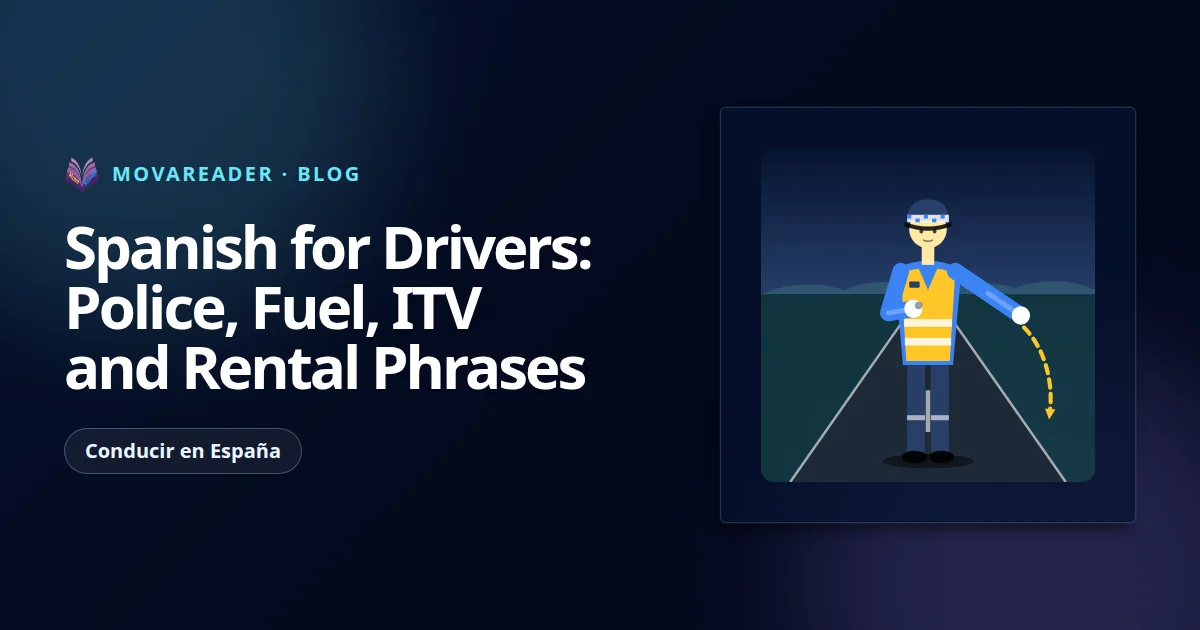
Who stops you depends on where you are: the Guardia Civil on interurban roads, the policía local (municipal police) in towns, and the Mossos d'Esquadra or Ertzaintza in Catalonia and the Basque Country. Being pulled over is dar el alto. What to do:
- Indicate and stop where the officer tells you, somewhere safe.
- Switch off the engine; at night, turn on the interior light.
- Lower the window and keep your hands on the wheel.
- Stay in the car unless you are asked to get out.
- Greet the officer and use the formal usted: Buenos días in the morning, Buenas tardes in the afternoon, Buenas noches at night.
An officer's instructions override traffic lights, signs and road markings. If a police car behind you shows a red light facing forward, pull over on the right in front of it, somewhere safe, and stay inside: the officer will give instructions over the loudspeaker.
| Spanish | English | When |
|---|---|---|
| Pare el motor, por favor. | Switch off the engine, please. | Often the first thing you hear |
| Documentación, por favor. | Your documents, please. | Document check |
| ¿Me enseña el permiso de conducción? | Can I see your driving licence? | Licence check |
| ¿Es usted el titular del vehículo? | Are you the registered keeper? | The car is not in your name |
| Sople por la boquilla hasta que le diga. | Blow into the mouthpiece until I tell you. | Breath test |
| ¿Puede repetirlo más despacio, por favor? | Could you say that again more slowly? | You did not understand |
| Quiero hacer una segunda prueba. | I would like a second test. | After a positive breath test |
| ¿Cuál es su número de identificación? | What is your ID number? | You want the officer's number |
| Puede continuar. Buen viaje. | You may go. Have a good trip. | The check is over |
Documents. The driver must carry the driving licence, the permiso de circulación and the tarjeta ITV (vehicle inspection card). Spanish licences and registration certificates also work in the miDGT app, with the same legal value as paper inside Spain. You do not need to carry the insurance certificate: officers check insurance in a database.
Alcohol. Every driver must take a breath test when asked, even at a routine checkpoint. After a positive result, the second test comes at least 10 minutes later, and you may ask for a blood test (análisis de sangre) at a medical centre. Refusing the test is a criminal offence.
Visitors. If you cannot prove legal residence in Spain, the officer sets the fine on the spot and you can pay it there with a 50 % reduction. If you do not pay, the vehicle is immobilised.
At the petrol station
Most stations are self-service: you fill up and pay at the caja (till), or pay by card at the surtidor (pump) first. Check your fuel type on the filler cap before you start.
| Spanish | English | When |
|---|---|---|
| repostar | to refuel | General word |
| gasolina sin plomo 95 / 98 | unleaded petrol 95 / 98 | Petrol cars |
| gasóleo, diésel | diesel | Diesel cars |
| Lleno, por favor. | Fill it up, please. | Attended stations |
| Veinte euros en el surtidor cinco. | Twenty euros on pump five. | Prepaying at the till |
| ¿Me da el tique? | Can I have a receipt? | You need a receipt |
Pumps use the European fuel labels: E5 and E10 in a circle (petrol), B7 in a square (diesel), LPG and CNG in a diamond (gas). Spanish rules require the engine off, and lights, radio and phones switched off while refuelling; at self-service stations that duty falls on whoever is filling the tank (article 115 of the General Traffic Regulation). Put the wrong fuel in? Do not start the engine; call your insurer's asistencia en carretera (roadside assistance).
At the garage
A taller is a repair garage. Explain what happens, when and since when, and ask for a written quote before any work.
| Spanish | English | When |
|---|---|---|
| Se enciende este testigo. | This warning light comes on. | Dashboard light |
| Hace un ruido raro cuando acelero / freno. | It makes a strange noise when I accelerate / brake. | Describing a fault |
| El coche no tiene fuerza. | The car has no power. | Loss of power |
| ¿Me puede hacer un presupuesto por escrito? | Can you give me a written quote? | Before the repair |
| ¿Cuándo estará listo? | When will it be ready? | Timing |
| Necesito la factura, por favor. | I need the invoice, please. | After the repair |
| avería, neumático, pastillas de freno | breakdown, tyre, brake pads | Common words |
Keep the factura: repairs carry a guarantee of at least three months or 2,000 km, and the garage must give you a signed, itemised invoice. A red oil-pressure or brake light means stop somewhere safe; an amber engine light means book the garage soon.
At the ITV inspection
The ITV (inspección técnica de vehículos) is Spain's compulsory roadworthiness test, the local equivalent of the UK MOT. Book a cita previa (appointment) at a station in your region, bring the permiso de circulación and the tarjeta ITV, and make sure your insurance is valid: without it the result cannot be favourable.
| Age of a private car | ITV frequency |
|---|---|
| Up to 4 years | Exempt |
| Over 4 and up to 10 years | Every 2 years |
| Over 10 years | Every year |
| Spanish | English | What it means |
|---|---|---|
| favorable | pass | Minor defects must be fixed within 2 months |
| desfavorable | fail | Drive only to a garage and back to the ITV, within 2 months |
| negativa | fail, unroadworthy | The car may not be driven; it leaves on a tow truck |
| distintivo V-19 | ITV sticker | Top right corner of the windscreen, inside |
| ¿Puedo volver a casa con el coche? | Can I drive home? | After a fail |
You can pass the ITV up to 30 days before the expiry date without losing time, because the next date counts from the old one. Prices vary by region and station.
Hiring a car: franquicia, fianza and telepeaje
The rental desk will ask for a licence valid in Spain and usually a credit card in the driver's name. Minimum age and years of driving experience depend on the company.
| Spanish | English | When |
|---|---|---|
| Tengo una reserva a nombre de... | I have a booking under the name... | At the desk |
| fianza | deposit | The amount blocked on your card |
| franquicia | excess, deductible | The part of any damage you pay |
| seguro sin franquicia | zero-excess cover | If you want no excess |
| lleno y lleno | full to full | Fuel policy |
| ¿El coche tiene telepeaje? | Does the car have an electronic toll tag? | Before toll motorways |
| golpe, arañazo | dent, scratch | Checking the car |
Walk round the car and photograph any damage before you leave. Check that it carries the permiso de circulación and tarjeta ITV, a hi-vis vest (chaleco reflectante) and a connected V-16 beacon, compulsory since 1 January 2026 for Spanish-registered vehicles. If a camera catches you speeding, the fine goes to the rental company, which names you as the arrendatario (renter).
Parking, tolls and low-emission zones
Each town sets its own parking rules in an ordenanza municipal (municipal by-law), so names and prices vary.
| Spanish | English | When |
|---|---|---|
| zona azul, zona verde, ORA | pay-and-display zones | Ticket from the meter or the app |
| parquímetro | parking meter | Paying for parking |
| carga y descarga | loading and unloading | Keep clear during the signed hours |
| vado | garage entrance, dropped kerb | No parking in front |
| doble fila | double parking | Not allowed |
| grúa, depósito | tow truck, car pound | Your car has been towed |
| Creo que la grúa se ha llevado mi coche. | I think my car has been towed. | At the pound or on the phone |
| peaje, telepeaje | toll, electronic toll | AP toll motorways |
Many autovías (A roads) are free, while some autopistas (AP roads) charge tolls. At the toll plaza, avoid the lane marked T unless you have a tag: it is for telepeaje only. Many cities run a zona de bajas emisiones (ZBE, low-emission zone) where access depends on the car's etiqueta ambiental (environmental sticker), and cameras read number plates.
Accidents and breakdowns: 112, parte amistoso and V-16
The emergency number in Spain and across the EU is 112, free from any phone. What the operator needs most: where you are (road, punto kilométrico or kilometre marker, and direction) and whether anyone is hurt.
| Spanish | English | When |
|---|---|---|
| Ha habido un accidente en la A-7, kilómetro 312, sentido Málaga. | There has been an accident on the A-7, kilometre 312, towards Málaga. | Calling 112 |
| Hay heridos. / No hay heridos. | There are injured people. / Nobody is hurt. | The operator asks |
| Tengo una avería. | I have broken down. | Calling roadside assistance |
| Necesito una grúa. | I need a tow truck. | The car will not move |
| ¿Está usted bien? | Are you all right? | First words to the other driver |
| ¿Hacemos el parte amistoso? | Shall we fill in the accident report? | Minor collision, no injuries |
| testigo | witness | Someone saw it happen |
Since 1 January 2026, Spanish-registered vehicles that stop after a breakdown or an accident are signalled with a connected V-16 beacon instead of warning triangles; foreign-registered cars passing through may still use triangles. Our guide to the V-16 beacon has the details. Put on a hi-vis vest before you step onto the carriageway or hard shoulder of an interurban road. The declaración amistosa de accidente (the European accident statement) must not be filled in on the road itself: move to a safe place first. Then notify your insurer within seven days.
Satnav and road signs: words you hear every day
| Spanish | English | When |
|---|---|---|
| En la glorieta, toma la tercera salida. | At the roundabout, take the third exit. | Satnav |
| ceda el paso | give way | Sign R-1 |
| cambio de sentido | U-turn, turning point | Motorway signs |
| desvío, obras | diversion, roadworks | Temporary signs |
| arcén | hard shoulder | Emergency stops only |
| retención | tailback | Variable message signs |
Glorieta is the word in the regulations and the exam; in conversation people mostly say rotonda. Who has priority, which lane to use and how to exit are explained in our guide to roundabouts in Spain.
All these words and dialogues (a Guardia Civil check, the garage, the ITV, the rental desk) are part of Conducir en España: el permiso B, with a 427-term glossary and B1-level Spanish lessons where every word and sentence translates into English with one tap. If you are working towards a Spanish licence, start with our DGT theory test guide.
FAQ
What documents do I need to carry when driving in Spain?
Your driving licence, the vehicle's permiso de circulación (registration certificate) and its tarjeta ITV (inspection card), as originals or certified copies. A Spanish licence and registration certificate can also be shown in the miDGT app, but only inside Spain. You do not have to carry the insurance certificate.
What should I say to the police if my Spanish is basic?
Try: Perdone, no hablo bien español. ¿Puede repetirlo más despacio, por favor? (Sorry, my Spanish is not good. Could you repeat that more slowly, please?). Use usted, stay in the car unless asked to get out, and follow the officer's instructions.
What does franquicia mean when renting a car in Spain?
It is the excess: the part of any damage you pay yourself even though the car is insured. The amount depends on the company. You can usually pay extra for a seguro sin franquicia, zero-excess cover.
How do you say "I need a tow truck" in Spanish?
Necesito una grúa. Add where you are: road number, punto kilométrico and direction, for example en la A-4, kilómetro 215, sentido Madrid.
What is a parte amistoso?
The everyday name for the declaración amistosa de accidente, the European accident statement used after minor collisions. It has two columns, for vehicle A and vehicle B. Fill it in somewhere safe off the road and notify your insurer within seven days.
Quick reference
- Police: Pare el motor, Documentación, por favor, Sople por la boquilla, ¿Puede repetirlo más despacio?
- Petrol station: repostar, gasóleo, gasolina 95, Lleno, por favor.
- Garage: avería, testigo, presupuesto por escrito, factura.
- ITV: cita previa, favorable, desfavorable, negativa.
- Car hire: fianza, franquicia, lleno y lleno, telepeaje.
- Parking: zona azul, parquímetro, grúa, depósito.
- Accidents: 112, punto kilométrico, heridos, parte amistoso, testigo.
Want to get used to road Spanish before your next drive? Open the free lessons on Spanish warning signs and how the DGT theory test works, and tap any word to see its translation.
MovaReader course
Conducir en España: Spanish road rules and DGT theory in Spanish
74 lessons · 1417 questions · exam simulator
Every word and sentence of the course translates into English with one tap. Two lessons are free.