Life in Spain
Roundabouts in Spain: Priority, Lanes, Exits and Fines Explained
Traffic already on the ring has priority, you leave only from the outer lane, and if you miss your exit you go round again. Every rule for Spanish glorietas, with the legal source.
Your satnav says "toma la tercera salida", you are in the inner lane, the outer lane is full and your exit is coming up. This is where the classic Spanish roundabout crash happens: someone cuts across the outer lane to make the exit. The rules that prevent it are short, consistent and worth learning before your first drive or your DGT theory test.
In short. On a Spanish roundabout, a glorieta, you drive counter-clockwise, keeping the centre on your left. Vehicles already on the ring have priority over those entering, unless a sign or traffic light says otherwise. Enter from the right-hand lane when it is free, and leave only from the outer (right-hand) lane; an inner lane may be used to exit only where road markings allow it. If you cannot reach the outer lane in time, go round again. Failing to give way costs 200 EUR and 4 points.
What a glorieta is and which way you drive
A glorieta (people also say rotonda) is a special type of junction: roads meet a calzada circular (circular carriageway) around an isleta central (central island). Article 43.2 of the Reglamento General de Circulación (RGC, the General Traffic Regulations) requires you to drive with the centre on your left, so counter-clockwise. If you learned to drive in the UK or Ireland, everything is mirrored: you go round the other way and look left, not right, when entering.
Signs and markings that announce a roundabout:
| Sign or marking | Code | Meaning |
|---|---|---|
| Triangle with circular arrows | P-4 "Glorieta" | Roundabout ahead |
| Blue circle with three arrows | R-402 "Sentido obligatorio en glorieta" | Compulsory direction around the ring |
| Inverted triangle at the entry | R-1 "Ceda el paso" | Give way to traffic on the ring |
| Arrows painted before the entry | M-5.7 | The exits you may take if you enter from this lane |
M-5.7 arrows are only painted on roundabouts where the lane decides the exit. When you see them, pick your lane before you enter. Our guide to Spanish road signs covers these and the other families in detail.
Who has priority on a Spanish roundabout
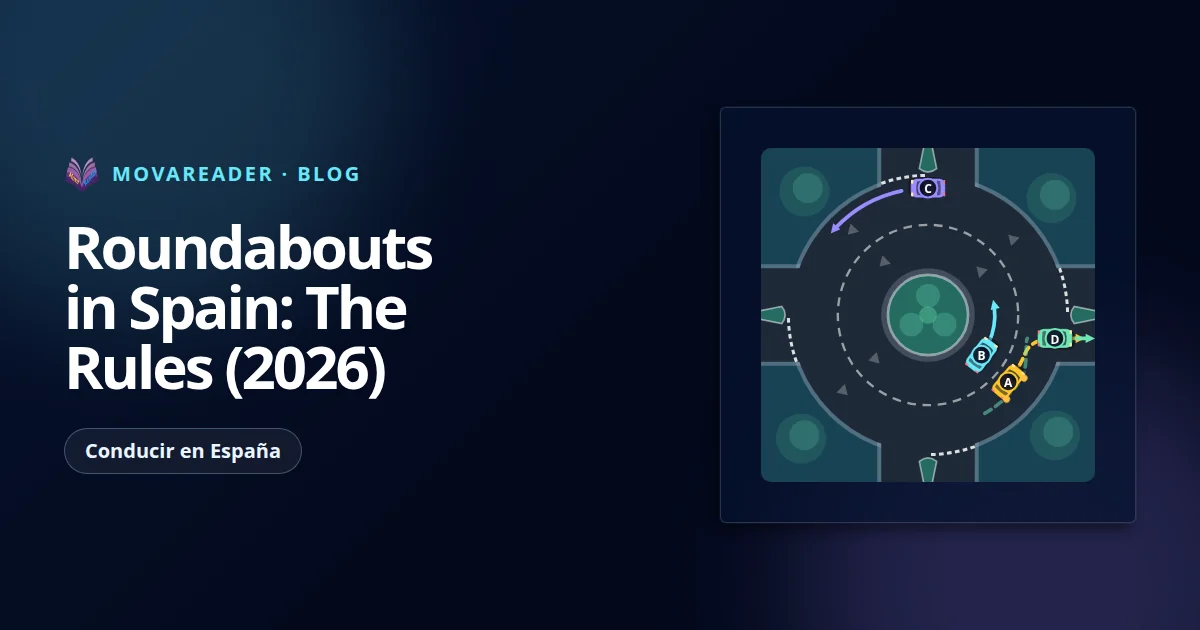
The core rule is RGC article 57.1.c: on a roundabout, vehicles on the circular carriageway have priority over those that want to enter. The default Spanish rule of giving way to traffic from the right does not apply here: a car arriving at the ring to your right still yields to everyone already circulating.
Two refinements:
- Signs and lights come first. Priority follows whatever signals control the junction (RGC article 56.1); the "inside first" rule applies when they say nothing else. On large roundabouts, lights or signs may stop even the traffic already on the ring, and then you obey them.
- Giving way means not making anyone brake. Under RGC article 58.1, a driver who must give way may not start or continue a manoeuvre that forces the priority vehicle to brake or swerve sharply. "I'll just squeeze in" at the entry is already an offence.
An exam-style example: cars A and D are on the ring, B and C wait at two entries. D is approaching B's entry from the left, so B waits until D has passed. Arriving before C, or being to someone's right, changes nothing: until B is on the ring, B has no priority.
An indicator does not give priority either. A car on the ring flashing right may still carry on round, so wait until it actually starts to leave.
How to enter a roundabout in Spain
- Slow down early to suit the signs and traffic. The DGT stresses that the approach and entry are the most critical moments: an AXA study it cites puts 54 % of roundabout crashes there.
- Take the right-hand lane. The DGT explains that you should enter from the right-hand lane whenever it is free and it is possible. If that lane is congested, you may enter from the left-hand lane straight into the inner lane.
- Look left, where traffic on the ring comes from.
- Give way to everyone on the ring, stopping at the ceda el paso line (the broken line across the lane) if necessary.
- If you cannot see, because of a lorry or a sloping approach, slow down further and stop before entering.
- Enter when there is a safe gap, without making anyone brake.
Choosing a lane inside the ring
On a single-lane roundabout there is nothing to choose. On multi-lane roundabouts, the DGT advises:
| Where you are going | Recommended lane | Remember |
|---|---|---|
| First or second exit | Carril exterior (outer, right) | Simplest and safest |
| One of the last exits, heavy traffic | Carril interior (inner) | Move out step by step before your exit |
| U-turn | Inner lane | Same: move out progressively |
| Roundabout with M-5.7 arrows | The lane whose arrow leads to your exit | Arrows override the general advice |
Every lane change inside the ring is a sideways move. It must be signalled with the indicator (RGC article 109) and made while respecting the priority of whoever is already in the lane you are moving into (RGC article 74.2). Breaches of article 74 are classed as serious, which means a 200 EUR fine.
Overtaking on a roundabout is allowed: RGC article 87.1.c expressly makes roundabouts an exception to the ban on overtaking at junctions. Normal precautions still apply.
Exiting: only from the outer lane
The key exit rule: you leave a roundabout from the outer lane, having moved into it in good time. The DGT puts it plainly: as a general rule, exiting from an inner lane is not allowed. The point is to avoid the cruzada, the cut across, in which a driver in the inner lane crosses in front of a car correctly using the outer lane. The single exception is a road marking, such as a painted arrow, that allows exiting from the inner lane.
Why so strict? The car in the outer lane may be carrying on round, and that lane is its own. Leaving from the inner lane is in fact a lane change without giving way to the vehicle already there, exactly what article 74.2 forbids.
How to leave a two- or three-lane roundabout:
- Before your exit, check the right mirror and your blind spot.
- Signal right and move to the outer lane, giving way to anyone already in it.
- Keep signalling right to show you are leaving.
- Exit from the outer lane.
- If you could not reach the outer lane, do not brake hard or cut in: dar otra vuelta, go round again.
Stopping on the ring to wait for a gap to your exit is dangerous. Another lap costs a minute; a cut across can cost a crash.
Cyclists, e-scooters, long vehicles and pedestrians
- Groups of cyclists. When cyclists ride as a group and the first one has entered the roundabout, the whole group has priority as if it were one vehicle (RGC article 64.2.c, in the version in force since 1 October 2026). Wait for the last rider. A lone cyclist who is still entering gives way to traffic on the ring like anyone else.
- E-scooters. The DGT reminds riders of personal mobility vehicles that the same rules apply: give way to traffic on the ring, signal lane changes and exits, and as a rule enter and leave from the outer lane. Other drivers should take extra care around them.
- Lorries and buses. Long vehicles may need several lanes to enter or leave, and they block your view. Give them room and never sit alongside them.
- Pedestrians. Pedestrians may not cross the circular carriageway; they walk around the roundabout unless there is a designated crossing (RGC article 124.4). If there is a zebra crossing at your exit, giving way to pedestrians is part of leaving.
Common roundabout mistakes and what they cost
According to Automovilistas Europeos Asociados, figures quoted by the DGT, Spanish roundabouts saw 45,000 crashes with victims between 2015 and 2019, with 317 deaths. The usual mistakes:
| Mistake | Rule broken | Consequence |
|---|---|---|
| Entering without giving way to traffic on the ring | RGC arts. 57.1.c and 58.1, priority | Serious offence: 200 EUR and 4 points |
| Changing lanes inside without giving way | RGC art. 74.2 | Serious offence: 200 EUR |
| Leaving from the inner lane across the outer one | Duty to exit from the outer lane, RGC art. 74.2 | Collision risk; as an article 74 breach, 200 EUR |
| Changing lanes or exiting without indicating | RGC art. 109 | Breach of the duty to signal manoeuvres |
| Stopping on the ring to wait for your exit | Road safety | Rear-end risk; go round again instead |
| Ignoring traffic lights on a roundabout | RGC art. 56.1, signals prevail | Running a red light: serious offence, 4 points |
A serious offence is 200 EUR (article 80 of the LSV traffic act), halved if you pay within 20 calendar days. If you have no legal residence in Spain, the officer can set the fine on the spot and ask you to pay there and then, by card or cash, with the 50 % reduction; if you do not, the vehicle is immobilised. Figures are as of October 2026; our guide to Spanish traffic fines and penalty points has the full tables.
Roundabout Spanish and the DGT test
Words you will hear from the satnav, the instructor and the examiner
| Spanish | English | Where you hear it |
|---|---|---|
| glorieta, rotonda | roundabout | Signs, rules, everyday speech |
| calzada circular | circular carriageway | Rules and test questions |
| carril exterior / carril interior | outer / inner lane | Test questions, instructors |
| Toma la primera / segunda / tercera salida | Take the first / second / third exit | Satnav, practical test |
| Ceder el paso | to give way | R-1 sign, rules |
| Poner el intermitente | to indicate | Instructors, examiners |
| Dar otra vuelta | to go round again | Instructors, DGT advice |
| Cambio de sentido | U-turn | Signs, satnav |
You can take the theory test in English, but the practical test examiner gives directions in Spanish, so "toma la segunda salida" should not need translating in your head. More useful phrases are in our article on driving Spanish.
Three typical test questions
- A lone cyclist reaches the roundabout while a car approaches on the ring. The car goes first: a cyclist riding alone gives way like any entering vehicle.
- The roundabout has traffic lights. The lights decide, not the general "inside first" rule.
- Two cars side by side on a two-lane ring, both indicating right. Only the one in the outer lane may exit; the inner car moves out behind it or goes round again.
The free lesson on how the DGT theory test works explains the format and the mistake limit.
FAQ
Who has right of way on a roundabout in Spain?
Vehicles already on the roundabout have priority over those entering (RGC article 57.1.c), with or without signs. The only exception is when traffic lights or signs on the roundabout itself regulate traffic differently.
Can you exit a Spanish roundabout from the inner lane?
As a general rule, no. You exit from the outer lane after moving into it in good time. Leaving from an inner lane is allowed only where road markings, such as a painted arrow, say so.
What should I do if I miss my exit on a roundabout?
Go round again and move to the outer lane early. Do not brake hard, stop on the ring or cut across another car; this is exactly what the DGT recommends.
Do you have to indicate on roundabouts in Spain?
Yes, for every lane change and when leaving: indicate right before your exit so others know you are going. RGC article 109 requires you to signal any sideways move, and an indicator never replaces giving way.
Is overtaking allowed on a roundabout in Spain?
Yes. Overtaking at junctions is generally banned, but RGC article 87.1.c makes an exception for roundabouts. Normal precautions apply, and any lane change must respect the vehicle already in that lane.
Which lane should I use to enter a roundabout in Spain?
The DGT says to enter from the right-hand lane whenever it is free and possible. If it is congested, you may enter from the left-hand lane straight into the inner lane. Where M-5.7 arrows are painted before the entry, follow them.
Five-step roundabout checklist
- Approach: slow down and take the right-hand lane, or the lane the arrows give for your exit.
- Entry: look left and give way to everyone on the ring.
- On the ring: counter-clockwise; outer lane for early exits, inner lane allowed for late ones.
- Lane changes: indicator, mirror, give way to whoever is already there.
- Exit: only from the outer lane, indicating right; if you cannot, go round again.
Rules like these are easier to learn with the diagram and the Spanish text in front of you. The course "Conducir en España: el permiso B" covers the full DGT theory in B1-level Spanish with a one-tap English translation of every word and sentence, and its roundabout questions use diagrams just like the real test. Try the two free lessons first: Spanish warning signs and how the DGT theory test works.
MovaReader course
Conducir en España: Spanish road rules and DGT theory in Spanish
74 lessons · 1417 questions · exam simulator
Every word and sentence of the course translates into English with one tap. Two lessons are free.