Life in Spain
V-16 Beacon in Spain 2026: Valid Models, How to Use It, Fines
The connected V-16 beacon has replaced warning triangles in Spain since 1 January 2026. What it is, how to check yours is legal, how to use it on a motorway, and what applies to UK and other foreign cars.
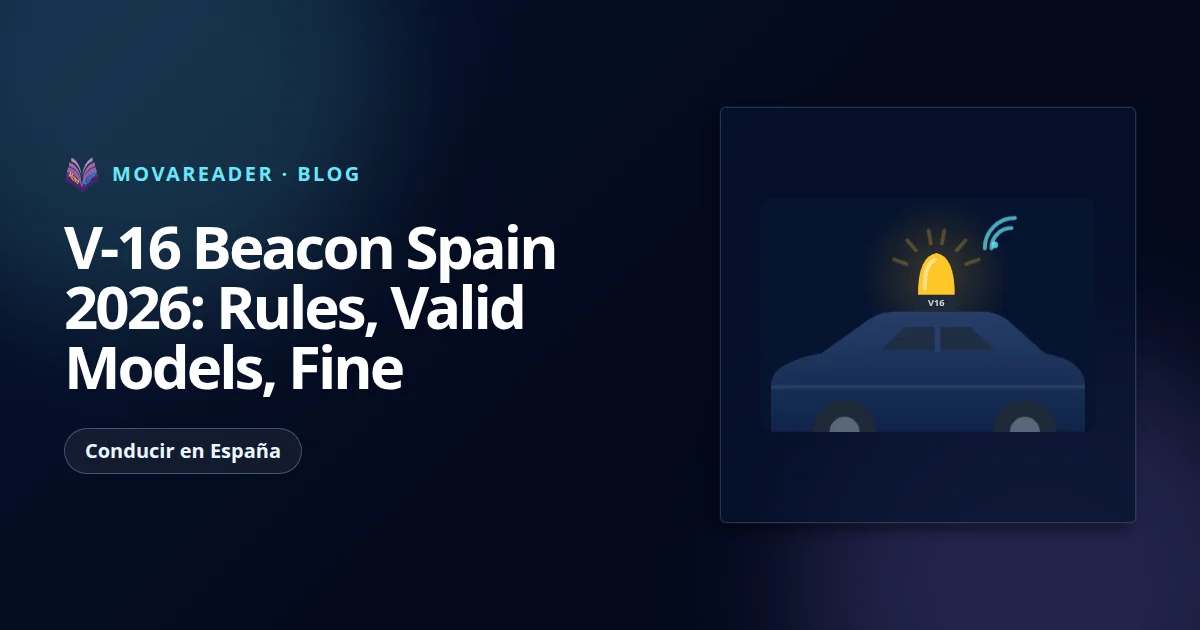
If you learned to drive in the UK or the US, the warning triangle in the boot probably feels like a fixed part of breaking down. In Spain it no longer is. Since 1 January 2026, a Spanish-registered vehicle that stops on the road after a breakdown or a crash must be signalled with a connected V-16 beacon, and triangles no longer count. Here is what the device is, how to tell whether yours is legal, and what to do when your car dies on an autovía.
In short. The V-16 is a small amber flashing light with a magnetic base that you switch on and put on the roof through the window, without getting out. It sends your position to the DGT 3.0 platform, which warns other drivers. Since 1 January 2026 a connected V-16 is compulsory for Spanish-registered cars, vans, buses and lorries, and warning triangles are no longer valid for them. The model must appear on the DGT's official list. According to the DGT, not carrying one is a minor offence with an 80 EUR fine.
What the V-16 beacon is
The legal name is dispositivo de preseñalización de peligro V-16 (hazard pre-warning device); everyone calls it the baliza V-16 (V-16 beacon). Its specification is in annex XI of Spain's vehicle regulations, the Reglamento General de Vehículos (RGV):
| Requirement | What the regulation says |
|---|---|
| Colour and visibility | amber light, visible through 360 degrees |
| Placement | the highest possible point of the vehicle |
| Light duration | at least 30 minutes |
| Power | battery or cells still usable after 18 months |
| Connectivity | reports switch-on and switch-off, and sends its position every 100 seconds |
| Data cost | included in the price, guaranteed for at least 12 years |
| Extra features | not allowed: light and location only |
The point is safety. Placing triangles meant walking around 100 metres along the carriageway, and according to the DGT about 25 people a year are killed in Spain after getting out of a stopped vehicle and being hit. The beacon goes on from inside the car. It also adds what the DGT calls virtual visibility: the stop appears on overhead message signs, in satnavs and in navigation apps, so drivers know about it before they can see it. In good conditions the light itself is visible from about 1 km.
What the beacon does not do:
- it does not call 112 or a recovery truck: you still make that call;
- it sends no personal data, number plate or speed, only a location, and only while switched on;
- it needs no phone, app or registration: the GPS chip and a non-removable SIM are inside.
Who has to carry one
Under annex XII of the RGV and the DGT's press note of 25 November 2025, the V-16 is part of the mandatory kit of these Spanish-registered vehicles:
- cars, turismos;
- vans and lorries, furgonetas and camiones;
- mixed-use vehicles;
- buses and coaches;
- vehicle combinations (conjuntos de vehículos, non-special).
Motorcycles are not required to carry one, though the DGT recommends it. Since 1 October 2026, however, motorcycles must carry a high-visibility vest (RGV annex XII.3, added by Royal Decree 518/2026).
The beacon is not tied to a car or a person. With two cars you can share one device, as long as it is in whichever car you are driving. The legal duty sits with the registered keeper, the titular:
- when you sell a car, whether the beacon goes with it is up to you; the duty passes to the buyer;
- a dealer does not have to supply one with a new car, although many do;
- in long-term leasing, renting, the owner must provide it unless the contract expressly passes that on to the lessee.
For hire cars, that means a Spanish-registered rental should come equipped. Check the glovebox before you leave the car park. You never have to register the device or give personal data; if a manufacturer's app asks for them, you can say no.
Which models are valid and how to check
There are more than two hundred models on the market, and "V-16" printed on a box proves nothing. Only models that passed certification and appear on the DGT's official list are valid (short address: dgt.es/v16).
Before you buy, or to check the one you have:
- Find the brand and model on the DGT list, which shows the certificate number and the laboratory.
- Look at the clear cover over the light, the tulipa: the laboratory's name and the certificate number must be engraved on it. The DGT says certification is done by IDIADA or LCOE.
- Find the connectivity end date on both the packaging and the device itself. It is a legal requirement.
- Make sure it is a connected beacon, a V-16 conectada. Older, unconnected V-16 lights were only valid until 1 January 2026.
If your model's certificate has since expired, the DGT states that units already bought remain valid for their owners until the end of their useful life. Those models are listed on the same page.
How to use it, step by step
Keep the beacon inside the cabin: glovebox, door pocket, anywhere you can reach from the driver's seat. Never in the boot. When you break down (avería) or crash:
- If the car can still move, leave the traffic lanes and head for the next exit along the right-hand hard shoulder, the arcén. If it cannot, stop on the right-hand hard shoulder or wherever you obstruct traffic least (article 130.2 of the Reglamento General de Circulación, RGC).
- Switch on your hazard lights, the luz de emergencia.
- Switch on the beacon.
- Open the window and place it on the roof, where the magnet holds it. If you cannot reach the roof, as in a lorry or bus, the DGT allows it on the driver's door.
- Put on your high-visibility vest, the chaleco reflectante, while still inside.
- Decide whether to get out or stay in (see below).
- Call 112 if anyone is hurt or in danger, or your insurer's breakdown line.
The operator will need the road, the kilometre point and your direction. These lines cover it:
| Spanish | English |
|---|---|
| Tengo una avería en la autovía A-7. | I've broken down on the A-7. |
| Estoy en el punto kilométrico 312, sentido Málaga. | I'm at kilometre 312, heading towards Málaga. |
| He puesto la baliza V-16. | I've put the V-16 beacon on. |
| No hay heridos. | Nobody is injured. |
For more phrases for the police, petrol stations and garages, see Spanish for drivers.
Awkward cases
- Aluminium body or glass roof. The magnet may not grip well. The DGT suggests a model with a suction cup or another mount; failing that, fix it on the door frame or the driver's door panel, as high and level as possible.
- Tunnels. The beacon uses dedicated IoT networks; where there is no signal at all it keeps flashing and sends its data once it reconnects.
- Motorcycles. If you carry one, the DGT suggests the fuel tank, the seat or top box, or the mirror stem.
- Bends and fog. The light is harder to see on sharp bends or in thick fog, but the alert still reaches connected drivers.
Switch the beacon off when you are done so it stops sending your position. For battery-powered models the DGT recommends replacing the batteries every year; for rechargeable ones, a full charge at least once a year and after every use.
Get out or stay in?
The rule is in article 130.3 of the RGC:
| Get out if... | Stay inside with your seatbelt on if... |
|---|---|
| there is a safe place off the road, such as behind the crash barrier, the barrera de seguridad | there is no safe place off the road |
| you can exit on the side away from traffic | you would have to get out into traffic |
| you are already wearing the vest | traffic is very heavy or visibility is poor |
Always get out on the side away from traffic, and do not walk or wait on the lanes or the hard shoulder. Wait behind the barrier, not on the hard shoulder. The DGT stresses that the driver judges whether getting out is safe.
Triangles, vests and foreign-registered cars
UK and other foreign cars
Triangles are no longer a valid way to signal a Spanish-registered vehicle. The exception is foreign-registered vehicles in international traffic. Under the 1968 Vienna Convention on Road Traffic, such a vehicle complies with the rules of its country of registration, so a UK-, Irish- or French-registered car passing through Spain may still use its triangles (DGT Instruction MOV 2025/1). It works the other way too: a Spanish car with a V-16 complies in other Vienna Convention countries.
If you move to Spain and register your car here, the V-16 becomes compulsory. Even on foreign plates, a beacon is far safer than a 100-metre walk along an autovía.
The vest
A high-visibility vest is mandatory kit in cars and light vans. Drivers of cars, motorcycles, buses, lorries and combinations must wear it whenever they get out and are on the carriageway or hard shoulder of an interurban road (RGC article 118.4). The law requires one for the driver; keeping one per passenger in the cabin is the sensible choice.
When you see a V-16 ahead
Since 1 October 2026 a new version of RGC article 88 applies (Royal Decree 518/2026). When a broken-down or crashed vehicle, an ambulance, a recovery truck or a road maintenance vehicle blocks all or part of your lane, you must:
- pass it with at least 1.5 metres of lateral clearance, even if that means using the opposite lane;
- slow down by at least 20 km/h below the speed limit there;
- where overtaking is banned, you may still pass it, but only after making sure it is safe.
The article itself classes a breach as serious, and serious offences carry a 200 EUR fine (LSV article 80). The other changes of 1 October 2026 are covered in Spain's new traffic rules.
V-16 fines: what is officially confirmed
Press reports quote different amounts, so here is only what an official source states. The DGT's press note of 25 November 2025 says that not carrying a V-16 is a minor offence, an infracción leve, with an 80 EUR fine, the same as for not carrying triangles before. Minor offences cost no points, and the usual 50 % discount applies if you pay within 20 calendar days.
Some outlets report 200 EUR for having a beacon but not signalling properly. We found no such figure in the official DGT texts we checked, so we do not confirm it. Separately, the RGC requires the driver of an immobilised vehicle to use the regulatory pre-warning device (article 130.4): a beacon left in the glovebox does not protect you.
For how Spanish fines and points work in general, see Spain traffic fines and penalty points.
FAQ
When did the V-16 beacon become mandatory in Spain?
On 1 January 2026. From that date the connected V-16 is the only legal way to signal an immobilised Spanish-registered vehicle; triangles and older unconnected beacons are no longer valid.
What is the fine for not having a V-16 beacon?
According to the DGT press note of 25 November 2025, it is a minor offence with an 80 EUR fine and no points. Other amounts circulating in the press did not appear in the official sources we checked.
Can I drive in Spain with warning triangles in a UK-registered car?
Yes, if the car is in international traffic: under the Vienna Convention it follows the rules of its country of registration. Spanish-registered cars, including hire cars registered in Spain, need the V-16.
Does the V-16 beacon call emergency services?
No. It only lights up and sends the vehicle's position to the DGT platform. You still call 112 or your breakdown service yourself.
How do I know if my V-16 beacon is approved?
Find the model on the official list at dgt.es/v16, check that the lens is engraved with the laboratory and certificate number, and look for the connectivity end date on the box and the device.
Do motorcycles need a V-16 in Spain?
No, it is only recommended for motorcycles. Since 1 October 2026, however, a motorcycle must carry a high-visibility vest.
Checklist
- A connected V-16 from the DGT's official list, kept in the cabin, not the boot.
- Laboratory and certificate number on the lens, connectivity end date on the box.
- Batteries replaced yearly, or recharged after every use.
- Vest in the cabin, ideally one per occupant.
- Sequence: hazards, beacon on the roof through the window, vest, exit away from traffic, behind the barrier, phone call.
- A stopped vehicle in your lane: 1.5 metres to the side and 20 km/h slower.
The V-16, the vest and what to do after a crash are part of the accidents topic in the DGT theory test. The Conducir en España: el permiso B course has a full lesson on it in B1-level Spanish, with a one-tap English translation of every word and sentence. Start with the free lessons on Spanish warning signs and how the DGT theory test works.
MovaReader course
Conducir en España: Spanish road rules and DGT theory in Spanish
74 lessons · 1417 questions · exam simulator
Every word and sentence of the course translates into English with one tap. Two lessons are free.