Life in Spain
Spanish Road Signs Explained: Shapes, Colours and the 2025 Catalogue
Shape first, colour second, symbol last: how to read any Spanish road sign in two seconds, which signs the 2025 catalogue added, and why a yellow sign beats a white one.
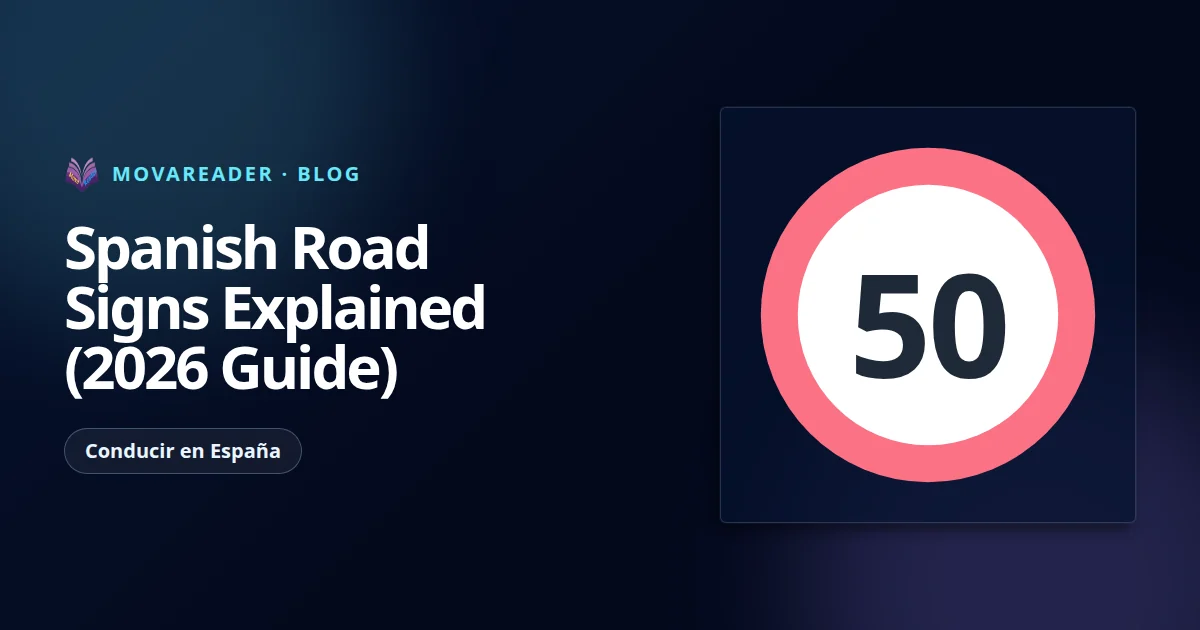
A blue square with "60" on a Spanish motorway is a suggestion. A blue circle with "60" is an order to drive at least that fast. A white circle with a red ring and "60" is the limit you must not exceed. Three signs, one number, three different rules, and the DGT theory test loves exactly this kind of trap.
In short. Spanish road signs fall into three groups: warning signs (codes starting with P, red-bordered triangles), regulatory signs (R: priority, prohibitions, obligations and end-of-restriction signs) and information signs (S, mostly blue squares and rectangles). Read the shape and colour first, then the symbol. As of October 2026 the official catalogue is the one in Royal Decree RD 465/2025, in force since 1 July 2025: it added new signs, keeps yellow backgrounds for roadworks and uses orange for other temporary situations.
How to read a Spanish sign: three groups, five families
The Reglamento General de Circulación (RGC, the General Traffic Regulations) splits señales verticales (signs on posts and gantries) into warning, regulatory (reglamentación) and information signs. In practice, five families with their own shapes and colours are all you need.
| Family | Code | Shape | Colours | Message |
|---|---|---|---|---|
| Peligro (danger) | P | Triangle, point up | White background, red border, black symbol | Hazard ahead |
| Prohibición (prohibition) | R | Circle | Red border, white or blue background | You must not |
| Obligación (obligation) | R | Circle | Blue background, white symbol | You must |
| Fin de prohibición (end of prohibition) | R | Circle | White with black or grey diagonal bars | A restriction ends |
| Indicación (information) | S | Square or rectangle | Usually blue | Information, sometimes new rules |
Priority signs have unique shapes so you can recognise them from behind or under snow: the inverted triangle and the red STOP octagon. If you learned to drive in North America, note that hazard warnings here are red-bordered triangles, not yellow diamonds. A panel complementario (plate under the sign) adds a distance, a length, the vehicles affected or a weather condition; read both together.
When two signals seem to contradict each other, RGC article 133 sets the order: police officers, temporary signals and cones, traffic lights, fixed signs and, last, road markings. Between two signals of the same kind, the more restrictive one wins: if 80 and 60 hang at the same spot, your limit is 60 km/h.
Warning signs (P): the triangle that forbids nothing
A warning sign tells you about a hazard that is hard to see in time (RGC article 144). It asks for attention and, if needed, less speed. Outside built-up areas they usually stand 150 to 250 metres before the hazard. A plate below gives either the distance to the hazard ("300 m") or the length of the hazardous stretch between arrows.
Worth knowing cold:
- Junctions. On the P-1 family the thick line is the priority road and the thin line is the road that gives way. A cross of two equal lines (P-2) means the default rule applies: give way to traffic from your right.
- Level crossings. A barrier on the sign means a crossing with barriers (P-7); a locomotive means none (P-8), so checking for trains is your job. Striped posts count down to the crossing: three red stripes at about 200 m, two at 150 m, one at 100 m.
- Pedestrians. P-20 warns of a paso para peatones (zebra crossing); P-20b "Peatones" warns of a stretch with many pedestrians even without a crossing.
- Road surface. A resalte (P-15a) is a hump such as a speed bump; a badén (P-15b) is a dip. On gradient signs (P-16a and P-16b) the figure is the slope in per cent.
- Roadworks. P-18 "Obras" is always yellow. Expect machinery, workers, narrower lanes and more yellow signs.
This part of the course is open to everyone: the free lesson on Spanish warning signs walks through every triangle with one-tap English translations of the Spanish names.
Regulatory signs (R): priority, prohibitions, obligations
Priority: ceda el paso and STOP
Ceda el paso (R-1, give way) is the only sign shaped as a triangle pointing down. It does not require a stop: slow down, look, and stop only if needed so that the driver with priority never has to brake or swerve because of you.
STOP (R-2, detención obligatoria) means a full stop every time, even at an empty junction, at the stop line or, without one, immediately before the junction. If you still cannot see, stop again where you can. Breaking priority rules, STOP and give way included, costs 4 points (LSV traffic act, annex II) and is a serious offence with a 200 EUR fine (LSV article 80).
A yellow diamond on white (R-3) marks a priority road; the same diamond crossed by bars (R-4) warns that priority ends ahead. On narrow bridges, follow the red arrow: a round sign with a red arrow pointing up (R-5) means you give way; a blue square with a white arrow up (R-6) means you go first.
Prohibitions: circles with a red ring
- R-100 and R-101. An empty white circle with a red ring bans all vehicles in both directions. A red disc with a white bar bans entry from that side, typically at the far end of a one-way street.
- Speed limit (R-301). Applies until an end-of-limit sign, the end-of-all-restrictions sign or another limit. If it shares a post with a warning sign, it ends where the hazard ends.
- No overtaking (R-305). Nobody may overtake motor vehicles if that means crossing into the opposite side. You may still pass a slow bicycle, moped or e-scooter when it is safe (RGC article 88 as amended by RD 518/2026), leaving at least 1.5 m and, outside built-up areas, at least 20 km/h below the road's limit. R-306 applies only to lorries over 3,500 kg.
- Turns. No left turn (R-303) also bans U-turns; "Cambio de sentido prohibido" (R-304) bans only U-turns.
- Stopping and parking. A blue disc with a red ring and a red X (R-307) bans stopping and parking; with a single red bar (R-308) only parking. Both apply on that side of the road up to the next junction unless a plate says otherwise. A parada (stop) lasts under two minutes without the driver leaving the car; anything else is estacionamiento (parking).
Obligations: blue circles
A blue circle with a white symbol says "you must". An arrow sets a compulsory direction; three arrows in a ring (R-402) set the direction of travel at a glorieta (roundabout). A number in a blue circle (R-411) is a minimum speed. The chains sign (R-412) means you may not continue without chains on at least one wheel on each side of a driving axle, or proper snow tyres. For the rules inside the ring itself, see our guide to roundabouts in Spain.
Information signs (S): blue squares that change the rules
Most S signs simply inform (parking, hospital, fuel, EV charging), but some switch on different rules from where they stand.
| Sign | Code | What changes |
|---|---|---|
| Autopista / Autovía | S-1 / S-1a | Motorway and dual-carriageway rules apply |
| Túnel | S-5 | Lights on even by day; no U-turns, no stopping, no parking |
| Town name (white sign) | S-500 | Built-up area rules apply; a regulatory sign next to it covers the whole town |
| Zona de estancia y juego | S-28 | 10 km/h, pedestrians have priority, play allowed, parking only where marked |
| Zona de coexistencia | S-47 | 20 km/h, street shared by cars, bikes and pedestrians, pedestrians have priority, no games |
| Velocidad máxima aconsejada | S-7 | Advisory speed, not a legal limit |
Until 2025, S-28 was the calle residencial (residential street) at 20 km/h; that speed now belongs to the new coexistence zone, S-47.
The Spanish signs drivers confuse most
| Pair | First sign | Second sign |
|---|---|---|
| Blue square with a number vs blue circle with a number | S-7: advisory speed | R-411: minimum speed, compulsory |
| Empty red-ringed circle vs red disc with white bar | R-100: no traffic either way | R-101: no entry from this side |
| One red bar vs red X on blue | R-308: no parking, stopping allowed | R-307: no stopping and no parking |
| No left turn vs no U-turn | R-303: bans the turn and U-turns | R-304: bans U-turns only |
| No overtaking vs no overtaking for lorries | R-305: everyone, when crossing into the opposite side | R-306: lorries over 3,500 kg only |
| End of all restrictions | R-500 ends limits for moving vehicles | It does not end parking or stopping bans |
| Toll tag in a circle vs in a square | R-418: lane only for vehicles with a working toll tag | S-32: you may also pay by tag here |
| Give way vs STOP | R-1: stop only if needed | R-2: always stop |
These pairs appear on the theory test again and again. How the test works and how many mistakes you are allowed is covered in the free lesson on the DGT theory test, and our DGT theory test guide covers booking, fees and preparation.
What is new in the 2025 sign catalogue
Royal Decree RD 465/2025 rewrote the signalling chapter of the RGC and approved an official catalogue of signs and markings, in force since 1 July 2025. The DGT's magazine counts 130 new or updated pictograms.
- Old signs fade out gradually. Signs already installed may stay until they are replaced in the normal renewal cycle. Signs removed from the catalogue had to come down within one year, so by 1 July 2026.
- The exam. The DGT said new content would not enter the theory test until at least three months after the decree took effect. As of October 2026, the test follows the 2025 catalogue.
- New signs you can already meet on the road:
| Code | Spanish name | Meaning |
|---|---|---|
| P-1e | Tramo con accesos directos | Stretch with many direct accesses (farms, petrol stations) where cars may pull out |
| P-20c | Pasos para peatones y ciclistas | Pedestrian crossing next to, or shared with, a cycle crossing |
| P-24a | Paso de animales en libertad (jabalíes) | Place where wild boar often cross |
| P-35 | Trenzado | Weaving section between an on-ramp and an off-ramp where paths cross |
| R-118 | Entrada prohibida a vehículos de movilidad personal | No entry for personal mobility vehicles such as e-scooters |
| R-120 | Entrada prohibida según distintivo ambiental | Access restricted by environmental badge; conditions on a plate |
| S-1c | Carretera 2+1 | Three-lane road whose centre lane is for overtaking, alternating by direction |
| S-47 | Zona de coexistencia | Shared zone, 20 km/h, pedestrians first |
| S-892 | Vigilancia por medios automáticos | Compliance with the sign is enforced by cameras |
| S-991g | Control de velocidad mediante medios aéreos | Possible speed checks from a helicopter or drone |
| S-992a-c, S-992e | Distancia mínima entre vehículos | How many painted chevrons or light beacons to keep to the vehicle ahead |
- What disappeared. The 2025 catalogue has no "Zona 30" sign and no odd-day or even-day parking signs. On streets with one lane in each direction the 30 km/h limit applies anyway, sign or no sign (RGC article 50). The fortnight parking signs remain: the first-half sign applies from 09:00 on day 1 to 09:00 on day 16, the second-half sign the other way round.
For other changes, including RD 518/2026 in force since 1 October 2026, see Spain's new traffic rules for October 2026.
Temporary signs: yellow for roadworks, orange for everything else
The 2025 catalogue separates the two temporary colours clearly:
- Yellow background means obras (roadworks) or road maintenance. Every warning sign turns yellow, as do R-1 and R-5, the entry prohibitions (except R-101), the size and weight restrictions, R-300 to R-306 and the end signs R-500 to R-504. Lane signs in works zones are yellow with black symbols, and fixed signs that do not apply during the works are covered with black adhesive.
- Orange background means temporary signals for any other reason, such as a crash or a sporting event. Same rules, different colour.
Temporary signals rank right after police officers, above traffic lights, fixed signs and markings: if a yellow sign says 60 and the white one says 90, you drive at 60. In works zones, never drive between cones, a fixed red light means the road is closed, and of the illuminated road studs only green ones may be crossed.
Road markings: the basics from day one
Marcas viales (road markings) are white by default. New markings in a works zone are yellow, while old white ones may stay if they still apply. Markings rank last: if a marking and a fixed sign disagree, the sign wins.
| Marking | Looks like | Meaning |
|---|---|---|
| Línea discontinua | Broken longitudinal line | May be crossed for a permitted manoeuvre |
| Línea continua | Solid line, single or double | Do not cross it or drive on it |
| Mixed line | Solid next to broken | Only the line on your side counts |
| Línea de detención | Solid line across the lane | Stop line for STOP, lights or an officer |
| Línea de ceda el paso | Broken line across the lane | Give way, stop only if needed |
| Yellow broken line at the kerb | M-7.7 | No parking |
| Yellow solid line at the kerb | M-7.8 | No stopping and no parking |
| Yellow zigzag | M-7.9 | No parking: bus stop or loading area |
| Yellow box grid | M-7.10 | Do not enter if you would get stuck, even on green |
| Cebreado (hatched area) | Diagonal stripes framed by a solid line | Do not drive into it |
The solid edge line may be crossed onto the arcén (hard shoulder) in an emergency. Blue parking lines usually mark a time-limited pay zone, with hours and prices set by each town hall (ORA, SER).
FAQ
What do the colours of Spanish road signs mean?
Red borders mean danger or prohibition, blue circles obligation and blue squares information. Yellow marks roadworks and orange other temporary situations; both override fixed signs, lights and markings, and only a police officer outranks them.
Do old Spanish signs still apply after the 2025 catalogue?
Installed signs of the old design may stay until they are replaced, and you must obey them. Signs removed from the catalogue had to be taken down by 1 July 2026. For the theory test, learn the 2025 catalogue.
Is a blue square speed sign in Spain a limit?
No. The blue square (S-7) is an advisory speed. A blue circle with a number is a compulsory minimum, and a white circle with a red ring is the maximum.
Can I take the Spanish theory test in English and still learn signs in Spanish?
Yes, the test is available in English, but signs, plates and police instructions on the road are in Spanish, so learn each sign with its Spanish name.
What is the fine for not stopping at a STOP sign in Spain?
Failing to respect priority, STOP and give way included, is a serious offence: 200 EUR and 4 points. Paying within 20 calendar days of notification halves the fine.
Quick checklist
- Triangle point up warns, triangle point down means give way, octagon means always stop.
- Red-ringed circle prohibits, blue circle obliges, blue square informs.
- Read the plate under a sign together with the sign.
- Yellow and orange outrank white; a police officer outranks everything.
- Between two signs of the same type, the stricter one applies.
- Since 1 July 2025 the RD 465/2025 catalogue applies: S-47 at 20 km/h, S-28 at 10 km/h, new signs for e-scooters, badges and cameras.
The course "Conducir en España: el permiso B" covers almost 200 signs from the 2025 catalogue, the full B-licence theory in B1-level Spanish with a one-tap English translation of every word and sentence, and an exam simulator. Start with the two free lessons: Spanish warning signs and how the DGT theory test works.
MovaReader course
Conducir en España: Spanish road rules and DGT theory in Spanish
74 lessons · 1417 questions · exam simulator
Every word and sentence of the course translates into English with one tap. Two lessons are free.