Curated Resources
Spanish Books for B1: First Real Novels After Graded Readers
Graded feels easy. A "real" novel feels impossible. This is the B1 graduation guide: how to know you are ready, which short bridge novels to try first, which famous titles wait, and one page rule that keeps you reading.
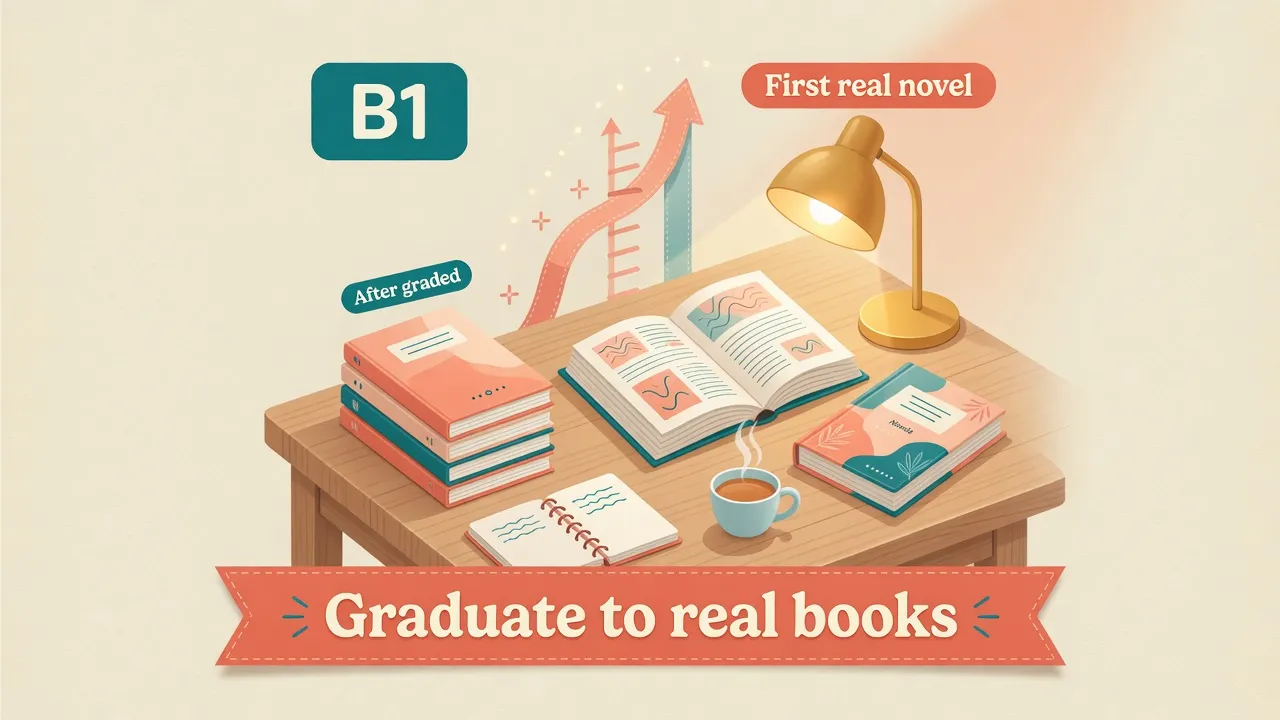
You finish another graded reader in a weekend. The level tag says A2-B1. You feel ready.
Then you open a "real" Spanish novel from a famous list. By page ten the dictionary is open on every sentence. By chapter three you quit. The gap is not your talent. It is the jump: pure graded practice into dense, native-aimed prose with no ladder between them.
This guide is that ladder. Solid B1 is the graduation moment: leave pure graded readers for a short, authentic-ish novel you can actually finish - not because someone online said "just read Cien años."
Here is the simple version. You want a first real Spanish book that still feels fair: known story, Spanish YA, or a short native novella. Below you get a ready check, about eight bridge titles with soft difficulty hedges (not certificates), a "not yet" prestige shelf, and one rule that saves more books than any list: stay when you understand roughly 80-90% of a random middle page.
If speed is still shaky, warm up on free graded samples. Longer commercial novels are files you buy, borrow, or already own. MovaReader does not host full El Principito or Zafón by default - the tools sit on your legal file.
If you want a finishable A2-B1 "easiest" mix rather than this graduation step, use our easiest Spanish books for A2-B1. That list owns pure finish inventory. This post owns the step after pure graded at solid B1.
Am I ready to leave graded readers?
Most of the ready signals below should fit. An exam label alone does not mean reading stamina. "B1 on paper" is useful; finishing chapter after chapter is the real test.
You are probably ready if most of these fit:
- You finish short graded A2-B1 texts without stopping every line
- A random graded page sits near 80-90% comprehension
- You can summarize a short chapter in simple Spanish or your first language without panic
- You want story, not only level-tagged practice
Stay graded a bit longer if:
- Every page is a dictionary session
- You quit mid-chapter often
- Even free A2 samples still feel heavy
If that last group is you, do not force prestige. Stay with finishable material: the easiest Spanish books for A2-B1, a deeper look at free graded Spanish readers online, or a true start with easy Spanish books for A1 beginners. For a quick speed check, try the free Spanish A2 sample Aprendiendo a reciclar en casa, or the lighter A1 sample Mi día en el parque.
What if I am "B1 on paper" but novels still crush me?
Exam scores measure a slice of skill. They do not always measure how long you can sit with continuous prose. Drop one rung. Mix graded warm-ups with one short bridge book. Protect the 80-90% page rule before you chase famous titles.
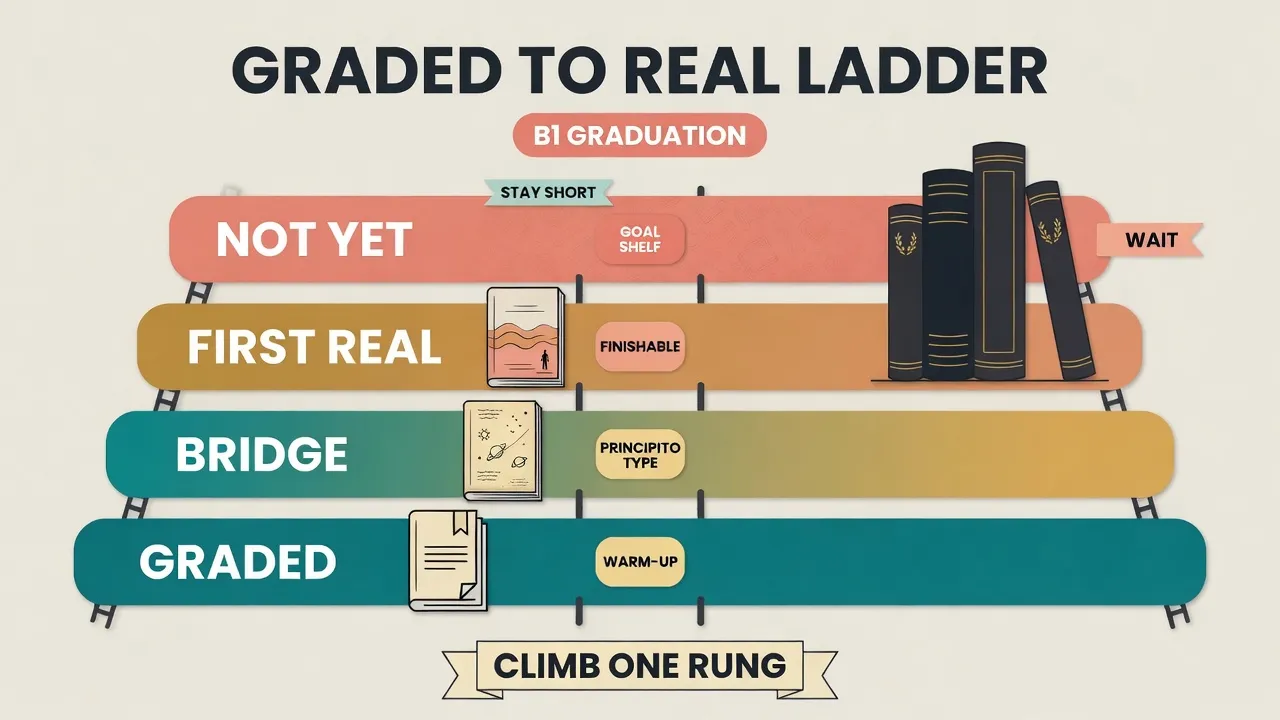
Think of the move as a ladder, not a cliff: graded warm-ups, short bridge books, a first adult-ish short novel, then a goal shelf for later.
What counts as a "first real novel" at B1?
For this article, "real" means something written for native or general readers (or long-established popular fiction), not only ELE level tags as the whole product. Prefer short when you can: novella length, short chapters, under about 200 pages. The goal is finish habit plus authentic-ish style - not a resume pad of famous titles.
Three good ways in:
- Known story in Spanish (El Principito, a familiar quest or YA you already know)
- Spanish YA / light contemporary (colloquial speech, concrete daily life)
- Short native novella or reportage-length prose (Relato de un náufrago, Aura)
What we are not doing here: turning this into an adapted-classics catalog, selling the Latin American boom as a "B1 starter pack," or treating soft CEFR bands as official scores. Adapted classics can help as a middle step, but they are not the same as popular modern prose - for that A2 theory, see adapted vs original books for A2.
Why short chapters beat famous titles
Finish habit beats prestige. A book you close in three weeks rewires your confidence more than a famous novel you abandon on page forty. Short chapters also give you natural stop points, so a busy day still counts as a real session.
Which books should I try first after graded readers?
This is a bridge ladder, not a ranking of Spanish literature. Soft bands are hedges for many solid B1 readers - not certificates, not gospel. Order is typical ease for a lot of people, not dogma.
If you only want the pure "easiest finish" inventory without this graduation focus, cross over to the top-10 easiest Spanish books for A2-B1. Below stays on the first real step after graded.
| # | Title | Soft band | Why it bridges | Watch-out |
|---|---|---|---|---|
| 1 | Last graded warm-ups (Lola Lago, Juan Fernández, Paco Ardit, Olly intermediate shorts you own) | high A2-B1 | Confidence and speed before "naked" prose | Not free full series in the app by default; buy or borrow |
| 2 | El Principito (Saint-Exupéry, Spanish) | A2-B1 bridge | Short chapters; known plot; easy stop and resume | Abstract lines can slow solid B1 |
| 3 | La casa en Mango Street (Sandra Cisneros, Spanish) | solid B1 | Very short vignettes; concrete neighborhood life | Poetic bits can stall speed |
| 4 | Manolito Gafotas (Elvira Lindo) | high A2 / solid B1 | Humor; spoken Madrid Spanish; real conversation rhythm | Colloquial slang; Spain-centric jokes |
| 5 | Cajas de cartón (Francisco Jiménez) | A2-B1 | Short autobiographical scenes; everyday family, work, school vocab | Emotional weight is not "kids only light" |
| 6 | El príncipe de la niebla or Marina (Carlos Ruiz Zafón) | solid B1 | YA plot pull; mystery momentum | Denser description than diary books - pick one first |
| 7 | Relato de un náufrago (García Márquez) | solid B1 | Short; journalistic voice; serious but finishable length | Sea and survival vocab; heavier tone |
| 8 | El alquimista or Aura (Coelho / Fuentes) | B1 / B1+ | Clear quest vs short uncanny novella - path choice | Philosophy thin for some; Aura denser per page |
Optional habit glue if you still need diary chunks: Diario de Greg in Spanish (A2-B1 feel). Light comedy later if available: Sin noticias de Gurb (light B1+).
El Principito - first known-story step
Known plot plus short chapters lowers panic. Many learners treat it as the classic first "real" Spanish book after graded readers. Watch the abstract lines ("what is essential is invisible...") - they can freeze you even when the story is clear. Fine bridge book; not your only source of modern spoken Spanish.
First session: one short chapter. Stay if you follow the visit and the dialogue gist.
La casa en Mango Street - micro chapters
Vignettes give a high finish signal. Scenes of neighborhood life stay concrete. Poetic compression and some US-Latina cultural references can slow you. That is fine if the overall picture still holds.
First session: three to five vignettes. Stop if every line needs a dictionary.
Manolito Gafotas - spoken Spanish with humor
Chapter rhythm feels like real conversation. You get colloquial Madrid Spanish and jokes that often land from context. It is not textbook-neutral Spanish - that is part of the bridge value.
First session: one chapter. Continue if dialogue rhythm works even when a slang word is fuzzy.
Cajas de cartón - everyday scenes
Scene-sized sections, family and school vocabulary, strong finish habit. Emotional intensity is not the same as hard language, but it can still tire you. Track the family situation and the next move.
First session: three to five pages.
Zafón YA - El príncipe de la niebla or Marina
Plot pull is the point. You want to finish chapters. Description density is higher than diary books, so pick one first, not both at once. If chapter 1 needs a lookup every sentence, drop a rung.
First session: full chapter 1. Stay only if atmosphere and plot hold without a dictionary wall.
Relato de un náufrago - short native prose
Journalistic clarity, serious tone, finishable length. Domain vocabulary (sea, survival) shows up. Opening pages must keep timeline and situation clear.
First session: first few pages under the 80-90% test.
El alquimista or Aura - path choice
El alquimista offers quest clarity and some repetition. Aura is a short uncanny novella with denser native style per page. Choose by path: known/quest vs short literary. Run the page test before you commit.
Quick scan by length feel and path:
| Title | Length feel | Best path | Watch-out |
|---|---|---|---|
| Last graded warm-ups | Short, controlled | Any (pre-step) | Not free full series in app |
| El Principito | Very short chapters | Known story | Abstract lines |
| La casa en Mango Street | Micro vignettes | Known / YA-ish | Poetic bits |
| Manolito Gafotas | Short chapters | YA / colloquial | Slang |
| Cajas de cartón | Short scenes | YA / memoir | Emotional intensity |
| Zafón YA (one title) | Full YA novel | YA plot | Description density |
| Relato de un náufrago | Short book | Short native novella | Domain vocab |
| El alquimista / Aura | Medium / very short | Known quest / literary short | Tone density |
Which popular titles should wait?
These are excellent books. For most solid B1 readers they are the wrong first project after graded. Treat the list as a goal shelf, not a shame list. Prestige is not readiness - and Cien años de soledad is not a B1 graduation title.
| Title | Realistic band | Why people push it | Why wait | Better bridge first |
|---|---|---|---|---|
| Como agua para chocolate | high B1+ | Food and romance lists | Recipe and sensory vocab pile | Cajas, Manolito, Mango Street |
| La sombra del viento | B2-C1 | Mystery addiction lists | Length plus dense description; high lookup load | One Zafón YA first |
| La casa de los espíritus | B2+ | "Intermediate" prestige | Timeline, politics, voice shifts | Relato de un náufrago or Aura |
| Cien años de soledad | C1 comfort for most | Famous = "should" | Multi-generation density; ban as B1 starter | Any bridge title above |
| Borges shorts as main diet | B2+ | "Short = easy" myth | Density per page | Mango Street or Aura |
| Full unadapted Don Quijote | far above | Culture guilt | Length plus classic load | Adapted only as a middle step, not this graduation |
When to try the goal shelf: after at least one easier finish, and only when a random middle page of the new book sits near 80%+ gist. Como agua para chocolate is a common "next" after a short win. La sombra del viento is usually more enjoyable with B2+ stamina. Cien años stays a goal book, not a graduation test.
How do I read without living in the dictionary?
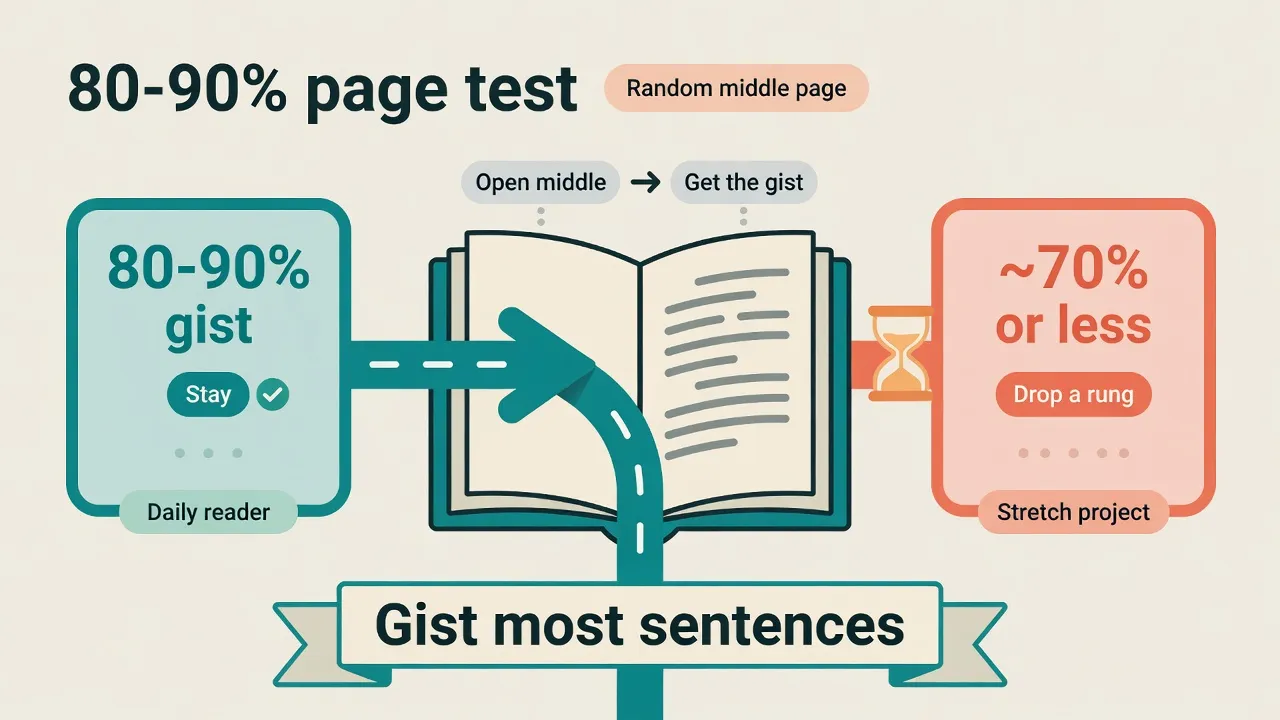
Use the 80-90% page test
Open a random middle page of the book you want to start. If you get the gist of most sentences, stay. Around 70% or below is a stretch project, not your daily reader. Drop a rung: easier bridge, or graded warm-up, until the page feels fair again.
Look up less, finish more
A simple session loop:
- Read a paragraph once without stopping
- Mark only sentence-blocking words
- Check those
- Reread the paragraph
- Save 3-10 useful phrases (not forty isolated words)
You are training the habit of continuous meaning, not building a private dictionary of every unknown item.
Prefer short daily sessions
Fifteen to twenty minutes a day beats a weekend guilt marathon. Stopping mid-chapter is fine. Returning tomorrow is the skill.
Keep a thin graded thread
Even after "graduation," one or two graded or free library days per week protect speed. Try the free graded library, the A2 sample, or the A1 sample when a novel week feels slow.
Use audio only when the page is mostly clear
Audio on an opaque page often adds noise. When the page is already clear, audio can help rhythm and sound.
Free graded warm-up vs own novel: what goes where?
Keep the two paths separate.
| Path | What you get | Watch-out |
|---|---|---|
| Free graded / library articles in MovaReader | Speed and confidence on A1-B1 samples | Not full commercial novels |
| Buy or borrow ELE graded you still like | Controlled bridge if a novel is still heavy | Paid or library; not free in the app by default |
| Buy or borrow bridge titles above | Motivation plus authentic style | Your legal copy |
| Upload your own EPUB to MovaReader | Reader tools on your file | Freemium limits apply |
Free graded library equals samples and learner articles for speed. Controlled ELE series and commercial bridge novels equal buy, borrow, or upload your legal file. There is no pirate path, and no full Principito or Zafón hosted in the app by default.
How does MovaReader fit?
Warm up on free graded Spanish texts, including a short A2 sample. When you pick a bridge novel, open a file you own or borrow legally (how to use), tap only blockers, and keep sessions to 15-20 minutes. Free use includes listening and about 20 word translations a day. Unlimited reading translations are Reader (€1/month); full trainers are Pro (€5/month) - see pricing. The language map is a compass for vocab gaps; the B1 vocabulary map helps when the same gaps keep blocking. We do not host full commercial El Principito or Zafón by default. Tools reduce friction; they do not turn a hard book into beginner material.
If you like a numbered loop:
- Free graded warm-up in All Articles
- Upload a legal EPUB you have → How to use
- Tap blockers only
- Train a small phrase set → free Spanish vocabulary trainer and everyday Spanish phrases practice
- Freemium ~20 translations/day · Reader €1 · Pro €5 → Pricing
- Optional: create an account when you want a full login, then keep climbing Path A or B
Which path should I pick if I feel lost?
Pick one path and stick with it for a few weeks. If Path B books two and three still crush you, switch to Path A without guilt. The best first real Spanish book is the one you finish this month, not the one that impresses a list.
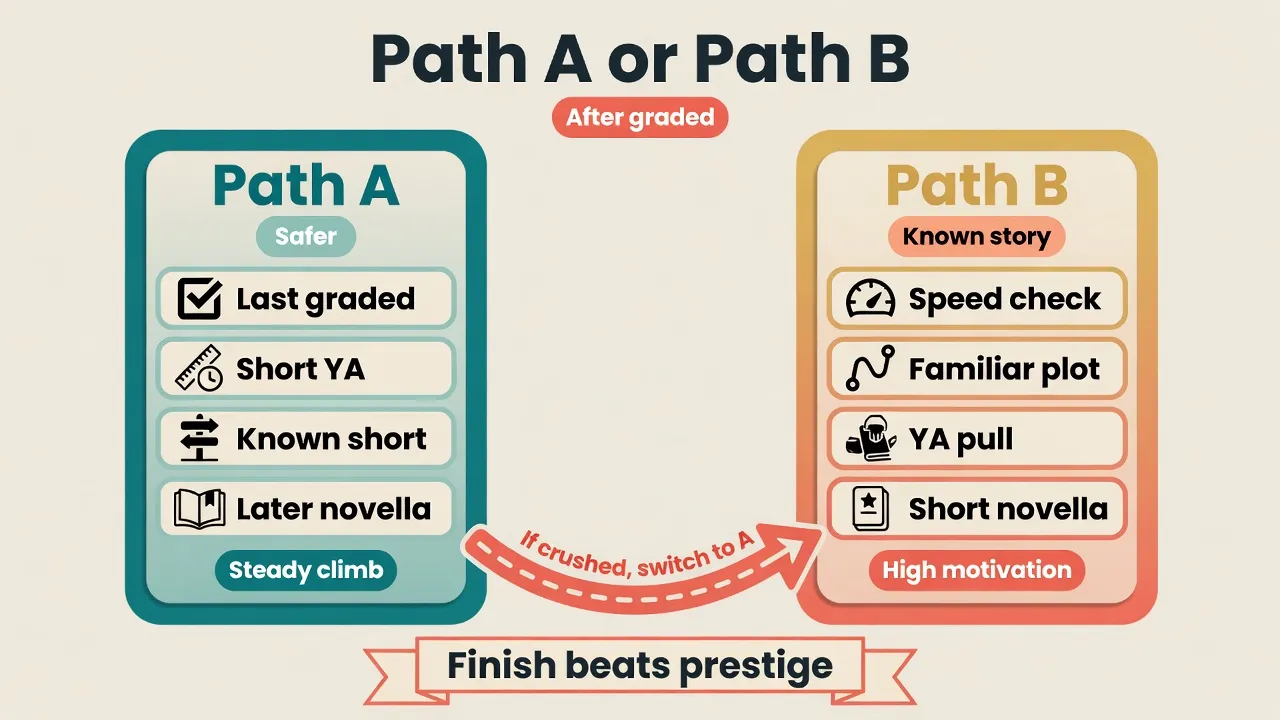
Path A (safer - story less known)
- Free A2-B1 articles or one last graded title you own
- Cajas de cartón or Manolito Gafotas
- El Principito or La casa en Mango Street
- El príncipe de la niebla or Marina (one only)
- Relato de un náufrago
- Later: Como agua para chocolate only if pages test near 80%+
Path B (known story / high motivation)
- Quick free A2 sample to check speed (Aprendiendo a reciclar en casa)
- El Principito
- El alquimista or Diario de Greg (habit glue)
- Marina or El príncipe de la niebla
- Short novella (Aura or Relato de un náufrago)
- Prestige shelf only as goal books
One-line rule: finish beats prestige. If you get crushed, step down the ladder - do not quit reading.
FAQ
Am I ready to stop graded readers completely?
Rarely "completely" overnight. If solid B1 pages test near 80-90%, make a short real novel your main book and keep graded as a thin weekly warm-up until speed feels stable. If every page is a dictionary session, stay graded a bit longer and use free A2 samples first - start with Aprendiendo a reciclar en casa or the free graded library.
What is a good first real Spanish novel at B1?
Often El Principito, Cajas de cartón, Manolito Gafotas, or La casa en Mango Street - short, concrete, or familiar. Pick by path (known story vs YA vs short native novella), not by prestige. Avoid starting with La sombra del viento or Cien años de soledad as a graduation test. For pure easiest-finish inventory, see the A2-B1 easiest list.
Is El Principito too easy or too literary for B1?
Both, in spots. Chapters are short and the story is familiar, but a few abstract lines slow people down. Fine bridge book; not your only source of modern spoken Spanish. Pair later with something colloquial like Manolito Gafotas if speech patterns are the goal.
Can a B1 learner read La sombra del viento or Cien años de soledad?
Some motivated readers start La sombra del viento with heavy support; most enjoy it more at B2+. Cien años de soledad is a goal book for most, not a B1 graduation title. Choose a shorter win first (Marina or El príncipe de la niebla, Relato de un náufrago, Cajas de cartón) if the goal is finishing.
Should I use adapted classics as my first "real" book?
They can help as a middle step, but they are not the same as popular modern prose. If your goal is first authentic-ish reading after graded, prefer short YA, known story, or short native novella over a full adapted Quixote catalog. For the A2 theory of graded vs original mix, see adapted vs original books for A2.
How many unknown words per page is OK?
Use the 80-90% gist rule more than a strict word count. If you need a lookup every sentence, drop a rung (easier bridge or graded warm-up). Save a handful of useful phrases per session, not every unknown item. Free graded Spanish readers online can refill speed when a novel week goes hard.
What to do next
The best first real Spanish book is the one you finish this month - not the one that looks impressive on a shelf.
Graduate with a short bridge novel. Protect the 80-90% page rule. Keep a thin graded thread if speed dips. Today is simple: if speed is shaky, open the free Spanish A2 sample Aprendiendo a reciclar en casa (or browse more free graded texts); then pick one bridge title from Path A or Path B; save a few phrases, not a dictionary.
You already finished graded books. That skill transfers. Climb one rung, not the whole prestige shelf at once.
Keep reading with translations inside the text
With a free account, an unknown word translates with one tap, and the words you are learning wait for you in the trainer.
Free account: 7 days of Pro, then 20 word translations a day or a paid plan.