Curated Resources
YA Spanish Books for B1-B2 Language Learners
Classics look impressive. Teen novels get finished. This is the daily B1-B2 YA shelf: why it works, original Spanish vs translations you already know, realistic difficulty, and a start-here order.
You want a Spanish book you can open every day. Not a trophy. A habit.
Prestige lists hand you Allende or García Márquez and call it intermediate. You last until chapter 3. The dictionary eats every sentence. You quit and feel behind.
You are not behind. You picked the wrong shelf.
At B1-B2 you do not need another prestige classic. You need a daily Spanish book you will actually open. Young adult novels (teen fiction / libros juveniles) are that shelf: modern talk, short chapters, story pull.
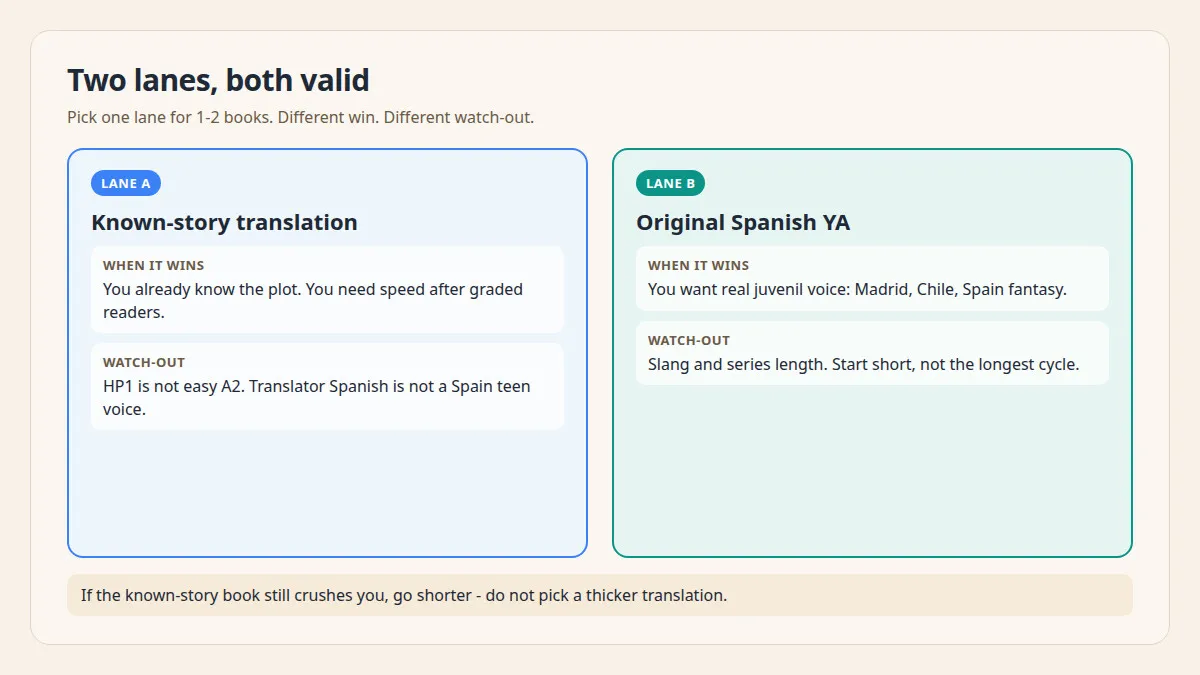
Use two lanes. A translation of a story you already know, when you need speed. Or original Spanish YA, when you want a real teen voice. Then pick from a start-here order with realistic difficulty notes.
Here is the simple version. This is the daily B1-B2 YA shelf. The easiest A2-B1 list is a finishable mix. First real novels after graded readers is the graduation moment. Once you want a book you open tomorrow, YA is the habit, not a side note.
If a page still feels opaque, warm up on a free graded sample. Commercial YA is a file you own or borrow.
This guide covers why teen novels beat classics, original vs translated lanes, realistic B1-readable cards, a wait-until-B2 goal shelf, a start-here order, slang without dictionary jail, free samples vs your own EPUB, then a short FAQ.
Why do teen novels beat classics as a B1-B2 daily habit?
Classics look smart on a list. Teen novels get opened tomorrow. That is the whole point of this shelf.
Young adult Spanish (literatura juvenil) is not "easy Spanish." Slang, speed, and emotion still bite. The win is finishability, not a lower official level. You hear how people talk. Chapters end in a place that wants you back. You can often finish one sitting in 15-20 minutes.
Prestige "intermediate" lists love boom novels, adult Allende, Como agua para chocolate, and La sombra del viento. Fine goal books. Wrong daily diet at B1. Adult thrillers like Patria or Gómez-Jurado belong on the modern Spanish bestsellers at B2 shelf, not here.
| Daily-habit trait | Teen novels / libros juveniles | Prestige "intermediate" classics |
|---|---|---|
| Dialogue | Modern talk you can hear | Literary or period voice |
| Come-back pull | Short chapters; plot wants tomorrow | Long ornate stretches |
| Syntax | Less boom / seminar prose | Dense clauses, time shifts |
| Session length | One chapter in 15-20 min is realistic | A sitting can stall by page 8 |
| Themes | Identity, mystery, found family | Politics, generations, prestige weight |
Finishable is not the same as officially easier. If a teen page still feels like a wall, the book is a weekend project, not your daily shelf.
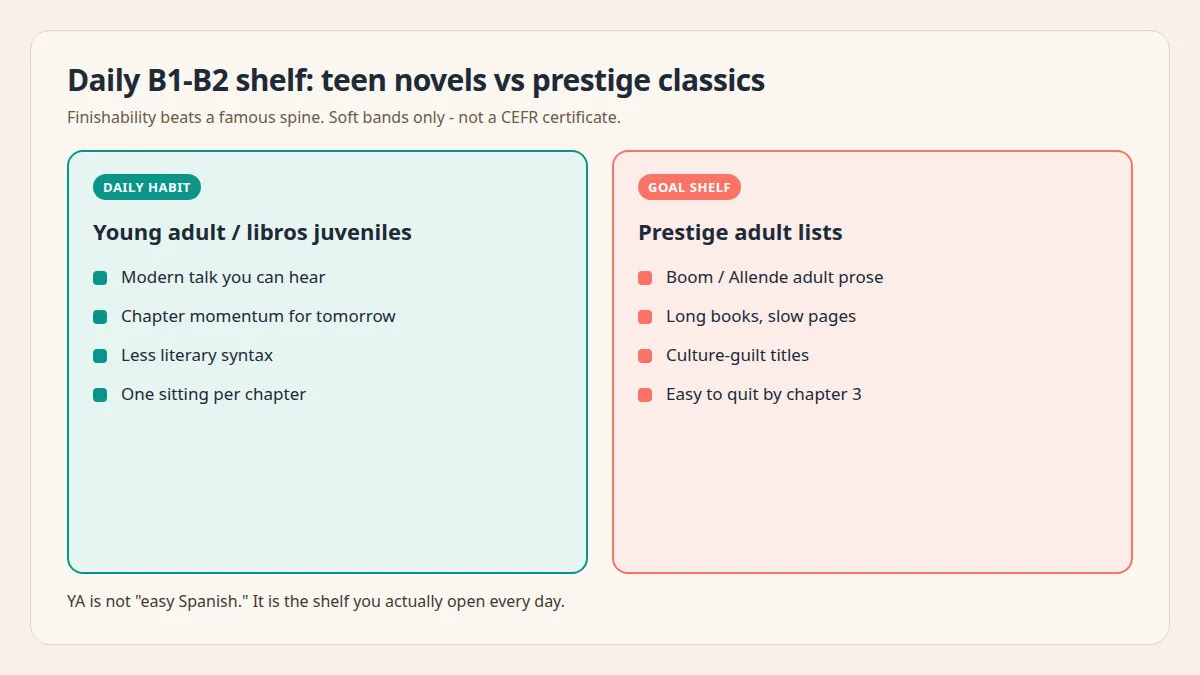
That split is easier to see than to feel. Here is the habit side by side with the prestige diet.
Is this only for teenage readers?
No. Adult learners use YA to practice spoken, plot-forward Spanish. Classroom and heritage catalogs serve bilingual kids and teachers. Different job. This post is for language learners who need a book they will actually finish.
Original Spanish YA or a translation I already know?
Both lanes are valid. They buy different things. Do not eat only translations, and do not start with the longest original cycle.
| Lane | What you get | When it wins | Watch-out |
|---|---|---|---|
| Known-story translation (HP, Los juegos del hambre, Divergent, Esperanza renace) | Speed + plot memory; fewer "what is happening" lookups | You already love the story; you need momentum | Translator Spanish is not Spain or LatAm teen voice; Harry Potter 1 is not easy A2 |
| Original Spanish YA / juvenil (Gallego, Zafón YA, Lindo, Moreno, Blue Jeans, Allende YA) | Real teen register, local slang, native pacing | You want Spanish written for Spanish-speaking teens | Slang load; some titles wait for strong B1+ / B2 |
Two classroom titles sit next to these lanes and often feel "easy": Cajas de cartón and La casa en Mango Street. They were written first in English. They are famous in Spanish class. Useful short vignettes. They are not original Spain YA.
When the translation lane wins
You know the plot. A hard page is survivable because the movie or the English book is already in your head. Use that as a bridge week, not the whole diet. If you pick Harry Potter 1 in Spanish, treat it as one start - book-by-book hedges live on Harry Potter in Spanish by book. It is not easy A2.
When the original lane wins
You want Madrid, Chile, or Spain-fantasy voice, not a UK boarding school in Spanish clothes. Start short: Manolito Gafotas or El príncipe de la niebla. Leave the longest Gallego cycle for later.
One-line rule: if the known-story book still crushes you, pick a shorter original or a last graded warm-up, not a thicker translation.
Two lanes, two different wins. Pick one for the next book, not both in the same week.
Which YA titles are actually readable at B1?
Difficulty cards, not a ranking of Spanish literature. Soft bands are hedges for many B1-B2 readers - not certificates. A first-session test is three to five pages, or one chapter. Gist holds: stay. Lookup every sentence: not today's daily shelf.
If you still want a pure "easiest finish" mix, use the A2-B1 easiest list. If you are still leaving graded readers, the first real novels after graded post covers that moment.
Short vignette YA (often the first real win)
| Title | Author / note | Soft band | Why on this shelf |
|---|---|---|---|
| Cajas de cartón | Francisco Jiménez (English-first; famous in Spanish class) | often A2-B1 / solid B1 with help | Short scenes; everyday migrant-life vocab; finishable |
| La casa en Mango Street | Sandra Cisneros (Spanish) | often solid B1 with help | Tiny vignettes; neighborhood life |
Cajas de cartón - short scenes you can finish
Francisco Jiménez. English-first (The Circuit), famous in Spanish class, not written in Spain. Soft band: often A2-B1 / solid B1 with help.
Scene-sized sections, family and school vocabulary, a high finish signal. Watch-out: emotional weight is not "kids only light," and the Spanish is classroom-famous, not Madrid or Chile teen slang.
First session: three to five pages. Track the family situation and the next move.
La casa en Mango Street - micro chapters
Sandra Cisneros, in Spanish. English-first, famous in Spanish class, not written in Spain. Soft band: often solid B1 with help.
Tiny vignettes of neighborhood life. You get a finish every few pages. Watch-out: poetic lines can stall a solid B1 page.
First session: three to five vignettes. Stop if every line needs a dictionary.
Short original YA / younger juvenil (spoken Spanish)
| Title | Author / note | Soft band | Why on this shelf |
|---|---|---|---|
| Manolito Gafotas | Elvira Lindo | often high A2 / solid B1 with help | Colloquial Madrid; humor; spoken patterns |
| Papelucho | Marcela Paz | often A2-B1 with help | Diary, Chile; younger voice |
| Los Futbolísimos / Barco de Vapor Roja | Roberto Santiago et al. | often high A2 / low B1 with help | Series glue; younger than "teen"; finish habit |
Manolito Gafotas - spoken Madrid with humor
Elvira Lindo. Original. Soft band: often high A2 / solid B1 with help.
Chapter rhythm feels like conversation. Jokes often land from context. Watch-out: not textbook-neutral, Spain-centric, younger than some "YA" lists. That spoken load is the point.
First session: one chapter. If dialogue rhythm works, stay.
Papelucho - Chile, diary, easy stop and resume
Marcela Paz. Original. Soft band: often A2-B1 with help.
Diary chunks you can stop after one day. Watch-out: child voice, not teen; Chilean marks. Useful for finish habit, not as your only adolescent slang.
First session: one diary entry. The gist of the day must hold.
Los Futbolísimos is younger than teen, but great series glue if you need a finish habit.
Short original YA with plot pull
| Title | Author / note | Soft band | Why on this shelf |
|---|---|---|---|
| El príncipe de la niebla | Carlos Ruiz Zafón (YA start) | often solid B1 with help | Atmosphere + mystery; denser than diary books |
| Marina | Zafón | often solid B1 / B1+ with help | Strong story pull; still gothic, not "easy" |
El príncipe de la niebla - mystery you want to continue
Carlos Ruiz Zafón's YA start, not the adult Cemetery cycle. Soft band: often solid B1 with help.
Atmosphere plus mystery. For many readers this is the first original Spanish YA that feels like a novel. Watch-out: denser than diary books. Full Zafón order lives on which Zafón book to read first.
First session: full chapter 1. Stay if atmosphere and plot hold without a dictionary wall.
Marina - gothic pull, still YA
Zafón again, still his teen lane. Soft band: often solid B1 / B1+ with help.
Strong story pull; many learners like it after Príncipe. Watch-out: gothic, not "easy." Do not jump from here into the adult Cemetery books.
First session: chapter 1. If description piles every sentence, wait or pick Príncipe first.
Known-story translations (useful, not the whole post)
| Title | Note | Soft band | Watch-out |
|---|---|---|---|
| Harry Potter 1 (Spanish) | Book-by-book notes in our HP guide | B1 with help, not A2 | Known plot buys speed; names + magic vocab still pile up |
| Los juegos del hambre / Divergent | Translations | often B1+ / B2 with help | Fast plot; US YA voice in Spanish; long |
| Esperanza renace | Pam Muñoz Ryan | often B1 with help | Classroom staple; bilingual and heritage lists love it |
Harry Potter 1 in Spanish - one bridge week
Translation, known story. Soft band: B1 with help. Not easy A2.
Plot memory buys speed. Watch-out: names and magic vocabulary pile up; translator Spanish is not Spain teen voice. Hedges by book live on the Harry Potter Spanish CEFR guide.
First session: first chapter. Stay only if gist holds without line-by-line lookup.
Los juegos del hambre and Divergent are useful if you already love the story, long, often B1+ / B2 with help. One known-story title is enough for a bridge week.
Esperanza renace - classroom journey you may already know
Pam Muñoz Ryan. English-first classroom staple. Soft band: often B1 with help.
Concrete journey; familiar if you met it at school. Watch-out: heritage lists love it. It is not original Spain YA.
First session: first chapter. Track the move and who is speaking.
Longer original fantasy / contemporary juvenil (B1+ stretch)
| Title | Author | Soft band | Why wait a little |
|---|---|---|---|
| El valle de los lobos / Memorias de Idhún | Laura Gallego | often B1+ / B2 with help | Original Spain fantasy; series commitment |
| La ciudad de las bestias | Isabel Allende (her YA, not Casa de los espíritus) | often B1+ with help | Adventure; still Allende sentences |
| Invisible | Eloy Moreno | often B1+ / B2 with help | Contemporary Spain; school + social themes; slang |
| La chica invisible | Blue Jeans | often B1+ / B2 with help | Mystery pull; contemporary juvenil; slang-heavy |
El valle de los lobos - Spain fantasy after one short win
Laura Gallego, book 1. Original. Soft band: often B1+ / B2 with help.
Written for Spanish-speaking teens. Watch-out: invented names, series length. Idhún is a longer commitment. Not day one. La ciudad de las bestias is Allende's YA adventure, not La casa de los espíritus - still Allende sentences, often B1+ with help.
First session: chapter 1 of book 1 only. Drop if names swamp the plot.
Invisible and La chica invisible - living teen Spanish, later shelf
Eloy Moreno and Blue Jeans. Original contemporary Spain juvenil. Soft band: often B1+ / B2 with help.
School and social themes, or mystery pull. You hear how Spanish teens get written now. Watch-out: slang-heavy. Later shelf, not day one.
First session: chapter 1. If slang blocks every line, wait.
Which popular titles should wait until strong B2?
Excellent books. Wrong daily B1 YA project. A goal shelf, not a shame list. If a title is famous and adult, it does not become YA because a B1 list said "intermediate."
| Title | Realistic band | Why lists push it | Why it is not this shelf |
|---|---|---|---|
| La sombra del viento | often B2-C1 | Mystery addiction | Length + dense Cemetery prose; see our Zafón guide |
| La casa de los espíritus | often B2+ | "Intermediate Allende" | Adult, not YA; politics + voice shifts |
| Cien años de soledad | C1 comfort for most | Famous = "should" | Not a B1 book; not YA |
| Como agua para chocolate | often high B1+ / B2 | Food + romance lists | Recipe and sensory pile; adult |
| Nada (Laforet), Don Quijote | far above | Culture guilt | Not juvenil; not daily B1 |
| Patria, Gómez-Jurado / Redondo thrillers | B2 adult | Modern Spain lists | Adult bestsellers, not YA |
El Principito is a children's classic, not YA. Useful as a known-story bridge on the first real novels post. Adult thrillers stay on modern Spanish bestsellers at B2.
What is a sensible start-here order?
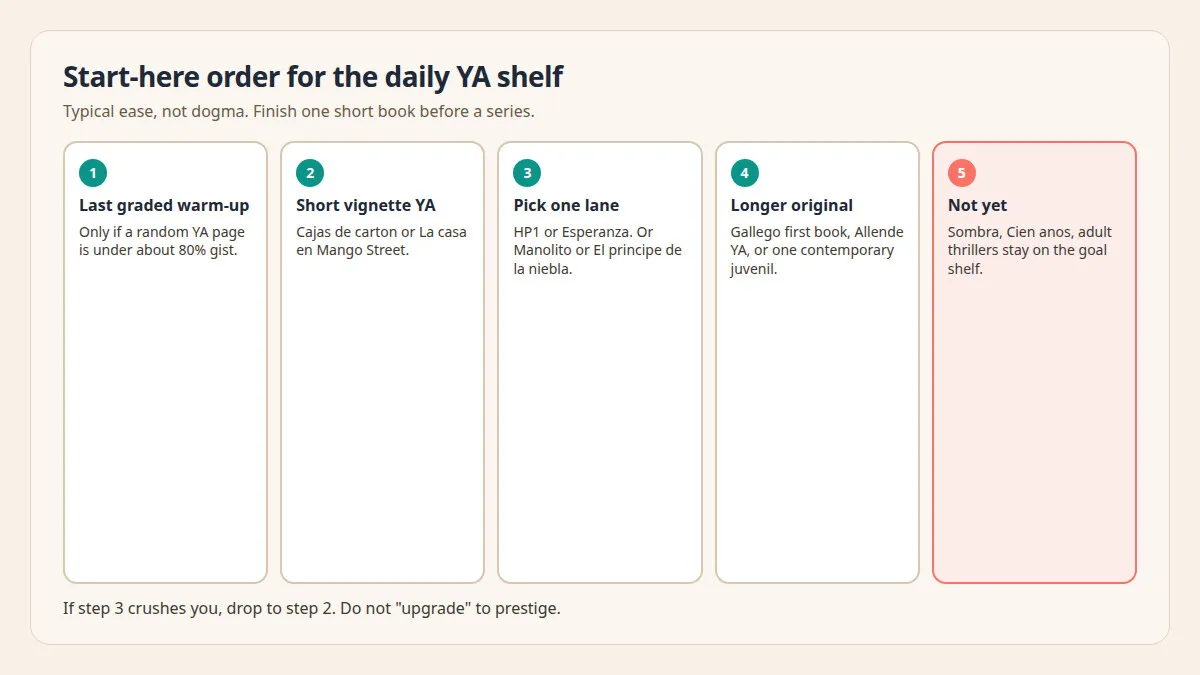
This is a YA shelf order. A last graded warm-up is only a ramp if a random YA page is still under about 80% gist. Then stay on YA.
- Last graded warm-up you still own (Olly, Paco Ardit, Juan Fernández, Lola Lago) if a random YA page is under ~80% gist. Speed-check with the free Spanish A2 sample Aprendiendo a reciclar en casa or the lighter A1 sample Mi día en el parque. Browse more in the free graded library.
- Short vignette YA - Cajas de cartón or La casa en Mango Street (English-first classroom titles; fine first win).
- Pick one lane for 1-2 books: translation = Harry Potter 1 or Esperanza renace (not both in week one); original short = Manolito Gafotas or El príncipe de la niebla (one only).
- Longer original - Gallego first book or Allende YA or one contemporary (Invisible / Blue Jeans) after the page test still holds.
- Not-yet prestige stays on the goal shelf.
One-line rule: finish one short YA before you start a series. If step 3 crushes you, drop to step 2. Do not "upgrade" to La sombra del viento.
| Step | Title pair | Lane | Soft band (hedge) |
|---|---|---|---|
| 1 | Last graded you own + free samples | warm-up (not YA) | A2-B1 speed check |
| 2 | Cajas or Mango Street | translation (English-first classroom) | often A2-B1 / solid B1 with help |
| 3a | HP1 or Esperanza renace | translation (known-story / classroom) | B1 with help; HP1 not A2 |
| 3b | Manolito or El príncipe de la niebla | original | often high A2-B1 / solid B1 with help |
| 4 | Gallego book 1 or Allende YA or Invisible / Blue Jeans | original | often B1+ / B2 with help |
| 5 | Sombra, adult Allende, GGM, Patria | park | B2+ goal shelf |
Here is that order as a picture you can follow without rereading the list.
How do I read YA slang without living in the dictionary?
Teen voice is the point of this shelf. The job is not to collect forty isolated slang items. The job is to keep tomorrow's chapter alive.
Use the 80-90% page test
Open a random middle page. If you get the gist of most sentences, stay. Around 70% or below is a weekend project, not the daily shelf. Drop to a shorter title. Do not add a thicker book because you feel you "should."
Let slang ride the first pass
Mark only sentence-blocking words. Guess insults, fillers, and fashion from context. Save 3-10 useful phrases, not a private slang dictionary.
Session loop
- Read a paragraph once without stopping
- Mark blockers
- Check those
- Reread
- Close the book while you still want tomorrow
Short daily beats weekend guilt
Fifteen to twenty minutes, or one chapter. Stopping mid-chapter is fine. Returning tomorrow is the skill.
Keep a thin graded thread if speed dips
Free library days protect the fluency of reading, not of slang. When a YA week feels slow, use the A2 sample, the A1 sample, or more free graded texts. Free graded Spanish readers online can refill speed.
Free graded warm-up vs own YA EPUB: what goes where?
Keep the two paths separate.
| Path | What you get | Watch-out |
|---|---|---|
| Free graded / library articles in MovaReader | Speed + confidence at A1-B1 samples | Not full commercial YA |
| Buy or borrow a last graded title | Controlled ramp if a YA page test fails | Paid or library; not free in the app by default |
| Buy or borrow the YA titles above | Motivation + real teen voice | Your legal copy |
| Upload your own EPUB to MovaReader | Reader tools on your file | Freemium limits apply |
Free graded library equals samples and learner articles for speed. Commercial YA novels equal buy, borrow, or upload your legal file. The app does not host full Harry Potter, Los juegos del hambre, Zafón, or Gallego by default.
How does MovaReader fit?
Warm up on free graded Spanish texts, including a short A2 sample. When you pick a YA novel, open a file you own or borrow legally (how to use), tap only blockers, and keep sessions to 15-20 minutes. Free use includes listening and about 20 word translations a day. Unlimited reading translations are Reader (€1/month); full trainers are Pro (€5/month) - see pricing. The language map is a compass for vocab gaps; the B1 vocabulary map helps when the same gaps keep blocking. We do not host Harry Potter, Los juegos del hambre, or Zafón by default. Tools reduce friction; they do not turn a hard teen novel into beginner material.
If you like a numbered loop:
- Free graded warm-up in All Articles
- Upload a legal EPUB you have → How to use
- Tap blockers only
- Train a small phrase set → Spanish typing practice and Spanish phrases practice
- Freemium ~20 translations/day · Reader €1 · Pro €5 → Pricing
- Optional: create an account when you want a full login
FAQ
Are YA books easier than adult Spanish novels at B1-B2?
Often more finishable: shorter chapters, modern talk, plot pull. They are not automatically "easy." Slang and speed can still sting. Easier as a daily habit than Allende or García Márquez prestige, not easier than a graded reader.
Should I start with Harry Potter in Spanish or original Spanish YA?
If you already know the story and need momentum, Harry Potter 1 in Spanish is a valid translation-lane start - it is not easy A2. If you want real Spanish teen voice, start with Cajas de cartón, Manolito Gafotas, or El príncipe de la niebla. Book-by-book hedges live on the Harry Potter guide.
What is a good first YA book in Spanish at B1?
Often Cajas de cartón, La casa en Mango Street, Manolito Gafotas, or El príncipe de la niebla. Cajas and Mango Street are English-first classroom titles, famous in Spanish class, not written in Spain. Pick by lane (vignette vs spoken original vs known-story), then do a random-page test.
Is El príncipe de la niebla or Marina too hard for B1?
Both are plot-forward YA, not adult Cemetery-cycle Zafón. Príncipe is usually the gentler start; Marina is gothic and denser. Soft B1 / B1+ with help, not a certificate. Full Zafón order lives on which Zafón book to read first.
Can a B1 learner read Laura Gallego, Blue Jeans, or Invisible?
As a stretch, yes, after one short YA finish and a page test near 80%. Those titles carry series length and/or contemporary slang. They are the later shelf, not day one.
Does MovaReader include Harry Potter, Hunger Games, or Zafón?
No, not by default. Warm up on free graded samples; buy or borrow the commercial YA; upload your EPUB. The language map is a compass for gaps.
What to do next
The best YA Spanish book is the one you open tomorrow, not the one that impresses a list.
Pick a lane (known story vs original). Take the next short title on the start-here order. Protect the 80% page rule.
Today is simple: if the last YA page felt opaque, open the free Spanish A2 sample Aprendiendo a reciclar en casa (or check gaps on the language map); then pick one short YA title you own or borrow; save a few phrases, not a slang dictionary.
You do not need a more impressive shelf. You need the one you will still open on a tired Tuesday.
Keep reading with translations inside the text
With a free account, an unknown word translates with one tap, and the words you are learning wait for you in the trainer.
Free account: 7 days of Pro, then 20 word translations a day or a paid plan.