7 French Short Stories for Beginners You Can Read Today

You want to read in French. Not "someday." Today.
But every time you open a French book, the wall of unfamiliar words hits you like a cold shower. You close it, open Duolingo instead, and match cartoon pictures to words you'll forget by dinner. Sound familiar?
Here's the truth most language apps won't tell you: the fastest path to reading fluency is reading itself — but only when you have the right stories and the right tools. Short stories in French for beginners are the perfect entry point because they deliver complete narratives in just a few pages, letting you experience the thrill of finishing something real on your very first day.
And the best part? Every story on this list is already pre-loaded into MovaReader's free library. That means you can tap any unfamiliar word for an instant translation, listen to professional AI narration while you follow along, and build your vocabulary automatically — without a single flashcard.
Let's dive in.
Quick Answer: Best French Short Stories for Beginners
The best French short stories for beginners are short, familiar, emotionally clear and repetitive. Start with selected chapters from Le Petit Prince, simple fairy tales like Cendrillon, and adapted classics where you already know the plot. These stories help you read real French without facing a full novel too early.
For A1-A2 learners, choose stories under 15 pages or read only one scene at a time. For B1 learners, move to Maupassant stories such as La Parure or diary-style texts like Le Horla, where the plot gives you enough context to survive unknown words.
Why Short Stories Are the Secret Weapon for French Beginners
Linguist Stephen Krashen's comprehensible input hypothesis makes a compelling case: we acquire language when we understand messages slightly above our current level. Short stories are the ideal delivery mechanism for this because they offer:
- Complete story arcs in 5–15 pages — you get beginning, middle, and end without committing to a 300-page novel
- Repetitive vocabulary within a contained context, so new words reinforce themselves naturally
- Emotional engagement — even a brief tale can make you laugh, gasp, or tear up, which anchors words in long-term memory
- A sense of accomplishment — finishing a story releases dopamine that fuels your motivation to read the next one
Compare this to the traditional textbook approach, where you read disconnected dialogues about booking hotel rooms. No wonder study burnout is the number one killer of language learning motivation.
French Beginner Story Roadmap
| Level | Story type | Best choice from this list | Reading goal |
|---|---|---|---|
| A1 | Familiar tales | Cendrillon | Understand the plot and repeated verbs |
| A2 | Short literary chapters | Le Petit Prince | Read one short chapter with support |
| A2-B1 | Adapted classics | Le Chat Noir | Follow suspense through context |
| B1 | Real short stories | La Parure | Notice tense patterns and social vocabulary |
| B1+ | Atmospheric prose | Le Horla | Read diary entries without translating every line |
The 7 Short Stories That Will Make You Fall in Love with French
1. Le Petit Prince — Antoine de Saint-Exupéry (Selected Chapters)
Why it works for beginners: Saint-Exupéry wrote this tale for adults using the vocabulary of a child. The sentences are short, the grammar is straightforward, and the philosophical depth keeps you thinking long after you close the page.
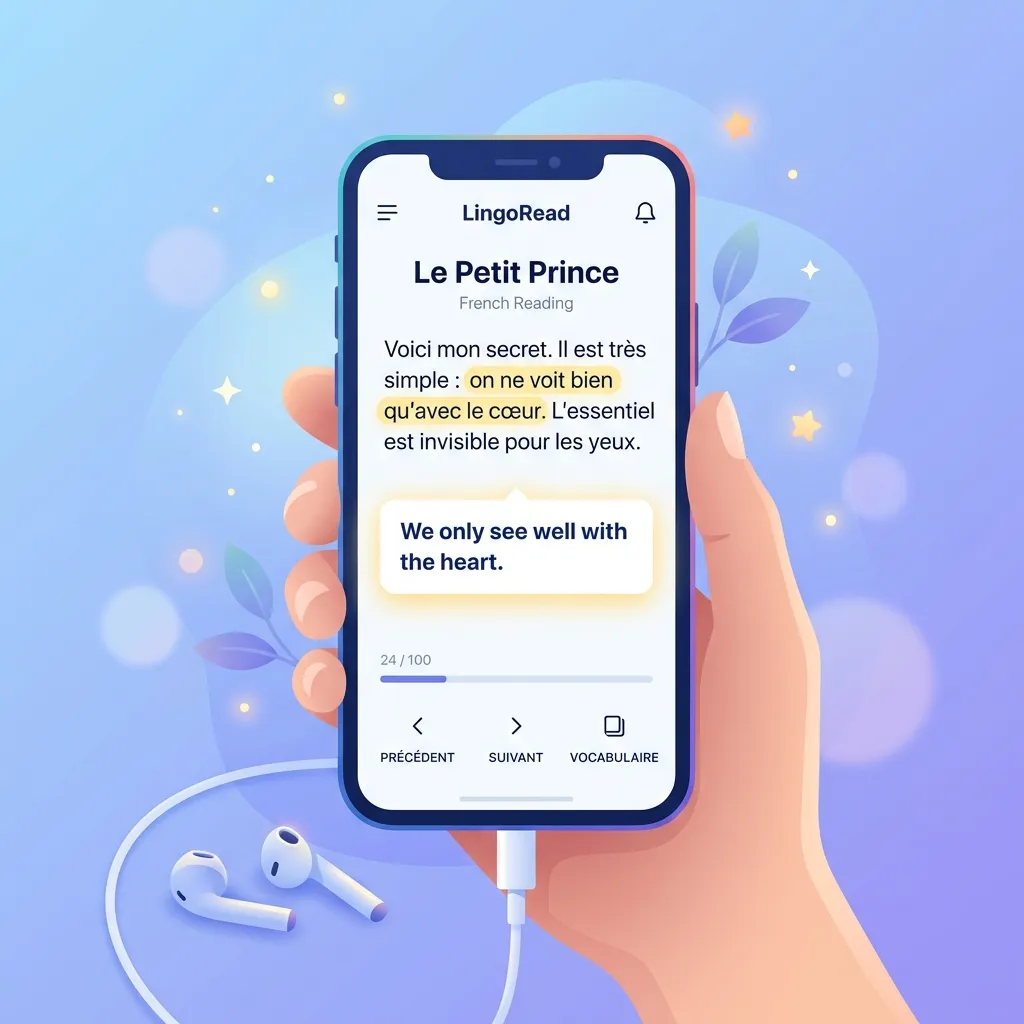
"On ne voit bien qu'avec le cœur. L'essentiel est invisible pour les yeux."
This single sentence teaches you the negative construction ne…que (only), the irregular verb voir (to see), and the word cœur (heart) — all wrapped in one of the most quoted lines in French literature. In MovaReader, tapping l'essentiel instantly reveals "the essential thing" while the AI narrator reads the sentence aloud with perfect Parisian intonation.
Estimated reading time: 15 minutes per chapter
2. La Parure (The Necklace) — Guy de Maupassant
Why it works for beginners: Maupassant is the undisputed master of the French short story, and La Parure is his most accessible work. The plot is driven by a single dramatic irony that keeps you reading to the very last line.
The story follows Mathilde Loisel, a woman who borrows a diamond necklace for a ball, loses it, and spends ten years repaying the debt — only to discover the original was a fake. The vocabulary clusters around everyday themes: clothing (robe, bijoux), emotions (tristesse, joie), and social situations (bal, invitation).
"Elle n'avait pas de toilettes, pas de bijoux, rien. Et elle n'aimait que cela."
Notice the repetition of pas de — this is exactly how French negation works in real sentences, not grammar drills.
Estimated reading time: 25 minutes
3. Le Chat Noir — Adapted from Edgar Allan Poe
Why it works for beginners: French translations of well-known stories give you a massive advantage — you already know the plot, so your brain can focus entirely on absorbing the language. This adapted version uses simplified vocabulary while preserving the gothic atmosphere that makes Poe irresistible.
Key vocabulary you'll absorb naturally: chat (cat), mur (wall), cave (cellar), peur (fear), cri (scream). These are high-frequency words that appear across dozens of other stories.
Estimated reading time: 20 minutes
4. Cendrillon (Cinderella) — Charles Perrault
Why it works for beginners: Before Disney, there was Perrault. The original French Cinderella is surprisingly readable because fairy tales use formulaic structures — repetition, simple past tenses, and universal vocabulary.
"Elle perdit une de ses pantoufles de verre, que le prince ramassa avec bien du soin."
This sentence introduces the passé simple tense (perdit, ramassa), which you'll encounter constantly in French literature. Rather than memorizing conjugation tables, you absorb the pattern through the story. MovaReader's AI highlights the verb form and shows you the infinitive alongside the translation — turning every sentence into a painless grammar lesson.
Estimated reading time: 15 minutes
5. Le Horla — Guy de Maupassant
Why it works for beginners: Written as a diary, Le Horla uses first-person narration with short, punchy entries. The diary format means sentences are naturally brief and conversational — exactly the kind of French you need to internalize.
The story follows a man who believes an invisible creature is haunting him. The suspense builds through simple, repetitive language:
"Je suis malade. Je ne dors plus. Je ne mange plus. Quelque chose me dévore."
Four short sentences. Four essential verbs (être, dormir, manger, dévorer). The emotional intensity makes them unforgettable.
Estimated reading time: 30 minutes (diary format — perfect for reading one entry per day)
6. Trois Contes Modernes — Contemporary Micro-Fiction Collection
Why it works for beginners: This curated collection of modern micro-fiction pieces (each under 500 words) was specifically selected for language learners. The themes revolve around daily life in Paris — ordering coffee, navigating the métro, meeting a neighbor — making the vocabulary immediately practical.
Unlike 19th-century literature, the language here mirrors how French people actually speak today. You'll encounter informal constructions, common slang, and the kind of filler words (ben, quoi, du coup) that textbooks pretend don't exist.
Estimated reading time: 5 minutes per story
7. Le Fantôme de l'Opéra — Adapted Excerpts from Gaston Leroux
Why it works for beginners: The adapted version of this classic mystery uses controlled vocabulary while preserving the atmospheric tension of the original. The setting — the Paris Opera House — introduces cultural vocabulary (scène, rideau, loge, orchestre) that enriches your understanding of French culture beyond words.
"Le fantôme existe. Il vit sous l'Opéra, dans un lac souterrain où personne n'ose descendre."
The vocabulary here is cinematic: fantôme (ghost), souterrain (underground), oser (to dare). These are exactly the kind of dramatic, memorable words that stick in your brain after a single encounter.
Estimated reading time: 20 minutes per chapter
How to Read These Stories Without Getting Stuck
Here's where most beginners fail: they open a French story, hit an unknown word in the first paragraph, panic, reach for Google Translate, lose the narrative thread, and give up.
MovaReader eliminates this cycle entirely. Here's how the reading experience works:
- Tap any word for an instant, context-aware translation — no copy-pasting into external apps
- Listen to AI narration at natural speed while following the text, training your ear and eye simultaneously
- Words you tap are saved automatically to your personal vocabulary list — no manual flashcard creation
- Track your progress with mathematical vocabulary analysis that shows exactly how many unique words you've absorbed from each story
This isn't theory. This is the same method polyglots use to learn languages — massive, enjoyable input with smart scaffolding.
Your 30-Day French Reading Challenge
Here's a simple plan to turn these 7 stories into real French fluency:
| Week | Stories | Daily Time | Goal |
|---|---|---|---|
| 1 | Le Petit Prince (Ch. 1–5) + Cendrillon | 15 min | Get comfortable with basic narrative French |
| 2 | La Parure + Le Chat Noir | 20 min | Build tolerance for longer texts |
| 3 | Le Horla (one diary entry/day) + Trois Contes | 15 min | Expand into modern conversational French |
| 4 | Le Fantôme de l'Opéra + re-read your favorite | 20 min | Notice how much easier everything feels |
By the end of week 4, you'll have read over 20,000 words of real French. According to vocabulary research, that's enough exposure to absorb 300–500 new words — passively, without a single drill.
Why AI Audio Changes Everything for French Pronunciation
French pronunciation terrifies beginners. The silent letters, the nasal vowels, the liaisons — it feels like the written language and the spoken language are two different species.
This is exactly why reading with audio is non-negotiable. When MovaReader's AI narrator reads "les yeux" aloud, you hear that it sounds like "lay-ZUH," not "less yucks." When you see "beaucoup" and simultaneously hear "boh-KOO," the connection between spelling and sound becomes automatic.
Compare this to silent reading alone, where your brain invents bizarre pronunciations that become fossilized habits. With AI audio, every reading session is also a pronunciation lesson.
The Vocabulary Snowball Effect
Here's something magical that happens when you read short stories in sequence: vocabulary compounds.
The word maison (house) appears in Cendrillon. It reappears in Le Horla. By the time you encounter it in Trois Contes Modernes, you don't even notice it — it's just... French. You know it the way you know the word "house" in English — instantly, without thinking.
This is the difference between passive and active vocabulary. Flashcard apps force you to memorize words in isolation. Reading builds a web of associations — maison connects to porte (door), which connects to clé (key), which connects to ouvrir (to open). One story feeds the next, creating an accelerating snowball of comprehension.
MovaReader tracks this snowball mathematically, showing you exactly how your known vocabulary grows with each story you finish.
Stop Preparing to Read French. Start Reading French.
The traditional path looks like this: study grammar for 6 months → memorize 2,000 flashcards → maybe attempt a children's book → get frustrated → quit.
The MovaReader path looks like this: open a story right now → tap words you don't know → listen to AI narration → finish the story → feel amazing → open the next one.
All 7 stories from this list are available in MovaReader's free library. No credit card. No registration wall. Just open the app and start reading.
For those who want to go further, the Premium subscription at €5/month unlocks all current and future language trainers — including the phrase trainer, typing trainer, and priority support. Or start with the Basic plan at just €1/month for unlimited reading with AI tools.
Either way, the first step is the same: pick a story, tap play, and let French wash over you.
Your first story is waiting. Browse the full library and start reading with pleasure today.
FAQ: French Short Stories for Beginners
What French story should a beginner read first?
Start with Cendrillon or selected chapters from Le Petit Prince. Both are familiar, short and easier to understand from context than a full modern novel.
Are French short stories better than novels for beginners?
Yes, usually. Short stories let you finish a complete narrative quickly, which builds confidence. Novels can be motivating too, but beginners often quit when the book is too long or dense.
How should I read my first French story?
Read the story once for the main idea. Do not stop at every unknown word. Then reread a shorter section, tap or look up only the words that block meaning, and save 5–10 useful phrases.
What level do I need to read Le Petit Prince in French?
A2 learners can read selected chapters with support. B1 learners can read more comfortably and focus on style, idioms and deeper meaning.
Should I listen while reading French?
Yes. Listening while reading helps connect spelling with pronunciation. French spelling can be deceptive, so audio support makes the same story much more useful for beginners.
Learn languages by reading!
Try MovaReader for just €1 — read texts with instant translation and interactive vocabulary training.
Try for €1