Reading Strategies
Comprehensible Input: A Realistic 30-Day Plan
One month of readable input and a simple daily loop: calibrate your level, build volume, stay on one theme, then add a little output.
You can memorize verb tables, keep a streak in an app, and still freeze when someone talks at normal speed. That gap is real. Then a loud slogan shows up: comprehensible input is the only scientific path, and fluency arrives on its own.
That slogan oversells a useful idea.
Comprehensible input is language you mostly understand (reading or listening), ideally a little above your level (i+1). A realistic comprehensible input 30 day plan is 15-25 minutes a day across four weeks: calibrate your level, build volume, stay on one theme for natural repeats, then add light output. Success is days done, texts finished, and reusable phrases - not a CEFR jump or "fluency."
CI is a strong ingredient, not a magic-only path. Full Krashen depth lives on our theory guide to comprehensible input. This post is the calendar you can start tomorrow.
| Piece | Fact |
|---|---|
| Daily dose | 15-25 minutes you actually finish |
| Week map | 1 calibrate → 2 volume → 3 one theme → 4 light output |
| Realistic month wins | 25+ days, 8-15 short texts, 80-150 phrases |
| Unrealistic goals | Not A1→B2, not effortless speech, not fluency in 30 days |
What is comprehensible input in plain words?
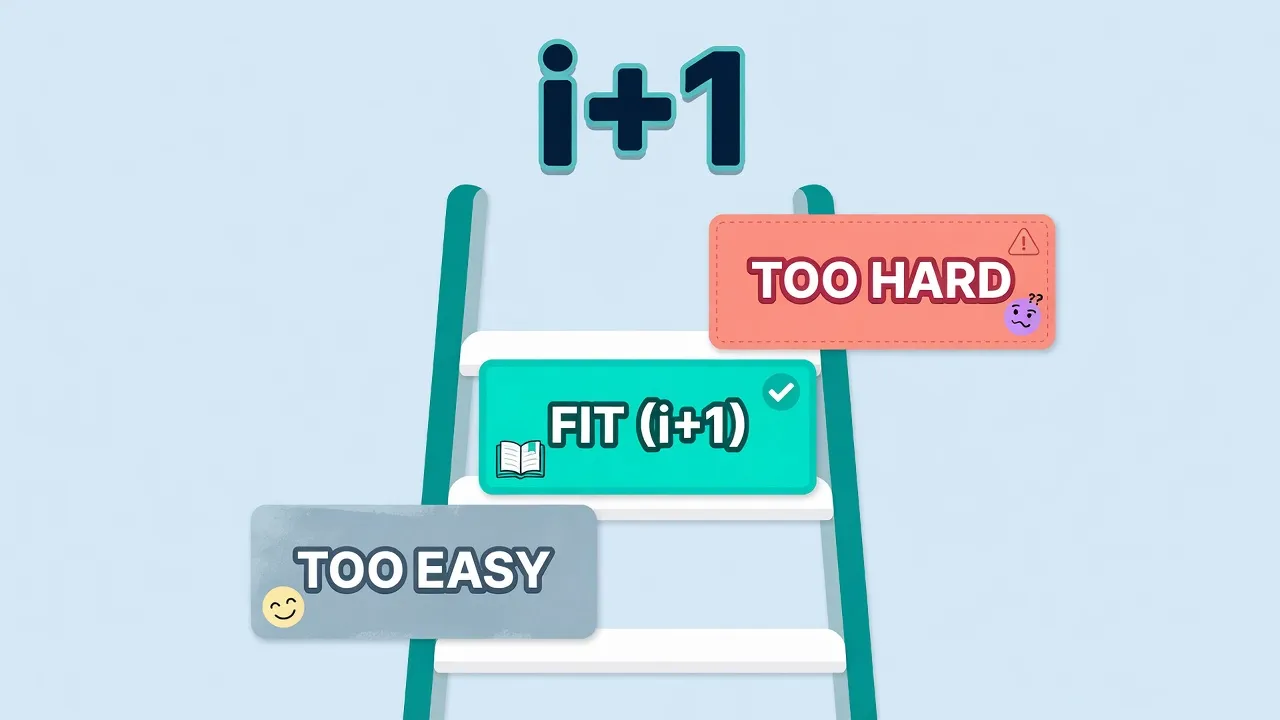
In Krashen's frame, you acquire a lot of language by understanding messages. The informal formula is i+1:
- i = what you already handle
- +1 = a little new language you can still parse with context, prior knowledge, or light help
In practice, good input usually means:
- you follow the main idea without constant dictionary panic
- new words appear, but not so many that the page collapses
- you care enough about the content to keep going
Classroom rule of thumb: you understand most of the page (many teachers aim near 80-90%+ of words for comfortable extensive reading). Those percentages are estimates, not physics. If every sentence is a wall, you are decoding, not reading.
Here is the ladder in one picture - too easy, fit, too hard:
For the full Monitor Model, five hypotheses, and the research debate, see the Krashen comprehensible input guide. Here we keep theory short so the plan can do the work.
Why a 30-day plan makes sense (and what not to expect)
A month is short for "fluency." It is long enough to:
- install a 15-25 minute habit
- learn to choose i+1 material
- weaken the reflex to translate every word
- finish several short texts and feel a bit faster on rereads
- build a small bank of reusable phrases
It is usually not enough to:
- move from A1 to B2
- speak without effort on any topic
- "close" English or Spanish grammar as an L2
- hit any fixed fluency date
If someone promises general fluency in 30 days from input alone, they are selling hope, not a plan.
Before day 1: three decisions
1) Target language and reading-first channel
This plan assumes daily reading as the spine, plus light audio once the page already tracks. Learning English? Read English. Learning Spanish as L2? Read Spanish.
Warm up on free graded samples, not prestige novels on day one:
2) Fixed daily window
Same slot most days - after coffee, on the commute, or at lunch. Habit beats motivation.
3) Realistic month success
Pick metrics you can count without vanity:
- 25+ days with at least ~15 minutes
- 8-15 short texts finished
- 80-150 reusable phrases (not 2,000 loose single words)
- optional short book only if your level already allows it
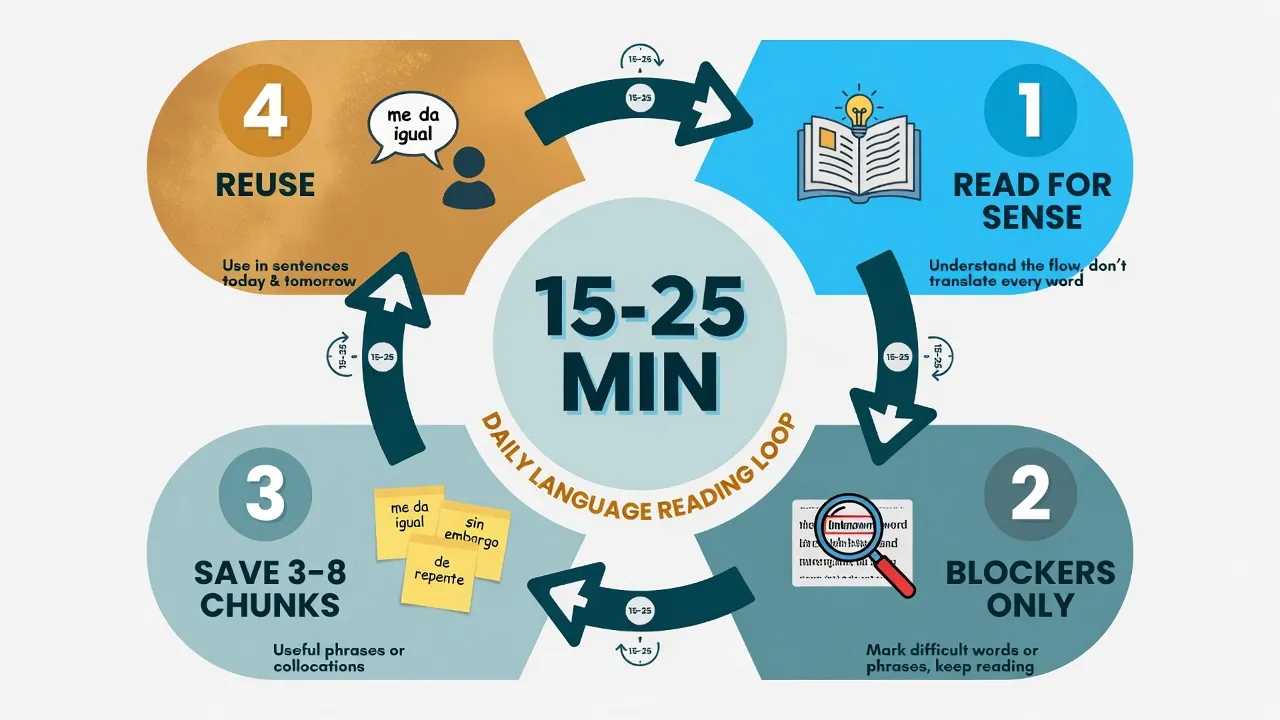
The daily loop (15-25 min)
Every day uses the same four steps. Sense first, dictionary second. An ego stretch that wrecks tomorrow's session is not i+1.
| Step | What you do | Minutes (guide) |
|---|---|---|
| 1. Read for sense | Finish a section without stopping on every unknown word | bulk of the session |
| 2. Blockers only | Look up words that actually stop the story | short |
| 3. Save 3-8 chunks | Prefer multi-word bits (want to, have to, a lot of) | 1-3 min |
| 4. Reuse | Speak 5 phrases aloud, write 3 new sentences, or run a light demo | 2-5 min |
The loop at a glance:
The 30-day plan
Four weeks. Same daily dose. Different focus each week so you do not stall on "just more of the same page."
The month map:
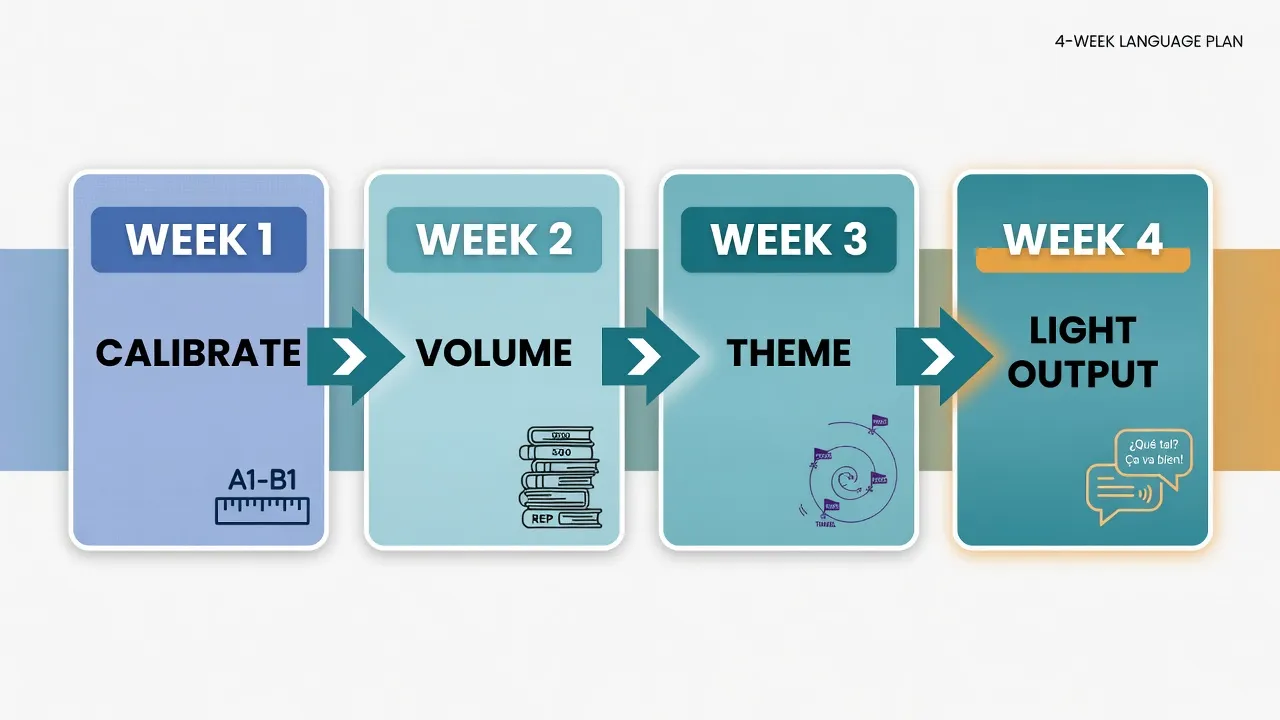
| Week | Days | Focus | Core move |
|---|---|---|---|
| 1 | 1-7 | Calibrate i+1 + habit seed | Find ~80-90% comfort; finish sessions without drama |
| 2 | 8-14 | Sustainable volume | More finished pages; same comprehension quality |
| 3 | 15-21 | One theme thread | Same topic 7 days for natural word repeats |
| 4 | 22-28 | Input + light output | Speak, write, or demo a little - still not a speaking course |
| Close | 29-30 | Review + design month 2 | More of the same loop, not a prestige jump |
Days 1-7: calibrate i+1 (habit seed)
Goal: material you mostly understand, and sessions you actually complete.
| Day | What to do |
|---|---|
| 1 | Read 1 very easy text end to end. Save no more than 5 phrases. |
| 2 | Same level. Try audio after reading if it exists. |
| 3 | If days 1-2 felt easy, step up one soft rung. If hard, step down. |
| 4 | Blockers only. Aim to finish the section without translating decorative adjectives. |
| 5 | Reread a day-1 or day-2 text: you should feel faster. |
| 6 | Save chunks (want to, have to, a lot of), not single words only. |
| 7 | Review: reread ~10 saved phrases out loud. No new content if you are tired. |
Days 8-14: sustainable volume
Goal: more finished pages, same understanding quality.
| Day type | Count in the week | Action |
|---|---|---|
| New comfortable text | 5 days | Stay at calibrated i+1; finish sections |
| Soft stretch | 1 day | ~70-80% comfort only if the topic hooks you |
| Review only | 1 day | Reread + phrase practice; no prestige material |
If stretch leaves you drained, return to comfortable level the next day. Ego does not count as i+1.
Days 15-21: one theme thread
Goal: lexical repetition by theme (travel, work, food, light news, a hobby).
Pick one thread and stay seven days. Natural repeats beat topic-hopping every session.
Optional short book: only if you already read A2+ with comfort. Use 2-3 days of the week for 10-15 pages or about 15 minutes. Upload an EPUB or file you own. MovaReader does not box free licensed commercial novels. See How to use for the upload path.
Days 22-28: input + light output
Goal: recognition is not enough. Recover a little of what you read.
Each session, after reading, do one of these:
- say 5 phrases from the day out loud, or
- write 3 new sentences with saved chunks, or
- use a practice demo
Try:
Full trainers live under Trainers (Pro €5/mo for the complete set). This week is low-stakes recovery, not a speaking course.
Days 29-30: review and design month 2
| Day | Action |
|---|---|
| 29 | Reread 2-3 week-1 texts. Note what feels easier. |
| 30 | Month review: days kept, text types you finish without hate, less word-by-word panic?, which ~20 phrases to keep using |
Design month 2 as more of the same loop, not Shakespeare or a dense classic on day 31 for prestige.
Month summary
| Week | Focus | Signal it is working |
|---|---|---|
| 1 | Calibrate i+1 + habit | You finish sections; you do not hate the session |
| 2 | Volume | More pages, same or fewer look-ups |
| 3 | Theme thread (+ optional short book) | Same words reappear and start to sound familiar |
| 4 | Light output + review | You reuse phrases without staring at the full list |
What research supports vs marketing claims
Stronger in practice:
- extensive reading of mostly understandable text helps vocabulary, speed, and comfort with writing
- words seen again in varied contexts stick better than one-shot lists for many people
- anxiety and shame cut practice minutes; minutes matter a lot
- grammar drills with little meaningful input often transfer poorly to real use
Weak or inflated:
- "only proven theory" (several useful models exist: interaction, output, usage-based, skill acquisition, and more)
- automatic fluency from input slogans
- "never study grammar"
- "any text becomes perfect i+1 with AI"
Tools lower friction. They do not rewrite the need for repetition, sleep, and some active use. For the research in more depth, open the Krashen theory post.
Where MovaReader fits
MovaReader is a reading tool, not "the only scientific path."
Helps with:
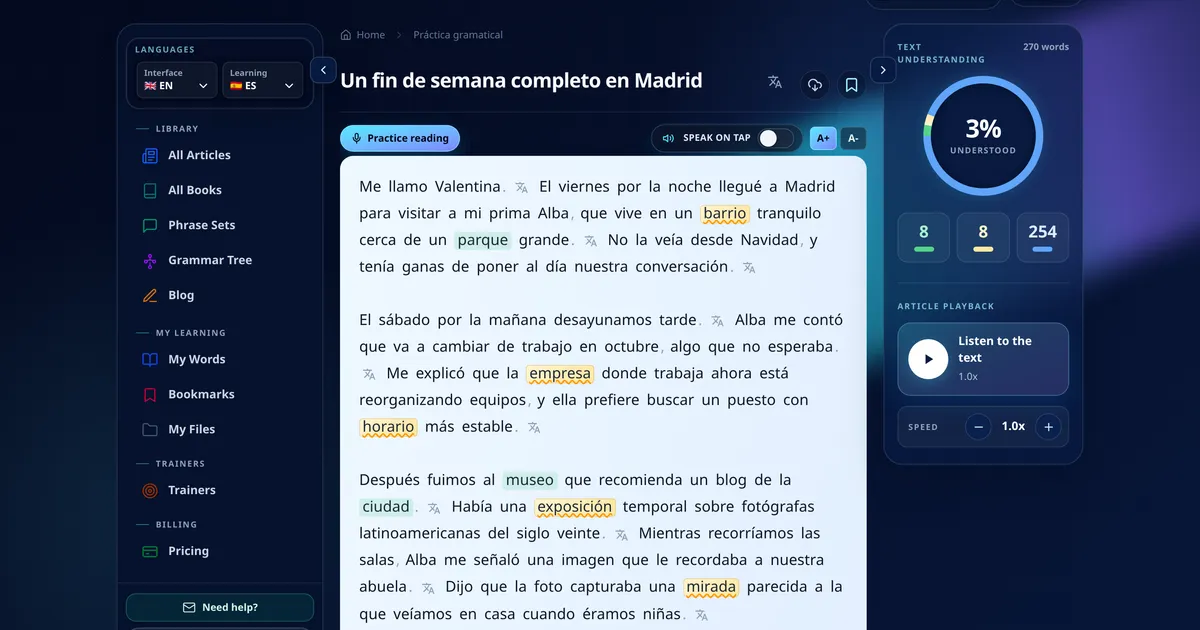
- free graded articles and tap-to-translate
- upload of EPUB / files you own
- less lookup friction so sessions stay on meaning
- unlimited listening on the free plan (useful once the written page already tracks)
- moving saved items into practice
Does not:
- host licensed commercial novels free out of the box
- replace contact hours and productive practice
Plans:
- Free plan: unlimited listening + ~20 word translations/day
- Reader (€1): unlimited word translations
- Pro (€5/mo): full trainers
Details: Pricing.
How that maps to the month: week 1 can live on free samples and light look-ups on the free plan; real volume often wants Reader so translations do not run out mid-page; week 3 own-file reading uses How to use; week 4 demos are free to try, full set on Trainers.
FAQ
Is comprehensible input science or a marketing slogan?
A real research tradition in second-language acquisition, especially around extensive reading and vocabulary. Not a single law that cancels other useful findings (interaction, output, form-focused instruction, skill acquisition, and more). Treat CI as a strong ingredient, not a brand-only path.
How much comprehensible input per day is enough?
For this habit plan: 15-25 minutes a day you actually finish is enough to build the loop. Other guides push 30-60+ minutes when the goal is faster growth. More quality contact usually helps; fake precision ("exactly N minutes = B2") does not. Consistency beats heroic weekends.
Do I still need grammar?
Often a little, used wisely. If a short rule helps you notice a pattern in real text, keep it. If tables replace reading for months, rebalance toward input. Grammar as flashlight, not prison.
Can absolute beginners use this 30-day plan?
Yes. Use very easy material, more support, and shorter sessions. The 30-day logic stays (calibrate → volume → theme → light output). The text level changes; the habit structure does not.
Does listening count as comprehensible input?
Yes, when you understand enough of the message. Many adults control reading better at first because they can pause and reread. A practical combo: read first, then light audio on the same material when it exists.
Will I be fluent in 30 days? Should I stay silent until massive input?
There is no single fluency date, and 30 days almost never equals general fluency. Measure days kept, texts finished, and phrases reused, not slogans. A quieter period can lower pressure, but light low-risk speaking or writing (week 4 style) usually helps you recover what you read. Do not treat "silent forever" as a hard rule.
Next steps
Krashen's practical message still holds: you need a lot of language you can understand, in a form you will actually consume.
The dishonest sequel is: this theory alone closes fluency, grammar is dead, and any product makes every text perfect forever.
Build a simple system for 30 days: interesting texts near your level, light help on blockers only, daily minutes, and a little reuse. Start today with a free graded article, read for sense, touch only what blocks you, and reuse a few phrases in the phrase typing demo. Tomorrow, same window.
Keep reading with translations inside the text
With a free account, an unknown word translates with one tap, and the words you are learning wait for you in the trainer.
Free account: 7 days of Pro, then 20 word translations a day or a paid plan.