Tips & Methods
How to Learn a Language with Movies and Series (7 Methods)
Seven practical techniques so movies and series give you phrases, listening and rhythm, not just a streak and passive immersion, plus a simple weekly plan.
You open Netflix (or any player), pick a show "for language practice," and leave it on while you cook. A month later you still freeze on everyday lines. That is not a willpower problem. It is how most of us actually watch.
Watching a series "while learning" sounds perfect. Most people use it as background, catch a few familiar words, and wonder why the level barely moved. Series help when you use short active cycles: understand the scene, catch sound and phrases, reuse a few of them - not when you binge passively.
Passive binge is not learning. Short active cycles win.
Below: 7 methods to mix (not all at once), a CEFR pick rule, a realistic week plan, and a reading bridge. Works for English, Spanish, and other languages. A toolkit, not a guaranteed system. This post is about how to watch. For what to watch in English, see our series list for learning English.
Why series help - and why they often do not
What series give well:
- Spoken shortenings, intonation, slang, and phrases textbooks skip
- Situational context (argument, joke, negotiation, date)
- Natural speech speed your ear can adapt to gradually
- Motivation: plot pulls you when grammar drills already tired you
What series do not do alone:
- They do not replace active use (speaking, writing)
- They do not "install" 50 new words per episode without your work
- They fail when content is so hard you only guess the plot from pictures
- Passive background watch looks like study and often feels like zero progress
Rule of thumb: if you understand less than about 60-70% of dialogue even with target-language subtitles, simplify the show or add more repeats first. Otherwise it is stress with subtitles, not training.
Method 1: The three-pass rule
Base technique: short scenes, three ways of looking. Ideal for a 20-25 minute sitcom; still useful on longer shows if you cut a scene.
- Pass 1 - native-language subtitles. Get the plot. Lower anxiety.
- Pass 2 - target-language subtitles. Map sound to words you already understand from the story.
- Pass 3 - none or minimal. Check what you really hear. Re-mark sticky lines.
You do not need to rewatch a full hour of dense drama three times. 8-12 minutes of one scene, three times beats one full episode watched "diagonally." Keep favorite 30-60 second clips for shadowing and phrases later.
Here is the loop in one glance:
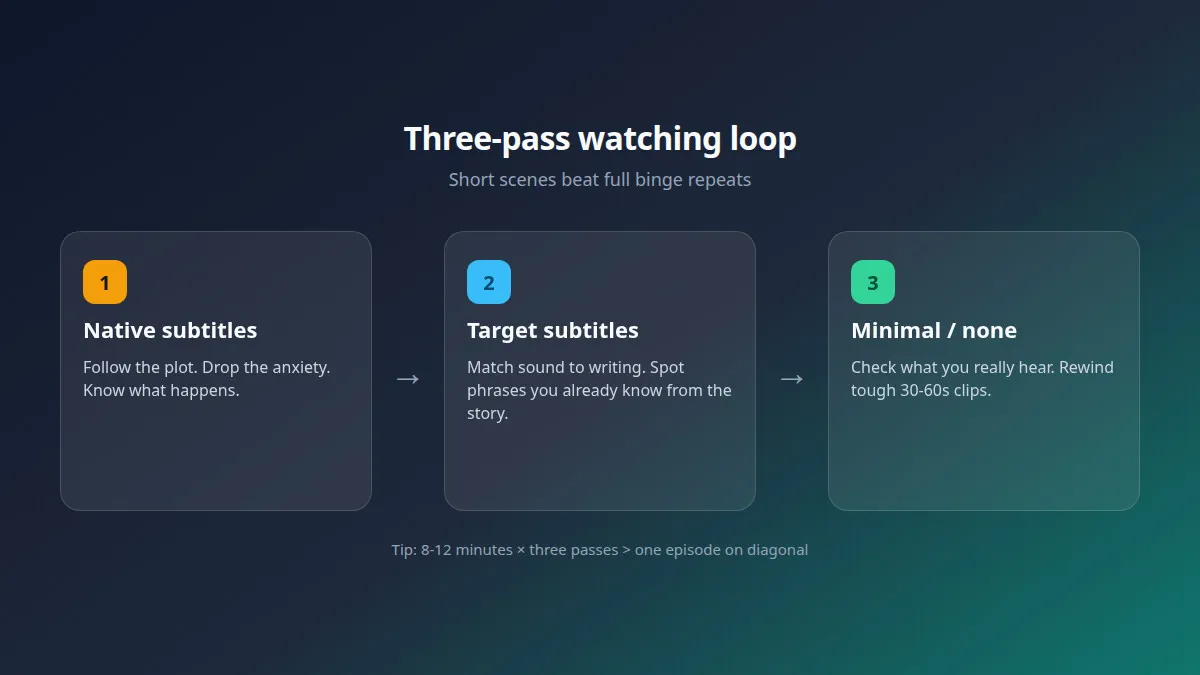
Native subtitles are a stage, not cheating forever. Goal: move toward the target language, then less dependence on known scenes.
| Pass | Subtitles | Job of this pass |
|---|---|---|
| 1 | Native language | Plot, lower anxiety, know what happens |
| 2 | Target language | Map sound to words you already understand |
| 3 | None or minimal | Check real listening; re-mark sticky lines |
Method 2: Shadowing - copy the actors
Shadowing means you repeat almost with the actor, or with a short lag. You copy rhythm, stress, and intonation - not only the dictionary form of words.
Steps:
- Pick a 30-60 second fragment (15-20s if speech is dense or fast).
- Listen 2-3 times.
- Pause after a line.
- Repeat out loud.
- Record yourself once. Note 2-3 concrete errors - not a "perfect actor" goal.
Sitcoms with short lines work especially well (Friends, Modern Family, Brooklyn Nine-Nine as examples only). Stand-up and dense crime drama: shorten the clip first. One clean shadowing session is often 5-15 minutes. Quality of repetition beats a marathon you abandon.
Method 3: Phrase journal in context
Do not harvest 40 isolated words from one episode. Save phrases in a situation.
| Field | Example |
|---|---|
| Phrase | pull yourself together |
| Show / scene | Breaking Bad, S2, panic moment |
| Who → whom | Skyler to Walter |
| Meaning in my words | "get a grip / calm down and focus" |
| My example sentence | I need to pull myself together before the call |
Memory sticks better to scene + voice + emotion than to a bare "word = translation" card. Limit: 5-12 phrases per session. More than that and you are building a dictionary dump, not usable language. Prefer chunks you will reuse: argument, joke, request, apology.
Method 4: Active pauses (stop and think)
Every 5-10 minutes:
- Pause.
- Say 2-3 sentences in the target language: what just happened.
- Optional: one prediction of the next line.
- If one phrase blocks meaning, journal it (Method 3) - not the whole dialogue.
This is simple active recall. You are not only consuming sound; you force the brain to rebuild meaning. Even clumsy sentences beat "I just finished the episode."
Method 5: Match the show to your level
Status titles do not raise your level. Match difficulty to what you can actually process.
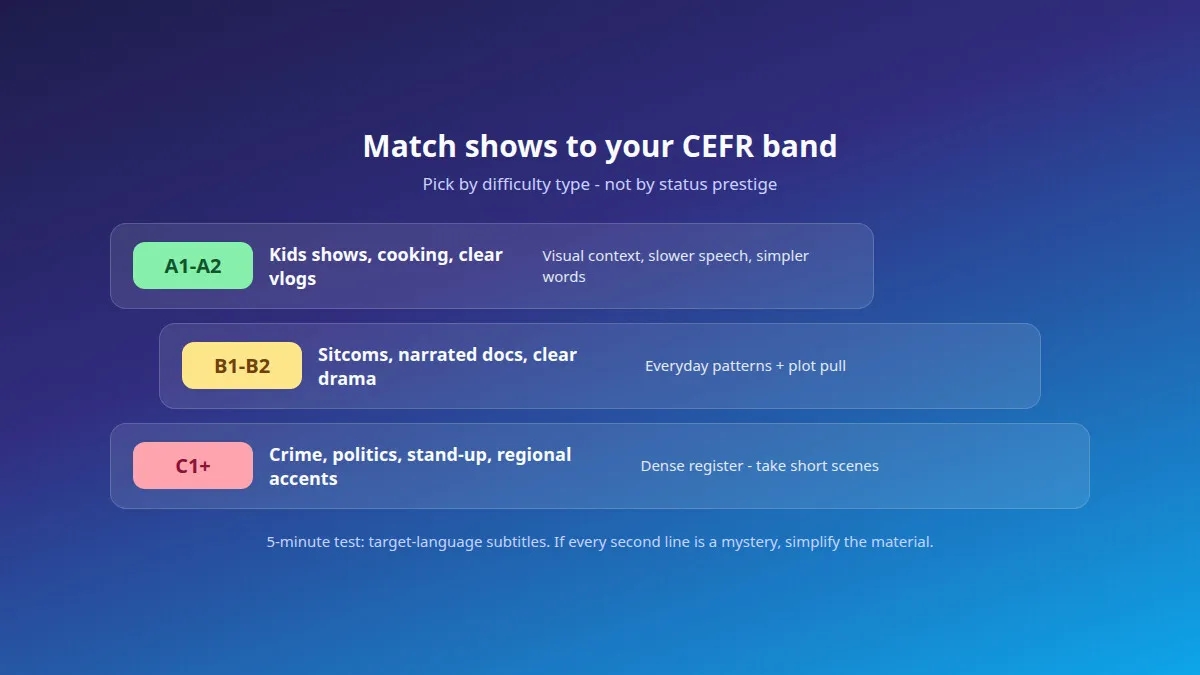
| Level | Start with | Why it works | Be careful with |
|---|---|---|---|
| A1-A2 | Slow kids/learning shows, cooking formats, clear vlogs | Visual context, simpler lexis | Adult slang, fast multi-speaker banter |
| B1-B2 | Sitcoms, narrator-led docs, drama with clear diction | Conversational patterns + plot pull | Very fast multi-character scenes |
| C1+ | Crime drama, politics, stand-up, regional accents | Register and density | Getting stuck in one subculture's slang |
5-minute test: turn on target-language subtitles. If every other sentence is a puzzle, the material is too hard for "main" practice right now. Use it for short scenes only, or step down.
Need titles rather than method? Hand off to the catalog posts - this article stays on how to watch:
- English picks by feel and level: what series to watch to learn English
For B1, a Friends-style sitcom with shorter lines is usually easier than dense drama on day one. Dense drama is useful in short scenes, not full-episode heroics when you are still building the ear.
Method 6: Micro-immersion outside the screen
Three active series sessions a week is solid. Light contact between them makes the language stickier:
- Phone / streaming / YouTube UI in the target language.
- One or two accounts in that language on topics you already care about.
- A podcast or interview about the same show or genre.
- Short reading on the same topic (news, recaps, graded articles).
Reading does not compete with series. It consolidates the same words in another modality - eyes and pace instead of only ears and plot. If you want a free graded start, browse all articles. Sample pages: Ukrainian A1 sample if that fits your path.
Method 7: Simple phrase review (light SRS)
Without review, new phrases fade fast. You do not need complex software to start.
For about 10-15 phrases from the week:
| Day | Action |
|---|---|
| 0 | Write the phrase after watching |
| 1 | Say it out loud |
| 3 | Again |
| 7 | Again |
| 14 | Final check: can you drop it into a new situation? |
After you meet phrases in text, optional practice: trainers (full depth on Pro), or quick demos - typing demo and phrase typing demo.
A realistic weekly plan
Regularity beats the perfect method. Twenty minutes most days beats three heroic hours once a week.
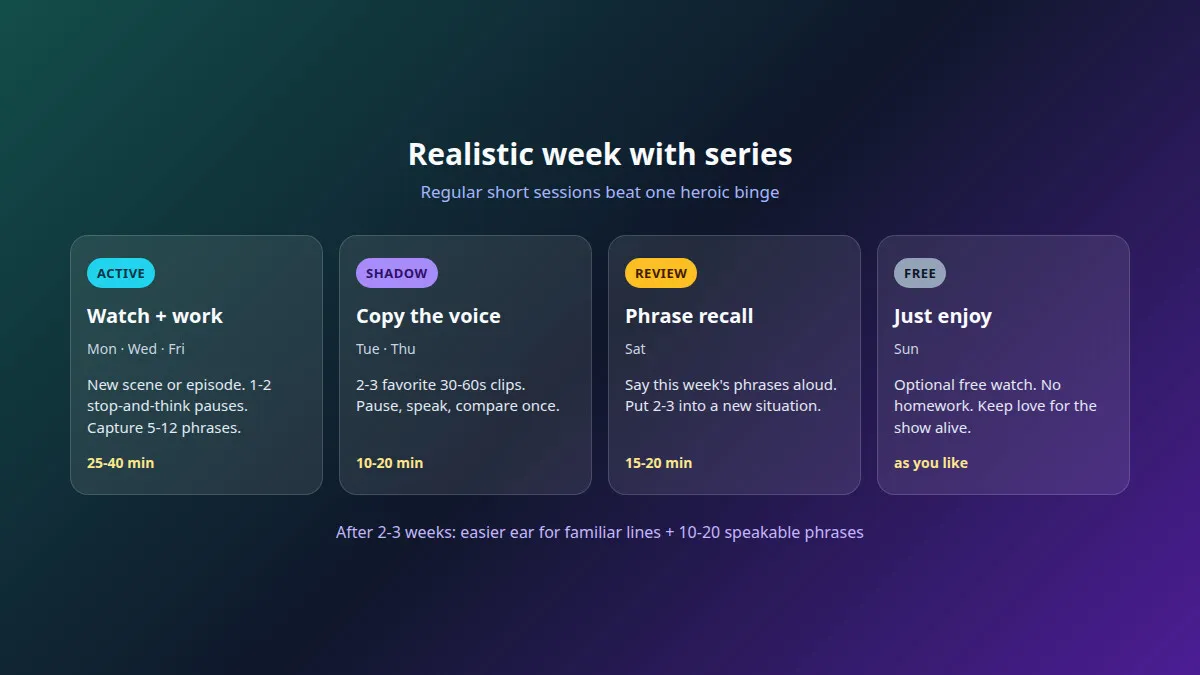
| Day | What to do | Time |
|---|---|---|
| Mon / Wed / Fri | New episode or scene + 1-2 active pauses | 25-40 min |
| Tue / Thu | Shadowing 2-3 favorite clips | 10-20 min |
| Sat | Review the week's phrases (day 0/1/3 pattern) | 15-20 min |
| Sun | Free watch without "homework" | as you like |
How do you know it is working (after 2-3 weeks)? Look for:
- Familiar phrases easier to catch by ear
- Fewer freezes of "what did they say?"
- About 10-20 phrases you can say without a prompt
If you want a weekly mix with reading: three series days (methods 1-4), two days of 15-20 minutes on all articles, one short phrase-practice day.
Typical mistakes
- Hard content for status - you pick the "serious" show because it looks advanced, not because you understand it.
- Pure passive - no shadowing, notes, or review; progress stays invisible.
- Translate every word - breaks flow; aim for scene sense plus a few useful phrases.
- No system - chaotic binge without any repeat.
- Magic expectations - "I watch for a month and start speaking." Series speed listening and living phrases; speaking still needs separate practice.
How series pair with MovaReader
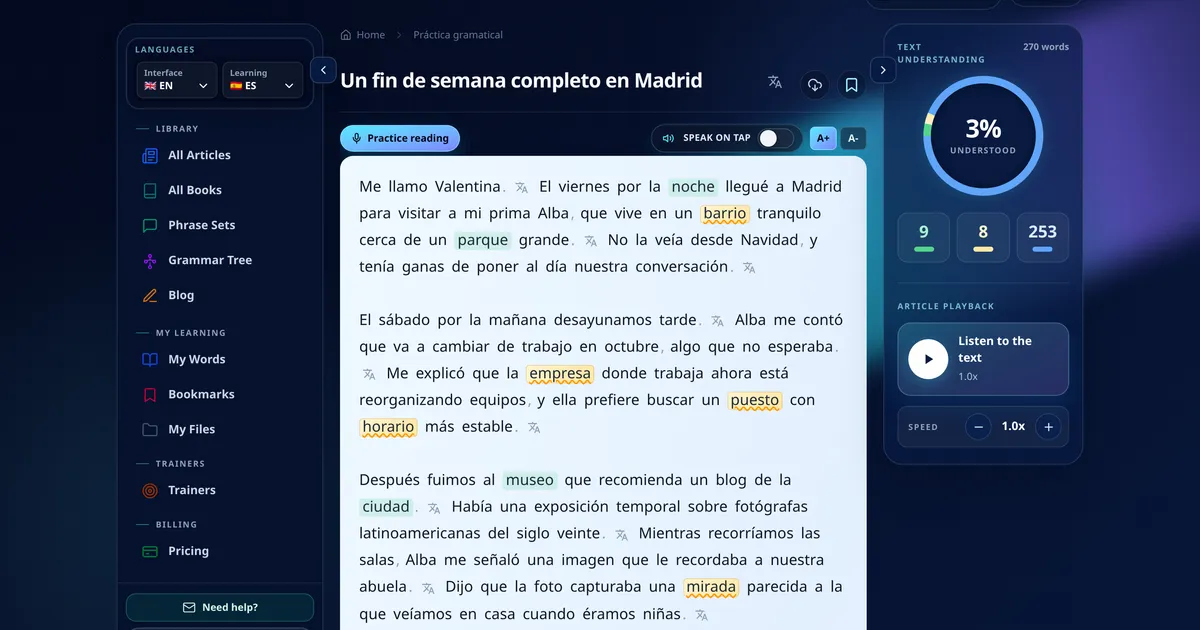
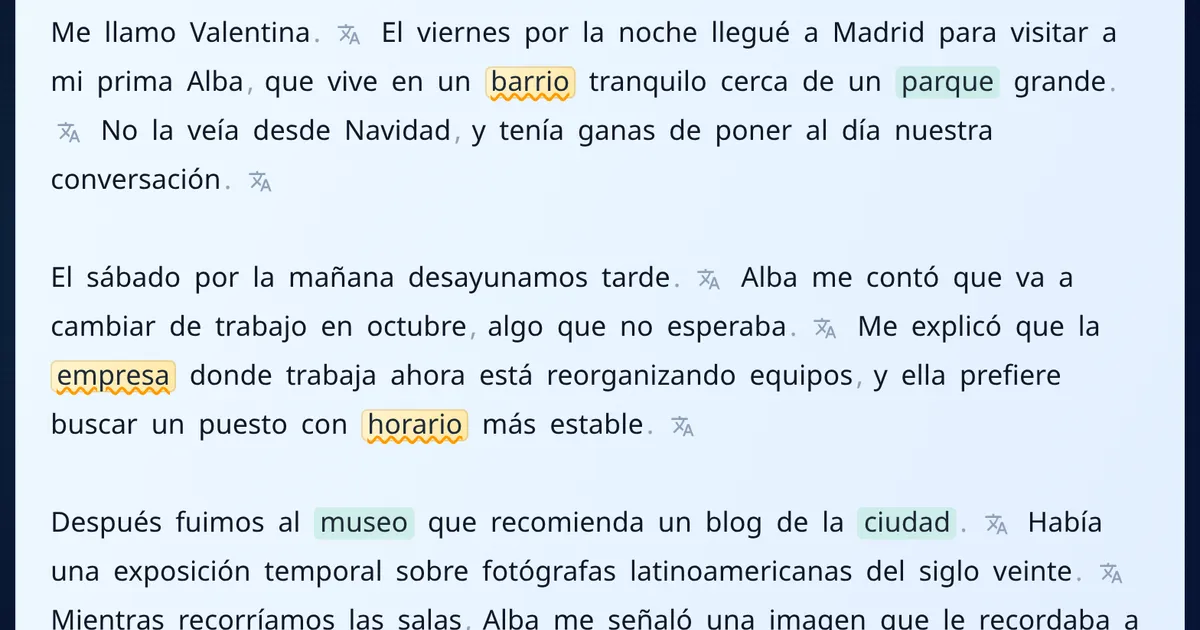
MovaReader is a reading tool. It is not a Netflix plugin. You keep watching on whatever player you already use. Next to a series plan, the app helps you lock language on the page: graded library, your own legal EPUB, click-to-translate, listening, and phrase trainers after you meet items in text.
| Plan | What you get for this method |
|---|---|
| Freemium | Library, unlimited listening, about 20 word translations per day - enough to learn the reading habit |
| Reader (€1) | Unlimited word translations when free plan caps break real pages |
| Pro (€5/mo) | Full trainers when review volume is the bottleneck |
Details: pricing. Browse texts any time: all articles. Trainers: trainers.
What it does not do: host licensed series, act as a streaming subtitle overlay, or replace conversation with real people.
Simple weekly mix: series days + reading days + one short trainer day. Series give ear and living phrases. Reading locks the same language on the page. Short review keeps the best phrases from vanishing - without pretending one app does everything.
FAQ
Can you learn a language only with series / TV?
You can strengthen listening and passive vocabulary a lot. Stable speaking and writing still need active practice. Series are a strong component, rarely the whole system.
What level should I start series at?
From A2 with simple content and subtitles is already workable. At A1, prefer very simple video plus more supported reading and listening first - otherwise you guess the plot from pictures and burn out.
Are native-language subtitles bad?
No, if they are a stage (first pass), not your forever strategy. Goal: move to target-language subtitles, then reduce dependence on known scenes.
How many new words from one episode?
5-12 phrases you will actually reuse. Forty words "for later" rarely stick. Prefer chunks in context over isolated dictionary lines.
Friends-style sitcom or dense drama for B1?
Sitcoms with shorter lines are usually easier to start. Dense drama is useful but faster and thicker - use short scenes only, not full-episode heroics on day one. For English title ideas by level feel, see what series to watch to learn English.
How do I know the method is working?
After 2-3 weeks: familiar phrases easier by ear, fewer "what did they say?" freezes, and about 10-20 phrases you can say without a prompt. That is progress.
Do I need a special Netflix plugin?
No. Active methods work on any player you already use. MovaReader is for reading and phrase practice beside series - not a streaming host or subtitle overlay.
Plan for today
- Pick one show that matches your level (not your status list).
- Take one scene of 8-12 minutes; do two passes (native + target subs).
- Write 5 phrases in context.
- Do 5 minutes of shadowing on a short clip.
- Optional: 10 minutes of graded reading on all articles.
One deliberate scene today beats a perfect year plan you never start.
Keep reading with translations inside the text
With a free account, an unknown word translates with one tap, and the words you are learning wait for you in the trainer.
Free account: 7 days of Pro, then 20 word translations a day or a paid plan.