Grammar in Context
English conditionals 0-3: the architecture of dreams
You know every word in the if-clause and still miss the time meaning. Conditionals are not only school formulas. They are a map of what is always true, what is possible, what is imagined, and what is already lost.

You finish a page of fiction. Every word looks familiar. Then the line lands: If she had told him earlier... and something in the story shifts. Not the vocabulary. The time. The speaker is not planning. They are looking backward at a door that already closed.
That is the real job of English conditionals. Not filling blanks for an exam. Mapping reality against time: laws and habits, real plans, unreal dreams, and past regret.
The short answer: Zero means always true. First means a real possible future. Second means unreal now or future. Third means unreal past. Learn each form with its time meaning, then train your eye while you read. Tables help. Meaning labels help more.
Below: the four types as an emotion map, clean teaching examples, a second-vs-third board, one clear mixed pattern, a spotting checklist, and a simple way to practice with real texts.
Four types: the architecture of dreams
Think of conditionals as four rooms in the same house. Same door word (if), different light.
| Type | Core meaning | Default pattern |
|---|---|---|
| 0 Zero | always true / habit | If + present, present |
| 1 First | real possible future | If + present, will + verb |
| 2 Second | unreal now / future | If + past, would + verb |
| 3 Third | unreal past (regret) | If + past perfect, would have + V3 |
When a line appears on the page, ask one question first: Is this a law, a real plan, a dream, or a regret? That question beats memorizing formulas alone.
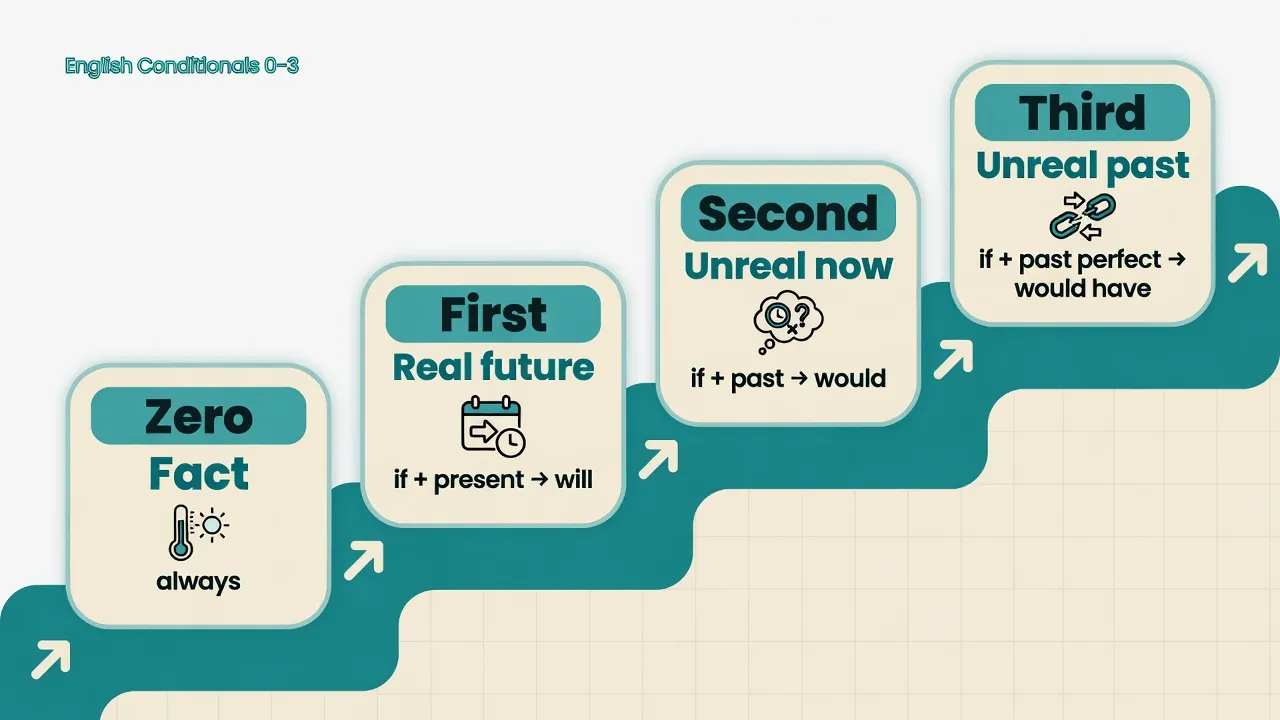
You will meet the same patterns in dystopian prose (rules stated as facts), adventure (survival plans), romance (impossible love), and tragedy (what might have been). The genres change. The architecture stays.
Zero conditional: laws and habits
Form: If + present simple, present simple.
Meaning: This is not a plan. It is how the world works, or how someone always behaves.
If you heat ice, it melts.
If she is tired, she goes quiet.
Zero is the room of facts and habits. Science textbooks live here. So do characters who speak in rules: house laws, social codes, daily routines.
Soft literature note: in dystopian writing you often see Zero used for propaganda-as-fact (If citizens obey, order holds). The form says "this is how things are." Whether you trust the speaker is a different question.
Tip: when often swaps with if here without changing much: When water reaches 100°C, it boils. Both point at a general truth.
First conditional: real plans and warnings
Form: If + present simple, will + base verb (or can / might / should when the force is softer).
Meaning: This future is possible. The speaker treats it as real, not fantasy.
If I don't find water soon, I will be in real trouble.
If you text her tonight, she will answer.
First is the room of plans, threats, promises, and weather talk. Adventure scenes use it constantly: If we wait until dawn, they will catch us. The speaker believes the condition can still happen.
First vs Zero in one beat:
- Zero: If it rains, the streets flood. (general rule)
- First: If it rains tomorrow, we will cancel the trip. (this specific future)
Tip: when in a First-like sentence can sound more certain about timing (When she arrives, we will start). If keeps a real alternative open.
Second conditional: unreal present and dreams
Form: If + past simple, would + base verb. Formal style often keeps If I were (not was) for unreal identity.
Meaning: The condition is not true now, or is imagined as unlikely. The result lives in a parallel present or future.
If she loved me the way I hope, I would feel safe.
If I were you, I would wait.
If money were no object, we would leave next week.
Second is the room of dreams, advice, and polite distance. Romance lives here a lot: love that is not reciprocal yet, lives not shared yet. So does careful advice (If I were in your place...).
You will see this pattern in many love stories and character monologues. The shape is what matters: past form in the if-clause, would in the result, meaning "not real (or not likely) now."
Common teaching choice: prefer If I were for clear unreal present, especially in exams and careful writing. Informal speech often uses was. Neither means the speaker is broken; the register shifts.
Third conditional: unreal past and regret
Form: If + past perfect, would have + past participle.
Meaning: The past is closed. The speaker rewrites a path that did not happen.
If we had left earlier, we would have caught the train.
If I had told the truth then, everything would have been simpler.
Third is the room of regret, relief, blame, and alternate history. Jazz-age tragedy vibes, war stories, "one wrong turn" plots: they all lean on this room. The form itself carries the weight: had + would have says "too late to change the condition."
Emotion check: if the line makes you feel "I wish I could go back," you are probably in Third, not Second.
Second vs Third: the comparison board
These two confuse people the most. Same emotional intensity. Different clocks.
| Second | Third | |
|---|---|---|
| Time | now / future unreal | past unreal |
| Form | past + would | past perfect + would have |
| Sense | if it were true now | if it had been true then |
| Example | If I knew her number, I would call. | If I had known her number, I would have called. |
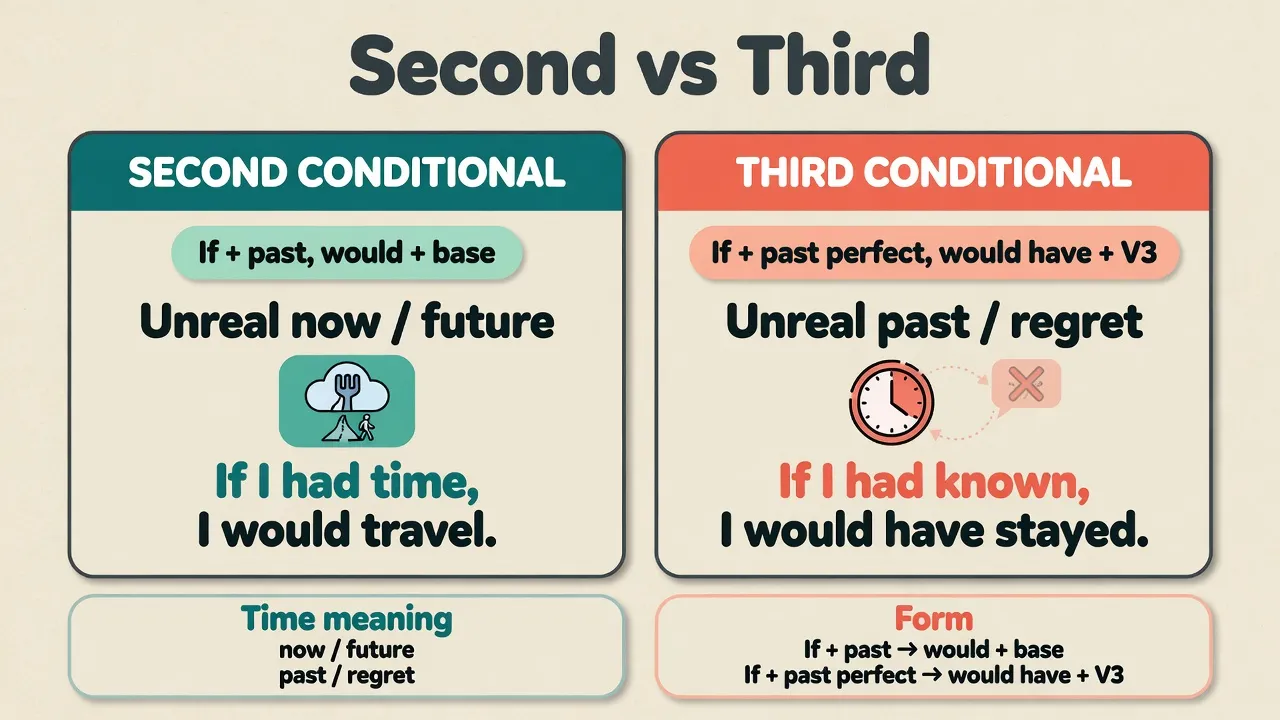
Quick test: can you still change the condition?
- Yes, in theory (even if unlikely) → Second.
- No, the moment is gone → Third.
Mixed conditionals: one clear picture
You do not need mixed forms on day one. After Zero through Third feel stable, mixed conditionals become useful: one time in the condition, another in the result.
Classic mix (past condition → present result):
If I had told the truth then, I would be freer now.
Read it slowly. The if-clause is Third-shaped (past closed). The result is Second-shaped (present consequence still felt). Past mistake. Present cost.
The reverse also exists (present unreal → past result), but one solid example is enough until the base four are automatic.
Do you need mixed early? No. Master 0-3 first. Add mixed when real texts force the pattern on you.
Emotion map: fact, plan, dream, regret
Before more theory, pin the feelings to the forms.
| Label | Type | Reader question |
|---|---|---|
| Fact / habit | Zero | Is this always how it goes? |
| Plan / warning | First | Can this still happen? |
| Dream / advice | Second | Is this imaginary or contrary to fact now? |
| Regret / rewrite | Third | Is the speaker looking back at a closed past? |
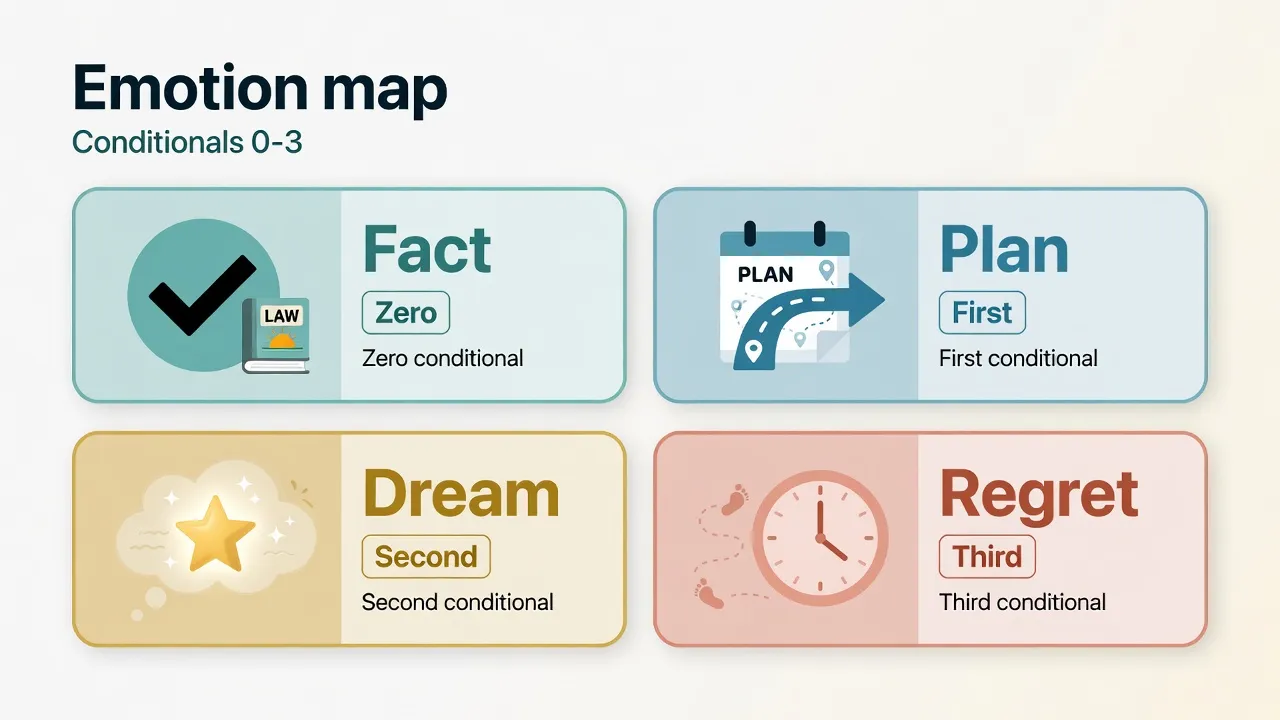
Fiction uses all four rooms. News and essays do too. Your job as a learner is not to name every line under exam pressure. It is to feel the room fast enough that the story stays clear.
Spotting checklist while reading
Use this on any page (graded text, article, novel you have rights to):
- Find the door: if / unless / when / as long as / provided that.
- Check the tense pair: present + present? present + will? past + would? past perfect + would have?
- Ask meaning: always true / real possible / dream now / regret past.
- Note were: formal Second often keeps If I/he/she were for unreal present.
- Mark one full chunk, not only the if half. Save the whole condition + result when you practice.
Fifteen to twenty minutes of reading with this checklist beats another isolated drill set for transfer. You still need some form focus. You need context more.
Related structure skill: once if-clauses get long, you also need a clear sentence spine. See our English word order guide if long sentences freeze you.
Practice path
Old path: endless gap-fills with no story. Better path: meet conditionals inside meaning, then practice the chunks.
A simple loop:
- Read a level-fit text for 15-20 minutes.
- When you hit an if-line, pause and run the checklist (do not wait for software to paint it).
- Translate only the blockers that stop meaning.
- Save the full conditional as a phrase when it matters.
- Type or recall that chunk later.
What MovaReader actually does
MovaReader is reading with support, not an AI that auto-highlights every conditional in green.
What is real:
- free graded library and samples
- click-translate on unknown words (about 20 word translations per day on the free plan)
- listening is often unlimited on the free plan
- Reader at €1 for unlimited translations
- Pro at €5/month for full trainers (phrases, typing demos)
- upload your own legal EPUB/files when you already have the rights
What is not there:
- automatic grammar color tags for Zero / First / Second / Third
- a free unlimited library of commercial bestsellers
Useful route:
- More texts: all articles
- Spanish path if you want contrast practice: article 1209
- Phrase practice demos: type training, phrase typing
- Plans and product path: pricing, how to use
The app lowers lookup friction. You still train the eye for time and reality.
FAQ
Is If I was always wrong?
In formal Second conditional teaching, If I were is the classic unreal form. In informal speech, was appears a lot. For exams and clear writing, prefer were when the meaning is unreal present. Nobody fails life for saying If I was you in a cafe.
Can I replace if with when in Zero?
Often yes for general truths: When water reaches 100°C, it boils. In First, when can shift the feel toward "this timing is expected," while if keeps a real alternative open.
First or Second: how do I choose?
Real and likely enough to plan around → First. Imaginary or contrary to fact now → Second. If it rains, we will stay in (weather can happen). If I won the lottery tomorrow, I would quit (dream distance, even if "tomorrow" is in the words).
Do I need mixed conditionals early?
No. Stabilize Zero through Third. Then learn one mixed pattern well: past condition, present result (If I had told the truth then, I would be freer now).
What is the best way to remember them?
Meaning labels (fact / plan / dream / regret) plus repeated meetings in real texts, plus whole-chunk practice. Isolated words alone rarely stick. Full if + result lines do.
Does MovaReader auto-highlight conditionals?
No. There is no automatic grammar paint for each type. You read, translate blockers within your plan's limits, listen, and practice phrases. You train recognition yourself. That is slower than an automatic tag, and more transferable.
Should I machine-translate whole if-sentences?
Fine for rough meaning once. Weak as a daily habit if you want the pattern. Prefer one or two blockers, then reread the English frame so would have still lives in English in your head.
Close: four rooms, one map
- Zero - always true, habits and laws.
- First - real possible future, plans and warnings.
- Second - unreal now, dreams and careful advice.
- Third - unreal past, regret and rewrite.
Conditionals are the architecture of dreams only if you also keep the other rooms: facts, plans, and closed pasts. Fiction uses all of them. So does a normal week of English: If the train is late... at the station; If I were free... with a friend; If I had known... after a mistake.
Start today with one short graded text. Find three if-lines. Label each fact, plan, dream, or regret. That is already real conditional practice - meaning first, formula second.
Browse more reading practice in all articles, or open pricing if you want unlimited lookups while you train.
Learning English?
The English version of MovaReader teaches Spanish and Ukrainian. To read English with a translation for every word, open the reader in Ukrainian or Spanish:
Книги англійськоюЦя стаття українськоюLibros en inglésEste artículo en español