Curated Resources
Fantasy Books in English: Difficulty Rating (Harry Potter to Dune)
Opened Dune, closed it after three invented terms. Here are 8 fantasy series scored for real English difficulty - from Percy Jackson to Tolkien - plus a progression path that does not start with the boss fight.

You decide to read fantasy in English. You open the first page of Frank Herbert's Dune - and three paragraphs later you close the book. Kwisatz Haderach, gom jabbar, Bene Gesserit... Is this even English? Do you need C2 just to finish chapter one?
Breathe. Fantasy can be great for learning English - if you pick the right rung. Difficulty jumps hard between series: Percy Jackson and early Harry Potter sit near A2-B1; Dune and The Lord of the Rings are C1-C2 boss fights, not first books. Below: 8 popular series scored 1-5 on five criteria, with CEFR bands and a green-to-red path. Warm up on free graded samples; long novels are copies you own or borrow.
Here is what you get if you keep scrolling: five scoring criteria, four color bands with all eight books, a progression path that protects your habit, a method for invented names, and a free graded warm-up before any thick novel.
Why fantasy for English learners (and why it trips you)
Fantasy has a real advantage: the plot pulls when a textbook would hit the wall. Series habit helps too - you already care what happens next, so you come back. YA dialogue often sounds closer to living English than dense Victorian prose.
The trap is invented lexicon. Names of people, places, spells, whole made-up systems. When you hit Chandrian in The Name of the Wind, your brain treats it like unknown English. It is not always a word you should grind on flashcards.
Keep in mind:
- Fantasy does not replace A1 grammar if basic sentences still fall apart.
- Finishability beats prestige. A finished Percy Jackson beats an abandoned Dune.
- You do not need Anki cards for pure proper nouns and lore tags (Voldemort, house names, spell labels). Mark real English blockers instead.
For a light warm-up before long books, try a free English A2 sample or browse all free texts.
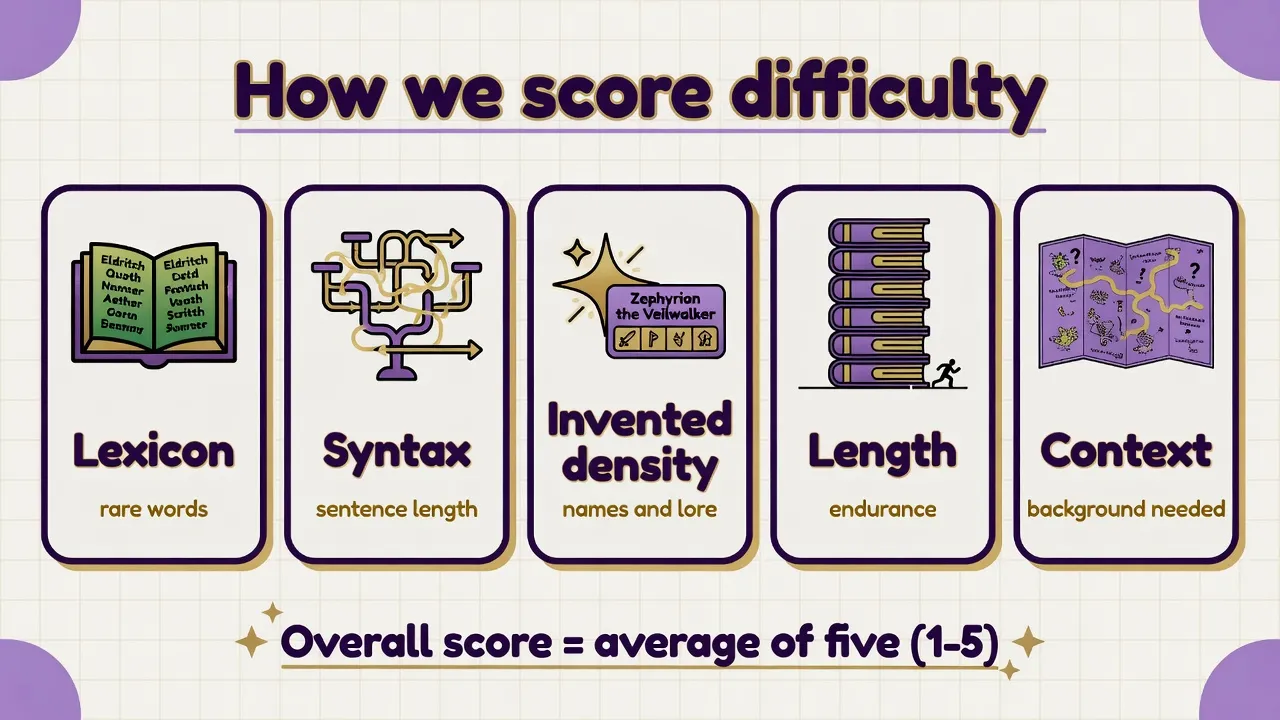
How we score difficulty: 5 criteria
These are editorial estimates for learners, not exam certificates. Overall score = average of five scores from 1 to 5. The CEFR band is a comfort band: roughly, you can follow the plot without word-by-word collapse. It is not a claim that natives find every YA title "easy."
| # | Criterion | What it measures |
|---|---|---|
| 1 | Lexicon | Rare words, archaisms, jargon |
| 2 | Syntax | Sentence length and structure |
| 3 | Invented density | Names, places, spells, conlang load |
| 4 | Length | Endurance (word / page load) |
| 5 | Context | Background / culture needed |
One glance at the five axes before the books:
Four difficulty bands - all 8 books
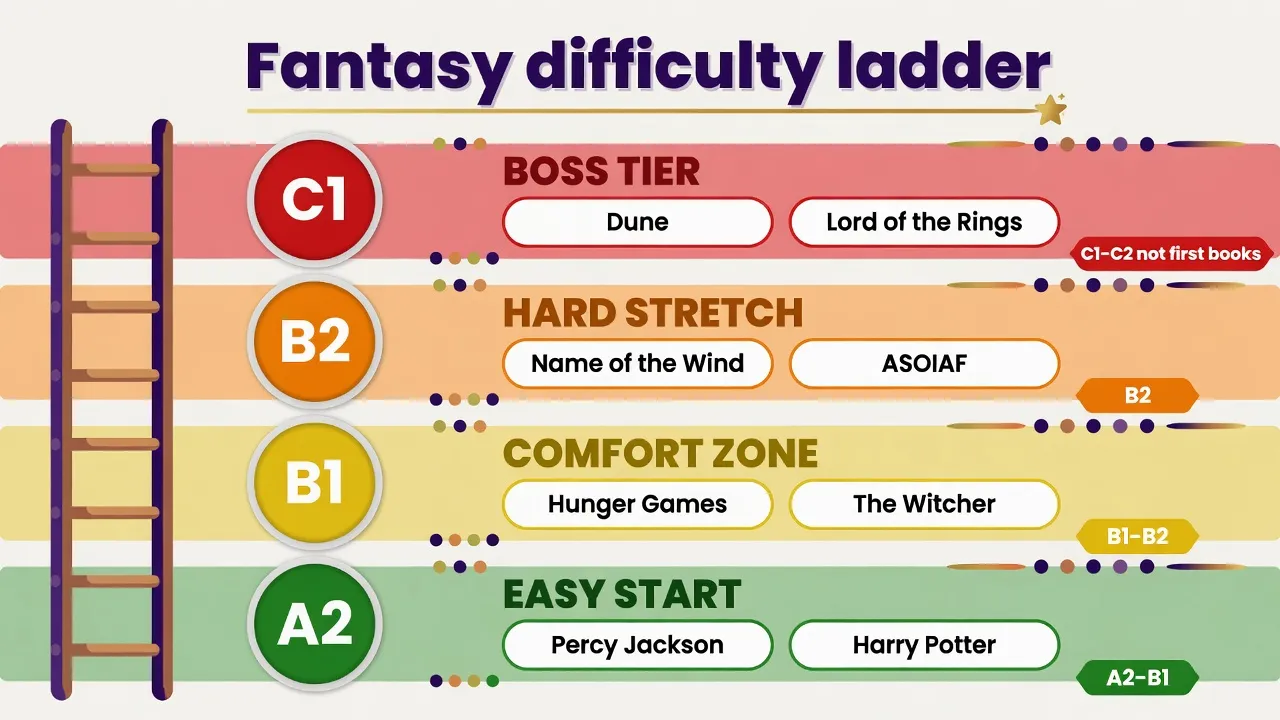
Green start at the top, red bosses at the bottom. Order is by difficulty, not prestige. Scores are /5 averages.
| Series | Author / note | Score /5 | CEFR | Main friction |
|---|---|---|---|---|
| Percy Jackson | Rick Riordan | 1.6 | A2 | Lightest modern spoken English; myth names still appear |
| Harry Potter | J.K. Rowling | 1.8 | A2-B1 | Books 1-3 easier; from Goblet of Fire climbs toward B1-B2 |
| The Hunger Games | Suzanne Collins | 2.4 | B1 | Short tense prose; dystopia-adjacent world terms |
| The Witcher | Sapkowski (EN tr. David French) | 2.6 | B1-B2 | Slavic names / places; grammar often clearer than fans fear |
| The Name of the Wind | Patrick Rothfuss | 3.2 | B2 | Poetic diction; rare English + lore |
| A Song of Ice and Fire | George R.R. Martin | 3.4 | B2 | Length + cast + dense description |
| Dune | Frank Herbert | 4.2 | C1 | Heavy invented lexicon + politics / ecology; not a first book |
| The Lord of the Rings | J.R.R. Tolkien | 4.4 | C1-C2 | Archaic diction + long syntax + inventiveness; not a first book |
The same ladder as a picture - all eight titles on green-to-red rungs:
Level 1 - Easy start (A2-B1)
Percy Jackson (Rick Riordan) - 1.6 / A2
| Criterion | Score |
|---|---|
| Lexicon | 1 |
| Syntax | 1 |
| Invented density | 2 |
| Length | 2 |
| Context | 2 |
Short spoken sentences, modern humor, lightest start in this set. Riordan writes in a teenager's first-person voice - living slang, few archaisms.
"Look, I didn't want to be a half-blood. If you're reading this because you think you might be one, my advice is: close this book right now."
Watch: myth names still show up. Treat them as labels, not English vocabulary to grind. Who first: A2 readers who want confidence before school-ish HP volume.
Harry Potter (J.K. Rowling) - 1.8 / A2-B1
| Criterion | Score |
|---|---|
| Lexicon | 2 |
| Syntax | 1 |
| Invented density | 2 |
| Length | 2 |
| Context | 2 |
Golden start for many learners. Early books lean on everyday lexicon; invented terms (Quidditch, Muggle) often clear from context.
"Mr. and Mrs. Dursley, of number four, Privet Drive, were proud to say that they were perfectly normal, thank you very much."
The climb: books 1-3 easier; from Goblet of Fire toward B1-B2. Lifehack: do not skip straight to later HP because of the films.
Level 2 - Comfort zone (B1-B2)
The Hunger Games (Suzanne Collins) - 2.4 / B1
| Criterion | Score |
|---|---|
| Lexicon | 2 |
| Syntax | 2 |
| Invented density | 2 |
| Length | 3 |
| Context | 3 |
Technically dystopia-adjacent, but it sits fairly on this fantasy-ish ladder for learners. Short tense prose and plot pull keep pages turning.
"I stare down at my ugly hands, pressing them to the cold glass of the window. I try to imagine the person who could do this to children."
Watch: world terms plus tension. Keep sessions short if atmosphere drains you.
The Witcher (Andrzej Sapkowski, EN tr. David French) - 2.6 / B1-B2
| Criterion | Score |
|---|---|
| Lexicon | 3 |
| Syntax | 2 |
| Invented density | 3 |
| Length | 3 |
| Context | 2 |
Surprise for many fans: the English translation is often clearer than people fear. Main friction is Slavic names and places (Novigrad, Kaer Morhen, Yennefer), not wall-to-wall impossible grammar.
"People," Geralt turned his head, "like to invent monsters and monstrosities. Then they seem less monstrous themselves."
Lifehack: light name list for plot; look up real English blockers only (invent, monstrosities, monstrous).
Level 3 - Hard stretch (B2)
The Name of the Wind (Patrick Rothfuss) - 3.2 / B2
| Criterion | Score |
|---|---|
| Lexicon | 4 |
| Syntax | 3 |
| Invented density | 3 |
| Length | 4 |
| Context | 2 |
Poetic diction. Rare English plus lore density. Beautiful prose costs vocabulary - do not confuse style with "easy YA."
"Words are pale shadows of forgotten names. As names have power, words have power. Words can light fires in the minds of men."
Watch: pale shadows, forgotten names are not A2 chalk words. Save a few phrases that actually block meaning; skip pure lore labels.
A Song of Ice and Fire (George R.R. Martin) - 3.4 / B2
| Criterion | Score |
|---|---|
| Lexicon | 3 |
| Syntax | 3 |
| Invented density | 4 |
| Length | 5 |
| Context | 2 |
Quotes can be simple while pages between are heavy. Cast size plus length crush finishability. A Game of Thrones alone is roughly four times Philosopher's Stone in word count.
"When you play the game of thrones, you win or you die. There is no middle ground."
Watch: endurance first. A mini cast map helps more than flashcarding every house name. Dialogue-first days help when banquet paragraphs exhaust you.
Level 4 - Boss tier (C1-C2)
Dune (Frank Herbert) - 4.2 / C1
| Criterion | Score |
|---|---|
| Lexicon | 5 |
| Syntax | 4 |
| Invented density | 5 |
| Length | 4 |
| Context | 3 |
Heavy invented lexicon wall plus politics and ecology load. Not a first book. Tools reduce friction; they do not turn C1 prose into B1.
"I must not fear. Fear is the mind-killer. Fear is the little-death that brings total obliteration. I will face my fear. I will permit it to pass over me and through me."
That Litany is one of the simpler stretches. Typical Herbert packs several terms no dictionary owns. Bottom line: start easier, climb later.
The Lord of the Rings (J.R.R. Tolkien) - 4.4 / C1-C2
| Criterion | Score |
|---|---|
| Lexicon | 5 |
| Syntax | 5 |
| Invented density | 4 |
| Length | 5 |
| Context | 3 |
Archaic diction, long syntax, inventiveness. Tolkien was a linguist; you feel it. Not a first book.
"The world is indeed full of peril, and in it there are many dark places; but still there is much that is fair, and though in all lands love is now mingled with grief, it grows perhaps the greater."
Peril, fair (beautiful, not "honest"), mingled - C1-ish lexicon in long nested clauses. Dialogue-first days help when landscape paragraphs exhaust you.
Your progression path: green to red
Stay on a rung until a 3-page sample feels green or yellow. Prestige FOMO is a habit killer.
| Step | Band | Route |
|---|---|---|
| 1 | A2 | Percy Jackson → Harry Potter (books 1-3) |
| 2 | B1 | Harry Potter (4-7) → Hunger Games → Witcher |
| 3 | B2 | Name of the Wind → A Song of Ice and Fire |
| 4 | C1 | Dune → Lord of the Rings |
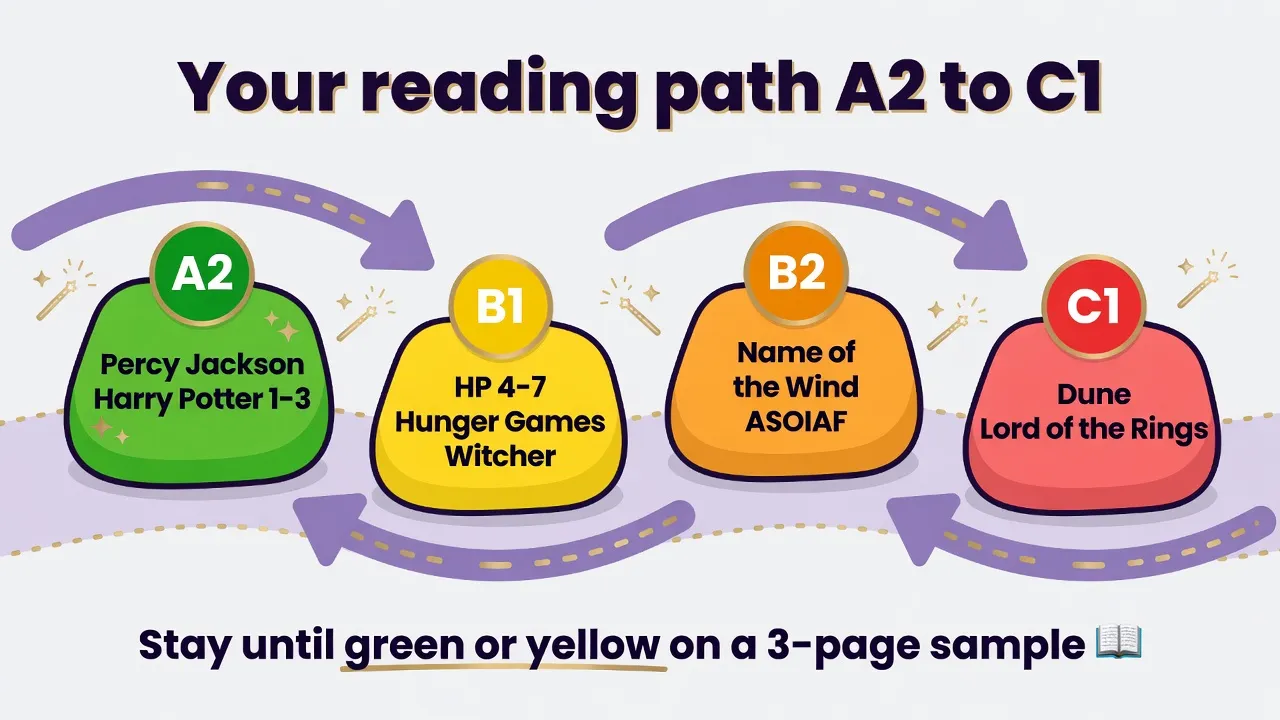
Finishability rule: protect daily habit. Finishability > prestige.
Each rung adds denser real vocabulary and more name noise. Track blockers that reappear. Do not expect a fixed "words per level" quota, and do not treat six months to comfortable Dune as a guaranteed skill outcome.
Want another angle without this 1-5 matrix (including Mistborn and prose-friction notes)? See another fantasy difficulty ranking.
How to read fantasy without drowning in invented names
Human method. No auto lore dictionary required.
- 3-page comfort test - open near the start, mid-chapter, and another chapter. Label green / yellow / red.
- Blockers only - if plot holds, skip rare adjectives. Look up words that block who-did-what.
- Name list, not Anki factory - light list of recurring people and places for plot. Skip grinding pure proper nouns and made-up lore tags as "English vocabulary."
- Graded + own book mix - free level texts some days; long novel days on EPUB or paper you own.
- Dialogue priority when landscape paragraphs exhaust you (especially LOTR and ASOIAF).
Warm-up when the novel feels red: all free texts. When review of saved phrases is the bottleneck, light phrase practice or trainers help more than more name cards.
How to use MovaReader with fantasy novels
Free graded English texts warm you up. Long fantasy novels stay your EPUB or paper copy. MovaReader helps with click-translate on supported texts and phrase practice on files you already have. It does not host full commercial Dune, Harry Potter, Witcher, or similar bestsellers for free, and it does not auto-run a fictional-term CEFR engine or a real-time comprehension % dashboard.
A simple loop:
free graded EN sample
  → 3-page comfort test on real book
  → own EPUB / paper in the reader
  → blockers only + light name list
  → phrase trainers when review is the bottleneck
  → next ladder rung
| Plan | What you get | Fit for this ladder |
|---|---|---|
| Freemium | Free graded library; click-translate on supported texts; about 20 word translations/day; unlimited listening | Warm-up + short sessions |
| Reader €1/mo | Unlimited reading translations | Long novels you own without a daily translation wall |
| Pro €5/mo | Full trainers | When review of saved phrases is the bottleneck |
Details: pricing. Own-file workflow: how to use.
What it does not do: host free full commercial fantasy or turn C1 into B1 overnight.
Soft start today: all free texts → word training demo → phrase training demo → your own EPUB via how to use.
FAQ
Should I start with Dune or Lord of the Rings?
No for most learners. Both sit on the red boss tier: Dune about 4.2 / C1, LOTR about 4.4 / C1-C2. Start on A2-B1 rungs (Percy Jackson, early Harry Potter), then climb. Prestige titles make poor first habits.
What CEFR level is Harry Potter?
Not one flat level for the whole series. Early books are roughly A2-B1 (score 1.8 here). From Goblet of Fire the climb toward B1-B2 is real. Treat books 1-3 as the gentle start, not book seven.
Is The Witcher hard in English?
Mid ladder: 2.6 / B1-B2. The English translation is often clearer than fans fear. Main friction is Slavic names and places, not wall-to-wall impossible grammar. Use a light name list; look up real English blockers.
What is the easiest fantasy book for English learners here?
Percy Jackson (1.6 / A2), then early Harry Potter (1.8 / A2-B1). Warm up on free graded samples first if even Percy feels red on a 3-page test.
How do I handle invented names and spells?
Track plot with a light name list. Skip grinding pure proper nouns and made-up lore tags as Anki "English vocabulary." Look up words that actually block who-did-what. Tools can speed lookups; they do not replace your judgment.
Do I need a special app to "filter" fictional terms?
No special CEFR engine is required. What you have: click-translate on supported text, your own judgment on names vs real English, and a daily limit on word lookups in the free plan - not an auto lore dictionary as a skill substitute. Free graded warm-up still helps before a long novel you own.
Next steps
Your first fantasy book in English is not Dune (or LOTR as a day-one boss).
- Pick a green or yellow rung - Percy or early HP for most starters.
- Protect daily habit: blockers only + light name list.
- Today: free English A2 sample → 3-page test on Percy or HP → only later Witcher, Martin, and the bosses.
- Tools reduce friction; they do not turn C1 prose into A2.
When you want unlimited lookups on a novel you own, check pricing. Climb the ladder one rung at a time.
Learning English?
The English version of MovaReader teaches Spanish and Ukrainian. To read English with a translation for every word, open the reader in Ukrainian or Spanish:
Книги англійськоюЦя стаття українськоюLibros en inglésEste artículo en español