Curated Resources
5 Business English Books for Real Workplace Vocabulary
Five practical business English books for B2-C1: product language, negotiation frames, strategy, analytical English and management talk, with levels and a short reading plan.
You can finish a Business English course, tick every Market Leader module, and still freeze on a real call. Words like leverage, trade-off, runway, and push back look simple on a slide. They feel different when you need to hear them, answer, and sound natural in the same breath.
The problem is rarely "no talent." Textbooks give clean dialogues. Real workplace English lives in books, emails, status updates, and negotiations. Good business nonfiction will not replace live practice with people. It does give dense context that word lists never deliver.
Plain answer. Five English business books that actually build workplace language: The Lean Startup, Zero to One, Never Split the Difference, Thinking, Fast and Slow, and The Hard Thing About Hard Things. Best from solid B2 up. They will not double your salary. They will give recurring collocations and decision English if you read short sessions, save phrases not bare nouns, and do a tiny weekly output.
Better Business English can support a career. Pay depends on market, role, company, and the value you deliver - not five bestsellers on a shelf. Treat this list as a language ladder, not a compensation plan.
A quick note first: MovaReader does not host licensed commercial business books by default. The library has free graded texts. Long titles you upload yourself (for example EPUB) when you have the right to use them. It offers click-to-translate, audio, saved words and phrases, and trainers in its plans.
In this guide:
- who the list fits (and who should wait)
- why books beat isolated word lists
- five titles with level, audience, key language, and a reading method
- an 8-12 week path that protects the habit
- a collocation-first method and how MovaReader fits in
- short answers to common questions
Who is this list for?
Match the list to your level and goal, not to a title that sounds impressive on LinkedIn. Business nonfiction rewards readers who already handle basic nonfiction flow. If every page is a wall of unknowns, you will stop - and stopping kills the vocabulary gains.
| Your level / goal | Take this list if... | Wait or warm up if... |
|---|---|---|
| Strong B1 - low B2 | You already read simple nonfiction | Short news still feels heavy |
| Solid B2 | You need domain language for work | You only want fiction right now |
| B2-C1 for career | You work with English teams or clients | An exam register matters more than workplace talk |
| C1+ | You want denser strategy and decision prose | You expected "business English for A2" |
Quick check: open a random page of The Lean Startup or Never Split the Difference. If you understand about 80-90% without a dictionary, the book is yours. If you are under ~70%, spend 1-2 weeks on free graded texts first: all articles.
If exam English is your only goal this quarter, prioritize exam materials. If your pain is meetings, emails, and negotiations, these books sit closer to that register than another unit of sterile dialogues.
Why business books beat word lists
Context changes meaning. The same lemma can mean three different things depending on the room you are in.
"We need to leverage our existing customer base to drive new revenue streams."
Here leverage is not a school "lever." It means use something for maximum return. Drive means push or generate. Revenue streams means sources of income. Three units in one sentence - and all of them live in collocations, not in isolation.
That is why a useful loop looks like this:
- Read a full argument, not a vocab dump
- Capture only words that block meaning
- Save collocations, not naked nouns
- Once a week, write or say a short update with the phrases you kept
Flashcards help after context. They do not replace it. A deck of runway, pivot, and anchor without sentences will not teach you when each one sounds natural in a stand-up or a board update.
Here is the ladder of the five titles in this guide - product and negotiation first if you need usable language fast, then strategy and management, then denser analytical prose:
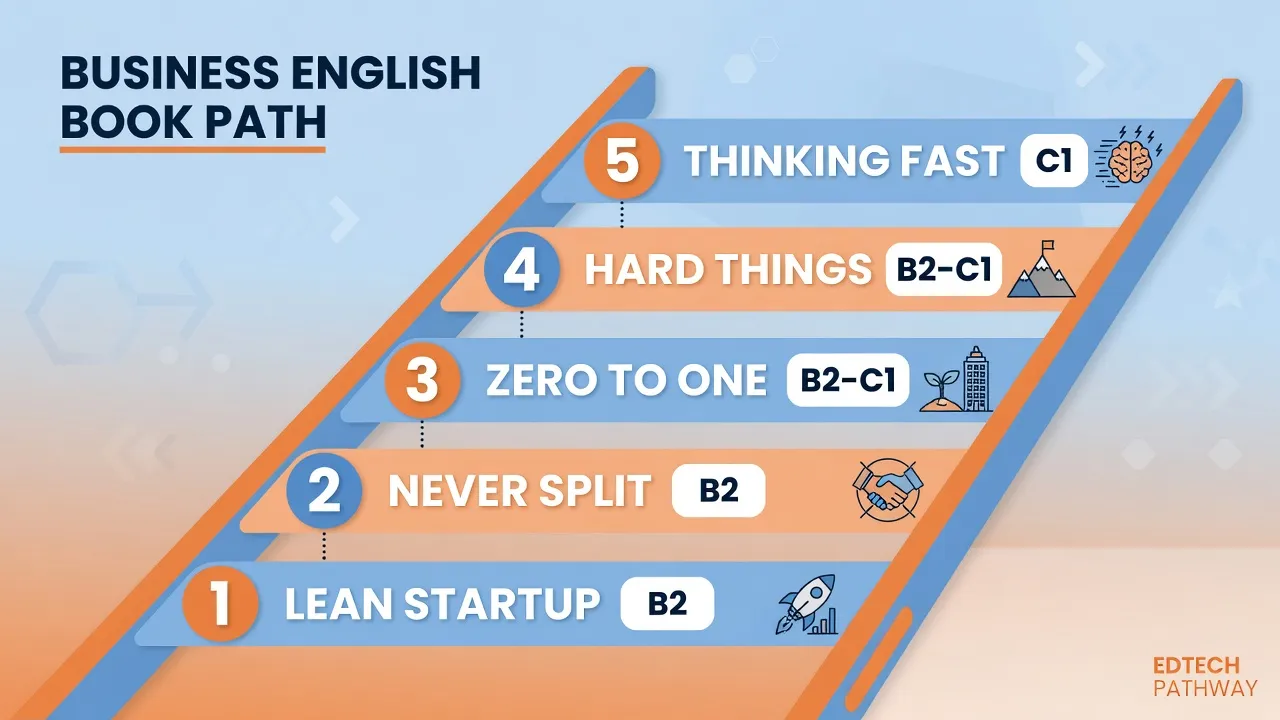
Book 1: The Lean Startup - Eric Ries
Realistic level: solid B2
Best for: product, startup, tech, delivery teams
Why it helps: Terms you hear on real meetings every week.
Watch for: Silicon Valley shorthand and borrowed English that feels "techy." That is normal for the industry.
Key language: MVP, pivot, validated learning, actionable metrics, build-measure-learn, hypothesis, experiment, runway (in a startup cash sense).
How to read for language:
- Save process verbs: validate, measure, iterate, kill a feature
- After a chapter, write a 4-line product update in English
- Do not outline the whole methodology if your real goal is language
A strong first "tech-business" book if you already work in IT and want less silent translating in your head. You will meet the same clusters in roadmaps, retros, and investor updates - which is exactly why they stick better than a random 50-word business deck.
Book 2: Zero to One - Peter Thiel
Realistic level: strong B2 - low C1
Best for: strategy, investment, founders, innovation roles
Why it helps: Dense, precise argument; lots of contrast and definition-style sentences.
Watch for: Abstract passages. Pace can drop.
Key language: monopoly vs competition, contrarian, first-mover advantage, vertical progress, definite optimism, startup as a way of thinking, not only a company type.
How to read for language:
- After a short section, state the author's thesis in one sentence
- Lift 5 contrast frames: not X but Y, the next Y will not simply copy X
- Compare one claim to your industry in 3-5 sentences
This is not light evening fluff. It is a gym for dense business-reasoning English. If you write strategy notes or long Slack threads that need a clear spine, the contrast frames alone repay the effort.
Book 3: Never Split the Difference - Chris Voss
Realistic level: solid B2
Best for: sales, HR, procurement, customer success, salary talks
Why it helps: Ready-made negotiation frames you can use almost the next day.
Watch for: FBI stories. Take the principle, not the theatre.
Key language: tactical empathy, mirroring, labeling, calibrated questions, no-oriented questions, black swan (as a surprising fact in a deal).
How to read for language:
- Save ready frames, not only labels: It seems like..., How am I supposed to...?
- After a chapter, write 3 calm refusal lines
- Speak one dialogue out loud for 60-90 seconds
If you could keep only one book "for tomorrow's hard conversation," this one often wins. The language is conversational enough for solid B2, and the frames transfer to client calls, vendor talks, and performance discussions - not only hostage lore.
Book 4: Thinking, Fast and Slow - Daniel Kahneman
Realistic level: strong B2 - C1
Best for: analytics, marketing, product, finance, research
Why it helps: Decision, bias, and evidence language that shows up in serious reports.
Watch for: Academic density. Prefer short sessions.
Key language: cognitive bias, anchoring, loss aversion, heuristic, regression to the mean, System 1 / System 2 (as handy labels in the text).
How to read for language:
- One subsection = one bias + one work example from your job
- Save evidence-evaluation phrases: is not easily distinguished from, a reliable way to...
- Do not race the whole book for a checkbox finish; quality beats volume
For many readers this is the hardest title on the list. That is fine. Its value is precise analytical English. Leave it for later if Lean Startup already felt heavy - depth is useful only if you keep showing up.
Book 5: The Hard Thing About Hard Things - Ben Horowitz
Realistic level: strong B2 - C1
Best for: leads, founders, CEO/CTO-track roles, people in hard decisions
Why it helps: Direct managerial English without corporate sugar.
Watch for: Tough tone and a US startup context. The language is useful; not every piece of advice is universal.
Key language: wartime CEO / peacetime CEO, the struggle, hire for strengths, lead bullets (vs silver bullets), give ground grudgingly, organizational communication.
How to read for language:
- Lift management lines for 1:1s and all-hands
- After a chapter, write a short decision note: problem → options → decision → risk
- Save constructions that push back on weak arguments: that's fine, but that wasn't the hard part
Works well after the lighter titles, once product and finance vocabulary already feel familiar. Read it for the managerial register: how people name conflict, trade-offs, and bad news without hiding behind soft corporate fog.
A realistic 8-12 week plan
You do not need five books open at once. One finishable path beats a guilty stack on the nightstand.
| Weeks | Book | Focus |
|---|---|---|
| 1-3 | The Lean Startup or Never Split the Difference | Fast applied language |
| 4-6 | The other of those two | Lock a second register (product vs negotiation) |
| 7-9 | Zero to One or Hard Thing... | Strategy / management |
| 10-12 | Thinking, Fast and Slow in small bites | Analytical English |
Rules that protect the habit:
- 15-25 minutes on weekdays beats a Saturday guilt marathon
- 5-15 phrases per session, maximum
- Once a week: short output (email, Slack update, 60-second voice note)
- If understanding falls under ~70%, return to graded texts for a few days
- Skip chapters that are pure case detail if the language density is low and your energy is lower
A simple strip of that plan:
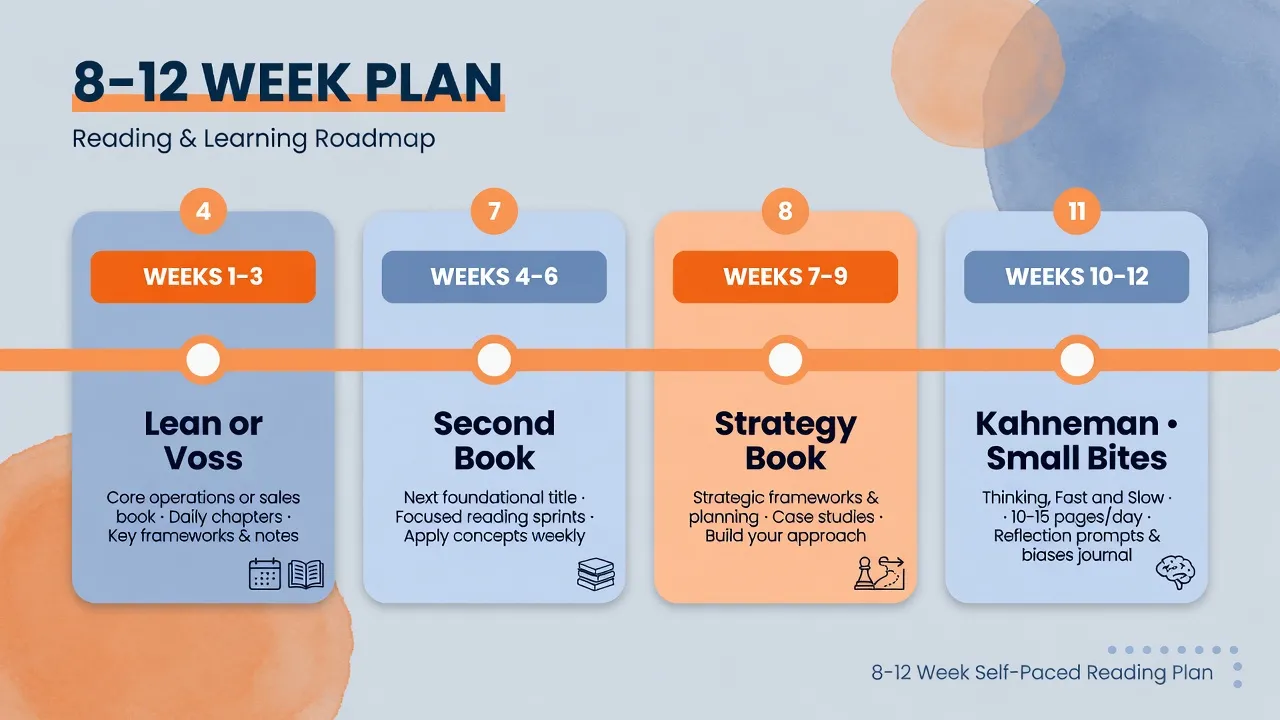
If twelve weeks is too long, cut to six: one applied book (Ries or Voss), then one denser book (Thiel or Horowitz). Keep the weekly output. The plan exists to protect rhythm, not to grade you.
How to work a business book without dictionary hell
1) Separate language from advice
You can learn excellent English from a book whose ideas you only half agree with. Mark the language. Judge the advice on its own. Your goal is usable workplace English, not agreement with every Silicon Valley claim.
2) Collocations beat word lists
Better: drive revenue, run an experiment, push back politely, close the gap
Worse: revenue, experiment, gap with no neighbors
When you save a phrase, keep the verb + object, or the frame + slot. That is what you will reuse in a meeting.
3) Translate only blockers
If the decision and logic are clear, keep reading. If one term kills the whole sentence, check it, save it, move on. Looking up every adjective trains patience for dictionaries, not fluency in speech.
4) Do a tiny output
After a section:
- a 5-sentence summary, or
- a mock email / update, or
- a 1-minute spoken retell
Input alone builds recognition. Small output builds working language. The weekly output is the difference between "I have seen this word" and "I can say this under pressure."
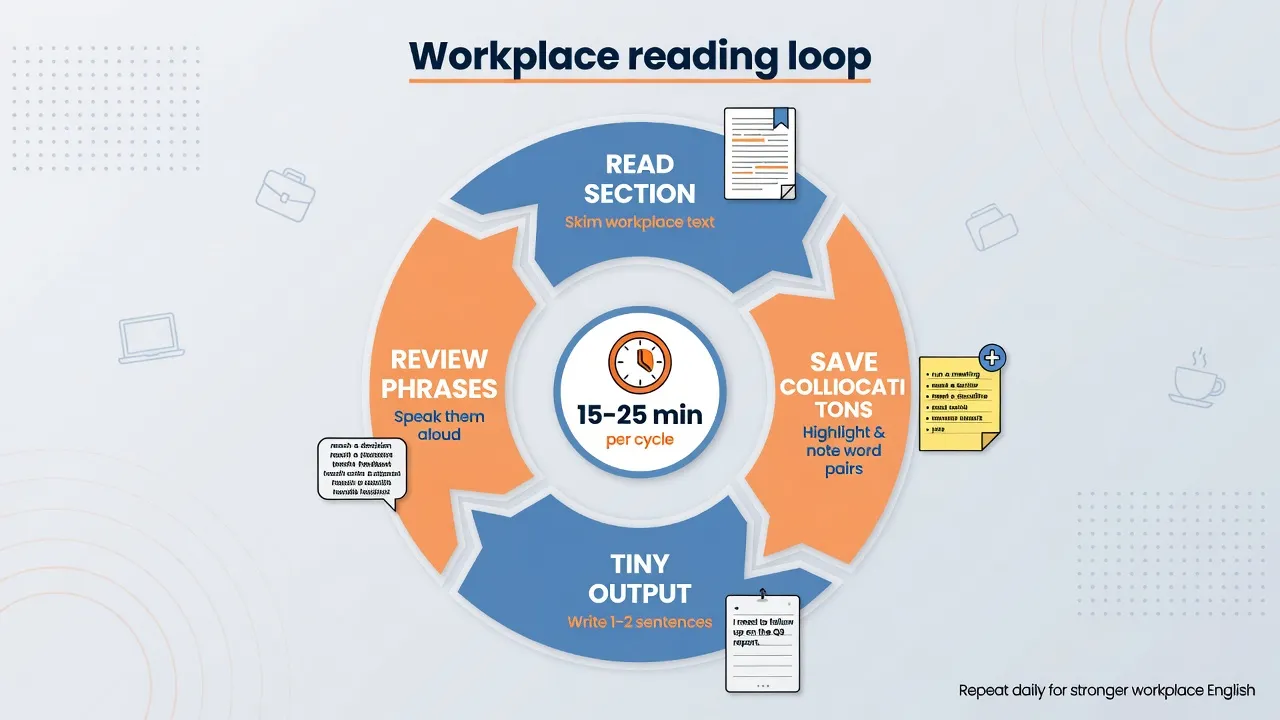
The read → save collocations → short output loop:
How to use MovaReader
MovaReader lowers friction. It does not replace thinking, mentoring, or live practice.
- Warm up on free texts in All articles. Graded pages rebuild speed before a dense chapter.
- Upload a book file you own when you are ready. See How to use. Free library content is not a free copy of commercial bestsellers.
- Tap only meaning blockers, not every unknown word.
- Train a small phrase set in the word training demo and phrase typing demo, then in trainers.
- Clear pricing: free includes listening and 20 word translations per day. Reader (€1) unlocks unlimited translations. Pro (€5/month) unlocks full trainers. Details: Pricing.
A clean start today:
- Word training demo
- Phrase typing demo
- Upload one book you own and begin with Lean Startup or Never Split the Difference
FAQ: Business English through books
Will these books double my salary?
No. Stronger Business English can open options: clearer interviews, cleaner updates, less friction with English-speaking teams. Compensation still depends on market, role, and results.
Which book should I start with?
Tech or product work: The Lean Startup.
Hard talks and negotiation: Never Split the Difference.
If nonfiction still feels heavy: graded texts first, not Kahneman.
If you already live in product language and want managerial tone: skip ahead to Horowitz later, not first.
Do I need B2 or C1 for this list?
Solid B2 is the comfort zone. Strong B1 can start with the lighter title and more support. C1 readers move faster and can take Kahneman or Horowitz earlier. Level labels here are soft editorial estimates for learners, not exam results.
Are flashcards enough?
Flashcards help after context, not instead of it. Business English sticks better when the term first appears inside an argument you care about. Save the collocation from the page, then drill that phrase - not a random synonym list.
Must it be these five authors?
No. The principle matters more: modern nonfiction in your field + short sessions + few saved phrases + weekly output. This list is a practical start, not dogma. A solid industry book you will finish beats a famous title you abandon.
Can I read only news instead of books?
Yes, if news keeps the habit alive. Books give deeper recurring terms. News gives freshness. The best mix is both: news for volume days, books for denser registers.
Closing
Business English is not "more grammar in a suit." It is repeated professional language inside decisions: product, money, people, risk, deals.
Pick one book you will actually finish. Save fewer phrases. Use them in short output. MovaReader can lower friction on your own files and free graded texts.
Want a clean start today? Begin the easiest relevant title from this list in short daily sessions.
Learning English?
The English version of MovaReader teaches Spanish and Ukrainian. To read English with a translation for every word, open the reader in Ukrainian or Spanish:
Книги англійськоюЦя стаття українськоюLibros en inglésEste artículo en español