Tips & Methods
English Job Interview Prep: A Clear Plan for Non-Native Speakers
You do not need perfect Advanced English to interview well. You need a clear story about your work, a few STAR examples, and phrases that buy you time when you miss a question.
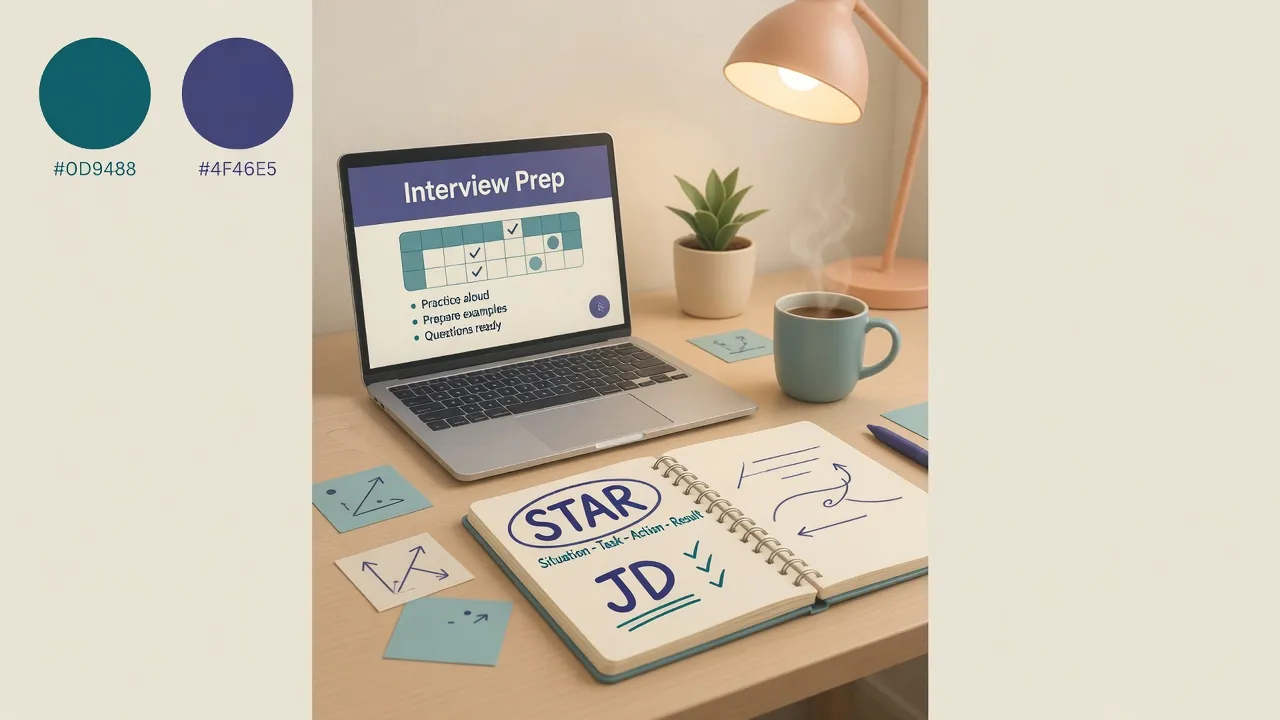
The calendar invite lands. "Interview - English." Your stomach does that small flip. You are not scared of the job. You are scared of freezing on a question, missing a word, or sounding less sharp than you are in your first language.
Here is the useful truth: for most roles, recruiters are not grading you on a CEFR scale. They want to understand your work. Can you explain what you did, what problem you solved, and why you would help them? That is the bar.
Short answer. You do not need perfect Advanced English to interview well. Pull keywords from the job description, prepare 3-4 STAR stories, rehearse five classic questions, practice a little small talk, and memorize a few clarify / buy-time phrases. Small grammar mistakes are fine if the answer is clear. This guide gives you a plan you can actually finish.
Why your CEFR level is not the whole interview
Unless you are applying for an English teacher, interpreter, or language-heavy role, the interviewer is not sitting there with a Cambridge checklist. They care about hard skills, soft skills, and whether you can work with the team in English.
If you can clearly explain:
- what you owned in the last job
- which problems you solved
- what you would bring to this team
...you already pass the communication test for many roles. Forgetting a Present Simple -s or mixing up a and the is not a deal-breaker when the story is clear. Confidence comes from structure, not from "I must sound native for 45 minutes."
What does hurt you is chaos: long rambling answers, zero examples, or silence when you miss one word. Structure fixes most of that.
Step 1: Mine the job description for vocabulary
Do not start with random grammar review. Start with the vacancy text.
Read the job description a few times. Circle verbs and nouns that repeat. Those are your target chunks.
- List the key requirements. Examples: manage cross-functional teams, implement scalable solutions, drive user engagement, own the roadmap.
- Rewrite your experience in that language. If you "ran a team," do not say "I was a boss." Say: "I managed a cross-functional team of five."
- Prefer action verbs. Achieved, designed, launched, optimized, resolved, led, shipped beat weak passive lines.
Say those chunks out loud until they feel automatic. Reading them once is not enough.
If you want a low-friction drill, put the job phrases into a set and run them in the phrase trainer. The free plan is enough to start; more volume is a paid choice later, not a requirement for week one.
Step 2: STAR for behavioral questions
Behavioral questions usually start with "Tell me about a time when..." Interviewers like them because past behavior is a decent signal for future work.
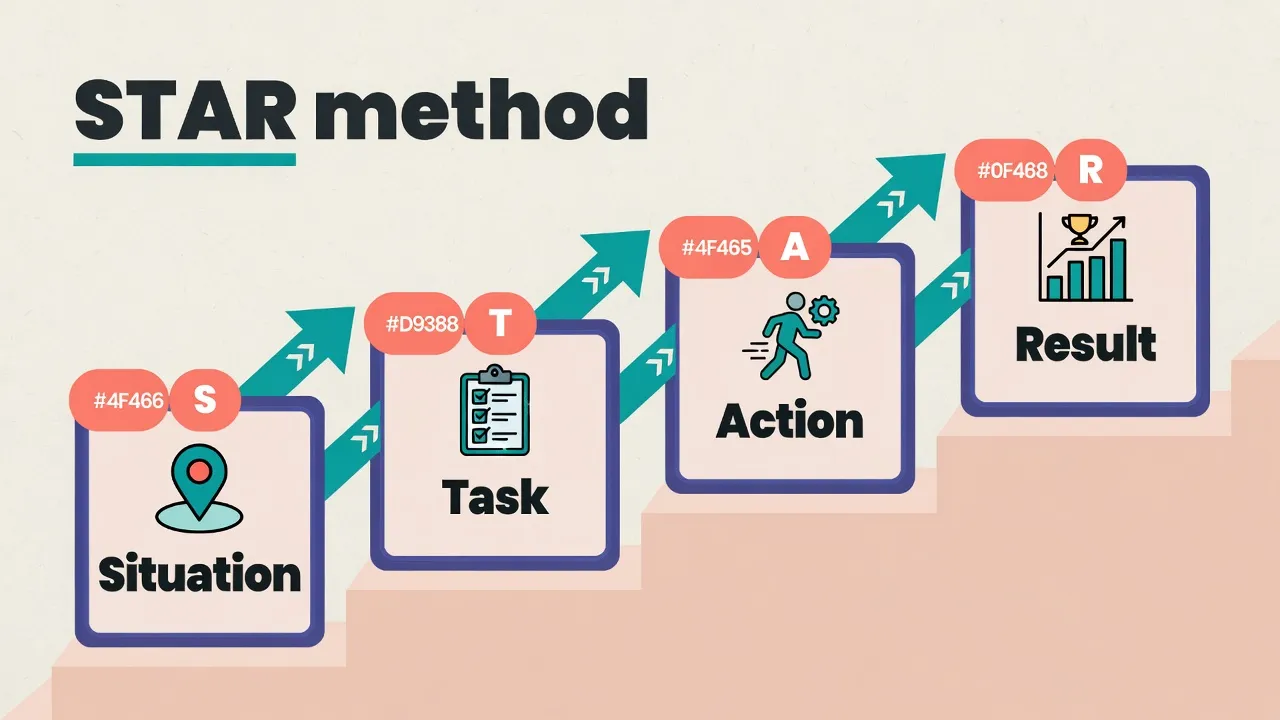
The clean structure in English is STAR:
| Letter | Meaning | What you say |
|---|---|---|
| S | Situation | Short context |
| T | Task | Your responsibility |
| A | Action | What you did (use "I", not only "we") |
| R | Result | Outcome, with numbers when you can |
Worked example:
- S: We had a tight deadline for a new product launch.
- T: My task was to stabilize the backend before release.
- A: I added a caching layer and rewrote three heavy SQL queries.
- R: Load time dropped by about 40%, and we shipped on time.
Prepare 3-4 stories you can reshape for teamwork, conflict, deadlines, failure recovery, or leadership. Write them in English early. Translating full paragraphs from your first language in real time creates lag and panic.
Here is STAR as a simple ladder you can keep on one sticky note:
Step 3: The top 5 questions (with skeletons)
These show up in a huge share of interviews. Do not memorize a script word for word. Memorize the shape, then fill it with your facts.
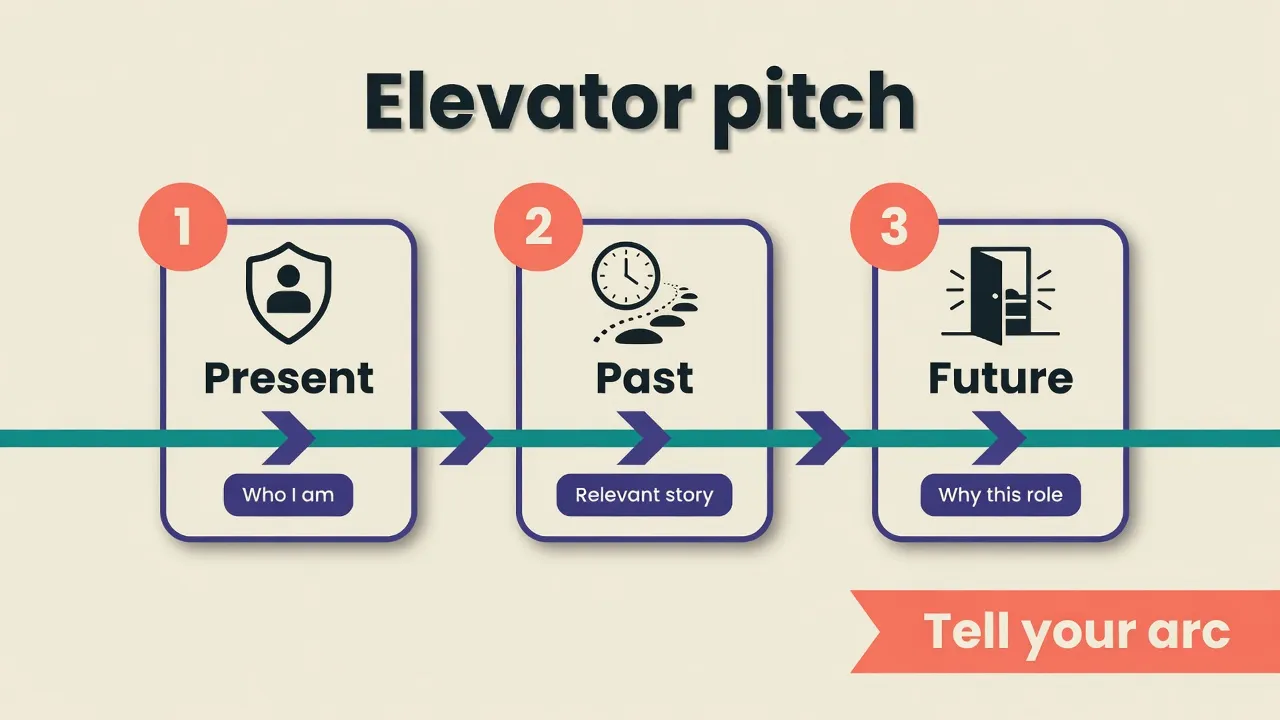
1. "Tell me about yourself"
This is not your life story from childhood. It is a short pitch.
Structure: present role → relevant past → why you are here now.
- Present: I am currently a product analyst at...
- Past: Before that, I spent three years working on...
- Future / fit: I am looking to bring that experience to a team like yours because...
Keep it under two minutes. Then stop.
2. "Why do you want to work here?"
They are checking whether you researched them. Avoid "I need a job" and "It seems like a good company."
Skeleton: I followed your recent work on X. I like how you approach Y. I want to contribute to Z with my background in...
Name one real product, news item, or value - something you can only say if you looked them up.
3. "What are your greatest strengths and weaknesses?"
- Strengths: Match the job description. I am strong at solving messy problems under pressure and explaining trade-offs to non-technical stakeholders.
- Weaknesses: Skip the fake "I am a perfectionist." Pick a real, non-fatal weakness and show what you do about it. I used to hold tasks too long instead of delegating. Now I use a shared board and weekly handoff check-ins.
4. "Where do you see yourself in five years?"
They want ambition that still fits the role. Skeleton: In five years I want to be a strong specialist in this area, take more ownership, and mentor juniors when it makes sense.
Avoid "I want your manager's job next year" unless the process is clearly for that path.
5. "Why should we hire you?"
Close the loop. My background in X maps to your need for Y. I learn fast, and I can start contributing without a long ramp-up.
Tie it to their pain points, not a generic "I am hardworking."
Step 4: Small talk is part of the interview
In many English-speaking hiring cultures, the first two or three minutes are light talk. It is not wasted time. It lowers stress and shows basic social English.
You might hear:
- How is your day going?
- How is the weather where you are?
- Did you have any trouble joining the call / finding the office?
Do not answer with one word. Use a full line and bounce a question back:
- My day is going well, thanks. I have been looking forward to this conversation. How is your day going?
Listening practice helps here more than another grammar worksheet. Short graded articles with audio on all articles (for example EN A2 sample) train your ear for natural pace without exam pressure.
Step 5: When you do not catch the question
This is the fear most non-native candidates name first. Someone speaks fast. The accent is new. One word blocks the whole sentence.
Rule: do not invent an answer. Clarifying is professional. Native speakers ask for repeats too.
Learn these lines cold:
| Situation | Phrase |
|---|---|
| You missed it | I am sorry, I did not quite catch that. Could you please repeat the question? |
| You need simpler wording | Could you rephrase that for me? |
| You need a second to think | That is a great question. Let me think for a second. |
| You lack the exact story | I have not faced that exact case, but here is how I would approach it. |
Silence feels longer to you than to them. One clean clarify phrase is better than a wrong answer delivered with confidence.
If typing muscle memory helps you lock phrases, try the phrase typing demo or type training demo. Speaking still needs your voice: record yourself or practice with a friend.
Step 6: Questions you should ask them
When they say "Do you have any questions for us?", "No, everything is clear" is a weak close. It can sound like low interest.
Keep two or three ready:
- What does a typical day look like in this role?
- What are the biggest challenges the team is facing right now?
- How do you measure success for this position?
Ask about real work, not only vacation days. You are interviewing them too.
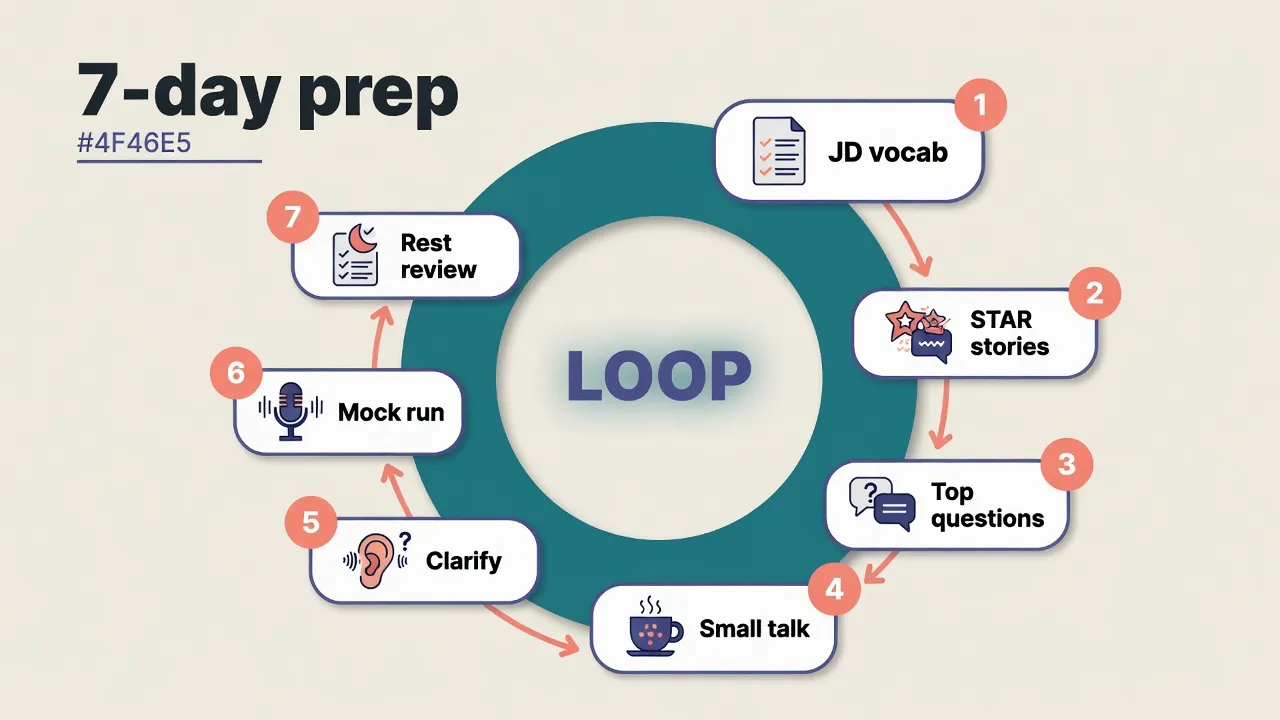
A light 7-day prep plan
You do not need a three-month bootcamp for every interview. One focused week beats vague "I will prepare somehow."
| Day | Focus |
|---|---|
| 1 | Read the JD twice. Build a keyword list and action-verb versions of your experience. |
| 2-3 | Write 3-4 STAR stories in English. Speak each one out loud twice. |
| 4 | Rehearse the top 5 questions with a timer (90-120 seconds each). |
| 5 | Small talk openers + clarify / buy-time phrases until automatic. |
| 6 | Mock interview: friend, coach, or self-record on video. Fix the three weakest moments only. |
| 7 | Light review. Sleep. Do not rewrite everything at midnight. |
If your interview is tomorrow, compress days 1-4 into tonight and do a short mock in the morning. Imperfect structure still beats no structure.
Practice tools (and what they cannot do)
Apps help you rehearse phrases, read professional English, and train your ear. They do not take the interview for you. Speaking still needs you: out loud, on a call, with a human if you can.
MovaReader in short:
- Free plan: graded library with click-to-translate, about 20 word translations per day, plus listening for many texts. You can also work with files you already have the right to use.
- Reader (~€1/month): higher translation volume when you actually read a lot while prepping.
- Pro (~€5/month): full trainers for words and phrases you save.
Reader and Pro are different plans. Details live on pricing. For a calm product walkthrough, see how to use.
Useful starting points while you prep:
- All free articles
- Phrase trainer
- Related reads if you want more workplace English: business English books and English for IT
Practice job-description chunks. Read a little every day. Record your STAR answers. That combination beats downloading ten random "interview phrase PDFs" and never opening them.
FAQ
Do I need perfect grammar for an English job interview?
For most roles, no. Clarity and structure matter more. Language-teacher or interpreter roles are different - those may test accuracy harder.
Must every answer use STAR?
No. Use STAR for behavioral "tell me about a time" questions. Use the present-past-future pitch for "tell me about yourself."
Is my accent a problem?
Usually less than unclear structure or answers that never land. Speak at a steady pace. Ask for a repeat when you need it. Many global teams hire across accents every week.
Should I write full answers in my first language first?
Risky. Full L1 drafts often create translation lag in the room. Draft key points and stories in English early, even if the first version is simple.
How many STAR stories do I need?
About 3-4 adaptable stories cover most behavioral questions. Quality beats a long list you cannot remember.
Is the free plan enough to prepare?
Enough to start: graded reading, listening, and limited phrase work with about 20 word translations per day. Upgrade to Reader (€1) if you need more translation volume, or Pro (€5) for full trainers.
What to do next
- Open the job description and list 10-15 keywords.
- Write three STAR stories tonight - messy drafts are fine.
- Speak the top five answers out loud once.
- Put clarify phrases on a sticky note by your screen.
You do not need to sound like a native speaker. You need to sound like a clear professional who prepared. The interview is a conversation about your work - in English. Structure gives you that conversation back when nerves try to take it away.
Learning English?
The English version of MovaReader teaches Spanish and Ukrainian. To read English with a translation for every word, open the reader in Ukrainian or Spanish:
Книги англійськоюЦя стаття українськоюLibros en inglésEste artículo en español