Tips & Methods
Find an English Speaking Partner: Options, Prep, Safety
Looking for someone to practice English with? An option map (apps, tutors, clubs), when free or paid fits, first-call prep, exchange rules and safety tips.
You know the grammar charts. You have saved half a notebook of vocabulary. You can follow a podcast when the host speaks clearly. Then you try to find someone to talk with - and the search itself feels messy. Apps look like dating platforms. Tutors cost money you may not want to spend yet. Forums fill with "DM me" posts that go nowhere. You close the tab and tell yourself you will try next week.
That stall is normal. Speaking English needs another human, and humans do not appear because you finished unit twelve.
You can find an English speaking partner through language-exchange apps, paid tutors, online communities, or offline clubs - and you can improve readiness with solo prep while you search. A native speaker helps, but is not mandatory for useful practice. Before the first call, prep a short pitch, questions, repair phrases, and a topic from recent reading. MovaReader does not match you with partners; it helps you bring phrases and input into real human calls.
Below is a clear option map: where to look online and offline, which path fits your budget and anxiety, how to prep the first call, how to run a fair exchange, how to stay safe when matches flop, and where MovaReader fits.
Why regular speaking practice matters
Understanding a page is not the same skill as answering a live question under social load. Passive comprehension can feel solid. Active retrieval - finding words while someone waits - often still feels empty.
That gap shrinks when you produce language with another person. The language barrier and fear of mistakes both ease with real output practice, not with one more silent grammar drill alone. Repeated spontaneous talk also trains you to rebuild less of every sentence in your first language mid-reply.
One thing to know early: you do not need a native speaker for every session. A patient partner at a similar or higher level can still build turn-taking, confidence, and fluency habits. For heavy correction, exams, or professional polish, a paid tutor usually beats a random native who will not teach systematically. Partners are practice partners, not automatic teachers.
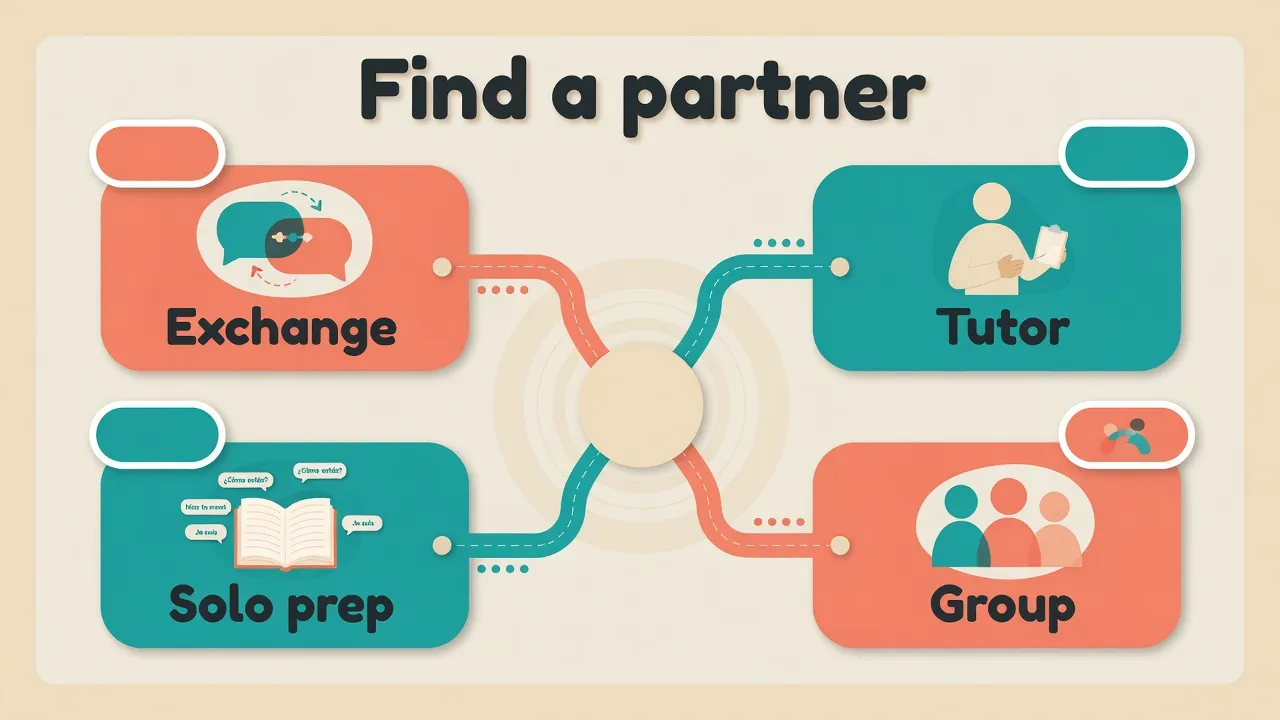
Option map: find a partner online
Skip "best app forever" lists. Features and prices change. Match the category to your goal, budget, and tolerance for strangers - then check current pricing and safety tools on each site yourself.
| Option type | Examples (illustrative, not ranking) | Best when | Watch-outs |
|---|---|---|---|
| Language exchange apps | Tandem, HelloTalk, Conversation Exchange, Speaky-class | Free mutual practice; flexible schedule | Ghosting, flaky schedules, dating misuse |
| Paid tutors / community tutors | italki, Preply (examples) | Need correction, reliability, exam or job goals | Cost; still not automatic friendship; partners ≠ teachers |
| Communities | Discord English rooms, Reddit r/language_exchange, interest forums | Shared hobbies; text → voice ladder | Noise; moderation varies |
| Solo prep (while you search) | Graded reading, phrase drills, self-talk, shadowing | Anxiety, empty calendar, thin active phrases | Not a substitute for eventual human conversation |
Language exchange apps
These apps are built for "I help you with my language; you help me with yours." They are the default free path for many learners who want voice or video after some text warm-up.
They work when both people show up and when you set time split and topics early. They fail when profiles treat language exchange like a dating queue, when schedules never stick, or when every chat dies at "hi, how are you." Keep more than one contact so one silence does not end your habit.
Paid tutors and community tutors
If you need reliable correction, exam structure, or a job-interview plan, pay for that service. Marketplaces such as italki or Preply (examples only - check current rates) sell scheduled practice with clearer expectations than a random match.
That is not friendship on demand. You are buying time and feedback. When your goal is structure more than free chat, this path often wastes less energy than weeks of ghosted DMs.
Communities: Discord, Reddit, interest rooms
If 1:1 strangers feel heavy, start in a room. English Discord servers and language-exchange subreddits (and hobby spaces that drift into voice) let you text first, then join a voice channel when ready. Shared interests give you something to say beyond small talk.
Moderation varies. Noise varies. Treat communities as ladders toward speaking, not as guaranteed weekly partners.
Solo prep while you search
Empty calendar and high anxiety are valid reasons to delay the first call - for a short runway of prep, not forever. Graded reading, phrase drills, self-talk, and shadowing fill your mouth with ready chunks so the first conversation is less blank.
General AI chat tools can be low-stakes practice. They are not a human partner. They are also not what MovaReader is. Graded texts and phrase demos can stock fuel before you message anyone. More on MovaReader later in this post.
Offline options
Offline still works if your city has people. Body language and local accountability help some learners more than another chat app.
| Path | What it is | Best when | Watch-outs |
|---|---|---|---|
| Speaking clubs | Schools, libraries, city language groups | Facilitated talk; lower 1:1 stranger stress | City-dependent; may need booking |
| Meetup / expat events | Interest plus language mix | Body language; local accountability | Travel time; uneven English level |
| Traveler / social hangouts (category only) | Informal mixers if your city has them | Casual practice | Feature names go stale; do not treat any one app hangout as eternal truth |
First meet stays public. That is not paranoia; it is basic adult safety (more below). City options are uneven. If offline is thin where you live, the online option map is enough - you are not "behind" for practicing on a call.
Decision table: which path fits you?
Here is the wedge most "top 12 apps" posts skip. Match path to budget, anxiety, goals, and schedule - not to last year's ranking.
| Your situation | Prefer first | Why |
|---|---|---|
| Budget ~0, want mutual help | Exchange app + fair 50/50 rules | Free practice if both show up |
| Need heavy correction / structure | Paid tutor | Partners ≠ teachers |
| Hate 1:1 strangers | Group club / Discord room | Shared facilitation |
| Too anxious for first call | 1-2 weeks solo prep, then short text → voice | Confidence before the leap |
| Only 20 min twice a week | Scheduled exchange or short tutor slots | Random chat rarely sticks |
| Goal = exam / job interview | Tutor + topic prep from reading | Exchange alone is uneven |
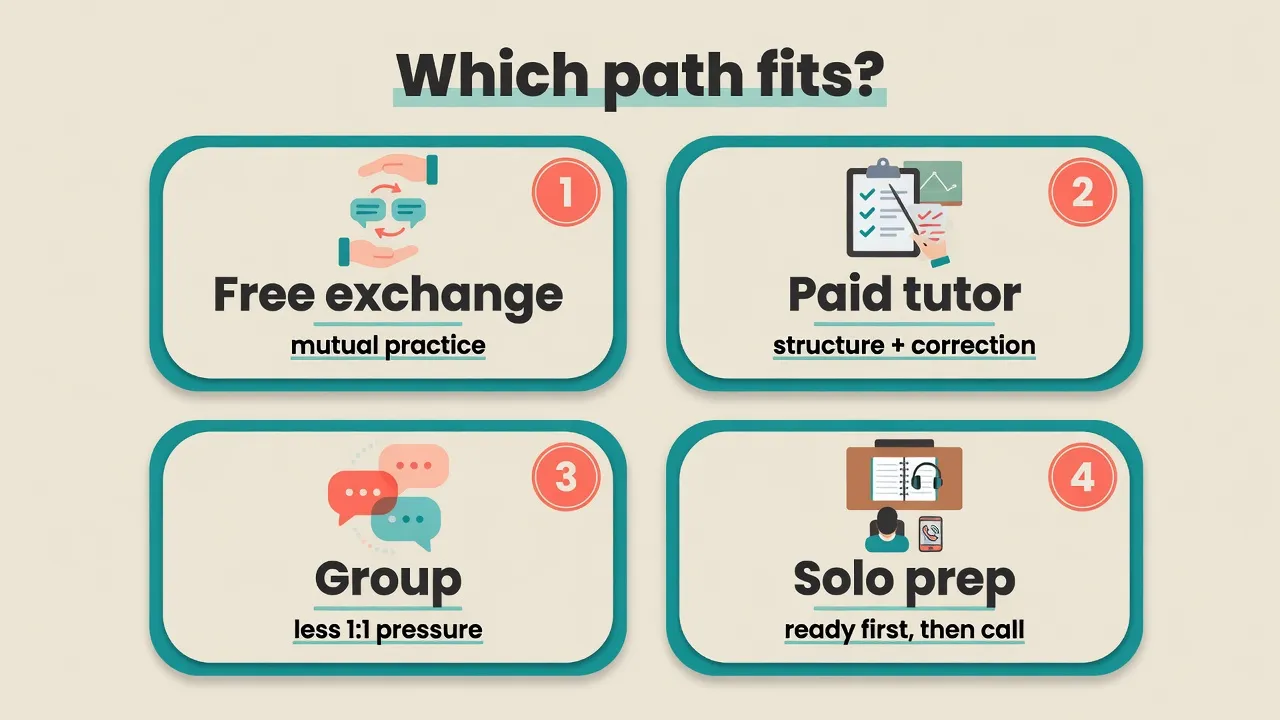
Many people mix paths: one short tutor slot for feedback, exchange for volume, or group rooms when 1:1 energy is low. The table is a first pick, not a life sentence.
If free exchange keeps collapsing into ghosting, that is data - not a character flaw. Move budget or structure up a notch. If money is tight but anxiety is high, solo prep plus a small Discord room often beats forcing a video date with a stranger this week. For the freeze side, see the language barrier and fear of mistakes posts; for 1:1 stranger drain, the introvert runway note may fit better than another cold message.
How to prepare for the first call
First-call stress is normal. Prep beats "just wing it."
| # | Step | What to prepare |
|---|---|---|
| 1 | Elevator pitch | Who you are, approx level, why you need English (30-60 seconds) |
| 2 | 5-10 questions | Plus one shared-interest topic so talk is not only "where are you from" |
| 3 | Repair kit | Could you repeat…; slower please; can you type it; what does X mean? |
| 4 | Input warm-up | One short graded text; save 3-8 phrases; plan a 2-minute retell |
| 5 | Logistics | Time zone, duration, video vs audio, which language first, correction style |
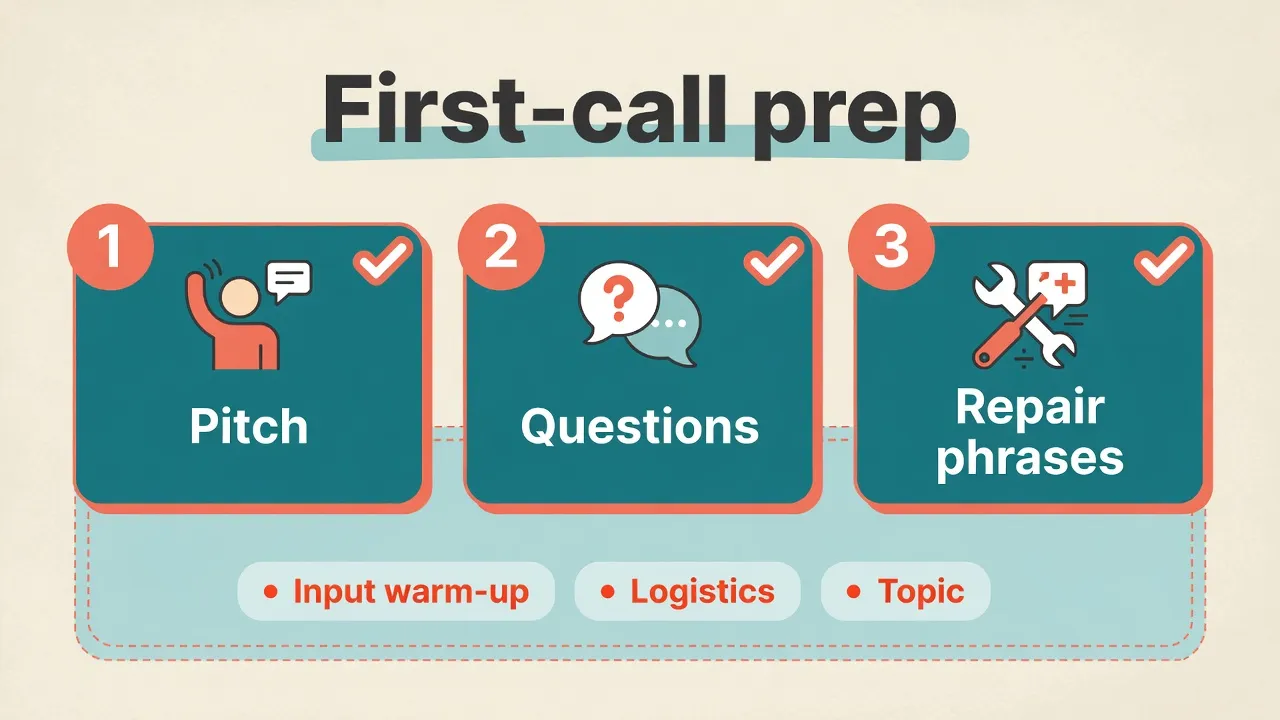
Elevator pitch
Write a short self-intro and say it out loud once. Name, city or time zone if useful, level in rough terms ("B1-ish, better at reading than speaking"), and why English matters now (work, travel, study, friends). Thirty to sixty seconds is enough. The goal is to stop the blank first minute, not to perform a TED talk.
Questions and one shared topic
"Where are you from?" dies fast. Keep five to ten open questions ready, and one topic you actually care about: a hobby, a book, a recent trip, work tools, a series you both watch. Shared interest is how exchange stops feeling like an interview.
Repair kit (copy-ready)
- Could you repeat that, please?
- Could you speak a bit more slowly?
- Can you type that word / sentence?
- What does ___ mean?
- Sorry - I meant…
Repair is not failure. It is conversation maintenance. Agreeing how you correct each other (end of turn, end of session, not every word) reduces the red-pen panic many learners bring from school.
Input warm-up before the call
Read one short graded text the day before. Save three to eight reusable phrases, not every unknown word. Plan a two-minute retell: "I read about X; the main idea was…; what surprised me was…" That gives you content when small talk stalls.
You can pull a short piece from the graded library, or use your own legal EPUB. Optional light production: type a chunk on the phrase demo or type training demo so your fingers and mouth have seen the pattern before the call. That is prep fuel for the call.
Logistics worth agreeing once
Time zone and duration. Video or audio only. Which language first, and for how long. When to correct. A written message with those points prevents half the awkward mid-call negotiation.
Rules for an effective language exchange
A logo on your phone does not create practice. Rules do.
| Rule | Spine |
|---|---|
| Fixed schedule | Same slot beats binge-then-ghost |
| 50/50 language split | e.g. 30/30 minutes; avoid mixed half-sentences if goal is speaking time |
| Topic day before | Prep vocabulary; fewer blank silences |
| Correction style | End of turn / end of session - not every word mid-sentence |
| Exit if mismatch | Polite, short, no guilt - not every match works |
| Partners ≠ teachers | Book a paid tutor when you need structured correction |
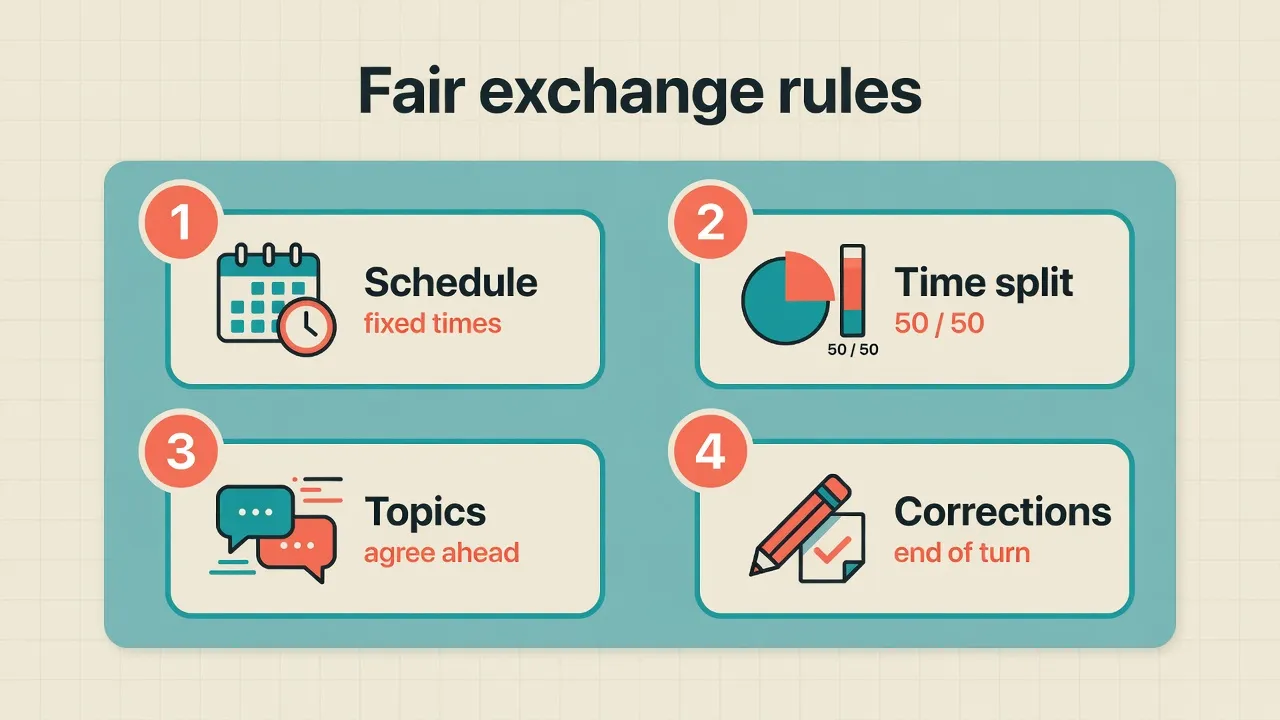
One conversation every Tuesday at a fixed hour beats five chats in one night and then silence for a month. Split languages cleanly when both of you need practice time. Mixing every other sentence can feel friendly and still leave you with little real speaking minutes.
Topics agreed the day before let both people prep words. Correction works better as notes at the end of a turn or session than as a constant interrupt. If styles clash - you want voice, they only text; you want error feedback, they want pure chat - exit politely.
Short exit script you can adapt: "Thanks for the chats - I need a different schedule / focus right now. Good luck with your practice."
You do not owe endless second chances. Not every match works. That is a design fact of free exchange, not proof you are bad at English.
Safety and realistic expectations
Exchange is optional. You do not owe strangers personal data, flirty chat, or endless second chances.
| Tip | Detail |
|---|---|
| Public profile | Limited personal data; no home address; prefer platform chat first |
| Video | Optional after trust; neutral / public-looking background |
| Dating / flirty pressure | Decline, block, report; exchange is not owed |
| Ghosting buffer | Keep 2-3 contacts; do not stake progress on one person |
| Audience | Adult learners assumed for 1:1 stranger apps |
| Offline first meet | Public places only |
Text-only can be a ladder toward voice. If your goal is speaking and they never take a short call after a clear ask, move on. Ghosting is common on free platforms - keep two or three contacts so one silence does not kill the habit.
Flirty or dating pressure is not part of the language deal. Decline once, then block and report if needed. You are not rude for protecting your time and boundaries.
Offline first meet: public place, daylight if you can, tell a friend where you are. Prefer platform chat before personal numbers. Video is optional after trust; you can use a neutral background and keep the first call short (15-20 minutes) as a trial.
Realistic expectation: some matches are great, many are okay once, some never reply. Build a system (option map + prep + buffer contacts), not a crush on one perfect partner.
How MovaReader fits
By now you have paths, a decision table, prep, rules, and safety. Tools only reduce friction on the prep side.
MovaReader does not find or match speaking partners. It does not include an AI voice partner. It prepares input and phrase chunks so the first human call is less empty. Reading and trainers build fuel. They do not replace conversation partners.
| Plan | Fit for this habit |
|---|---|
| Free plan | Test reading + phrase prep; free graded library within limits; ~20 word translations/day; listening; upload own legal EPUB |
| Reader €1/mo | Volume reading + dictionary without constant flow breaks |
| Pro €5/mo | Phrase / type trainers when moving patterns into active use (when available) |
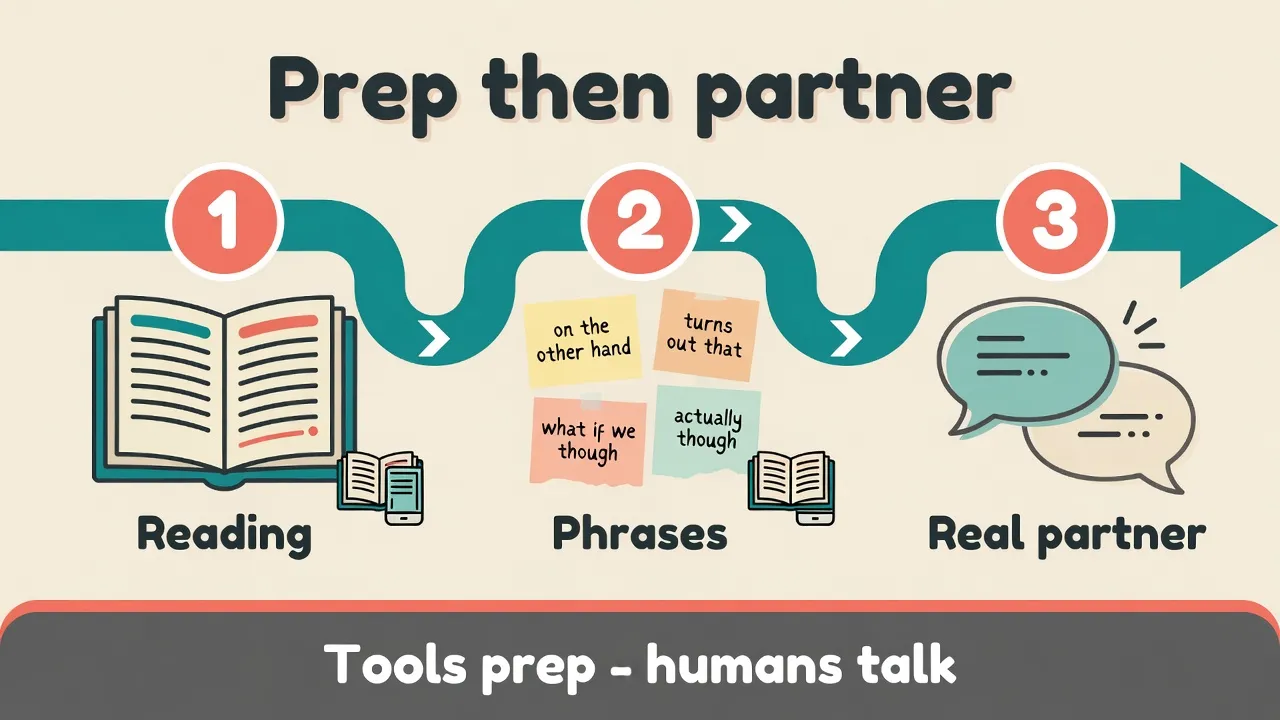
A practical prep path:
- Open /en/all-articles - pick one text at a workable difficulty (or your own legal EPUB if that fits).
- Read a short stretch: meaning first; mark 3-8 reusable phrases for the call (not every unknown word).
- Optional: listen and shadow a short stretch after the page.
- Soft production: try /en/demo-phrase-typing or /en/demo-type-training when open.
- Stay on the free plan while testing; move to Reader on /en/pricing when translation limits stop real pages. Pro is for trainers when that is the bottleneck - not required to message a partner.
- Same day or week still act human: message 2-3 possible partners or book one short tutor slot. The product does not do that for you.
FAQ
Do I need a native English speaking partner?
No. A native speaker helps with natural models and culture, but is not mandatory for useful practice. A patient non-native partner at a similar or higher level can still build fluency, confidence, and turn-taking. For heavy correction, exams, or professional polish, a paid tutor often beats a random native who will not teach systematically. Partners are practice partners, not automatic teachers.
Free language exchange vs paid tutor - which should I try first?
Start with free exchange if budget is tight, you want mutual help, and you can set fair 50/50 rules. Choose a paid tutor first if you need reliable correction, exam or job-interview structure, or you keep losing time to ghosting and flaky schedules. Many learners mix both: short tutor slots for feedback, exchange for volume. Use the decision table above for your situation.
What are the best apps for finding a speaking partner?
There is no eternal #1. It depends on goal, budget, and style. Think in categories: language-exchange apps (examples: Tandem, HelloTalk, Conversation Exchange), tutor marketplaces (examples: italki, Preply), communities (Discord rooms, Reddit language-exchange), and offline clubs / Meetup. Features and pricing change - check current pricing and safety tools on each site. Skip "best app 2026" crowns; pick the path that fits your week.
How do I prepare for the first call?
Write a short elevator pitch (who you are, level, why English). Prep 5-10 questions plus one shared interest. Keep a repair kit ready: repeat, slower, type it, what does X mean. Warm up with one short graded text, save 3-8 phrases, and plan a 2-minute retell. Agree logistics: time zone, duration, video vs audio, which language first, and when to correct. Prep beats winging it. Graded pages live under /en/all-articles; phrase demos can warm production lightly.
What if they only text, ghost, or flirt?
Text-only is fine as a ladder toward voice, but if your goal is speaking, ask for a short call once and move on if it never happens. Ghosting is common - keep 2-3 contacts so one silence does not kill your habit. Flirty or dating pressure is not part of the deal: decline, block, report if needed. Exchange is optional, not owed. Not every match works; exit politely and try another path (tutor, group, or new partner).
Can I improve speaking without a partner for a while?
Yes for a runway, not forever. Solo prep (graded reading, phrase drills, self-talk, shadowing) lowers anxiety and fills ready chunks before the first call. It does not replace eventual human conversation - negotiation, repair, and social load need people. If 1:1 strangers feel hard, use group clubs or Discord rooms first. Soft links: language barrier and fear of mistakes for the freeze side.
Does MovaReader find speaking partners?
No. MovaReader does not match you with natives or include an AI voice partner. It helps you prep with graded reading, click-translate on the free plan (~20 word translations/day), listening, and phrase/type trainers (Pro €5/mo when available). Reader €1/mo is for volume reading + dictionary flow. Free graded library within limits; upload own legal EPUB. Humans still do the conversation. Details: /en/pricing.
Next steps
Today: pick one path from the decision table. Write your elevator pitch, five questions, and three repair phrases.
This week: message two or three possible partners, or book one short tutor slot. Read one graded page and save three to eight phrases for a two-minute retell. Start from /en/all-articles if you want a level-tagged text.
Tools prep vocabulary. Humans still do conversation.
Find a fit, prep the first call, stay safe.
Learning English?
The English version of MovaReader teaches Spanish and Ukrainian. To read English with a translation for every word, open the reader in Ukrainian or Spanish:
Книги англійськоюЦя стаття українськоюLibros en inglésEste artículo en español