Language Learning Psychology
Introvert language barrier: speak English without stress
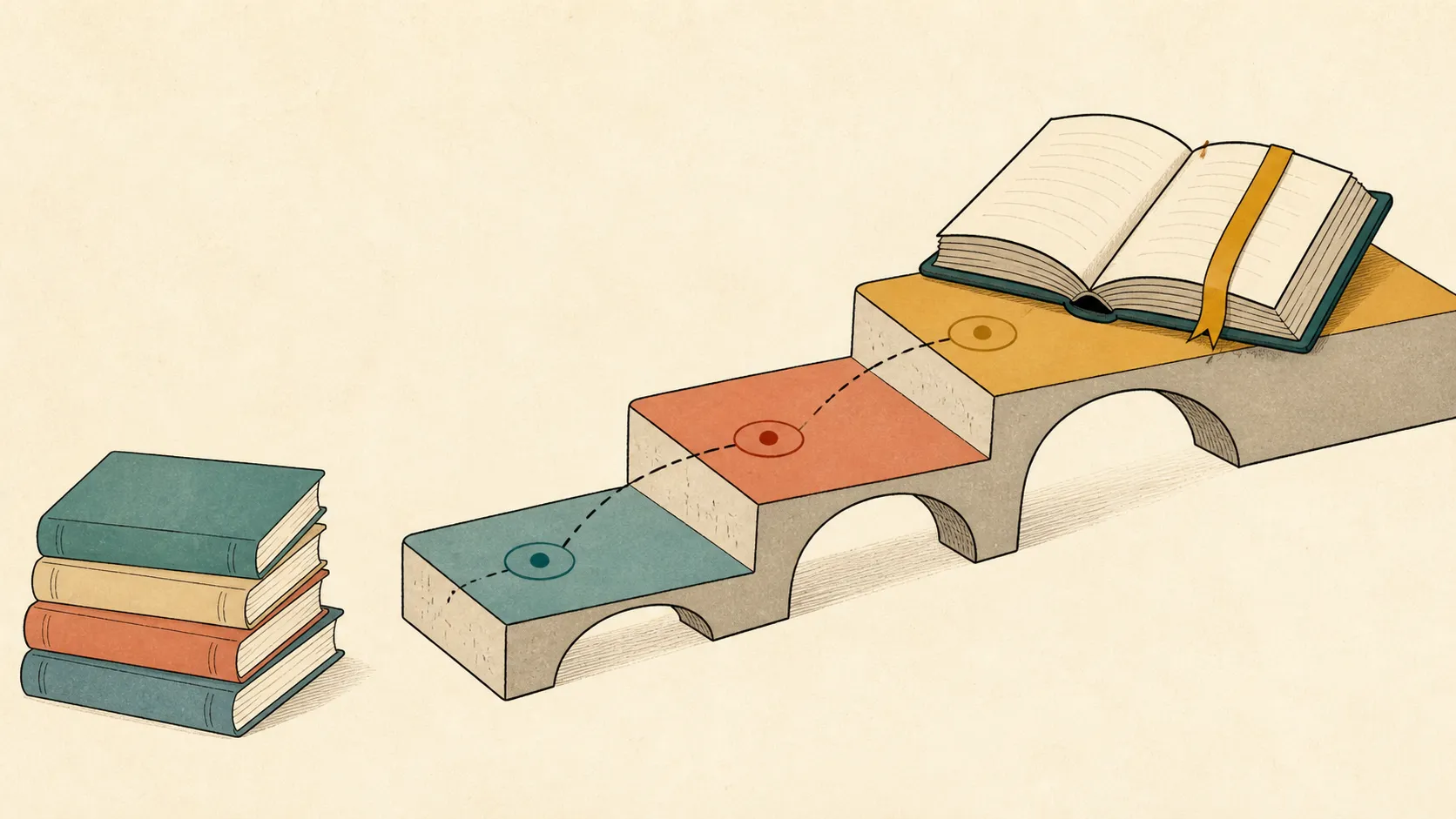
If speaking clubs drain you, you are not broken. Many introverts need a quiet runway of reading, listening, and low-stakes mouth practice before real talk feels possible.
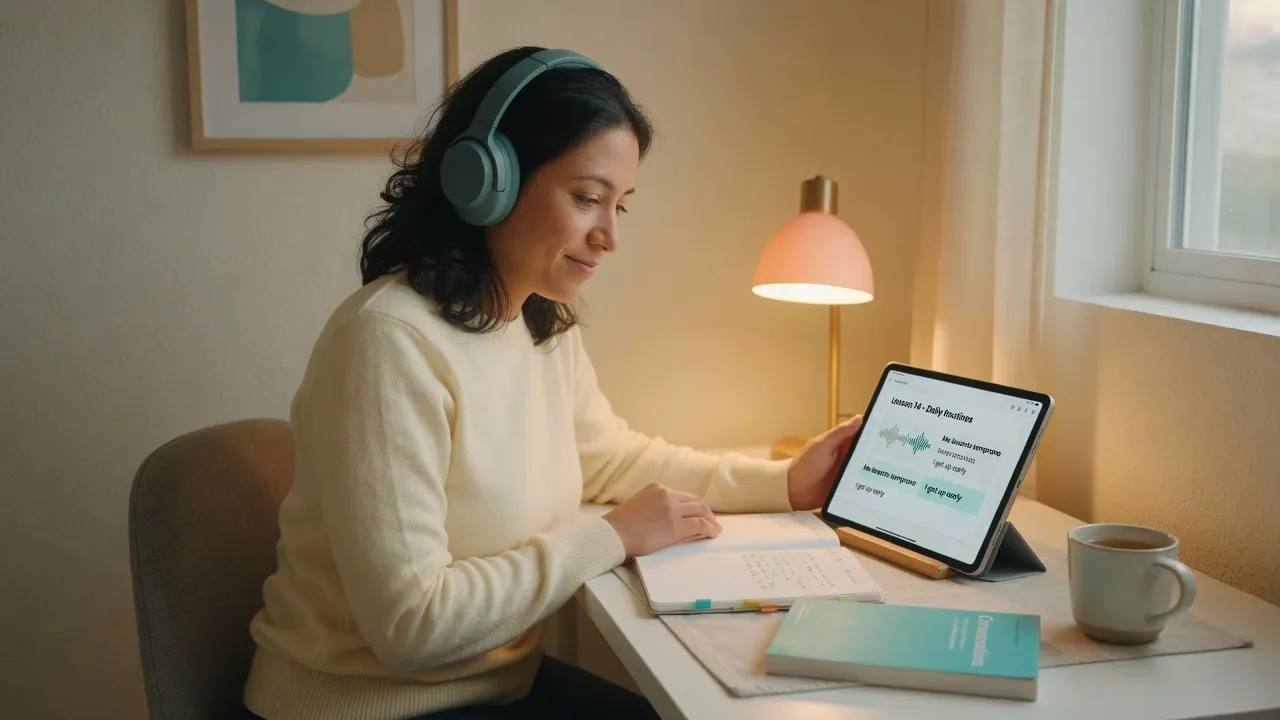
Has anyone told you: "To speak English, just talk more"? If you are an introvert, that advice can feel like "to stop fearing heights, just jump with a parachute." The freeze, the tight throat, the blank mind in front of strangers - that is not laziness and not proof you lack talent.
The short version: your "language barrier" is often environment plus anxiety load, not an empty brain. Stack social fear on top of a foreign language and working memory fills up. Words you know go offline. A better first move is a solo runway: interesting reading, listen and shadow, read aloud, short inner monologue, then light phrase practice. Real conversation can come later with less panic. Clubs and tutors are optional tools, not a moral test.
Change the prep and the setting. You do not need to change your personality.
Why speaking clubs drain many introverts
The language industry loves one story: more conversation equals better progress. So courses push speaking clubs, pair work, and random partners on Zoom.
For many introverts, a loud club is not "practice." It is a stress test.
Here is what often happens in your head:
- Attention splits between English and "what do they think of me?"
- Working memory fills; simple words disappear
- Mistakes feel like shame, not useful data
- After the session you feel drained, not motivated
You may quit English not because the grammar is impossible, but because the room is unbearable. That is a problem of load and environment, not a character flaw.
Club time can still help some people later - small groups, kind hosts, topics you know. The mistake is treating "join a club tomorrow" as the only path.
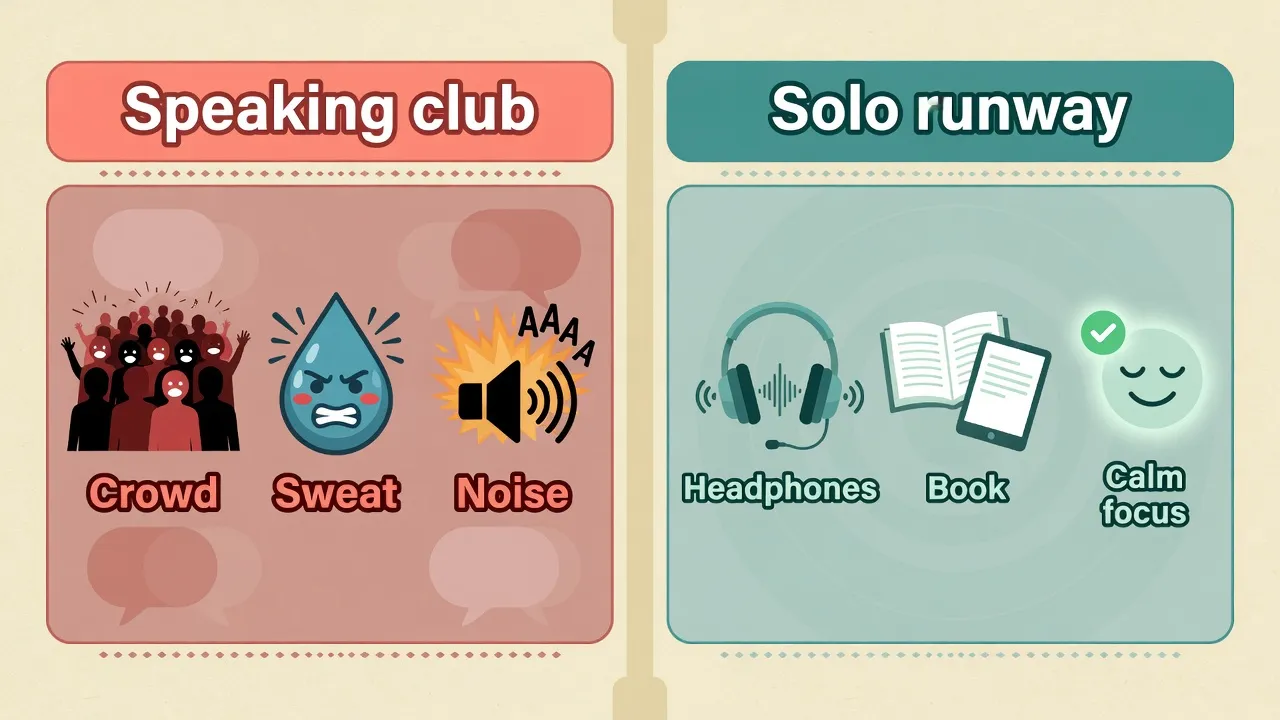
Two loops side by side: high social load versus a quiet solo runway.
Method 1: Shadowing with text and audio
Shadowing means you listen and speak almost at the same time, like a soft echo. Interpreters use versions of this. You can use a gentler home version.
Why it fits introverts:
- No live audience
- You train rhythm, stress, and mouth comfort
- You can repeat a line ten times without anyone waiting
- Text on screen keeps meaning attached to sound
How to do it without turning it into torture:
- Pick a short, interesting paragraph (not a dry drill list if you can help it).
- Read for meaning first. Unknown words: look up a few; skip the rest for now.
- Play audio sentence by sentence.
- Speak with the voice, a half-beat behind if full speed is hard.
- Slow the audio if needed. Clarity beats speed.
Where does the audio come from? Podcasts, graded readers with tracks, or a reader app that plays sentences while you see the text. In MovaReader, listening while you read is built for this kind of prep. TTS is useful practice audio - it is not a native human coach and should not be sold as one.
Shadowing alone will not make you "fluent." It builds motor comfort and listening so later talk is less panic. That is enough for method one.
Method 2: Reading aloud (the calm four-step loop)
If shadowing is about timing and flow, reading aloud is slower rehearsal. Think of it as a private stage, not a performance for the class.
When you read English out loud, a useful loop often runs:
- Eyes see the words
- Brain builds meaning
- Mouth shapes the sound
- Ears hear what you actually said
That loop helps move words from "I recognize this on the page" toward "I can produce this." Silent reading still matters for vocabulary. Mouth practice makes the same phrases less foreign when you need them under mild pressure.
A simple session:
- Choose a text you care about (story, article, hobby topic).
- Listen to a sentence or two if you have audio.
- Read the same lines aloud, a little slower than natural speech.
- Mark one tough chunk; repeat only that chunk.
- Optional: record yourself once. Nobody else needs to hear it.
You are not aiming for radio-host perfection. You are aiming for comfort and clearer chunks you could reuse later.
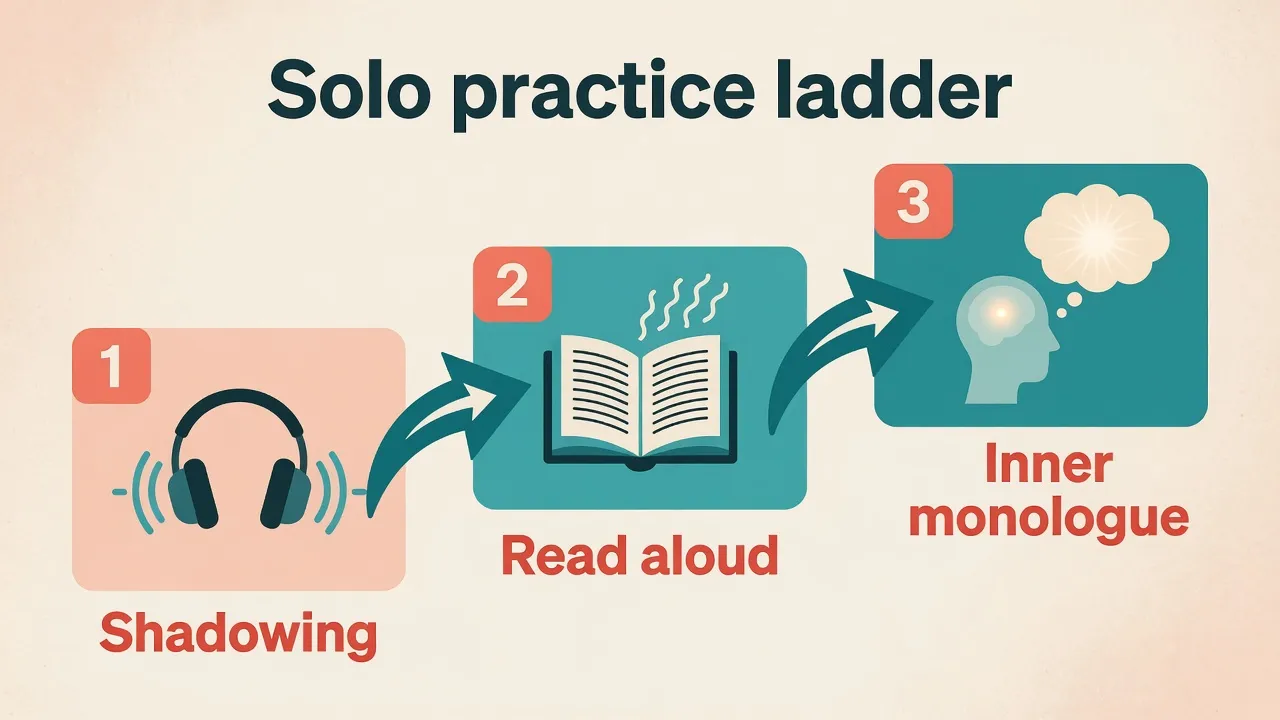
Three solo methods as a ladder - start where energy is lowest:
Method 3: Inner monologue (plus fuel from reading)
This is the quietest tool and the one courses almost never grade: think in English for a few minutes a day.
Examples:
- Narrate what you are doing: "I'm making coffee. The sky is grey."
- Plan the next hour: "I need to finish this email before lunch."
- Retell something you just read in three short sentences.
- Rehearse a soft script: "If they ask about my project, I'll say..."
Zero audience. Zero grading. Your brain still has to assemble English in real time.
The catch: monologue needs phrase fuel. If your active store is thin, you loop "I like" and "I want." Regular reading fills the tank with patterns you can steal: not only single words, but whole chunks ("it occurred to me," "I was reluctant to...," "the reason I froze was...").
Pair the two: read something interesting, then retell it in your head (or in a whisper). That is speaking prep without a club calendar.
For more on fear of looking stupid in the language, see perfectionism and fear of mistakes. For the "I have no talent" story, see the language talent myth.
Soft science: load, not a defective brain
What is fair to say in plain language:
- Many introverts prefer lower stimulation and deeper processing of input. That is a preference and energy pattern, not a closed language ability.
- Doing hard language work while being evaluated by strangers can overload attention. Language anxiety research has talked about this for years: fear steals slots that could hold words.
- Quiet focus, reading, and careful listening often play to that style. Extroversion is not a language gene.
So: solo methods can fit how you use energy. They do not prove you will outrun every extrovert, and they do not replace every form of interaction forever.
A 30-minute introvert day
You do not need a heroic schedule. Thirty minutes, split if life is noisy:
| Slot | Minutes | Focus |
|---|---|---|
| Morning | 10 | Read something interesting; listen to a few sentences |
| Midday | 10 | Shadow or read those sentences aloud |
| Evening | 10 | Retell in your head; reuse 2-3 new chunks |
Same plan as a simple day strip:
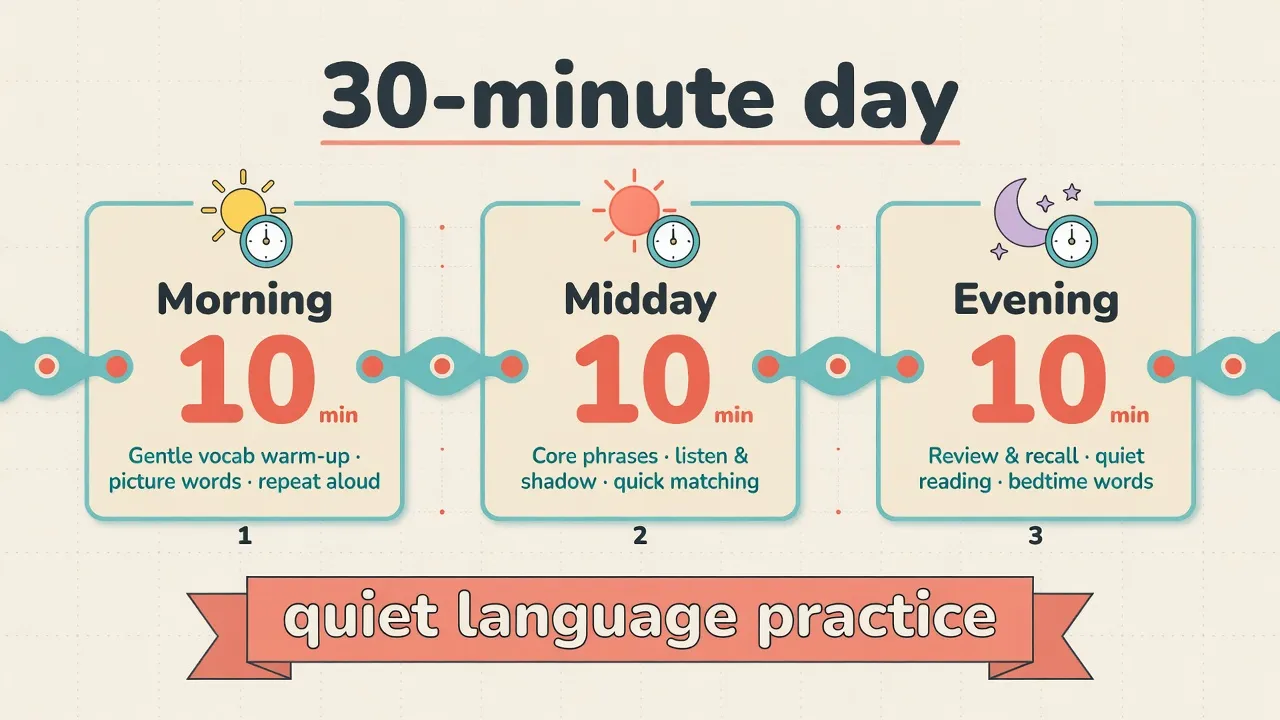
Miss a block? Do one block well. Consistency of contact beats a perfect grid you abandon in week two. Adults starting (or restarting) after 30 often need the same kindness of pace - more on that in is it too late after 30.
A gentle ladder: solo prep, then low-stakes talk
Solo practice is a runway, not a forever bunker.
| Speaking club | Solo runway | |
|---|---|---|
| Social load | High | Low |
| Good for | Talk under mild pressure, turn-taking | Pronunciation habits, vocab, confidence base |
| Risk | Burnout if anxiety is high | Never talking to humans at all |
| Best use | After some prep; small groups; kind hosts | Daily foundation |
A practical rule of thumb (not a law): when you can retell a short paragraph and shadow simple audio without panic, try something low-stakes - a patient tutor, a friend, text chat first, a short call on a topic you know. The goal is not "never feel nervous." It is "nerves no longer wipe the whole sentence."
Input that you mostly understand still sits under all of this. If you want the theory in calm form, try Krashen and comprehensible input.
How MovaReader fits
MovaReader is built around reading + look-up + listen, which maps cleanly onto an introvert runway:
- Free graded library: read alone at your pace (all articles)
- Click-translate on words (the free plan gives about 20 word translations per day)
- Listen while reading for shadowing and read-aloud prep (listening is often generous on the free plan; it is practice audio, not a private native tutor)
- Phrase / typing trainers for low-stakes mouth and finger work (demos, type training, trainers)
- Your own EPUB or files when you already have them; we do not host unlimited commercial bestsellers by default
Pricing: free plan · Reader €1/month · Pro €5/month for full trainers. Details on pricing.
Try a gentle start: Spanish A2 sample. Optional compass for levels: language map.
This is safer prep so talk costs less energy later. It does not mean you will never need people.
FAQ
Do I have to join a speaking club?
No. Clubs help some learners. If they leave you exhausted and ashamed, pause them and build solo skills first. One kind tutor or friend later often beats a noisy room of strangers.
Is shadowing enough to become fluent?
No single method is enough. Shadowing helps rhythm, listening, and mouth comfort. You still need comprehension (reading and listening with meaning) and, eventually, real interaction.
Can introverts learn languages well?
Yes. Quiet focus, reading, and careful listening are real advantages for input and depth. Extroversion is not a requirement and not a language gene. Progress still depends on hours, level-fit material, and whether fear is eating the session.
How long should I practice alone before talking to people?
There is no fixed number of weeks. A practical checkpoint: when you can retell a short paragraph and shadow simple audio without panic, try low-stakes talk (one-to-one, text first, short call). Zero human contact forever is not the goal.
What if my pronunciation is bad alone?
Normal. Use an audio model, slow speed, and short chunks. Record yourself privately if that helps. Aim for clarity, not perfection. A human ear later can fine-tune what solo practice cannot hear.
Is reading a waste if I want to speak?
No. Reading loads vocabulary and patterns that speaking draws on. Pair it with mouth practice (shadowing or read aloud) so knowledge is not only silent. Speaking without words in the tank is harder than most club ads admit.
Close
You do not need an extrovert's key for an introvert's door. Shadowing, reading aloud, and a short daily monologue are valid speaking prep. Build the runway. When the first real conversation comes, you may still feel nerves - but you will have phrases, rhythm, and proof that English already lives in your mouth at home.
Start small today: ten minutes of a text you like, three sentences out loud, one quiet retell. That is not "cheating." That is how many introverts actually get ready to speak.
Learning English?
The English version of MovaReader teaches Spanish and Ukrainian. To read English with a translation for every word, open the reader in Ukrainian or Spanish:
Книги англійськоюЦя стаття українськоюLibros en inglésEste artículo en español