Tips & Methods
How to Overcome the English Language Barrier: 7 Steps
Understand English but freeze when spoken to? What the language barrier really is, a low-anxiety ladder from reading to ready phrases, and seven practical steps to start speaking.
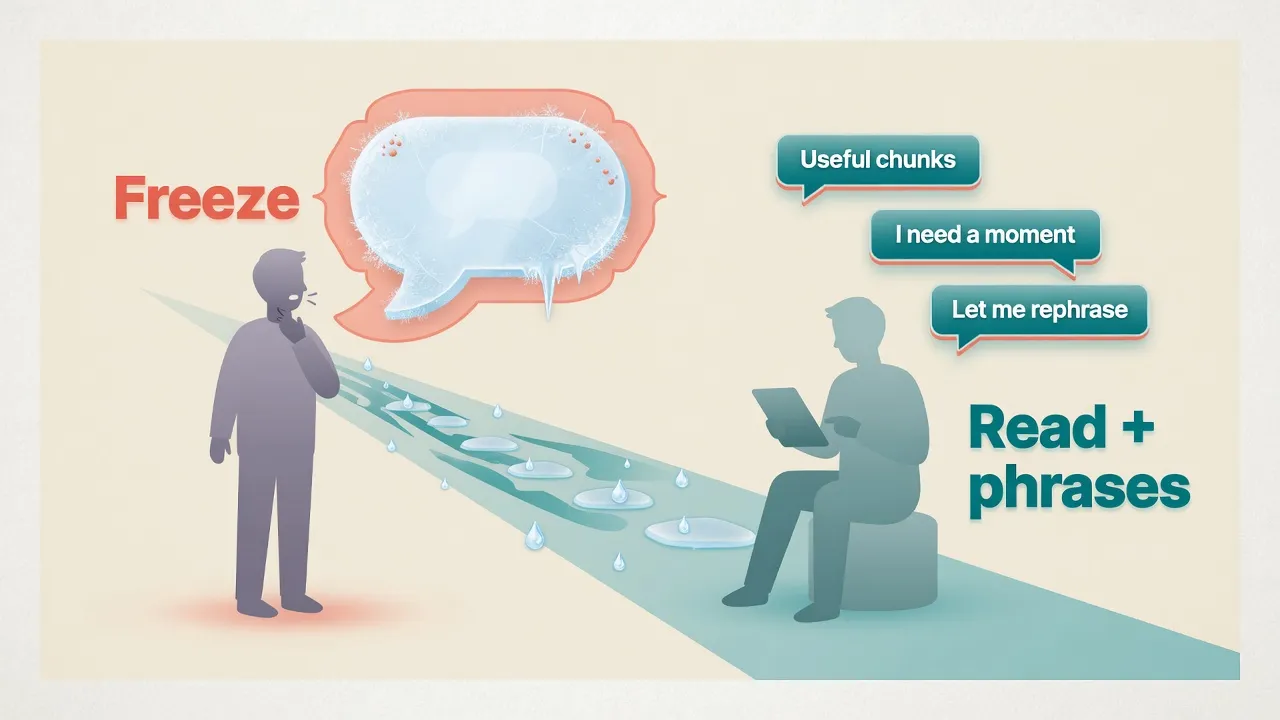
You follow English texts and series. The plot sticks. The jokes land. Then someone turns to you and asks a simple question - and the words vanish. Your heart races. Your mouth opens on silence, or on a tiny "yes" that is not what you meant.
That freeze is the English language barrier for millions of learners. It feels personal. It usually is not a talent verdict.
The English language barrier is usually a psych block - fear of mistakes, perfectionism, and little speaking practice - not missing talent. You can understand books or series and still freeze when someone talks to you. First steps: allow imperfect speech, build a low-anxiety runway with graded reading, harvest ready phrases (not isolated words), then light production (type, self-talk, shadow) before high-stakes conversation. Reading builds fuel; it does not replace live speaking.
Below: what the barrier really is, why the freeze loop tightens, a calm reading-to-phrases ladder most "just speak more" posts skip, seven practical steps, what you can do for free in MovaReader, and a short FAQ.
What is the English language barrier - and why does it happen?
The English language barrier is a psychological block that stops you expressing yourself even when vocabulary and grammar look "enough" on paper or on a test. Input can work. Output under social load does not.
The body often joins in:
- Racing heart
- Blank mind
- Simple words vanish mid-reply
None of that proves you lack a "language gene." The freeze is common among people who already understand a lot.
Four drivers show up again and again:
- Fear of mistakes - school red-pen habits make wrong speech feel dangerous. We unpack that fully in fear of mistakes and perfectionism.
- Perfectionism - "must sound native or stay silent."
- No regular production practice - read-only or listen-only atrophy of the speaking muscle.
- Fear of not being understood - accent worry or thin active phrases. That retrieval gap is the sibling story in passive to active vocabulary.
So if you understand English but freeze when speaking, start with psych load and missing ready phrases - not with shame and "start grammar from zero" unless basic input truly fails.
The freeze loop: why "just speak more" feels impossible
One silence feels safe. The next freeze feels "proven." That is the loop - not proof you cannot learn.
understand input → speak request → fear / blank → silence
→ less practice → weaker retrieval → more freeze next time
| Stage | What happens |
|---|---|
| Understand input | Text, TV, or podcast makes sense |
| Speak request | Someone addresses you in English |
| Fear / blank | Working memory freezes; words vanish |
| Silence | Short answer or nothing |
| Less practice | Retrieval never trains under light risk |
| Weaker next time | Freeze returns faster |
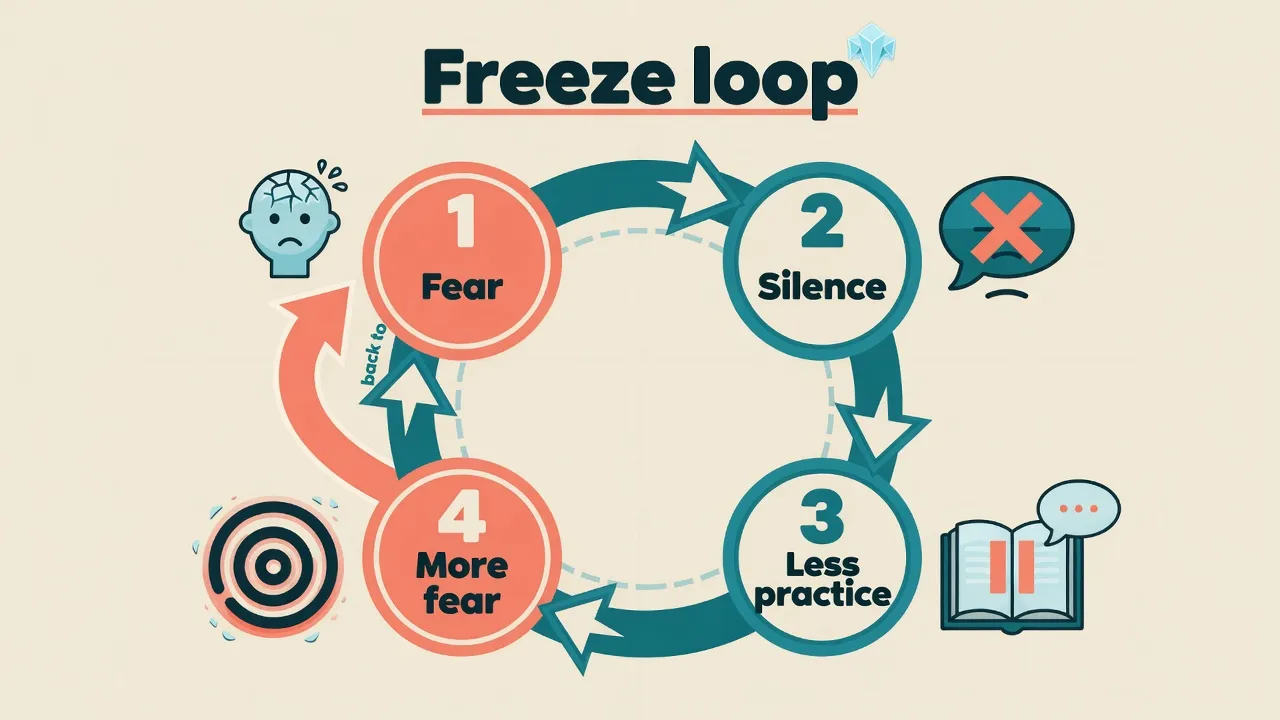
Forcing high-stakes clubs on day one often backfires. Fear and blank mind already fill working memory. Stack social judgment on top and many people dig the silence deeper. Break the loop with a lower-anxiety runway, not willpower theater alone.
The low-anxiety ladder: reading → phrases → light production → speaking
Most search results say "speak more first." Fair eventually. Brutal when freeze is strong.
A calmer order builds fuel before high social load:
| Rung | Action | One-line spine |
|---|---|---|
| 1 | Right-difficulty text | Graded article or easy page; mostly understood |
| 2 | Calm read | Meaning first; mark only real blockers |
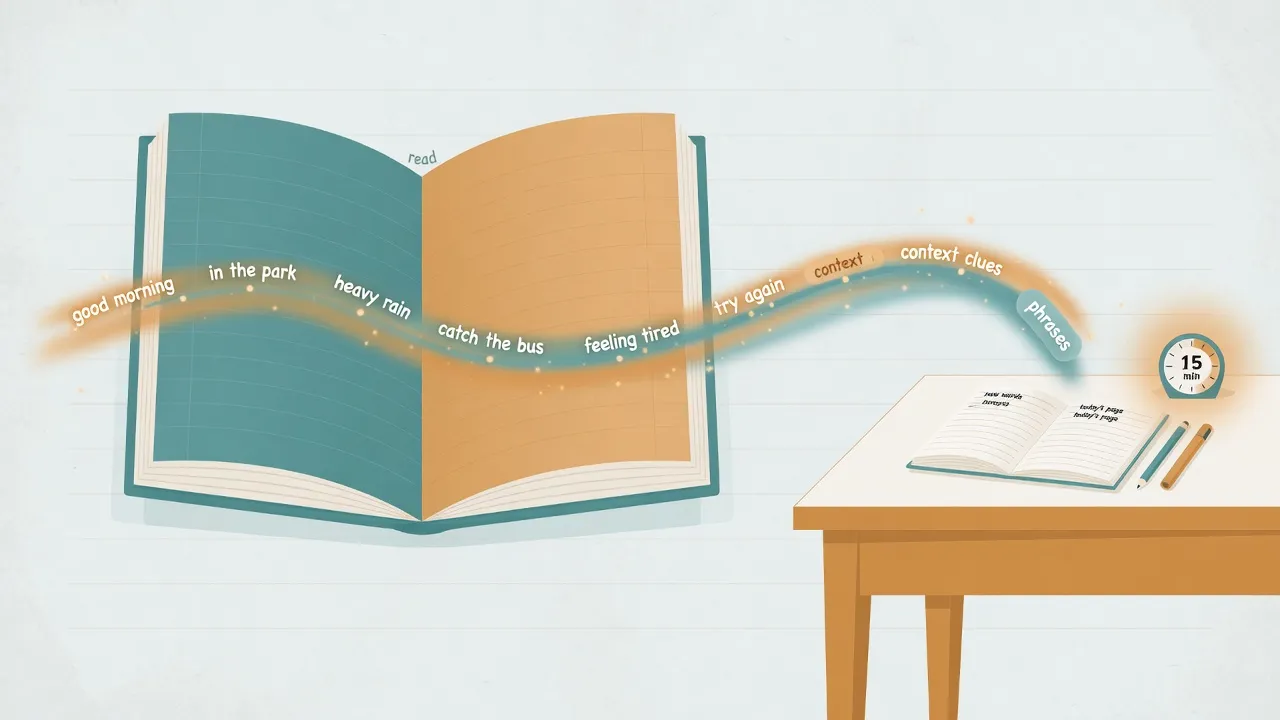
| 3 | Harvest phrases / collocations | Chunks you could reuse tomorrow, not isolated words |
| 4 | Light production | Type phrases, self-talk, optional listen + shadow |
| 5 | Low-stakes speak | Self → safe partner, club, or exchange |
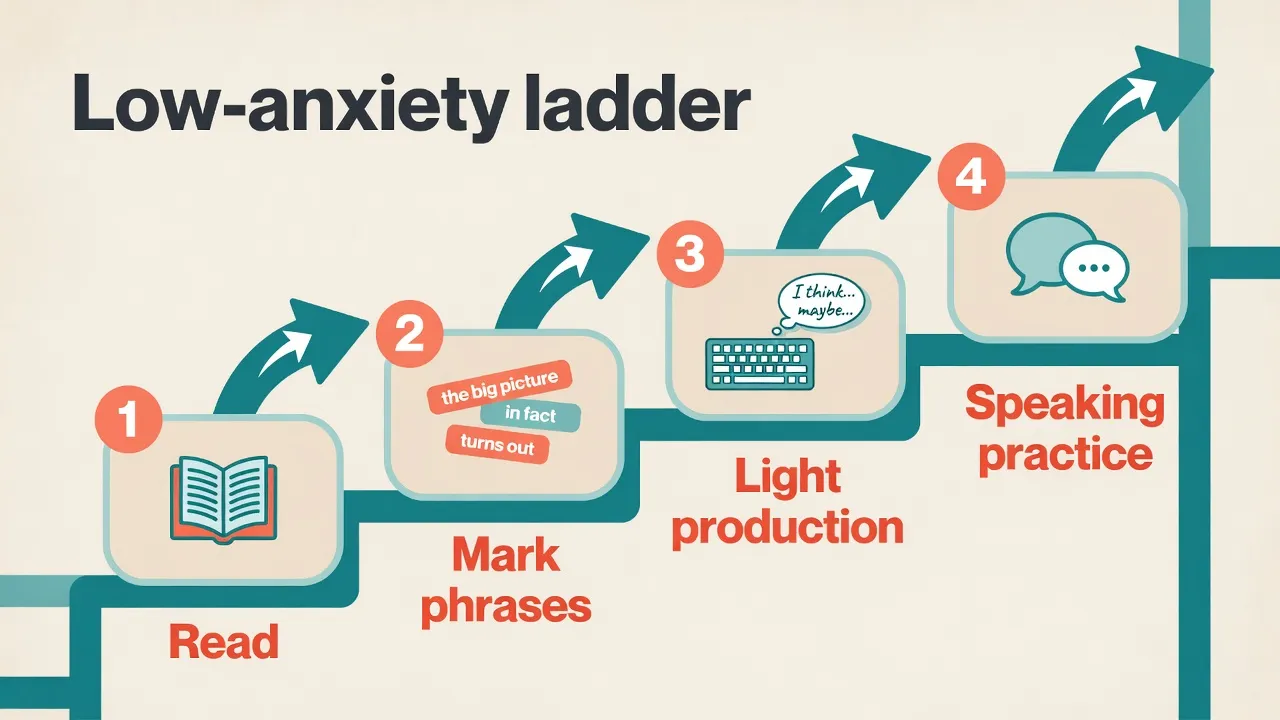
This runway builds confidence and ready language. It is not a speaking club substitute. A reading app does not replace live conversation, partners, or real back-and-forth repair. No page count turns into fluent speech by itself.
If you want calm graded pieces to start the first rungs, browse the article library. More on MovaReader later; the method stands without a purchase.
7 practical steps to unfreeze
Same useful ideas as classic tip lists - reordered to follow the ladder, not dumped at random. Permission and calm input early. High-stakes partners last.
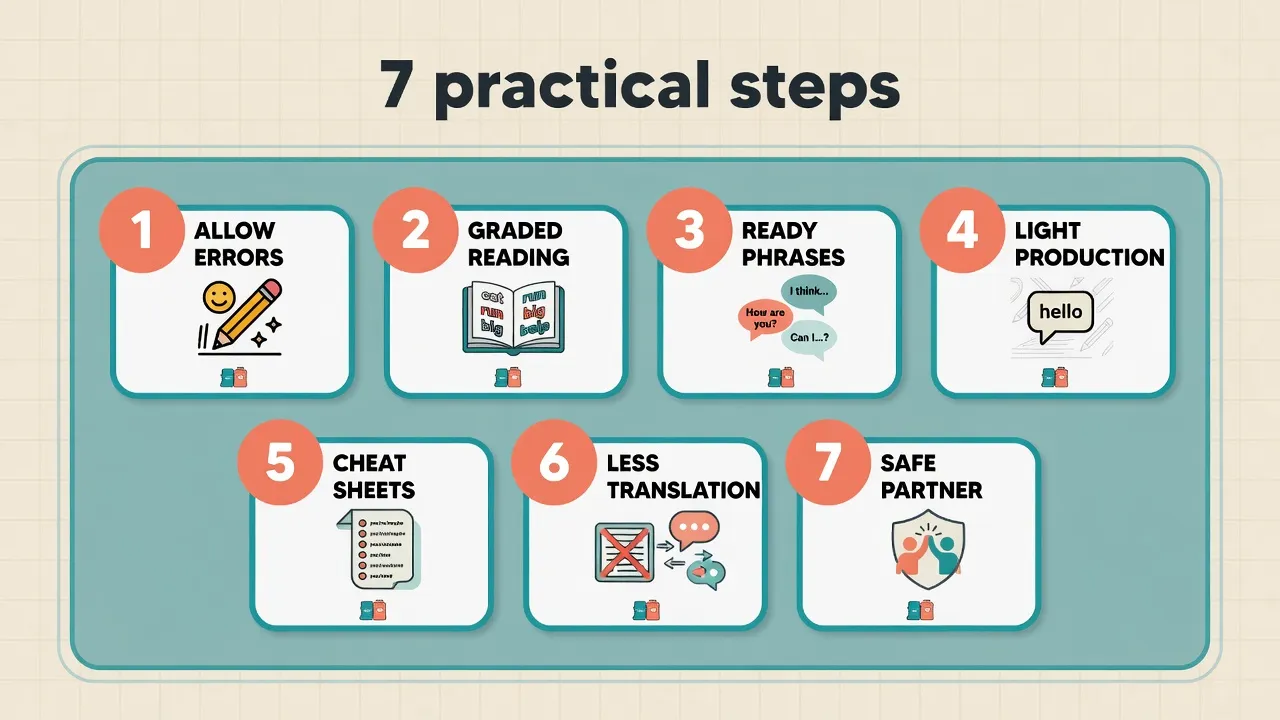
1. Allow errors (permission first)
Mistakes mean you are trying, not failing. Native listeners usually care about meaning first. A wrong article rarely kills the message. Perfect silence kills the practice.
If the internal red pen is loud, read fear of mistakes and perfectionism as the deep dive. Permission is not a pep talk. It is the gate that lets the other six steps work.
2. Build calm input with graded reading
Pick text at the right difficulty: mostly understood, not panic density. Daily pages at low social risk beat one brutal cold conversation that ends in shame.
Meaning first. Mark only real blockers. Save the "wow" lines you could reuse tomorrow.
Browse all articles when you want graded pieces. Own legal EPUB uploads fit later if that is how you read - details below.
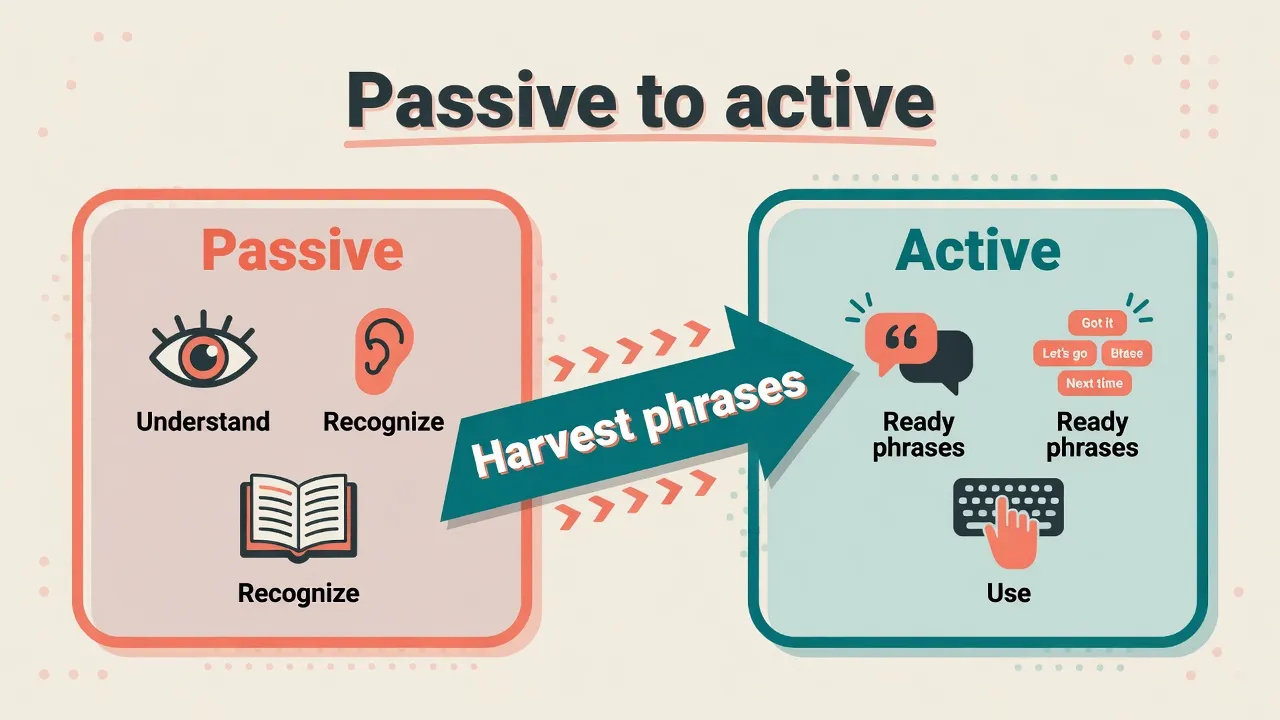
3. Learn ready phrases and collocations, not isolated words
Isolated words force mid-speech grammar rebuilds. Ready phrases arrive as chunks, so working memory does less assembly under pressure.
Examples you already half-know:
- I was wondering if…
- To be honest…
- Could you say that again?
Harvest them from graded reading. Type or shadow them lightly. For the full passive→active story, see passive to active vocabulary. Try the demos at phrase typing and type training - useful for light production, not a miracle "unfreeze button."
4. Light production alone: self-talk + shadowing
Start with the safest partner: you.
- Narrate simple actions out loud (I'm making coffee).
- Retell a page or a short scene from a series.
- Shadow short audio after a page: copy rhythm and mouth shape without a grammar courtroom mid-line.
Listen where your tools allow it. Mouth muscle and retrieval under zero social load matter. Solo production is still not a full conversation - it is the runway before one.
5. Cheat sheets for predictable situations
Unpredictability fuels anxiety. Restaurant, small talk, interview, doctor, meetup intro - pick one real situation and write 5-10 phrases you will almost certainly need.
Memorize them enough that the first line is available under stress. Reduce the blank with prep, not with more perfectionism. Update the sheet after each real use.
6. Less mental translation; meaning over form
Building a perfect sentence in your first language, then translating it mid-air, often dies half-built. English structure is not a copy of Ukrainian, Spanish, or any other home language.
Prefer three simple English sentences over one complex rebuild that freezes you. Lead with who does what. Form can clean up later; meaning has to leave your mouth now.
If the inner translator is the main drag, twin posts help: how to stop translating in your head and how to think in English.
7. Safe partner / club / exchange after runway
When anxiety is lower and a few phrases feel ready, add a human:
- a friend who is also learning
- a language-exchange app
- a small, kind club
Not as a moral day-one test. As the real speech step after the runway. If clubs drain you for personality reasons, not only language, the introvert path is speak English without stress as an introvert.
| Tool / habit | Helps with | Does not replace |
|---|---|---|
| Graded / calm reading | Input fuel, patterns, lower social risk | Live back-and-forth talk |
| Phrase harvest + typing demos | Ready chunks, light production | Partner negotiation and repair |
| Listen + shadow | Mouth muscle, rhythm, confidence alone | Unpredictable social dialogue |
| Cheat sheets | Predictable situations | Full spontaneous conversation |
| Safe partner / club / exchange | Real interaction after runway | (this is the speaking practice) |
How MovaReader fits
Tools reduce friction. Humans still teach conversation later. Here is how MovaReader maps onto the ladder.
| Need | Realistic plan |
|---|---|
| Test the reading runway without commitment | Free plan: free graded library within limits; about ~20 word translations/day; listening; upload your own legal EPUB |
| Daily page volume + dictionary without flow breaks | Reader €1/mo |
| Phrase / type trainers for active chunk practice | Pro €5/mo (when available) |
What it does: supports graded reading, phrase harvest, optional listen for shadow prep, and later phrase/type practice when trainers are the bottleneck.
What it does not do: replace conversation partners or speaking clubs.
Suggested path: open all articles → try a sample → optional phrase typing or type training → check pricing only when the free plan's limits stop real pages. Stay on the free plan while you test the habit. Move to Reader when volume needs it. Add Pro when trainers are the missing piece - not on day one of "I freeze when spoken to."
Related reading in this cluster
This post is the overview: freeze, psych block, ladder, seven steps. Sibling posts own the deep dives:
- Fear of mistakes and perfectionism - red-pen freeze and permission work
- Passive to active vocabulary - retrieval and activation drills
- Introvert language barrier - solo runway when clubs drain you
- Stop translating in your head and think in English - inner translator habits
Use them when one driver is your main bottleneck. You do not need to reread every essay in one sitting.
FAQ
What is an English language barrier if I already understand movies and texts?
The barrier is usually a psych block, not empty vocabulary. You can understand a lot and still freeze when someone addresses you: fear of mistakes, perfectionism, thin ready phrases for output, and little speaking practice. Comprehension means the input channel works. Speaking needs retrieval under social load. That gap is normal - it is not proof of "no talent."
Is the freeze fear, or am I just low level?
Often both feelings mix, but the freeze can hit even when tests and reading look "fine." If you follow series and texts yet go blank face to face, fear plus missing production practice is a better first diagnosis than "start grammar from zero." If basic input still fails, raise level with calm graded reading first. Either way, shame is a bad coach. Some people feel strong speaking anxiety (foreign-language anxiety in teaching blogs); that is a plain-language gloss, not a medical diagnosis.
Can reading really help me speak?
Yes as a low-anxiety runway: right-difficulty text → harvest reusable phrases → light production (type, self-talk, shadow) → then safer speech. Reading fills patterns and ready chunks so the blank mind has bricks to grab. It helps foundation and confidence. It does not replace live conversation, clubs, or partners - and a reading app is not a speaking club substitute. No page count turns into fluent speech by itself. Start with the graded library if you want low-risk input.
Should I force speaking clubs first?
Not as a moral day-one test if freeze is strong. High social load on top of weak retrieval often deepens the silence loop. Prefer a short runway first (calm input + phrases + light solo production), then a safe partner or club when anxiety is lower. Clubs are useful later. Forcing them early is willpower theater for many learners. If the club itself is the stressor, see the introvert barrier path.
How do ready phrases reduce freeze?
Isolated words force mid-speech grammar rebuilds. Ready phrases and collocations (I was wondering if…, To be honest…) arrive as chunks, so working memory does less assembly under pressure. Harvest them from graded reading, type or shadow them lightly, and keep a 5-10 line cheat sheet for predictable situations. Phrases help retrieval; they are not a miracle unfreeze button and still need real conversation later. More depth: passive to active. Practice: phrase typing demo.
What can I do free in MovaReader?
The free plan supports the habit start: free graded library within limits, about ~20 word translations/day, and listening. You can upload your own legal EPUB. We do not host unlimited free commercial novels. Reader at €1/mo is for volume reading without constant translation walls. Pro at €5/mo is for phrase/type trainers when available - not required to start reading. Reading still does not replace speaking with humans. Details: pricing.
Next steps
Today: one graded page; mark 3-8 reusable phrases; allow one imperfect spoken line alone (self-talk or shadow).
This week: a cheat sheet for one real situation; one low-stakes human exchange if you are ready.
Open all articles for the first page. Tools lower friction on the runway. Speech with people still has to happen later.
Thaw the freeze with runway and ready phrases.
Learning English?
The English version of MovaReader teaches Spanish and Ukrainian. To read English with a translation for every word, open the reader in Ukrainian or Spanish:
Книги англійськоюЦя стаття українськоюLibros en inglésEste artículo en español