Tips & Methods
How to Think in English: A Self-Talk Ladder
You already think in images and intent. Thinking in English means quick labels and sentence patterns under light time pressure. A practice ladder, a week plan and reading as a chunk gym.
You open your mouth to answer in English. Half a second stretches. Your mind builds the idea in your first language, then rebuilds it word by word. By the time the sentence is ready, the moment has moved on.
That pause is common. It is not proof you lack talent. It is a stage where meaning still takes a detour. You do not need to "switch your native brain off." You need more direct English labels and sentence patterns for ordinary moments - under light time pressure.
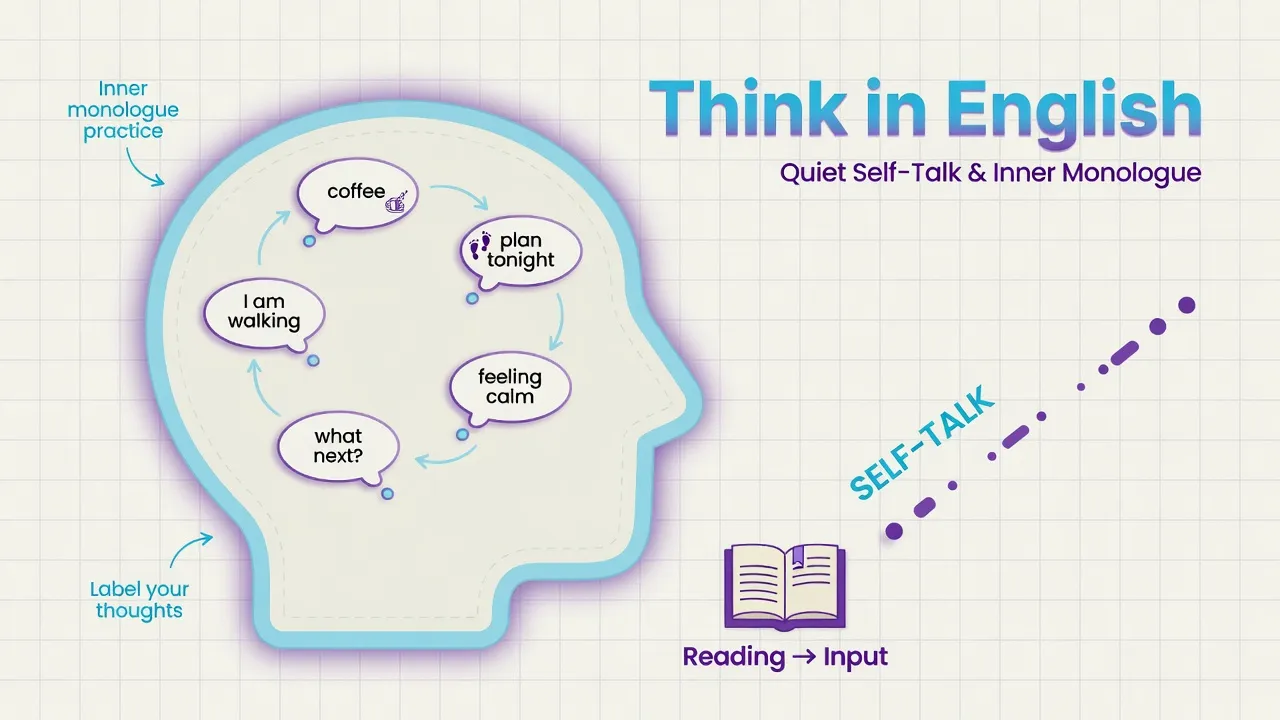
Here is the simple version. Thinking in English does not mean erasing your first language. You already "think" in images, feelings, and intent; English thinking is labeling those moments and retrieving sentence patterns under light time pressure. You build that with a self-talk ladder (objects → actions → plans → short monologues), timed micro-sessions, and easy reading that supplies reusable chunks - not overnight "native brain" magic.
Below: what "think in English" really means, why the inner translator shows up, a practice ladder with timed minutes, a realistic week plan, reading as a chunk gym, immersion without panic, common mistakes, and where MovaReader fits.
What does "thinking in English" actually mean?
Here is the plain version.
It is not:
- deleting your first language
- living 24/7 in a pure English monologue
- a talent switch or overnight "native brain"
It is:
- more direct access to English labels and ready sentence patterns for ordinary moments
- thinner first-language mediation more often, not a purity war
- labels + self-talk + input volume; hard topics may still use your first language
You already think in pictures and intent before words. Language arrives as labels and patterns. "Thinking in English" means those labels arrive sooner for coffee, doors, dinner plans, and small opinions - without a full rebuild every time.
If the main pain is speaking lag from constant mental translation, the full anti-translator workflow lives on how to stop translating in your head. This post trains the self-talk skill side: ladder, timed slots, reading as phrase inventory.
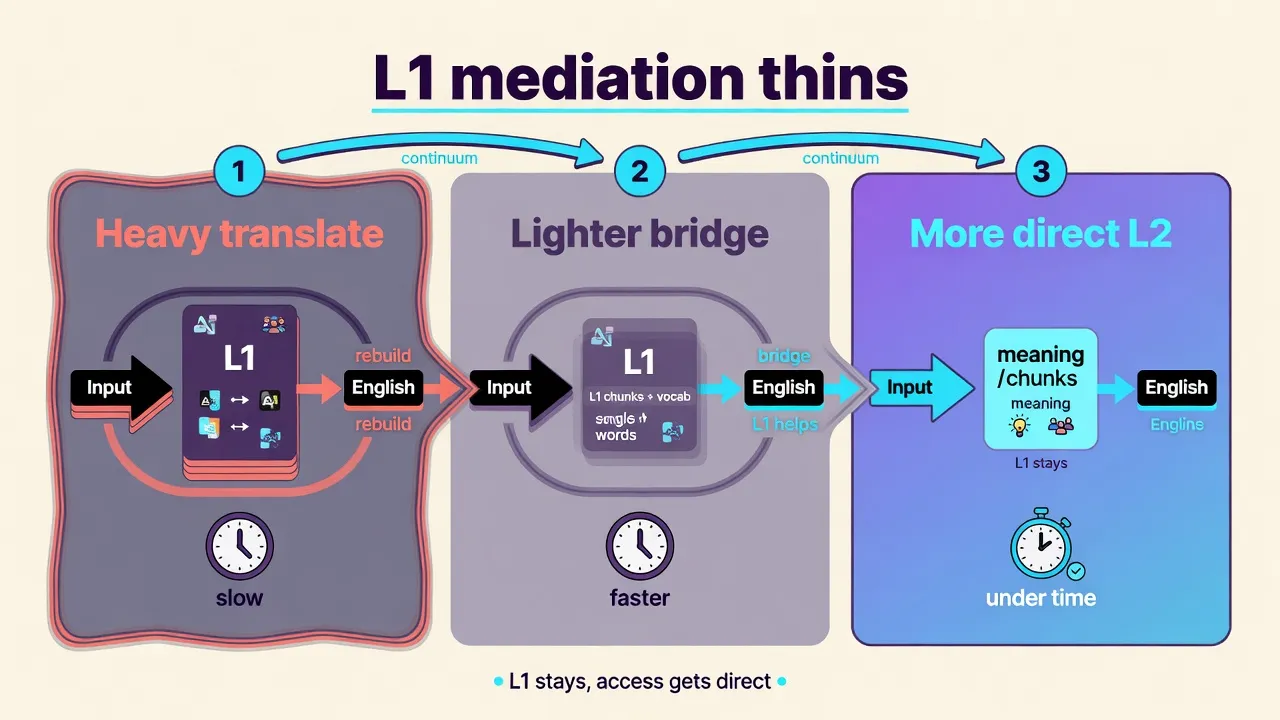
Picture one metaphor and keep it: the inner translator is a mediation layer. Practice does not erase it. With input and self-talk, it thins for daily moments so English chunks come out more directly. Your first language stays for hard ideas, emergencies, and early levels. That is healthy, not failure.
Why does the inner translator show up?
Short version - not a second stop-translating essay.
- Your first language is the default base. Many words were learned as pairs (apple ↔ your word). The bridge fires first because it already exists.
- Double processing costs time. Meaning → first language → rebuild English → lag. Even when every step is correct, talk feels slower.
- School habit: assemble, not retrieve. You build sentences word by word from rules instead of pulling ready chunks like I'm opening the door or What should I make for dinner?
The problem is not that the bridge exists. The problem is when it is the only path for coffee, doors, and dinner plans. Hard ideas may still need first-language scaffolding. That is fine. Habit + retrieval practice thins the bridge for ordinary moments. No "break the neural bond forever" story required.
Practice ladder: from objects to short monologues
This is the spine of the method. Measurable levels, not a personality transplant. Climb when the current level feels easy most days.
| Level | Practice | Time box | CEFR note | Micro example |
|---|---|---|---|---|
| 1 | Name objects / labels | 1-2 min dead time | A2+ | table, dog, cup |
| 2 | Narrate actions (self-talk sentences) | 2-5 min | A2-B1 | I am drinking coffee. I am opening the door. |
| 3 | Plan day / short inner Q&A | 5-10 min | B1 | What should I make for dinner? |
| 4 | Short monologues (opinion, retell, "what if") | 5-10 min | B1-B2 | retell a short article; one opinion on a show |
| 5 | Optional: out-loud self-talk / voice notes | ~5 min | any | same content spoken |
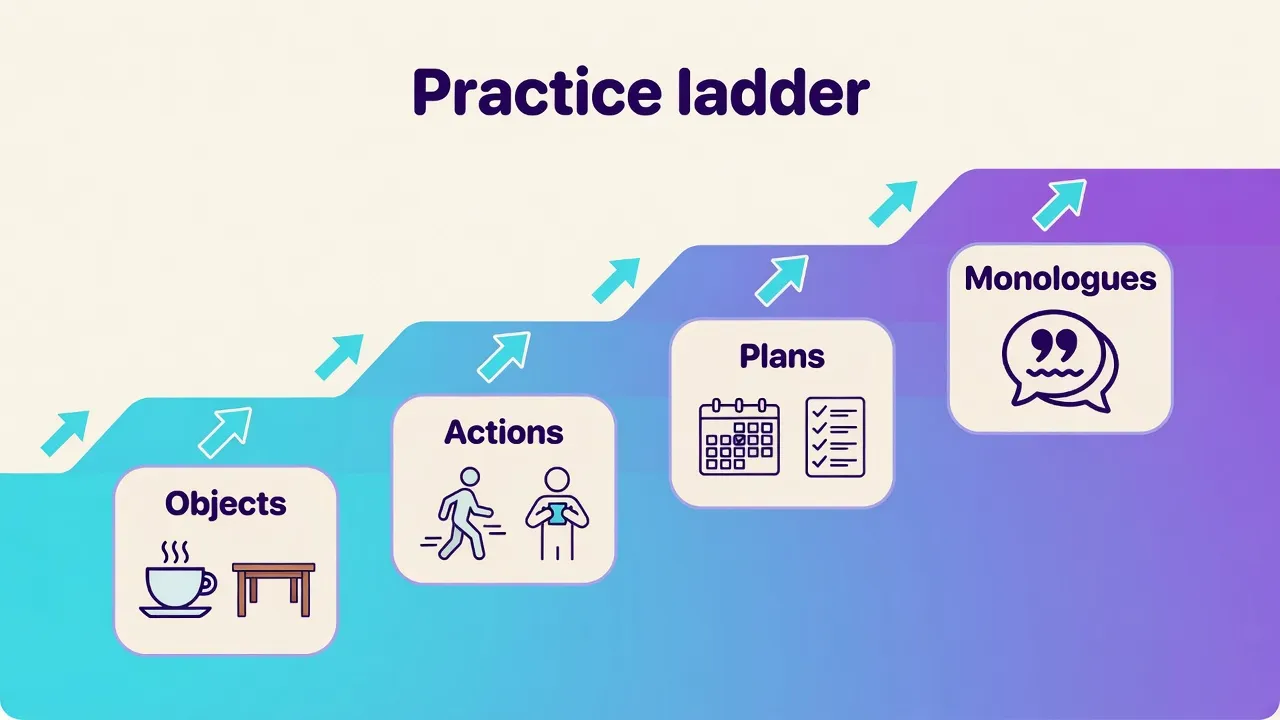
Use a kitchen timer or phone. The habit is measurable minutes, not "think English all day." Soft CEFR notes only: A2 leans labels + short actions; B1 adds plans and short Q&A; B1-B2 can try short monologues. Stepping down is progress.
Level 1: Objects and labels
Walk, desk, kitchen, bus stop. Look at what is in front of you. Name it in English when you know the word: table, window, keys, coffee.
If the label is ready, skip the long first-language detour. If you do not know the word, either skip it or note it for later reading - do not freeze the whole session.
Two minutes of dead time is enough: waiting for water to boil, standing in a queue, packing a bag.
Level 2: Actions as self-talk
Narrate what you are doing now. Present continuous or simple present is enough.
- I am drinking coffee.
- I am opening the door.
- I put the cup on the table.
Subject + Verb + Object is a full win at A2. Do not chase fancy grammar in the middle of a micro-session. Speed and meaning first.
Level 3: Plans and inner Q&A
Tomorrow, dinner, commute, weekend. Questions count as thinking practice.
- What should I make for dinner?
- When do I need to leave?
- First I finish this email, then I walk.
You are retrieving planning language under mild pressure. Stay at five to ten minutes. If you stall, drop back to Level 2 actions for the same scene.
Level 4: Short monologues
Five to ten sentences max. Retell a short article, give one opinion on a show, or play "what if" on a simple topic.
If you get stuck, paraphrase with simpler words. No dictionary rabbit hole mid-session. The goal is continuous English for a short stretch, not perfect grammar.
If Level 4 panics you, stay on Levels 2-3 another week. That is a realistic pace, not weakness.
Level 5: Optional out loud
Same content as Levels 2-4, spoken into a voice note on your phone. Still self-talk, not a fluency exam. Optional for introverts and anyone who freezes in social speech - private sound still counts. Soft related: introvert language barrier.
A realistic week plan (timed)
Small daily slots beat heroic weekends. Adjust minutes to your life; keep the ladder idea.
| Day | Self-talk focus | Minutes | Reading gym (optional same day) |
|---|---|---|---|
| Mon | Level 1-2: labels + actions | 5-8 | 10-15 min near-level text |
| Tue | Level 2-3: actions + one plan block | 8-10 | save 3-5 phrases |
| Wed | Level 3: plan day / Q&A | 8-10 | reuse yesterday's phrases in self-talk |
| Thu | Level 2 + optional out loud | 5-10 | 10-15 min reading |
| Fri | Level 4: short monologue (retell article) | 8-12 | same article / new short text |
| Sat | Light immersion day + easy self-talk | 5 + lifestyle | optional |
| Sun | Review: 5 min free monologue on the week | 5-10 | rest or light read |
Rules of the plan:
- Miss a day → restart next slot; no shame spiral.
- If Level 4 panics → stay on 2-3 another week.
- Hard topics may still use your first language - that is not failure.
You are building a habit of direct retrieval, not performing a purity contest.
Reading as a chunk gym
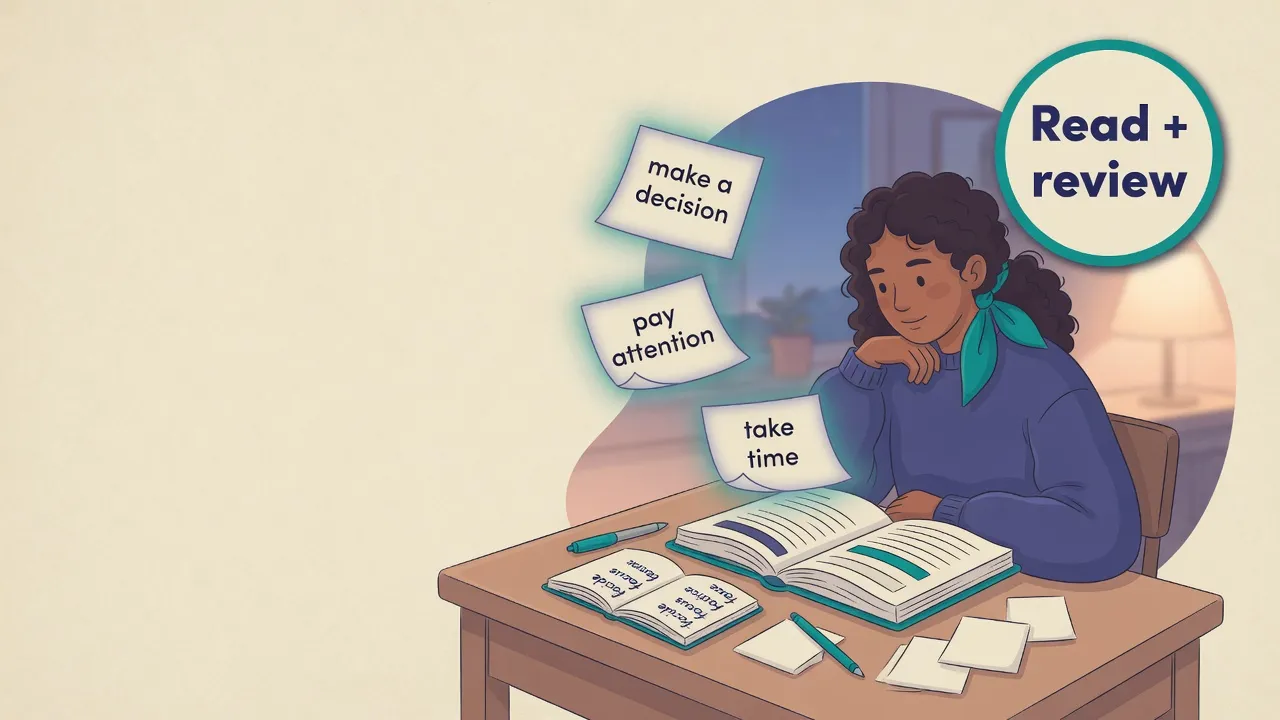
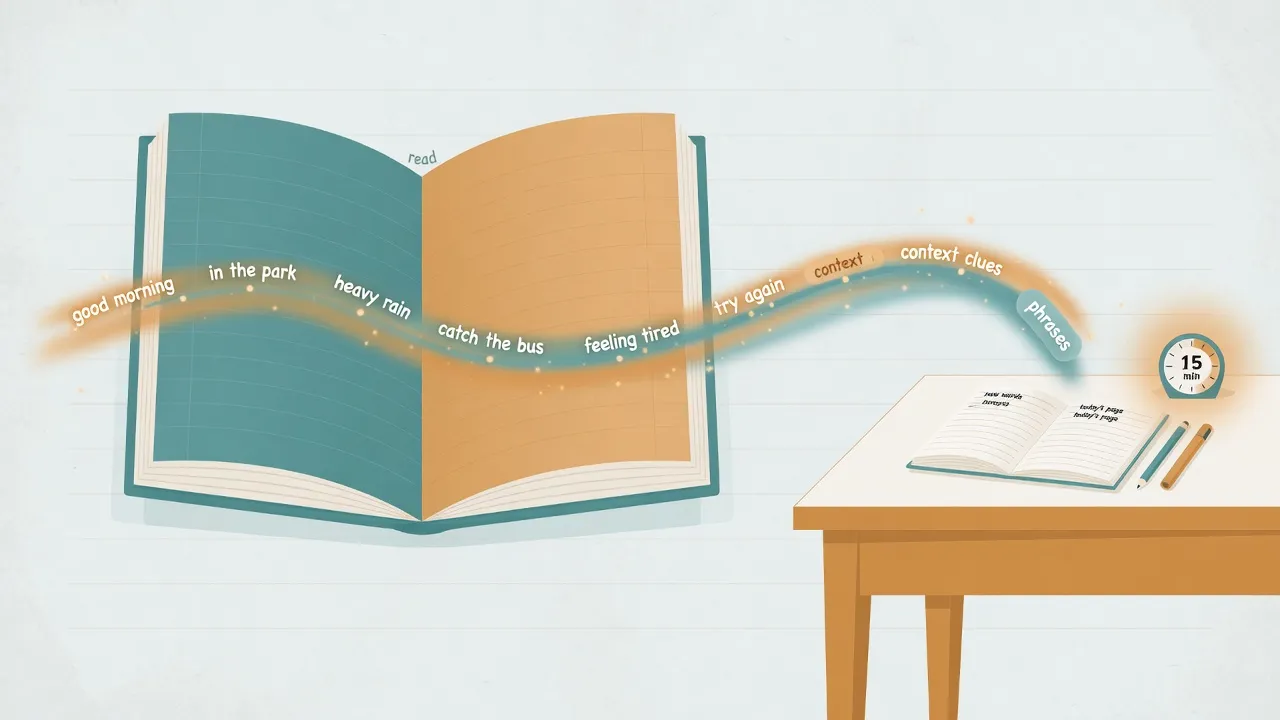
Reading is pattern input for the ladder, not a mid-article product wall. It fills the warehouse of phrases your self-talk can reuse.
near-level text → meaning first → translate blockers only
→ save 3-8 phrases → reuse those phrases in next self-talk slot
| Step | Action |
|---|---|
| 1 | Pick near-level text (soft ~70% page sense) |
| 2 | Full paragraph pass without stopping every word |
| 3 | Look up sentence-breakers only |
| 4 | Save 3-8 phrases, not 40 isolated words |
| 5 | Reuse those phrases in the next Level 2-4 self-talk slot |
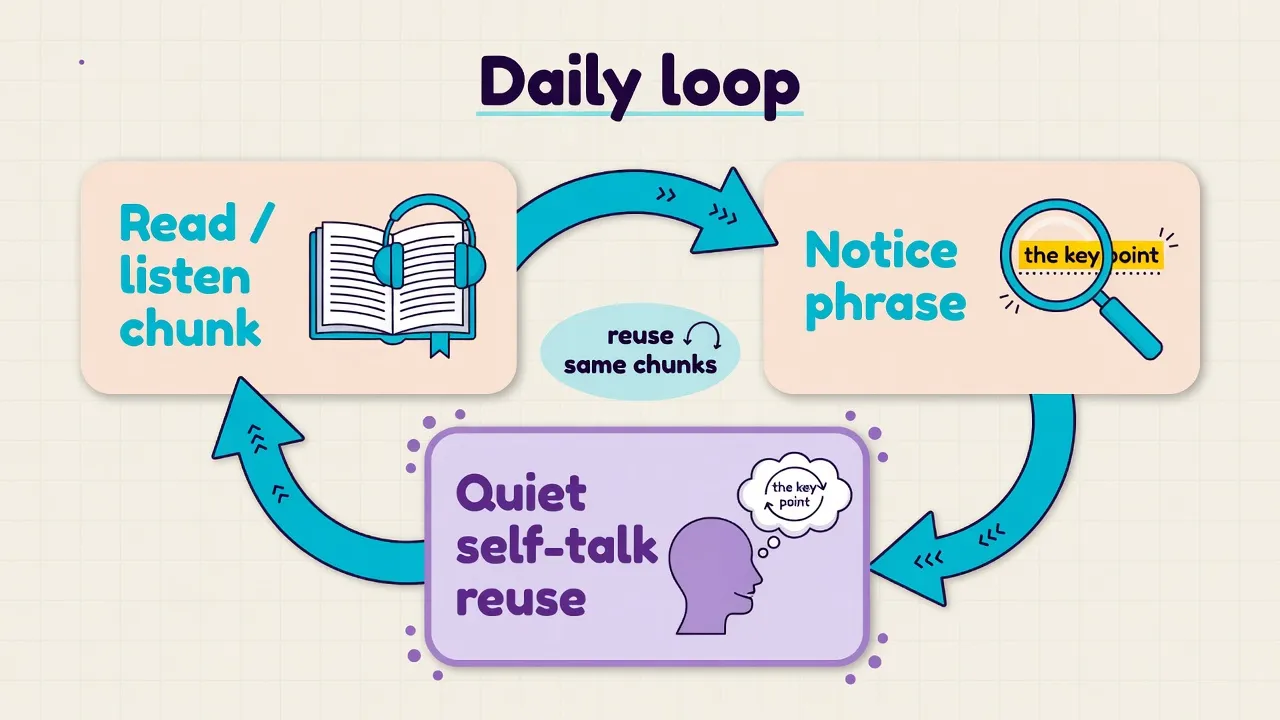
Soft ~70% page sense: if you understand less than roughly most of a page, step down. Too-hard text trains decoding, not thinking. Level pick helpers: 5-finger rule and adapted vs original books for A2. Reading-first still counts as thinking practice - inventory before forced speaking.
Try a free graded path: browse all articles. Meaning first, blockers only, save a few phrases, then feed them into tomorrow's plan or retell. If you want the deeper session protocol for speaking lag, see the guide on stopping mental translation. For first full books, how to read your first book in English is a calm next step.
Limit line: Reading builds inventory. Self-talk reuses chunks under light time pressure. Reading does not install English thoughts or replace live conversation. Moving chunks toward active use under pressure is also covered in passive to active vocabulary.
Immersion without panic
Immersion supports the ladder. Immersion alone is not the ladder.
- Phone / OS language - when ready; not day-one stress for A1.
- Search and tutorials in English - recipes, how-tos, error messages.
- EN-EN dictionary when almost known - bilingual still fine at A1-A2; monolingual as an optional habit later.
- Surround is not overwhelm - graded input beats raw Netflix with full first-language subtitles sold as "immersion."
- Stress check - forcing pure English all day can raise anxiety. Drop intensity; keep short ladder slots.
Surround yourself with English you can mostly follow. That feeds the chunk gym. Forcing a purity day does not make you think faster if you spend the day stressed and silent.
Mistakes that stall progress
Most stalls are habits, not missing talent. Fear of wrong grammar in private self-talk is common - soft related: fear of mistakes.
| Mistake | Better move |
|---|---|
| Fear of wrong grammar in self-talk | Speed + meaning first; polish later |
| Complex sentences too early | Simple S+V+O; build up levels |
| Word lists without phrases | Save phrases from reading; reuse in self-talk |
| "All day only English" purity war | Timed slots + first language for hard ideas |
| Looking up every word while reading | Blockers only; keep flow |
| Waiting for talent / overnight switch | Weeks of micro-practice + input |
| Chasing "rewire your brain" tricks | Build habits with short daily practice |
Common claims vs reality
| Claim | Reality |
|---|---|
| Think only in English 24/7 | Unrealistic; hard topics still use first-language mediation |
| Erase native language | Neither needed nor desirable |
| Automatic native-like inner speech soon | More direct chunks after weeks to months of input + practice |
| Reading alone = full fluency | Reading builds inventory; self-talk and speaking still need light output |
| An app installs English thoughts | Tools reduce lookup friction and supply chunks; they do not think for you |
Where MovaReader fits
Tools reduce friction while you climb the ladder. They do not install "think in English" with a button.
MovaReader fits the reading as chunk gym half: graded texts near your level, click-to-translate blockers only, optional audio when you want sound with the page, and later phrase or type trainers when you reuse saved chunks in self-talk. The method is still yours: self-talk ladder + timed minutes.
| Need | Realistic plan |
|---|---|
| Test reading + blocker discipline without commitment | Freemium (~20 word translations/day; listening often unlimited) |
| Daily page volume + dictionary without flow breaks | Reader €1/mo |
| Phrase / type trainers for active chunk reuse in self-talk | Pro €5/mo |
The freemium ~20 word translations/day limit actually teaches blocker discipline - you cannot productively click every adjective. Listening is often unlimited on free. Stay freemium while you test the habit. Move to Reader when the daily translation cap stops real pages. Pro is for full trainers when moving chunks into active reuse is the bottleneck. Details on pricing. Workflow notes on how to use. Browse the free library at all articles.
What it does not do: think in English for you, erase your first language or replace live conversation.
Today path (no perfection required)
- 5 min Level 1-2 self-talk (labels + actions) - no product required.
- Pick from all articles.
- Meaning first, blockers only, save 3-8 phrases.
- 5 min reuse those phrases in a Level 3 plan or Level 4 retell (optional Level 5 voice note).
- Optional trainers when phrases are ready: phrase typing demo, type training demo. Soft orientation for phrase inventory: language map.
If speaking lag from constant mental translation is still the main pain, use the guide how to stop translating in your head for the full workflow. This article stays on the ladder.
FAQ
Do I need to stop translating completely to think in English?
No. The goal is more direct chunks for ordinary moments - coffee, doors, dinner plans - not a purity ban on your first language. Your first language stays useful for hard ideas, emergencies, and early levels. If the main pain is speaking lag from constant mental translation, the full anti-translator workflow lives on how to stop translating in your head. This post trains the self-talk ladder side.
How long until English feels more "direct"?
Think weeks to months of regular micro-practice plus easy input, not a one-week switch. Timeline depends on level, how often you self-talk in short timed slots, and how much near-level reading feeds reusable phrases. More direct access more often is the win - not automatic native-like monologue forever.
Is thinking in English necessary for fluency?
Direct retrieval helps speed and more natural chunks. You can still be functional with some first-language mediation. Do not force a pure English monologue all day if it spikes stress - drop intensity and keep short ladder slots. Fluency is not a purity contest.
Do I need an inner monologue / what if I rarely "talk to myself"?
No universal requirement. Labels, short sentences, written notes, and optional out-loud voice notes all count. Inner monologue is not everyone. Level 1-2 practice still trains thinking-in-English access without a nonstop private commentary track.
Can reading alone teach me to think in English?
Reading builds inventory (the chunk gym). Self-talk and light output reuse those chunks under light time pressure. Best together: read → save 3-8 phrases → reuse them in the next self-talk slot. Try a graded sample from all articles. Reading does not replace live conversation or install English thoughts by itself.
What if I only know A2 - is monologue too hard?
Stay on levels 1-2 (labels + actions) longer. Plans and short monologues wait for B1 comfort. Stepping down is progress, not failure. Complex sentences too early feed the inner translator more than they train direct access.
Can I practice this on free MovaReader?
Yes for the habit loop. Freemium supports graded reading with about ~20 word translations/day and listening often unlimited on free - which fits blocker discipline and short reading gym sessions. Higher daily page volume usually wants Reader at €1/mo. Pro at €5/mo is for full phrase/type trainers when you move saved chunks into active reuse. See pricing. The product reduces lookup friction and supplies chunks; it does not think in English for you or erase your first language.
Next steps
Thinking in English means more direct labels and patterns, not deleting your first language. Climb the ladder in timed minutes. Feed it with easy reading chunks.
Today is enough:
- 5-10 min Level 1-2 (labels + actions)
- one short graded text (all articles) - blockers only
- save 3-5 phrases
- 5 min reuse in a plan or short retell
- optional voice note
You do not need a native-like monologue this week. You need more English labels for ordinary moments. Tools help the habit; they do not think for you.
Learning English?
The English version of MovaReader teaches Spanish and Ukrainian. To read English with a translation for every word, open the reader in Ukrainian or Spanish:
Книги англійськоюЦя стаття українськоюLibros en inglésEste artículo en español