Tips & Methods
How to Set Up ChatGPT for Learning English (Prompts + Rules)
ChatGPT is a flexible practice partner, not a magic tutor. Setup rules, five copy-paste prompts, practice modes, what AI still cannot do, and how graded reading fills the gap.
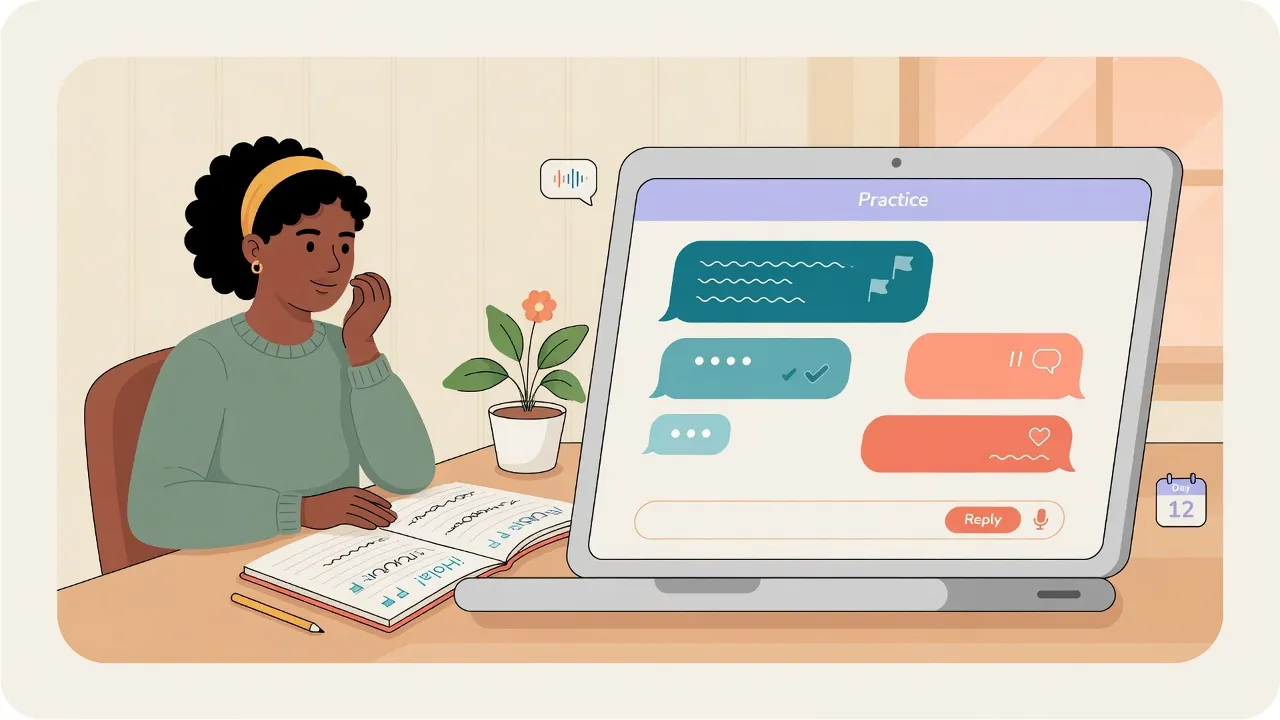
You open ChatGPT, type "let's talk English," and wait for something useful. What you often get is a stiff monologue: long paragraphs, mixed difficulty, almost no corrections, and a chat that drifts into essay mode. You did not do anything wrong. The tool just needs rules before it can act like a practice partner.
Here is the simple version. Start a dedicated chat (or Custom Instructions) with four rules: role as a patient practice partner, your CEFR level, short replies, and gentle corrections after you speak or write. Then switch modes with clear prompts: conversation, vocab in context, rewrite at level, roleplay, and optional voice.
AI is strong for drills and feedback. It can still invent details, and it is not a certified exam or a real teacher. Pair practice with graded reading so words reappear in full texts.
Below you will find setup rules and a quick comparison table, a five-prompt kit you can copy, practice modes (vocab, grammar, roleplay, voice), what AI still cannot do, and how reading closes the loop. Just configuration you can reuse.
Setup rules that actually work
Configuration beats "just chat." Five rules keep practice scannable.
- Dedicated chat for English practice. Do not mix homework, recipes, and coding into the same thread.
- State role + CEFR level + short answers + gentle corrections in the first message (or Custom Instructions).
- Restate level if the chat drifts harder or softer.
- Optional Custom Instructions for persistence. Still paste a mode prompt when you switch task.
- One task per stretch - conversation OR rewrite OR roleplay. Do not ask for everything at once.
Think of those four pieces as a stack you put under every session: role, level, short style, correction rule.
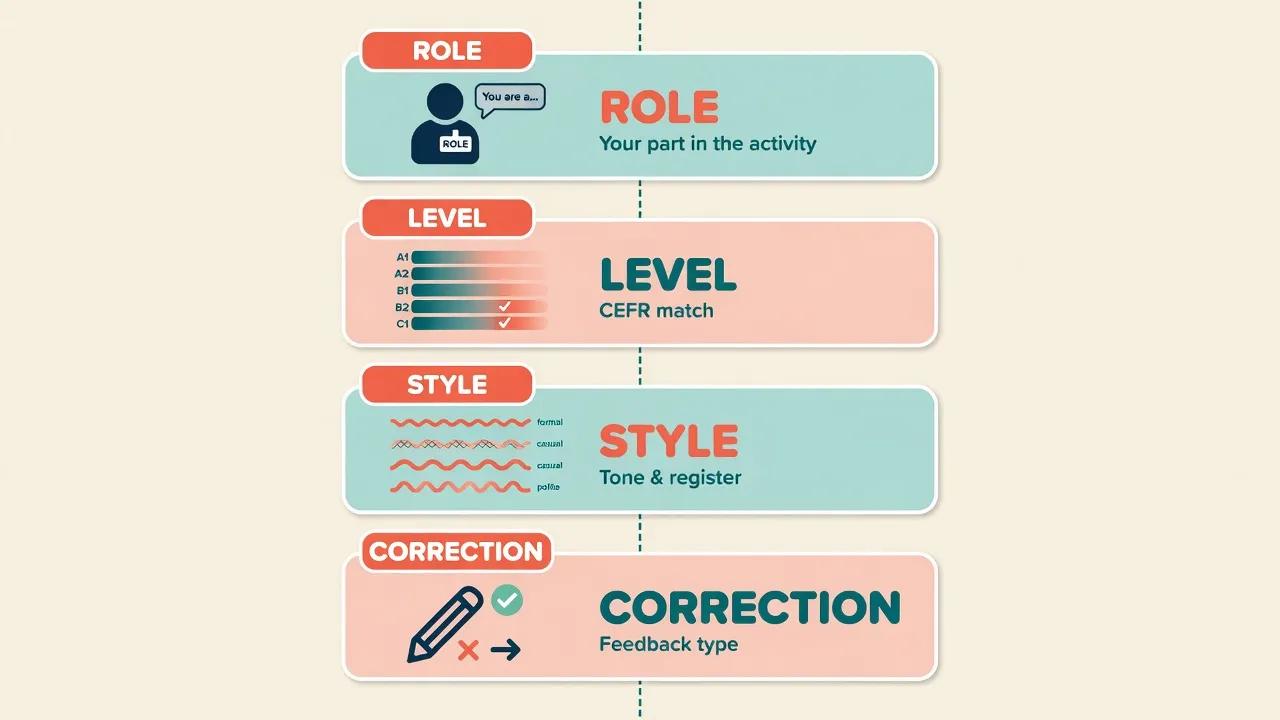
Same tool, two approaches. One gives structure you can reuse; the other often ends in stiff monologues.
| Approach | What you do | What you get |
|---|---|---|
| Just talk English | Open chat, "let's speak English" | Long stiff answers; mixed level; weak corrections; chat drifts |
| Good setup | Role + CEFR + short replies + gentle corrections; dedicated chat | Scannable practice; level-aware vocab; feedback you can use |
Once the stack is set, copy-paste prompts become reusable tools, not one-off luck.
Copy-paste prompt kit
Five boxes. Paste and swap level or theme in [BRACKETS]. English prompts work whether your UI is English, Ukrainian, or Spanish - you are practicing English.
1. Role setup (use first)
Use this first in a dedicated chat, or adapt it for Custom Instructions.
Act as a patient English practice partner, not a strict examiner.
I am a learner at CEFR level [A2 / B1 / B2].
Keep your replies short (about 2-4 sentences) so I can answer.
Ask me engaging questions to keep the conversation going.
After each of my messages, correct my English gently: fix clear mistakes,
explain briefly, then continue the chat. Do not write long walls of text.
Do not raise the level above [A2 / B1 / B2] unless I ask.
2. Grammar / writing review
Please review the following text I wrote.
Correct grammar, spelling, and punctuation.
Explain each important mistake in one short line.
Offer one more natural phrasing at my level ([A2 / B1 / B2]).
Do not rewrite my text into advanced C1-C2 English.
Here is my text:
[PASTE YOUR TEXT]
3. Short text at your level
Write a short story (or rewrite my paragraph) at CEFR [A2 / B1].
Use vocabulary and structures suitable for that level.
Keep it under about 150-200 words.
If I give a theme, stay on theme: [THEME, e.g. first day at a new job].
Optional: naturally include these 5 words or phrases in context:
[WORD1], [WORD2], [WORD3], [WORD4], [WORD5].
4. Roleplay for speaking confidence
Let's roleplay. Scenario: [coffee shop order / hotel check-in / job interview / small talk].
You play the other person. Stay in character.
Use short turns so I can reply.
My level is [A2 / B1 / B2]; keep language at that level.
After each of my turns, correct me gently if needed, then continue.
Start the scene now.
5. Vocabulary chunks + mini dialogue
Give me 5 useful English phrases or phrasal verbs for [THEME, e.g. travel / meetings / daily routines].
For each: short meaning + 2 simple example sentences at [A2 / B1] level.
Then write a short dialogue (6-8 lines) that uses all of them naturally.
Prefer chunks and phrases over isolated single words.
Optional compressed form for the Custom Instructions field:
I am learning English at CEFR [A2 / B1 / B2].
Be a patient practice partner. Keep replies short.
Correct my mistakes gently after I write or speak.
Ask questions to keep practice going. Avoid long essays unless I ask.
Use the kit as modes, not as one forever monologue. Swap the top prompt when the task changes.
Practice modes: vocab, grammar, roleplay, voice
Same setup stack. Different prompt on top.
Vocabulary in context
Prefer themes, example sentences, and a mini dialogue (prompt 5). Avoid pure word lists without sentences. Chunks stick better than naked words - the same idea as learning phrasal verbs as phrases, not isolated items.
After ChatGPT generates useful chunks, plan to meet them again in real reading. Generating a list is not long-term memory by itself.
Grammar and gentle rewrites
Send short self-written messages, emails, or journal lines (prompt 2). Ask for "why" plus one natural alternative - not a twenty-point essay on every comma. You can also ask for a rewrite at B1, or "more natural without raising the level" (prompt 3).
Roleplay for speaking confidence
Scenarios that work well: coffee shop, hotel check-in, job interview, small talk (prompt 4). Keep short turns. Type or use voice. The goal is less freeze in familiar situations, not "pass IELTS inside a chat."
While you practice, try answering in English without rebuilding every sentence from your first language. Our note on how to stop translating in your head pairs well with roleplay and short-reply rules.
Voice mode
Mobile ChatGPT voice is good for fluency rhythm and low-stakes speaking. It is still not real social stakes, and it is not a specialist pronunciation course with reliable scores. Setup rules still apply: say level and role first, and ask it to keep answers short so you can answer out loud.
A simple session looks like this:
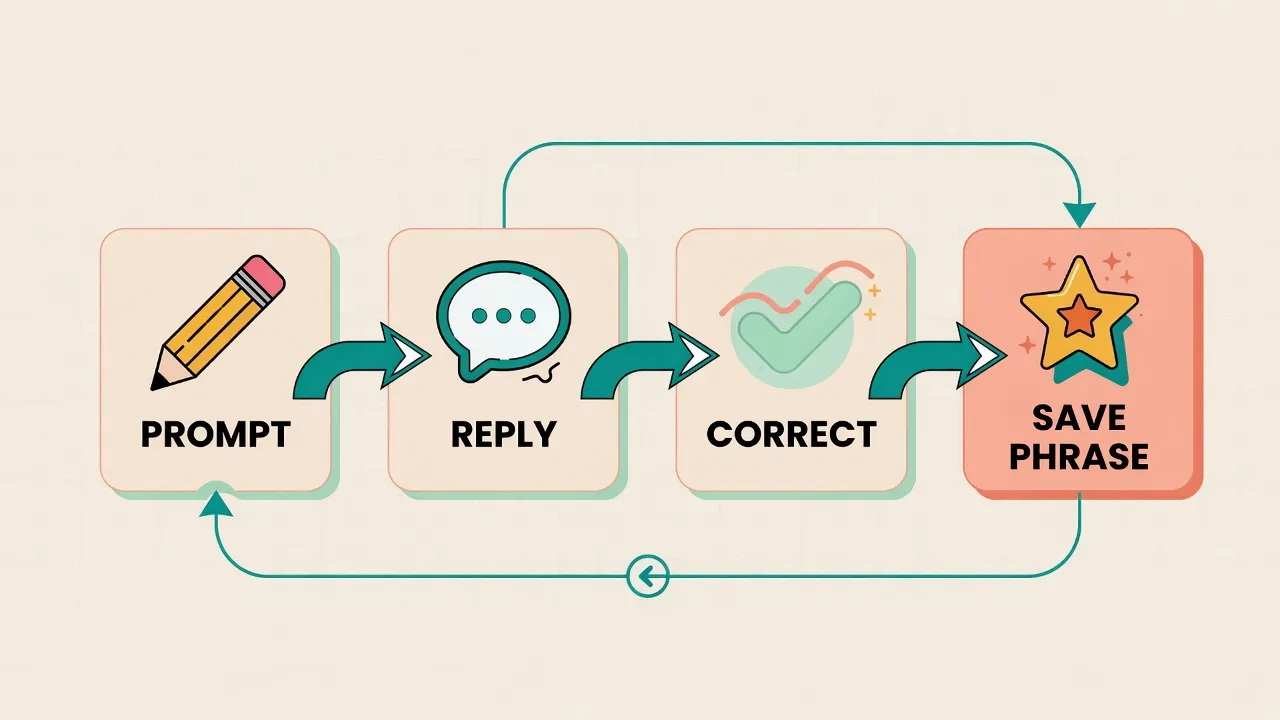
prompt → reply → correct → save phrase (then optional re-meet in reading).
| Step | Action |
|---|---|
| 1 | Paste master role (or mode prompt) in a dedicated chat |
| 2 | Reply in English (type or voice) |
| 3 | Read gentle corrections; note one clearer phrasing |
| 4 | Save 3-5 useful phrases from the exchange |
| 5 | Optional: meet the same theme again in a near-level text |
Soft teaser for step 5: a free EN A2 sample lives in the graded library. More on reading after the limits section.
What AI still cannot do
ChatGPT is useful. It is also limited.
- It can invent. Facts, off "native" idioms, fake citations. Verify anything important.
- It is not a certified CEFR examiner. Level labels are approximate, not an official test score.
- It is not a human teacher substitute. Weak accountability, weak long curriculum design, no real classroom stakes.
- Voice is not the same as real conversation stakes. Practice yes. Interruptions, body language, and social risk differ.
- Privacy is third-party. ChatGPT is OpenAI's product. MovaReader does not host ChatGPT. Do not paste secrets you would not trust with a third-party AI.
- A word list is not memory. Generating phrases once does not lock them in. Re-encounter and spaced practice still matter - the same forgetting-curve idea we cover for vocabulary work (Ebbinghaus and re-encounter).
So how do you close the loop without dropping ChatGPT? Keep the drills. Add real texts.
Pair ChatGPT with reading
ChatGPT is strong for interactive drills, feedback, and roleplay. Reading supplies full texts and spaced re-encounter of words and phrases. The complementary loop is simple: practice or generate with AI → meet language in graded stories → train a few saved phrases.
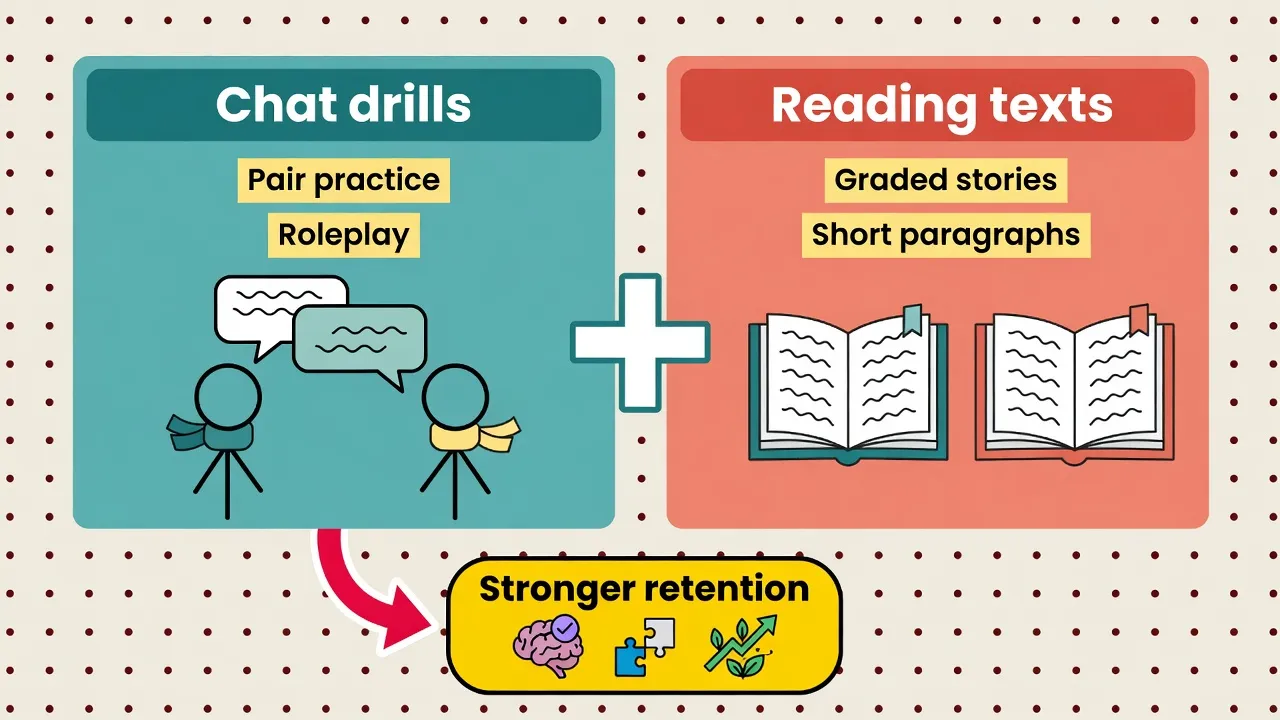
MovaReader is built for the reading half of that loop. It does not host ChatGPT, sell ChatGPT access, or replace your OpenAI account.
What you can use:
- Free graded library: /en/all-articles
- Click-to-translate on the free plan: about 20 word translations per day; listening is often included too
- Own legal EPUB upload when you are ready
- Phrase and typing practice: /en/phrases, /en/trainers, plus demos /en/demo-phrase-typing and /en/demo-type-training
- Plans on /en/pricing: Free · Reader €1/mo · Pro €5/mo for full trainers
| Need | Realistic plan |
|---|---|
| Test graded reading + light lookups | Free plan (~20 word translations/day; listening often included) |
| Daily page volume without constant limit friction | Reader €1/mo |
| Phrase / type trainers for saved chunks | Pro €5/mo |
Keep expectations realistic: AI plus an app will not make you fluent on its own, and words do not go into a personal dictionary unless you save them. You save useful phrases yourself (notes or in-app). If a graded text feels too hard after an AI theme, step down with a simple level check like the 5-finger rule.
A path you can run today
- Paste the master role prompt and practice 10 minutes (chat or roleplay) in ChatGPT.
- Save 3-5 useful phrases from the exchange.
- Read one near-level article (pick from /en/all-articles).
- Optional: try phrase typing or type training demos, then /en/phrases or /en/trainers when you want more.
- Stay on the free plan while testing; move to Reader when the daily translation limit stops real pages. Pro only when trainers are the bottleneck.
FAQ
Is the free ChatGPT tier enough for English practice?
Yes for text drills, copy-paste prompts, and typed roleplay. Limits on usage or model access are on OpenAI's side, not a MovaReader feature. Voice mode and some advanced models may need a paid OpenAI plan - check current OpenAI options rather than treating any price here as permanent. Free ChatGPT is still enough to run the full setup stack in writing.
Custom Instructions vs paste the role every time?
Custom Instructions help persistence (role, level, short answers, gentle corrections stay on). Still paste a mode prompt when you switch task: roleplay, rewrite, or themed vocab. A dedicated practice chat remains useful so English practice does not mix with homework or coding threads.
Is voice mode worth it?
Useful for fluency rhythm and low-stakes speaking practice. It is not a full pronunciation course and not the same as real social stakes. Keep short-answer rules so turns stay speakable out loud. Setup still matters: say level and role first.
Can ChatGPT replace a teacher?
No. It is a flexible practice partner for drills, feedback, and roleplay. It is weak on accountability, official assessment, and long curriculum design. Human teachers and classes still matter for many goals. Treat AI as a tool with limits, not a certified examiner or a full substitute.
How do I stop it inventing weird vocab or wrong "facts"?
Pin your CEFR level in the setup stack. Ask for common phrases and simple example sentences. Double-check odd idioms or surprising "facts." Prefer chunks you also see later in real graded texts. If a word feels off, ask: "Is this common at B1?" or "Give a simpler alternative."
How should I pair ChatGPT with reading?
Practice or generate with AI → meet the same themes or phrases in a near-level story → save a few phrases → light typing or phrase trainer later. ChatGPT handles interactive drills and feedback; reading supplies full texts and re-encounter. That is a complementary stack, not "ChatGPT or reading." Start with /en/all-articles.
Next steps
Setup stack first: role + level + short replies + gentle corrections. Use the prompt kit as modes, not one endless chat. Treat AI as a practice partner with limits, then re-meet language in real texts.
Today: open a dedicated English chat, paste the master role prompt, run one mode for ten minutes (roleplay or rewrite), save a few phrases, and read one short near-level piece. Library, demos, and plans when you want the reading half wired in: /en/all-articles, /en/demo-phrase-typing, /en/pricing.
You do not need a perfect tutor bot. You need clear rules, honest feedback, and words that show up again in stories.
Learning English?
The English version of MovaReader teaches Spanish and Ukrainian. To read English with a translation for every word, open the reader in Ukrainian or Spanish:
Книги англійськоюЦя стаття українськоюLibros en inglésEste artículo en español