Curated Resources
7 Psychology Books to Read in Original English (B1-C1)
Why original English matters for psychology and self-help: key terms and author voice. Seven books from Clear to Frankl, where to start at B1-C1, and a simple reading loop.
You have seen those motivational quotes that feel empty the moment you read them. "Be the best version of yourself." "Get out of your comfort zone." The idea once had teeth. After a few rounds of paraphrase, it sounds like a poster in a gym hallway.
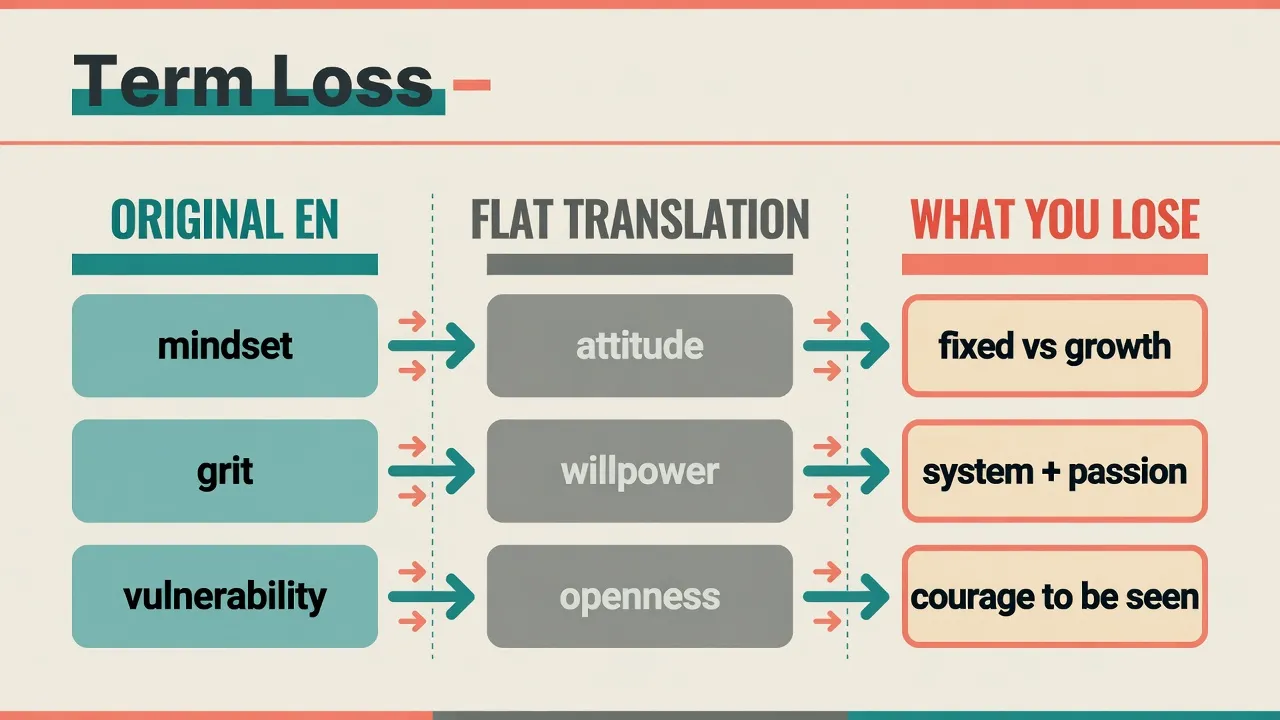
The same thing happens with psychology and self-help books. A careful translation can still teach useful ideas. But terms like mindset, grit, and vulnerability often land as near synonyms - almost right, a little soft, missing the system the author built. You wanted the idea and better English. You got a flattened copy.
If you want psychology and self-help ideas without translation blur, read the big titles in original English - and pick the book that matches your level, not the loudest bestseller. Start easier (Clear, Manson around B1-B2), then Brown, Dweck, Duckworth at B2, then Kahneman and Frankl when you are ready for denser prose. Keep the English terms (mindset, grit, vulnerability, atomic, System 1/2) - they carry the author's system, not just near synonyms. Warm up on graded English articles, then read your own EPUB with light look-ups; train a few saved quotes, not every unknown word.
Below: a scannable CEFR comparison, a start-here ladder, a short board of terms that blur, seven blurbs in level order, and a practical reading loop. The goal is a path you can use this week.
Why read self-help and psychology in original English?
Fiction translation can be art. Psychology nonfiction translation is almost always a compromise.
Three things tend to blur:
Terms. English psych jargon often names a whole model, not a single everyday word. Fixed mindset is a belief system about ability. Render it as "how you think" and half the theory walks away. The same pattern hits grit, vulnerability, atomic, and System 1 / System 2.
Voice. Brené Brown writes like someone on the sofa next to you. Mark Manson shocks on purpose. In many translations those voices flatten into one neutral "book tone." Style is part of how they persuade you.
Culture chunks. Habit stacking, named cognitive systems, productivity metaphors - these live in English research and self-help culture. Calques often sound like construction manuals or textbook glosses.
You do not need a perfect C1 certificate to start. You need a book that fits your level, a few terms you keep in English, and a loop that does not kill flow. If you are building reading vocab around B1, the method in how to build B1 vocabulary by reading pairs well with this list.
Quick comparison: 7 books by CEFR
Here is a scannable map before the longer blurbs. Match the book to your level, not the loudest cover.
CEFR bands below are soft editorial estimates for learners, not publisher labels, exam results, or official tests. For a sense of how big each band can feel, see how many words per CEFR level.
| Book | Author | CEFR | Why original | First-chapter tip |
|---|---|---|---|---|
| Atomic Habits | James Clear | B1-B2 | atomic = tiny and powerful; habit stacking loses punch as a calque | Read ch.1 for systems vs goals; save 3-5 habit terms, not every noun |
| The Subtle Art of Not Giving a F*ck | Mark Manson | B1-B2 | Controlled shock + Backwards Law live in EN rhythm and profanity tone | Skim early chapters for voice; accept slang; focus on values, not every swear |
| Daring Greatly | Brené Brown | B2 | vulnerability = courage, not a "weakness" near-synonym | Read for sofa-side voice; keep vulnerability in EN when you save quotes |
| Mindset | Carol Dweck | B2 | fixed/growth mindset is a belief system, not "how you think" alone | Track fixed vs growth language; one strong quote beats 20 half-saves |
| Grit | Angela Duckworth | B2 | grit has no clean one-word gloss; passion + perseverance over time | Note the grit definition early; save contrast pairs (enthusiasm/endurance) |
| Thinking, Fast and Slow | Daniel Kahneman | B2+ | System 1 / System 2 stay clean only as named systems | Do not start here at shaky B1; short sessions; one bias chapter at a time |
| Man's Search for Meaning (EN canon) | Viktor Frankl | B2-C1 | EN edition is the modern canon; we are challenged carries choice philosophy | Prefer a full modern EN edition; dense pages - slower pace, fewer lookups |
B1 readers: stay with Clear or Manson until pages feel light. Save Kahneman and Frankl for steady B2+ patience.
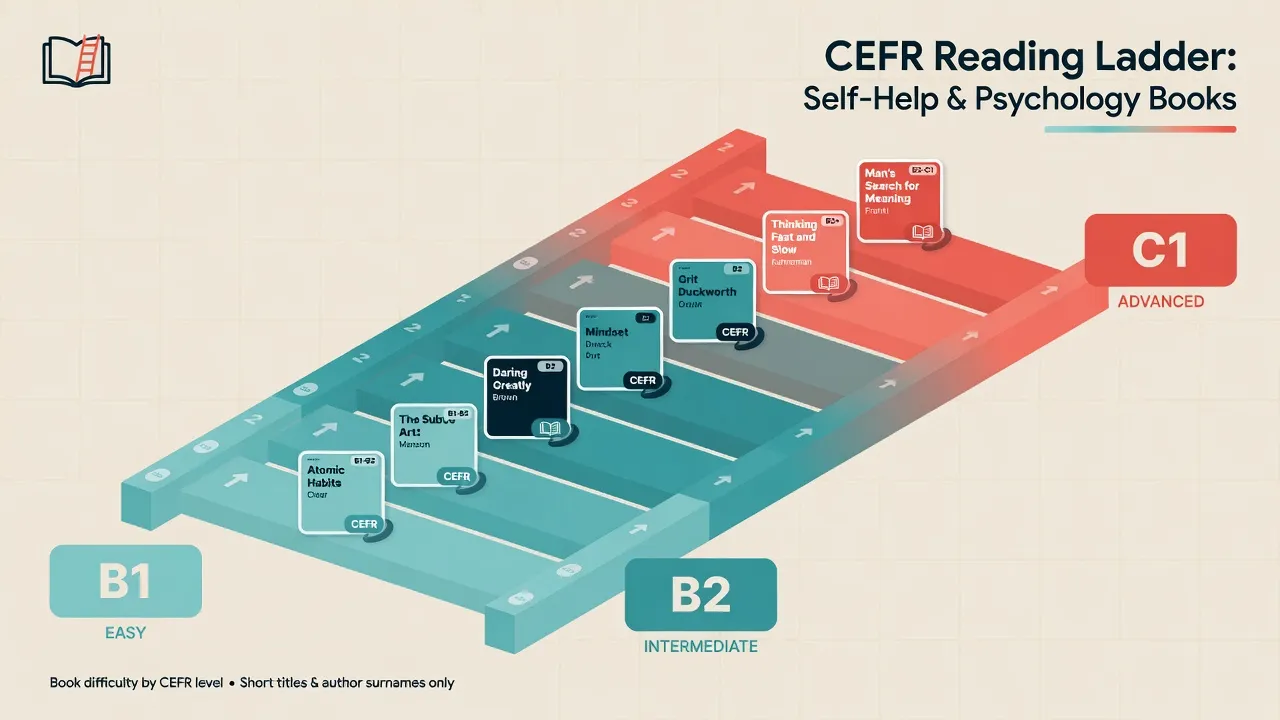
Which book first by level? (reading ladder B1 to C1)
Same order as the table - a start-here path, not seven equal blurbs.
- B1-B2 start: Atomic Habits (Clear) - plain, direct systems English
- B1-B2 alternate: The Subtle Art... (Manson) - conversational; slang + Backwards Law
- B2: Daring Greatly (Brown) - emotional spoken prose + research asides
- B2: Mindset (Dweck) - academic but readable; mindset is the core term
- B2: Grit (Duckworth) - narrative + data; the title word is half the lesson
- B2+ denser: Thinking, Fast and Slow (Kahneman) - science prose, named systems
- B2-C1 denser: Man's Search for Meaning (Frankl, EN canon) - philosophical density
What if I am only B1?
Start with Clear and/or Manson only. Warm up with one graded English article before chapter 1 so your brain is already in English mode. Do not open Kahneman or Frankl cold at shaky B1 - density will feel like failure when it is really a level mismatch. For fewer freezes on denser pages later, vocabulary for reading comprehension is a useful companion.
When are Kahneman or Frankl a good idea?
When steady B2 (or higher) feels normal and you can tolerate long abstract paragraphs. Short sessions beat hero marathons. One chapter of Kahneman, closed with two saved ideas, beats twenty pages of guilt. Frankl rewards slower pace and fewer lookups per page. Around mid-ladder B2 depth, how many words for B2 can reset expectations about size of the job.
English terms that blur in translation
This is not a list of foreign words to import into English. It is the reverse: English psych jargon that fails outward when forced into near synonyms.
Translation of this genre is a compromise on terms, voice, and culture. You lose tone and system precision.
| EN term | Rough gloss | Why keep the English word | Book |
|---|---|---|---|
| mindset (fixed / growth) | Belief system about ability, not "way of thinking" alone | Dweck's model is a system of beliefs; calques flatten fixed vs growth | Mindset |
| vulnerability | Openness to risk and emotion as courage, not mere fragility | Near synonyms often sound like weakness; Brown redefines the load | Daring Greatly |
| grit | Passion + perseverance over a long time | No clean one-word target; partial glosses drop the time + passion half | Grit |
| atomic | Tiny and powerful (double play) | Title system collapses if only "small habits" survives | Atomic Habits |
| System 1 / System 2 | Fast automatic vs slow effortful thinking | Named systems stay cleaner than long local paraphrases every sentence | Thinking, Fast and Slow |
| Backwards Law | Wanting more positive experience can be the negative experience | Logic lives in EN positive/negative + experience repetition | The Subtle Art... |
| habit stacking | Attach a new habit to an existing cue | Productivity-culture chunk; calques sound like construction manuals | Atomic Habits |
A quick "what blurs" view of four high-value terms:
| EN term | Near synonym trap | What blurs |
|---|---|---|
| mindset | "thinking" only | Belief system vs momentary thoughts |
| grit | "persistence" only | Passion + long horizon |
| vulnerability | "weakness / fragility" | Courage and authenticity load |
| atomic | "tiny habits" only | Power half of the double meaning |
When you save quotes later, leave these words in English. Gloss them in your notes if you need to - but keep the label the author used.
The 7 books (short blurbs, ladder order)
Each entry: why original, one strong quote, CEFR band, how to start.
Atomic Habits - James Clear (B1-B2)
Clear's system rides on a double meaning: atomic is tiny and powerful. Lose the second half and the title becomes "small habits" only. Habit stacking and systems language also sit cleaner in English.
"You do not rise to the level of your goals. You fall to the level of your systems."
Notice rise/fall and goals/systems. That contrast is architecture, not decoration.
Start tip: Chapter on systems vs goals. Save three to five habit terms, not every noun on the page.
The Subtle Art of Not Giving a F*ck - Mark Manson (B1-B2)
Manson's controlled profanity is a tool, not decoration. The Backwards Law needs English rhythm: positive and negative experience turning into each other.
"The desire for more positive experience is itself a negative experience. And, paradoxically, the acceptance of one's negative experience is itself a positive experience."
Start tip: Accept the tone shock early. Track positive/negative experience pairs. Focus on values, not every swear word.
If a page blocks you, click-translate the blocker only, then keep reading. Save one quote you would actually re-read.
Daring Greatly - Brené Brown (B2)
Brown made vulnerability the center of a whole philosophy. Many near synonyms sound like weakness or pain. In her English, vulnerability is courage and authenticity.
"Vulnerability is not weakness; it's our greatest measure of courage."
Read that pair out loud once: vulnerability beside courage. The load of the word is the lesson.
Start tip: Sofa-side voice, research asides. When you save, keep vulnerability in English next to courage.
Mindset - Carol Dweck (B2)
Fixed mindset and growth mindset are global English terms for a belief system about ability - not a temporary "mood of thinking."
"Becoming is better than being."
Three words. Whole thesis. Becoming (process) versus being (state).
Start tip: Track fixed vs growth language across a chapter. One strong quote beats twenty half-saves. Solid B2 is more comfortable than shaky B1 if academic tone tires you.
Around this band, a light session in trainers on a saved mindset line beats dictionary spam.
Grit - Angela Duckworth (B2)
Grit is the untranslatable core: passion plus perseverance over a long time. "Persistence" alone drops half the idea.
"Enthusiasm is common. Endurance is rare."
Contrast pairs stick: enthusiasm/endurance, common/rare.
Start tip: Capture Duckworth's definition of grit early. Define the word in English in your own notes. Save contrast pairs, not every study detail.
Thinking, Fast and Slow - Daniel Kahneman (B2+)
Kahneman's accessible science prose keeps System 1 and System 2 as named systems. Long local paraphrases every sentence blur the model.
"Nothing in life is as important as you think it is, while you are thinking about it."
Double think is the joke and the insight. Do not start here at shaky B1.
Start tip: Short sessions. One bias chapter at a time. Two saved ideas per sitting is a win.
Man's Search for Meaning - Viktor Frankl (B2-C1, EN canon)
Frankl wrote in German. The modern psychology conversation many readers cite runs through quality English editions - the EN canon. Prefer a complete modern English text when you can; older cut chains in other languages can lose framing.
"When we are no longer able to change a situation, we are challenged to change ourselves."
We are challenged is not pure force. Choice sits in that passive.
Start tip: Slower pace, fewer lookups. Dense pages reward patience more than speed.
How should you actually read them?
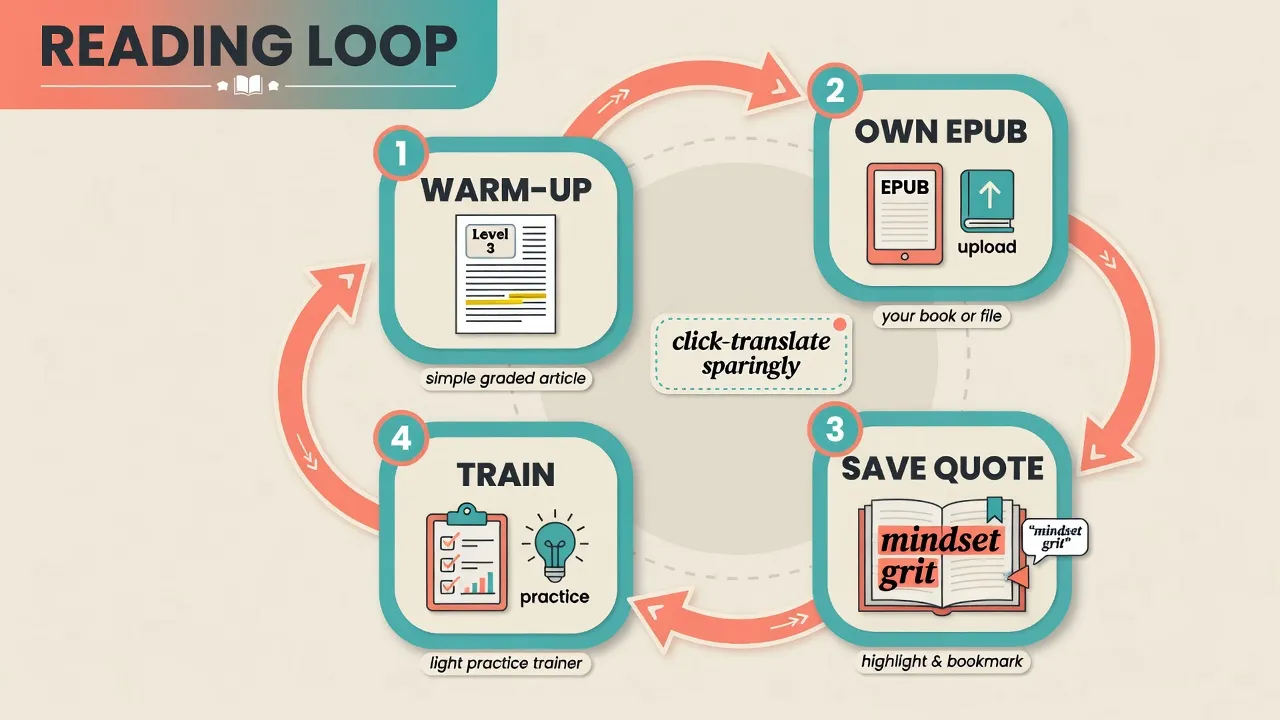
You do not need to dive into Kahneman cold. Use a simple loop: warm up, own the book, look up blockers, save a few high-value lines, train lightly later.

1. Warm up. Open one graded English article near your level - browse the free library at /en/all-articles. Five to fifteen minutes of easy English before a hard nonfiction chapter changes how the first page feels.
2. Own a legal copy. Buy or borrow the book. Paper is fine. EPUB is fine. MovaReader is a reading helper, not a free shelf of licensed commercial psychology bestsellers. We do not host those titles for you by default.
3. Upload your EPUB (optional). If you want in-page help, upload your file and follow the flow in how to use MovaReader. Paper readers can still practice terms and quotes in the app after a sitting.
4. Look up blockers only. A blocker is a word that stops the main idea. Everything else can wait. Re-read the sentence after the look-up. The free plan gives about 20 word translations per day - enough to learn the habit. Real book pages usually need more volume than that; Reader from €1/mo is the comfortable plan for day-to-day reading look-ups.
5. Save 5-10 high-value items. Key terms (grit, mindset, vulnerability, System 1/2) and quotes you would re-read. Not a wall of every unknown noun.
6. Train lightly later. Phrase and typing practice on what you saved - try demo phrase typing or demo type training, then the trainers hub. Pro €5/mo when full trainers and review volume are the bottleneck. The language map gives a rough sense of vocabulary depth.
Which plan fits:
| Need | Realistic plan |
|---|---|
| Learn the loop; short graded sessions | Free plan (~20 word translations/day + free graded library) |
| Real pages of your own EPUB day after day | Reader from €1/mo |
| Full trainers / heavy review of saved quotes | Pro €5/mo |
Details live on /en/pricing. Stay on the free plan while you test it; move up only when 20 look-ups a day block real chapters.
FAQ
Which psychology book should I read first in English?
Start with your level, not the most famous title. At B1-B2, pick Atomic Habits (Clear) or The Subtle Art... (Manson) - clearer sentences, usable systems voice. Then Daring Greatly, Mindset, and Grit at B2. Leave Thinking, Fast and Slow and Man's Search for Meaning for when denser prose feels OK (B2+ / B2-C1). Warm up on one graded English article before chapter 1 of a hard title.
Is B1 enough for Atomic Habits or Mindset?
Atomic Habits and Subtle Art: yes-ish for many B1-B2 readers if you look up blockers only and accept some slang (Manson). Mindset: better with a solid B2 - academic-accessible, but denser concept chains than Clear. If Mindset freezes you every paragraph, drop back to Clear/Manson and graded warm-ups, then retry. Method notes: build B1 vocabulary by reading.
Is a translation "good enough," or do I really need the original?
A careful translation can still teach useful ideas. For this genre it is almost always a compromise: key terms (mindset, grit, vulnerability, atomic, System 1/2), author voice, and culture chunks blur into near synonyms. If you want the author's system and English practice, original English is worth the extra effort when the CEFR band fits.
How do I look up words without killing the flow?
Translate blockers (words that stop the main idea), not every unknown. Save a small high-value set - often key terms and 5-10 quotes per sitting. Re-read the sentence after lookup. The free plan (~20 word translations/day) is enough to learn the habit; real book volume often wants Reader from €1. Train saved phrases later in trainers; do not interrupt every line for review. See also how to use.
Was Man's Search for Meaning written in English - which edition should I read?
Frankl wrote in German. The widely cited modern psychology conversation usually runs through quality English editions (the EN canon many readers and psychologists quote). Prefer a complete modern English text when you can. Band for learners: roughly B2-C1 - slower pace, fewer lookups per page.
Does MovaReader include these commercial bestsellers for free?
No. We do not host licensed commercial psychology bestsellers by default. Use the free graded English library to warm up, buy or legally own the book, then upload your own EPUB (or read paper and practice terms in-app). Free plan: free graded articles + about 20 word translations/day. Reader ~€1/mo for comfortable reading translation volume. Pro ~€5/mo for full trainers when review volume is the bottleneck. See /en/pricing.
Next steps
- Pick your rung (B1: Clear or Manson).
- Skim the term board; decide which words stay in English.
- Warm up with one graded English article on /en/all-articles.
- Start chapter 1 of your legal copy (upload the EPUB if you use digital).
- Save 5-10 high-value items, not every unknown.
- Optional: language map, trainers, or pricing when volume needs it - register if you want progress that sticks across devices.
Original English is for clearer ideas and better English. Start easy, keep the key terms, read a little often.
Learning English?
The English version of MovaReader teaches Spanish and Ukrainian. To read English with a translation for every word, open the reader in Ukrainian or Spanish:
Книги англійськоюЦя стаття українськоюLibros en inglésEste artículo en español