Tips & Methods
Why Learn English? 7 Practical Reasons
English is a practical lever for work, media, travel, and study when you have a use channel - not a personality upgrade. Seven practical reasons, a who-benefits check, and a graded reading start.
You keep pushing English to "next Monday." Meanwhile job posts ask for it, the series you love is better without a clumsy dub, and the next trip will dump you into booking screens and airport signs. Or the opposite: you feel guilty for not studying, but you have nowhere to use the language. That empty "use channel" is usually the real problem - not a missing talent gene.
Here's the simple version. Learn English when you have a real use channel - work, media you enjoy, travel, or study - because then the language is a practical lever, not a guilt project. The biggest daily payoffs are usually career options and docs, original media and books, and easier travel. Education access and possible cognitive side benefits are real, but quieter. Start with short interesting reading at a finishable level, not prestige textbooks or salary promises.
Below: seven reasons ranked by daily-life impact, who benefits and when it can wait, AI vs your own skill, a week-one reading plan, a calm tool path if you want less tab-switching, and FAQ.
7 reasons to learn English
Here are seven reasons people actually feel in daily life - with who benefits most, a first action this week, and a caveat. Ranked by daily impact, not prestige speeches.
| # | Reason | Who it helps most | First action this week | Caveat |
|---|---|---|---|---|
| 1 | Work and career options | Job seekers, remote/IT, international teams | Skim 3 job posts or work docs in English; note words that block you | Skill signal + more roles and docs - no fixed salary % |
| 2 | Media and books in original | Series and book fans, self-learners | 15 min graded article or one episode with English audio/subs | Joy path - not passive "watch and wake up fluent" magic |
| 3 | Travel and logistics comfort | Travelers, near-term relocation | Learn situational phrases via short texts (airport, hotel, problems) | Helps a lot; not required in every country for every trip |
| 4 | Study and knowledge access | Students, MOOC users, researchers-lite | Open one English course page or wiki section you care about | Access improves; IELTS/TOEFL still separate deliberate work |
| 5 | Tech, web, and professional docs | Developers, specialists, tool users | Read one tool doc or work blog post at your real level | English is common in high-value tech and web content |
| 6 | Possible brain side benefits | Anyone building a long habit | Short daily sessions beat rare marathons | Possible cognitive benefits from bilingual practice - not medical treatment or Alzheimer guarantee |
| 7 | Confidence and wider social range | People who freeze with foreigners | Low-stakes win: finish one short text; optional voice later | Confidence follows use, not slogans; reading alone is not free spoken fluency |
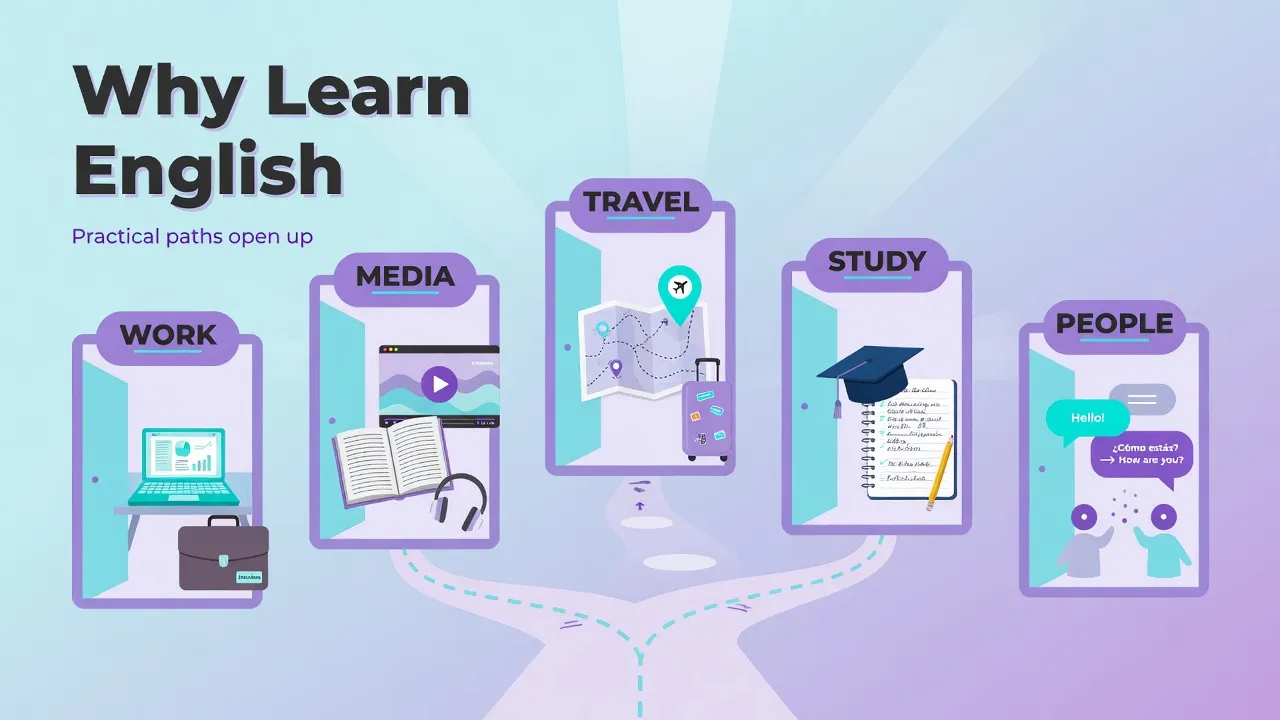
Daily-life impact map (work, travel, study, media, people - impact still needs a use channel):
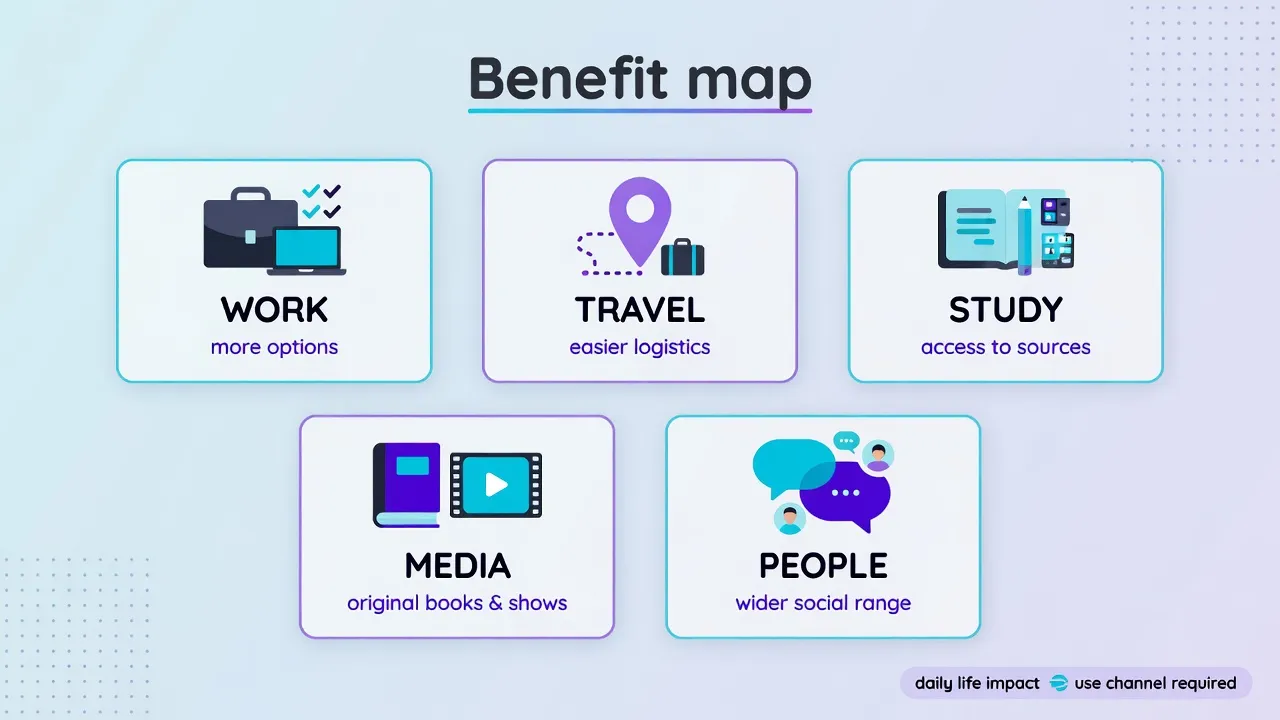
1. Work and career (a skill signal, not a guaranteed raise)
English often opens more job filters, remote threads, and international docs before you ever sit in a meeting. In many markets it works as a skill signal: employers and clients treat it as proof you can operate outside one language bubble.
That is not the same as a fixed raise. Markets differ wildly. Some roles pay more when English is required; others barely care. Treat the language as one career tool among many - more options and less friction with docs - not as a guaranteed percentage bump. If career English through books is your next step, see business English through books without the salary-myth noise.
First move this week: skim three real job posts or work docs in English and write down the words that actually block you. Those are your first high-value targets.
2. Media and books (joy path)
Series jokes land better in the original. Books keep the author's rhythm. Memes, podcasts, and fan forums stop feeling half-translated. For many adults, media is the habit that survives when textbooks die.
Joy is not passive magic. Watching with English audio or subtitles helps only if you stay awake and somewhat attentive. Graded short texts are a kinder on-ramp than a thick classic on day one. Browse free graded articles or pick something finishable from easiest English books for A2-B1.
3. Travel and logistics comfort
Travel English is not a passport without borders. It is booking pages, signs, hotel check-in, and "something went wrong" conversations. In many tourism hubs English is a shared fallback - useful even when locals prefer another language.
You do not need exam-level grammar for a weekend trip. Situational phrases from short texts (airport, hotel, transport, problems) give more ROI than a random textbook unit. English also fails you sometimes: remote regions, older speakers, or places where another lingua franca wins. Still, comfort goes up fast when you can read the form and ask for help without freezing.
4. Study and knowledge access
A huge share of open courses, technical wiki pages, research summaries, and specialist blogs show up first - or only - in English. Access improves when you can open the source instead of waiting for a translation that may never arrive.
Exams are a separate project. IELTS, TOEFL, or university admissions need deliberate prep. Reading denser English sources helps that path, but it is not the same work as a timed speaking test. English is common in high-value science and web content.
5. Tech, web, and professional docs
If your tools, product docs, GitHub issues, and specialist blogs default to English, the pain is Tuesday-at-work friction - not abstract "global opportunity." One error message you cannot parse costs real time.
This reason sits next to career options but is more concrete: you already live inside English interfaces. Reading one tool doc or work blog post at your real level this week is a better start than a prestige novel. Patterns from docs transfer: verbs, warnings, setup steps, and the way tech writers explain failure.
6. Possible brain side benefits
Sustained bilingual practice may support attention, memory habits, and mental flexibility for some people. Research on bilingualism and cognition is mixed and ongoing. Treat any brain side effect as a possible bonus from a long habit, not as medical treatment.
Do not study English to "prevent Alzheimer" or because a headline promised a multi-year delay. Those claims oversell what science can currently guarantee. Short daily sessions still beat rare marathons for habit and memory - that part is ordinary learning psychology, not a clinic pitch.
7. Confidence and wider social range
Confidence follows use. Finishing a short text, understanding a joke, or sending a clear message is a real win. Forums, games, and international chats can widen your social range when you want them - optional, not mandatory for "being a serious learner."
Reading alone does not equal free spoken conversation. Apps and phrase trainers do not either. Small low-stakes wins reduce freeze; speaking still needs later practice (talk, shadow, partners, or classes). Confidence is not a slogan you download.
Is English worth learning? Who benefits - and when it can wait
English pays sooner when a use channel already exists.
| Profile | Why English pays sooner |
|---|---|
| Job / remote / docs already in English | Direct use channel at work |
| Media addict who already watches or reads English half-way | Joy sustains the habit |
| Student with English courses or exams on the calendar | Deadline + access |
| Traveler with a near-term trip | Situational ROI |
When not to force English first
"Worth learning" is not the same as "must be #1 this month."
- No use channel yet and motivation is pure guilt or prestige - pick a real channel first, or a different life priority.
- Crisis bandwidth (health, displacement, overload): a tiny maintenance habit is fine; heavy courses can wait.
- Another language is job-critical this quarter (for example a local client language) - sequence that first; keep English light via media if you want.
- Kids path is different - interesting input still helps, but parenting methods need their own guide; see where to start learning English with kids only if that is your situation.
Worth learning does not mean you must prioritize it this month.
Effort ladder (reward follows use + consistency, not guilt volume):
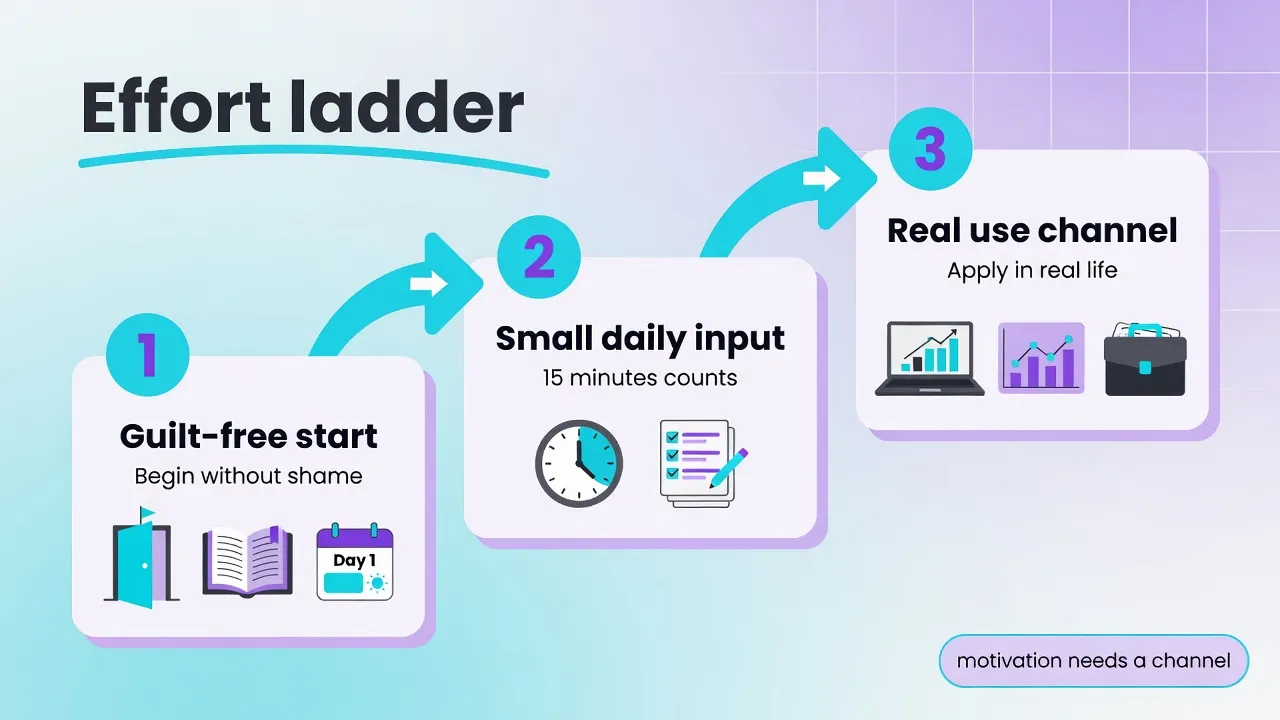
Low effort first: interesting short reading tied to a use channel. Mid: regular input plus light review. High later: exams, heavy speaking practice, prestige books. Climb when the channel is real - not when a poster shames you.
Is English still worth it if AI can translate?
Machine translation is fine for one-off messages, a rough email draft, or checking a menu. For those jobs, a good tool is often enough.
Live work is different. Meetings move fast. Humor lands in the moment or it dies. Trust builds when people hear you answer, not a polished paste. Reading flow suffers when every paragraph needs a machine detour. Speed of thought still wins when you already know the words.
AI is a helper: draft, check, gloss a rare term. It is not a reason to skip a use channel you already have - work docs, series, travel logistics, or study sources. If you already need English on Tuesdays, your own skill still cuts friction where translation apps lag or feel awkward.
No need to fight the tools. They get better. That still leaves a clear case for a usable level of your own English when the channel is real.
How to start this week with reading
Theory without a next step is why motivation articles underperform. Give yourself one week of short, finishable English - not a new personality plan.
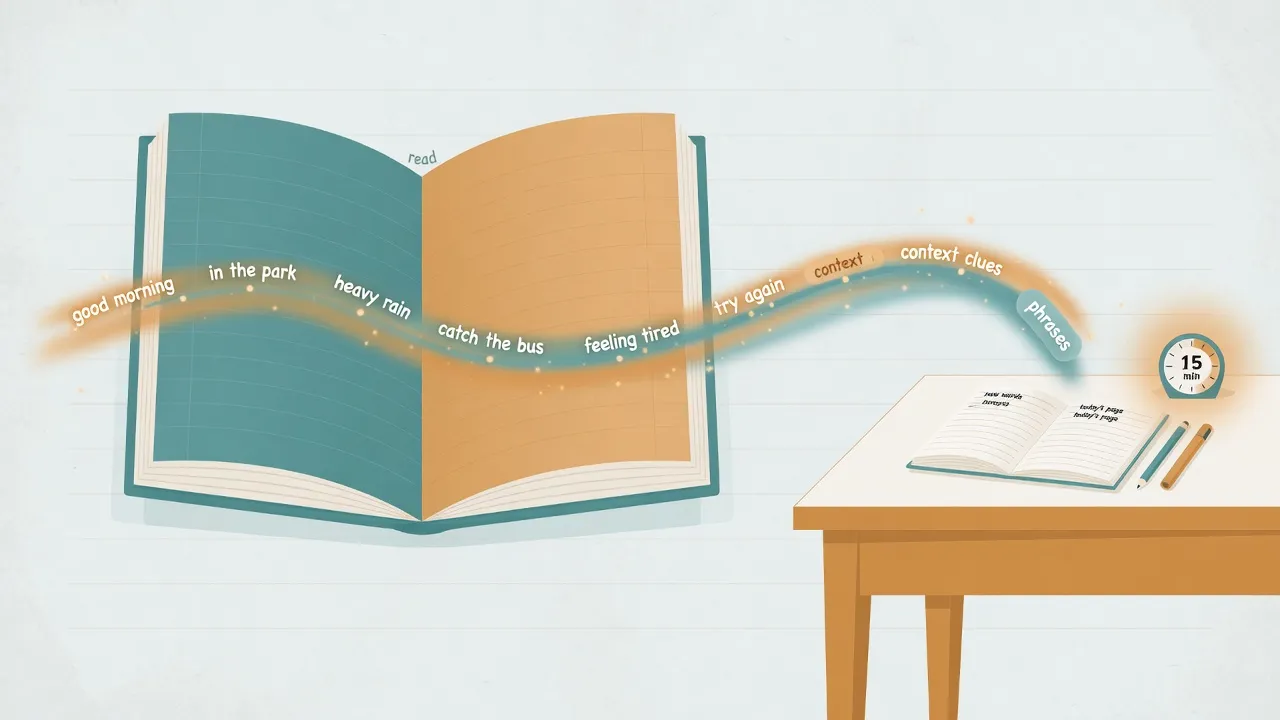
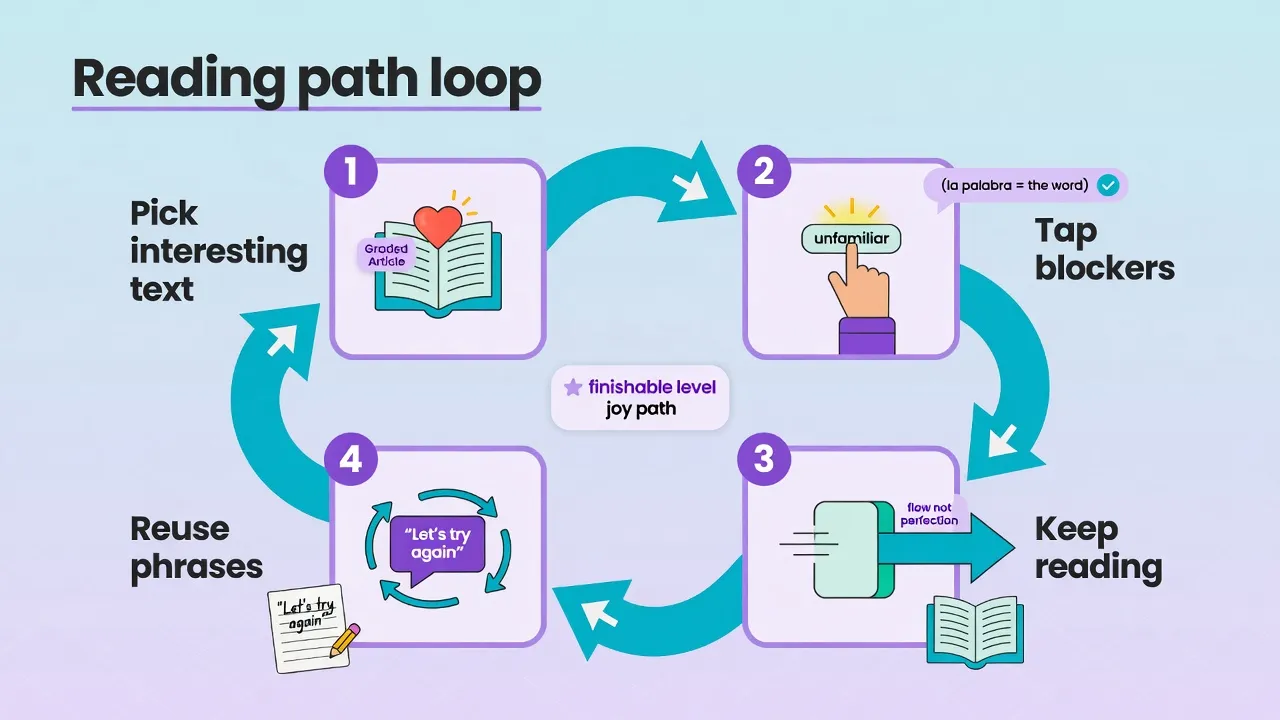
Week-one loop (15-20 min)
- Pick one use channel (job snippet, series interest, trip, course). Write it in one sentence.
- Open a graded English short text you might finish - browse free graded articles.
- Read for meaning. Tap or look up only blockers. Skip rare words that do not kill the plot.
- Optional 3-5 minutes of review on marked words if you use a list or SRS - not required day one.
- Stop while you still want more. That stop rule keeps tomorrow alive.
For a quick sense of vocab size and CEFR orientation, open the language map - a compass for where you roughly sit. If you want a calmer beginner path after this week, read where to start learning English. When you move from short articles toward a full book, how to read your first book in English covers the same "stop while you still want more" spirit.
Week-one reading loop:
What "good enough" looks like after 7 days
- 5-7 short sessions done, not perfection
- One finished short article or chapter slice
- A clearer sense of why you are learning (use channel in one sentence)
Missed one day? Continue. Guilt marathons are the enemy of week two.
A calm tool path if you want less tab-switching
Dictionary tab-tax kills flow. You bounce between text and translator until interest dies. If that is your pattern, a reading tool that keeps translations in context can help - as friction reduction, not as a personality upgrade.
MovaReader is a graded English library with tap-in-context translations and optional trainers for review. It is built so you can finish interesting texts with less tab chaos. It is not a shortcut to free conversation.
Plans at a glance (check current pricing):
| Tier | Approx. | What you get |
|---|---|---|
| Free plan | free | About 20 word translations per day; listening often unlimited; free graded library |
| Reader | about €1/month | More reading comfort when the free plan's limits get in the way |
| Pro | about €5/month | Trainers / SRS if you want structured review - optional, not required for the week-one plan |
You can also import your own legal EPUB. There is no free unlimited shelf of commercial novels by default.
Phrase trainers help recall. Reading builds patterns. Both still need real use later for speaking. Start small: open a sample, read 15 minutes, tap only blockers. See how tap-to-translate reading works. If the free plan is enough, stay free. If you read more, Reader is the calm step up. Add Pro only if you want review structure - not because you "must."
Tools should reduce friction. They should not invent motivation when you still lack a use channel.
FAQ
Is English worth learning if I am not emigrating?
Yes - if you have a use channel at work, in media you enjoy, for study, or for travel. If your only motive is guilt or prestige with no place to use English, it is optional, not a moral failure. You can wait until a real channel appears.
Will English raise my salary by 20-30%?
No fixed percentage. In some markets and roles, English can open more job filters and act as a skill signal, which may relate to pay or access - markets differ wildly. Never treat a single raise number as a promise. Treat language as one career tool among many, not salary magic.
Does learning English prevent Alzheimer or make me smarter?
Bilingual practice is linked in research to possible cognitive benefits for some people (attention, memory habits, flexibility). That is not a medical guarantee, treatment, or prevention claim for Alzheimer or dementia. Learn English for real use; any brain side effects are a bonus, not a therapy plan.
How long until I can use English at work or travel?
It depends on your start level, weekly hours, and how often you actually use the language. A week-one graded reading habit is a real start, not fluency. Work email, travel logistics, and free conversation are different targets with different timelines - pick one near goal and measure progress against that.
Should kids and adults start the same way?
The core idea is shared: interesting input you can mostly understand. Kids usually need more play, short sessions, and parent support; adults can lean on reading, work docs, and self-chosen media. This article is aimed at teens and adults. For a kids-focused path, see where to start learning English with kids.
Can I start from zero with reading only?
You can start with very easy or graded texts plus simple listening, not hard originals on day one. Pure advanced books will frustrate absolute beginners. Reading builds patterns and vocabulary fast; speaking still needs later practice (talk, shadow, partners, or classes). Reading is the heavy input engine, not the whole skill set.
Is English still worth it if AI can translate everything?
Short answer above in Is English still worth it if AI can translate?: machine translation is fine for one-offs; meetings, humor, trust, speed, and reading flow still reward your own skill. AI helps - it does not replace a use channel.
Next step
English is a practical lever when you have a use channel - work, media, travel, or study. The seven reasons above are real daily-life payoffs with realistic caveats: skill signal without fixed raise math, joy media without passive fluency magic, travel comfort without border myths, access without exam shortcuts, direct access to tech docs, possible brain benefits without medical guarantees, and confidence that follows use.
Pick one channel. Open one graded text. Give it 15 minutes today - the free plan is enough to start. Then stop while you still want more.
Learning English?
The English version of MovaReader teaches Spanish and Ukrainian. To read English with a translation for every word, open the reader in Ukrainian or Spanish:
Книги англійськоюЦя стаття українськоюLibros en inglésEste artículo en español