Curated Resources
Modern English Bestsellers for B2 (Skip Boring Classics)
At B2 you do not need Dickens to start originals. Five modern bestsellers with realistic difficulty, a 3-page traffic-light test, and a reading order that protects your habit.
Someone tells you to "read in the original," and the list starts with Shakespeare, Dickens, or at least Austen. For a lot of B2 readers that is a habit killer: language archaeology instead of pages you finish.
Modern bestsellers are not always easier than the classics. They sit closer to the English you actually meet in podcasts, series, and work chat: living dialogue, current topics, fewer thee/thou constructions, more of the language you will reuse.
Plain answer. At B2, modern English bestsellers often beat 19th-century classics as daily reading - not because they are "easy," but because vocabulary and dialogue transfer better to modern life. They can still be hard. Run a 3-page traffic-light test (start, middle, another chapter). Safer path: The Midnight Library or Normal People first, then Lessons in Chemistry, then stretch with Yellowface or Tomorrow, and Tomorrow, and Tomorrow. You need your own legal copy; MovaReader does not host full commercial novels by default.
In this guide:
- Why modern fiction often wins for B2 habit (without calling classics "bad")
- Five books with realistic level cards
- Classic vs modern comparison
- A reading-order ladder and a finish-first method
- How to use MovaReader for lookup help on your EPUB
Who this is for: upper-intermediate readers who want living English, already left pure beginners behind, and are tired of prestige lists that stall on page 40.
Why modern prose often helps B2 more
Compare the feel:
"It is a truth universally acknowledged, that a single man in possession of a good fortune, must be in want of a wife." - Jane Austen (1813)
and a contemporary dialogue or interior monologue about relationships, work, the internet, shame, or career.
For conversational and contemporary English, modern fiction usually offers:
- fresher vocabulary
- more natural dialogue for many B2 readers
- cultural references closer to the 2020s
- fewer archaic constructions
Classics are not the enemy. They are a different goal: literary style, history of the language, academic reading. If your aim is confident B2/C1 for life and work, modern fiction is often the better daily material. Prestige is optional; finishability is not.
If you still like genre ladders (crime, thrillers), see detective and thriller books for English learners. Want Spanish on the same "no boring classics" idea? Try modern Spanish bestsellers for B2.
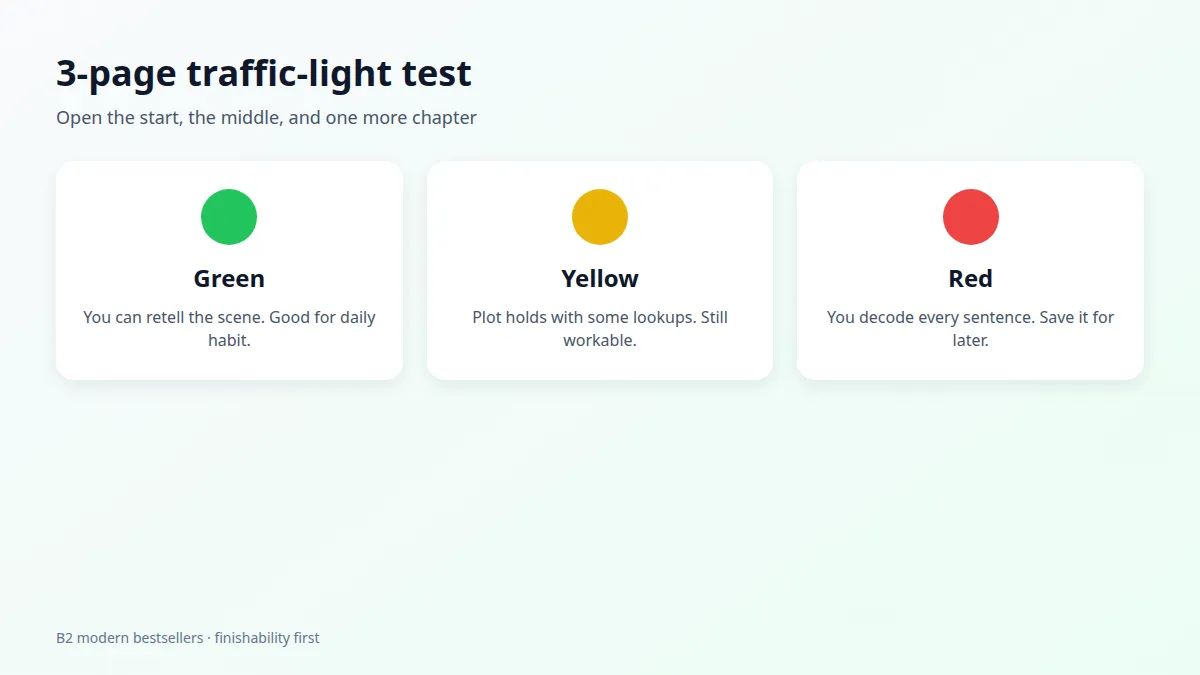
The 3-page traffic-light test
Before you commit to any novel, open three pages: near the start, somewhere in the middle, and another chapter.
- Green: you can retell the scene in your own words
- Yellow: the plot holds; you need some lookups
- Red: you decode almost every sentence
Daily habit needs green or yellow-green. A red page can still be a later goal - just not this month's habit book.
Warm up without buying a novel first:
For legal free EPUBs and public-domain options, use free legal EPUB libraries (English and Spanish).
Five modern books: level cards
These five show up again and again on "read English for intermediate" lists. The difference here is realistic levels: modern does not mean easy B2 for everyone.
1. Normal People - Sally Rooney
Realistic level: solid B2 (some high B1 with support if they already know the story)
Best for: modern dialogue on relationships, class, university, insecurity
Why it helps: conversational contemporary prose; little decorative old style
Watch-outs: Irish usage (grand = fine); emotional subtext between the lines
Short sentences do not mean simple social nuance. You may follow the words and still miss how characters feel.
Start tip: try 5-8 pages of dialogue. If you can track who wants what, continue. If feelings blur, slow down and save emotion phrases, not every adjective.
2. The Midnight Library - Matt Haig
Realistic level: B2 (often the gentlest of the five)
Best for: a philosophical theme in plain modern prose
Why it helps: shorter sentences, clear "choice / other life" structure, ideas that return
Watch-outs: mental health themes; self-reflection words can feel abstract even when grammar is light
A strong bridge when graded readers feel boring but literary fiction still feels heavy.
Start tip: good first modern novel after easy English books. Pair with the traffic-light test on a middle chapter, not only page one.
3. Yellowface - R.F. Kuang
Realistic level: high B2 to low C1
Best for: publishing, internet culture, race, cancel discourse, social media voice
Why it helps: media and internet vocabulary (going viral, cultural appropriation, sensitivity reader)
Watch-outs: cultural context often matters more than a single dictionary hit
Pace is often fast; sentences feel modern. That is closer to media-era English than school classics - and still not an "easy A2 book" in disguise.
Start tip: stretch pick, not the default for low B2. If media discourse is hard even in your first language, wait.
4. Lessons in Chemistry - Bonnie Garmus
Realistic level: B2
Best for: humor plus a strong heroine; science, food, and work vocabulary inside a plot
Why it helps: everyday language mixed with lab words (hypothesis, compound, catalyst) and social conflict
Watch-outs: US humor and a 1960s gender setting; not dry British comedy
Works well if you like witty narrative more than pure romance or pure thriller.
Start tip: sample a humorous stretch and one workplace scene. If the voice clicks, the length is manageable for many B2 readers.
5. Tomorrow, and Tomorrow, and Tomorrow - Gabrielle Zevin
Realistic level: high B2 to C1
Best for: IT/gaming interest, or stories about friendship, work, and creative ambition
Why it helps: gaming and tech words in human context (NPC, respawn, lag, sandbox) plus emotional prose
Watch-outs: length, time jumps, emotional density; feelings language may be harder than the tech jargon
If you already know the tech words, growth often sits in relationship language, not in respawn.
Start tip: treat as stretch. Run the traffic-light test on a mid-book chapter where years jump; that is where many readers stall.
Classic vs modern for B2
| Criterion | Classics (Austen / Dickens) | Modern list here |
|---|---|---|
| Vocabulary freshness | more archaic constructions | closer to living English |
| Dialogue | more literary | often more natural for B2 |
| Internet / media language | almost none | strong in Yellowface |
| Cultural references | 19th century | 21st / late 20th |
| Typical B2 risk | style overload | themes, slang, length |
| Transfer to daily talk | lower for modern life | higher for current English |
Takeaway: modern does not always mean easy. Modern usually means more transferable to how people speak and write now.
Reading order: protect the habit
Think ladder, not prestige shelf.
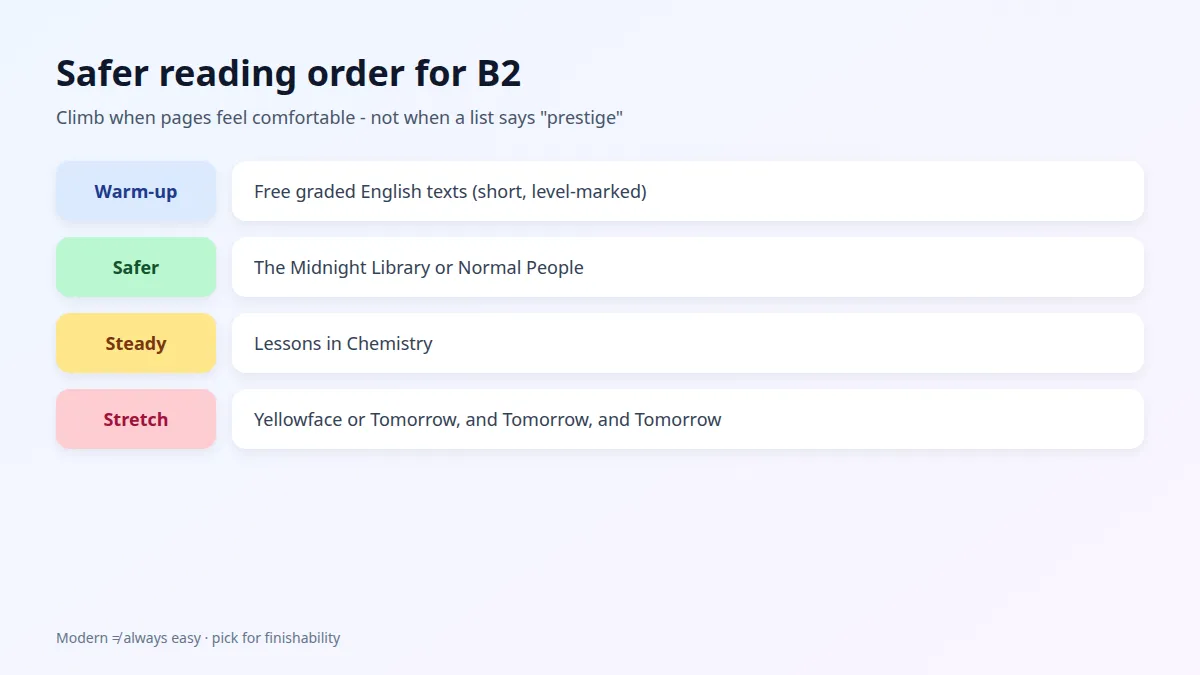
Safer path:
- Free graded English texts (all articles)
- The Midnight Library or Normal People
- Lessons in Chemistry
- Yellowface or Tomorrow... as stretch
If you already know the plot from a show or film:
- Graded warm-up
- The book whose story you already know
- One new book without a screen version
Knowing the plot is not cheating. It frees attention for language. For an earlier step on the ladder, see easy English books for Spanish speakers (A2-B1) or the first-book method notes in how to start reading English.
Rough vocabulary orientation for B2: how many words for B2.
A method that does not burn you out
1) Choose finishability, not prestige
Finishing The Midnight Library beats abandoning a "more serious" novel on page 40. Your brain learns from completed loops.
2) Look up blockers only
Session loop:
- Read a paragraph without stopping
- Mark only words that break the meaning
- Check those
- Re-read the bit
- Save about 3-10 phrases per session
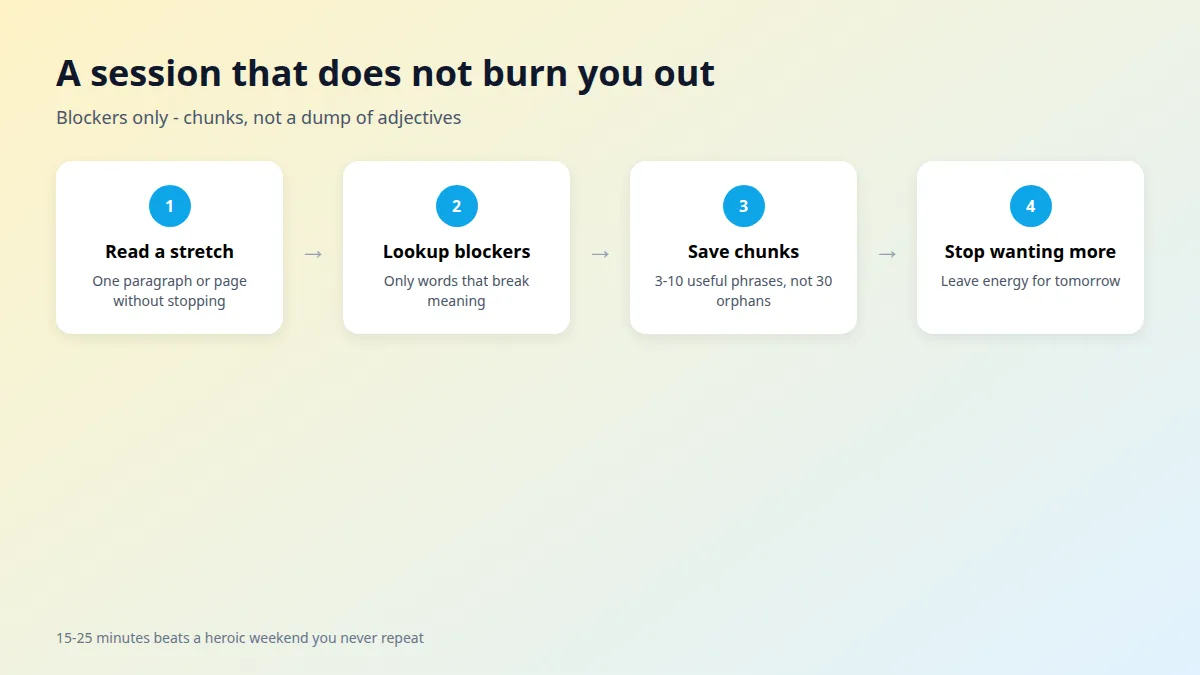
3) Save chunks, not a word landfill
More useful:
- size someone up
- play along
- for better or worse
than thirty isolated adjectives you will never reuse.
4) Weekly rhythm that keeps speed days
- 3-4 days: free graded texts for speed and confidence
- 2-3 days: your bestseller
- 1 day: review saved phrases (trainers when you want structured practice)
Samples:
5) Audio after the eyes, not instead of them
If you have an audiobook separately, listen to a stretch you already read. Parallel audio on an opaque page often only tires you.
Pages per day? Prefer 15-25 minutes, or enough that you still want to open the book tomorrow. Consistency beats a heroic page count.
How to use MovaReader
MovaReader is a reading and practice tool.
- Warm up in the text library.
- When you are ready, open your legal EPUB (how to use).
- Look up only blockers.
- Practice phrases in trainers when you want active recall (trainers).
- Check limits and plans on pricing.
Plans at a glance:
- Free: listening + about 20 word translations per day
- Reader (€1): unlimited translations
- Pro (€5/mo): full trainers
Own the file (or paper) and use the app for lookups and practice.
FAQ
Are classics worse for language learning?
No. Classics are a weak first daily habit for many B2 readers who want modern communication. They stay valuable for literary style and the history of English.
Which book on this list is easiest?
Often The Midnight Library or Normal People, depending on whether you prefer clearer narrative or dialogue-heavy pages. Always run the 3-page traffic-light test.
Is Yellowface okay for low B2?
Usually a stretch. If media and identity discourse is heavy even in your first language, wait. High B2 / low C1 is a fairer band for many readers.
Do I need a separate slang dictionary?
Not required. Save repeating chunks. Skip one-off meme hooks if the plot is already clear.
How many pages per day at B2?
Think in minutes first: 15-25 minutes of attentive reading beats a random page goal. Stop while you still want tomorrow's session.
Do I still need graded texts at B2?
Yes as warm-up and speed work. Many people keep 2-3 easier days per week so the hard novel does not become the only voice in their week.
Next steps
The best "modern English bestseller for B2" is the one you will actually finish and whose language sits near your life - not the one that looks smartest on a shelf.
Do not punish yourself with classics if they kill the habit. Do not pretend every modern novel is automatically light. Choose by what you understand on the page, protect short daily sessions, and translate only what blocks meaning.
Clean start:
- Browse all articles
- Run a 10-minute traffic-light test on one book from this list
- Load your legal file only if you want reader support (how to use, pricing)
- Keep graded days in the mix; stretch only when green/yellow holds
Related reading: how many words for B2, detective English thrillers, free legal EPUB libraries, modern Spanish B2 bestsellers.
Learning English?
The English version of MovaReader teaches Spanish and Ukrainian. To read English with a translation for every word, open the reader in Ukrainian or Spanish:
Книги англійськоюЦя стаття українськоюLibros en inglésEste artículo en español