Tips & Methods
How Long to Learn English? CEFR Hours to B2
Time to learn English is not a calendar trick: it is quality hours toward a named CEFR goal. Hour ranges to B2, tempos for busy weeks and what counts as practice.
You want a clean number. Weeks. Maybe months. Ads and calendar apps love that story: fluent English in 30 days, one perfect challenge, done.
Real life is less cinematic. How long it takes to learn English depends on what "learned" means for you - and how many hours of real practice you bank each week.
How long it takes to learn English depends on your goal level (A2 travel vs B2 work) and how many quality hours you bank each week. From a true zero, B2 often sits around 500-600 quality hours of deliberate practice - a range, not a guarantee. Calendar time follows that bank: roughly months if you study hard daily, years if you study a little on weekdays. Fluency is not one finish line; pick a CEFR skill goal and count hours that actually move it.
Below: what changes the clock, the CEFR hour ladder, calendar tempos to B2, a filter for hours that count, a busy-week skeleton, and a short note on tools.
Why is there no single number?
"Learn English" can mean very different finish lines.
- Order coffee on a trip (near A2)
- Work with colleagues in meetings and chat (often B1-B2)
- Write hard reports or pass a C1 exam (C1+)
Those are not the same distance. Fix a target level and a skill first: reading, speaking, writing, listening. Skills grow unevenly. Many people read better than they speak, and that is normal.
If "fluency" makes you anxious, rename it. Pick a CEFR skill goal you can test in real life: finish a work article without pain, hold a 10-minute call, send a short clear email. Vibes are hard to schedule. Skill goals are not.
What speeds you up or slows you down?
Same goal, different clocks. These knobs move the total more than motivation posters.
| Factor | How it moves the clock |
|---|---|
| Start level | True zero ≠ school leftovers at A2 |
| Hours per week | 7 h/week ≠ 1 h/week |
| Regularity | 20-30 min daily usually beats 3 h once a week |
| Input quality | Comprehensible text/audio > random chaos |
| Output | Speaking/writing lock what reading only shows |
| Related languages | Prior L2 experience often helps |
| Stress and sleep | Burnout kills "perfect plans" faster than hard grammar |
Think of progress as an hour bank. Deposits that count are deliberate practice. Background noise and empty streaks barely move the balance. We will filter that later.
CEFR hours: how many hours of active learning?
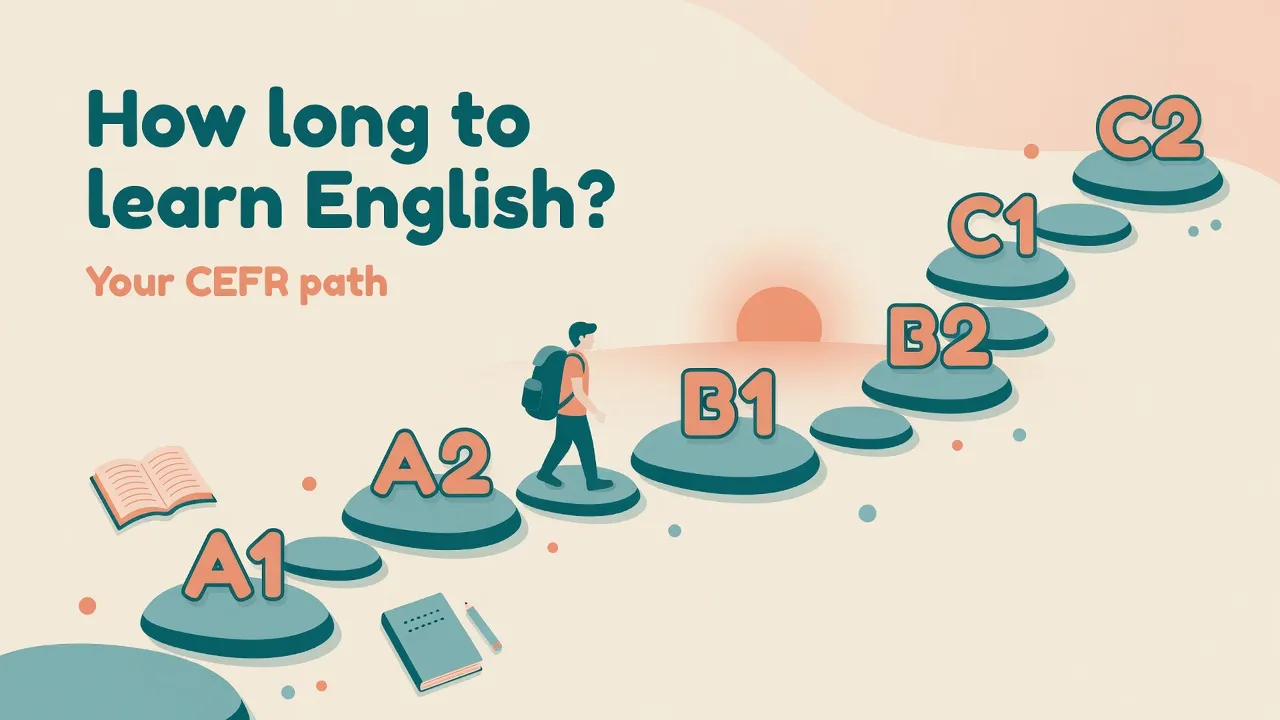
CEFR is the common scale from A1 (basic phrases) to C2 (very high control). Schools and publishers publish guided-learning hour bands. They differ a little. The order of magnitude is similar. Read every number below as a range, not a personal deadline.
"Hours" here means deliberate practice: a lesson, conscious reading, drills, feedback. A podcast only as kitchen noise counts weakly.
Here is the CEFR ladder with cumulative hour ranges from a true zero:
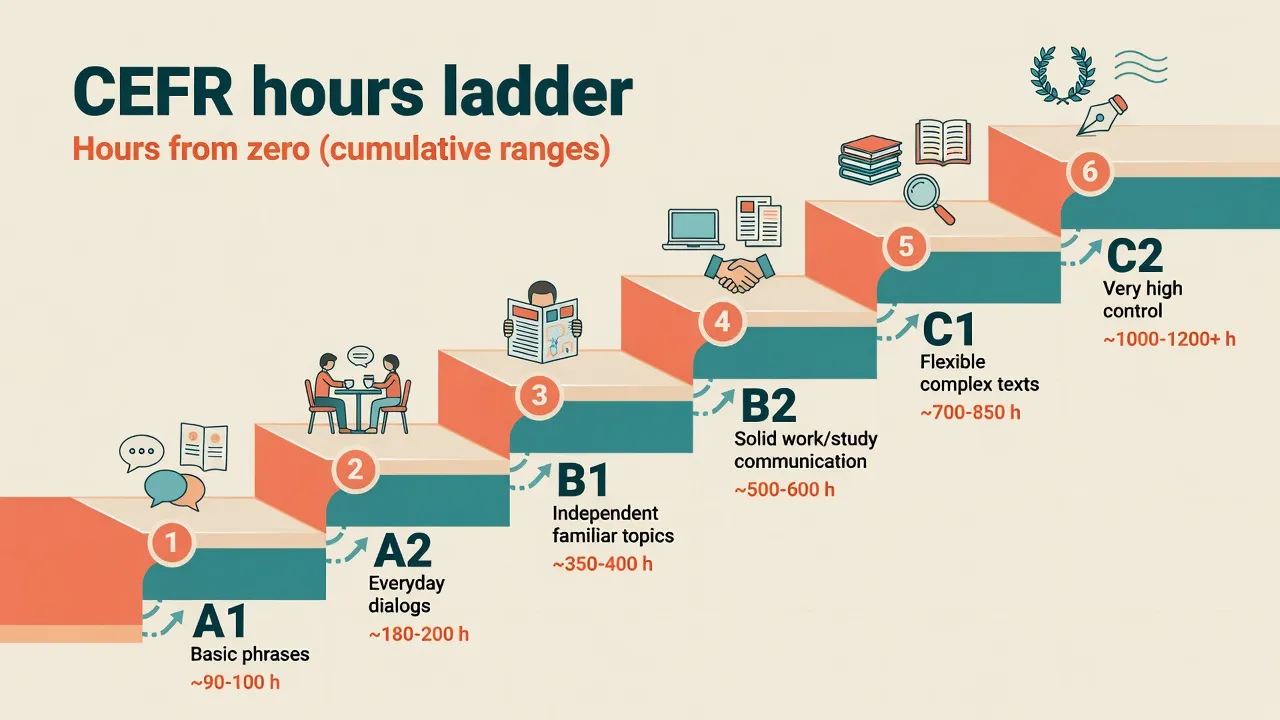
| Level | Rough meaning | Hours from zero (cumulative) | Extra from previous |
|---|---|---|---|
| A1 | Basic phrases | ~90-100 | 90-100 |
| A2 | Everyday / short dialogs | ~180-200 | +90-120 |
| B1 | Independent on familiar topics | ~350-400 | +150-200 |
| B2 | Solid work/study communication for many goals | ~500-600 | +150-220 |
| C1 | Flexible language, complex texts | ~700-850 | +200-300 |
| C2 | Very high control | ~1000-1200+ | +250-400 |
How to read this: B2 from zero often lands around 500-600 quality hours. Some people need less. Some need more. Strong reading plus real output can compress the path. Rare sessions stretch the calendar.
If English is not close to your first language, grammar can feel heavy. That does not erase the bank. Work, IT, and YouTube often add more input hours than people notice. Use them on purpose, not only as noise.
For a sense of vocabulary scale at mid levels, see how many words for B2.
How long on the calendar to ~B2?
Hours turn into calendar time only when you pick a weekly load you can keep. Anchor the bank at about 600 quality hours true zero to B2 (some less, some more). Then the math is simple.
Three common tempos:
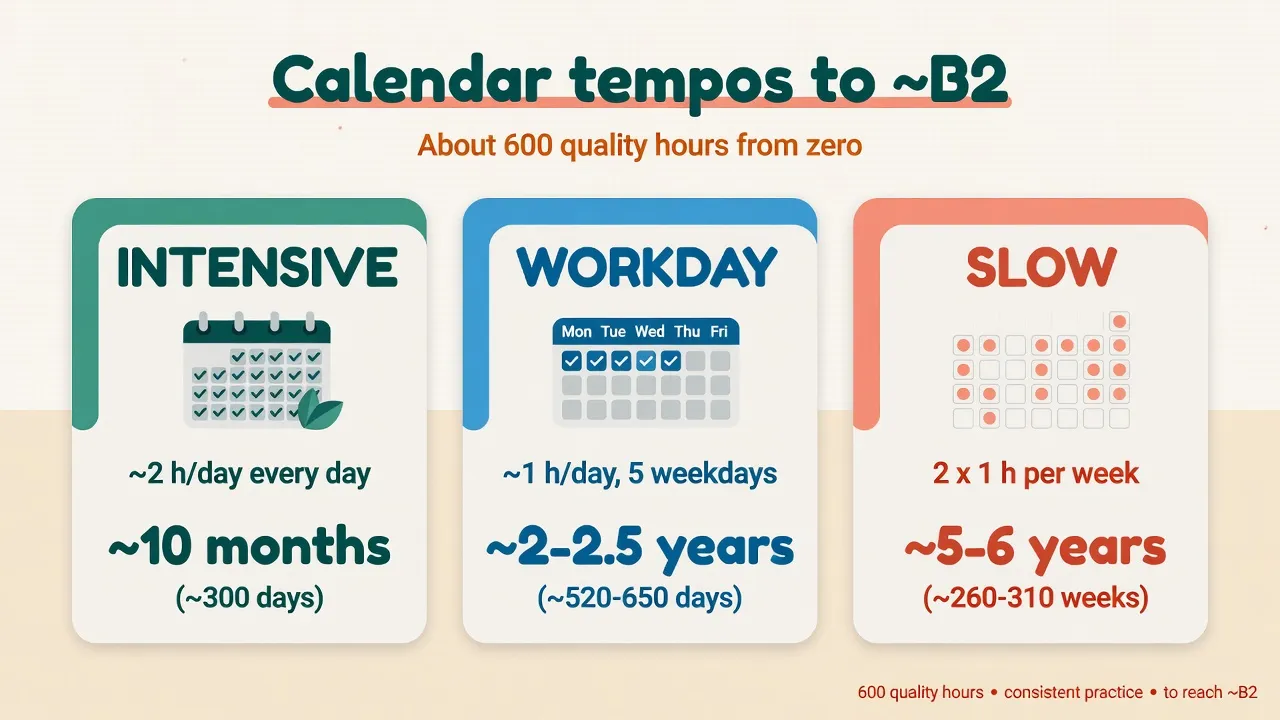
| Tempo | Load | Rough time to ~600 h |
|---|---|---|
| Intensive | ~2 h/day every day | ~10 months |
| Workday | ~1 h/day, 5 weekdays | ~2-2.5 years |
| Slow | 2×1 h per week | ~5-6 years |
This is hour math, not a poster. Intensive means real daily load, not "I thought about English on the train." Workday tempo is common for adults with a job. Slow tempo can still work, but people drop out more from no felt progress than from "no talent."
What if you are not starting from zero?
Many adults are not true beginners. School leftovers, travel English, or work chats already put you near A2 or higher.
Example: near A2 (~200 hours already banked). Remaining to B2 is often about 300-400 hours, not the full 600. That is months of life saved if you stop pretending you are at zero.
An honest self-check or placement test beats months of self-deception. If you are choosing a start path, where to start learning English pairs well with this tempo math.
What counts as a quality hour?
Not every clock minute is a practice hour. This is the part ads skip.
If you "watch English" for two hours while answering chat, you did not bank two hours. If you read a text you mostly understand, notice new phrases, and say three of them out loud, those minutes count.
Quick filter:
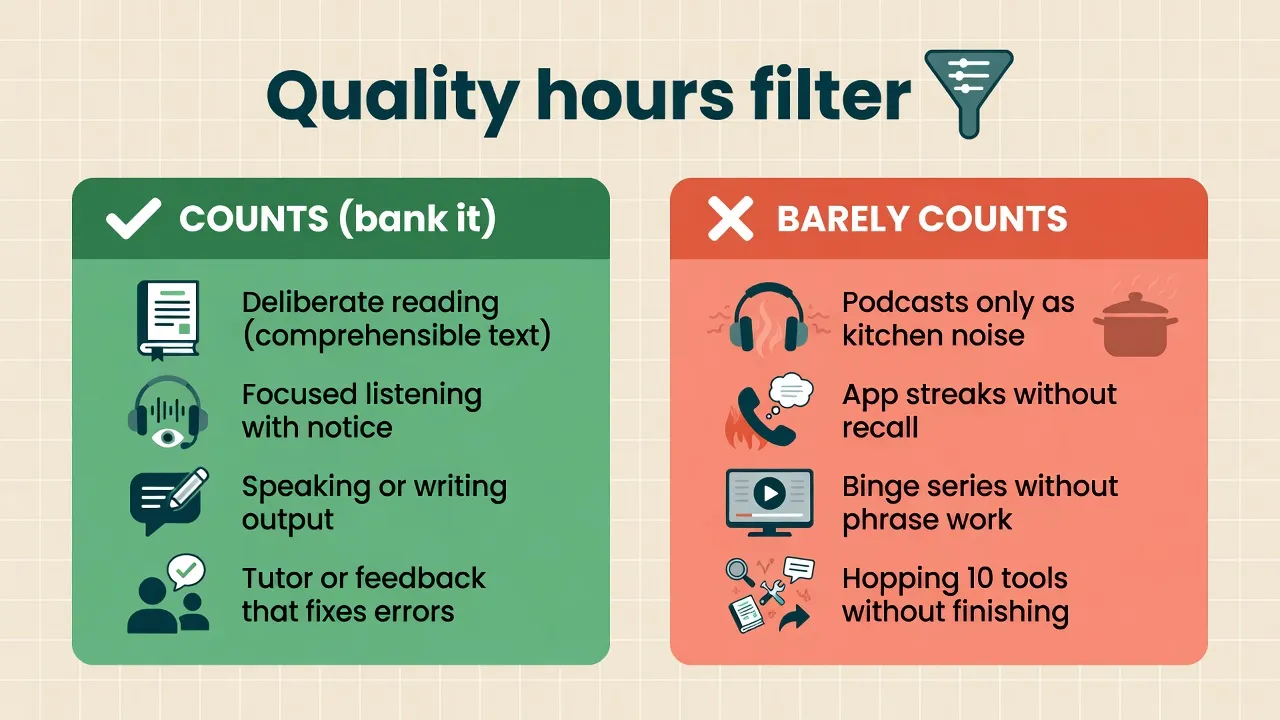
| Counts (bank it) | Barely counts |
|---|---|
| Deliberate reading of comprehensible text (~80%+ understood) | Podcasts only as kitchen noise |
| Focused listening with notice (not pure background) | App streaks without recall |
| Speaking / writing output | Binge series without phrase work |
| Tutor or feedback that fixes real errors | Hopping 10 tools without finishing anything |
Series and podcasts are not the enemy. They help ear and motivation when you pair them with notice and your own sentences. Alone, they often leave you passive: you "get the story" and still cannot say much.
Graded, comprehensible reading is one of the cleanest deposits into the bank. A free start lives in the article library. For a longer reading path, how to read your first book in English and how reading accelerates English learning go deeper.
What "fast" really means
Fast = more quality hours + fewer empty rituals.
Not fast:
- "Fluent in 30 days" promises from true zero to full B2
- Grammar only, with almost no input or output
- Tool-hopping across ten apps with zero finished texts
- Series-only study when your level is still low
Faster than average often looks boring on paper:
- A clear skill goal (B2 reading for docs, B1 speaking for calls)
- Short daily input plus a little output
- Texts you mostly understand (about 80%+)
- Mistakes that do not stop the next session
You cannot buy a shorter hour bank. You can waste fewer hours.
5 ways not to stretch learning for a decade
Small systems beat decade guilt. These five keep the bank filling without a heroic plan you abandon in week three.
1. Level goal, not "English in general"
"B2 reading for work docs" is a plan. "Know English" is fog. Fog makes every method look fine and none of them finishable.
2. Language as part of the week
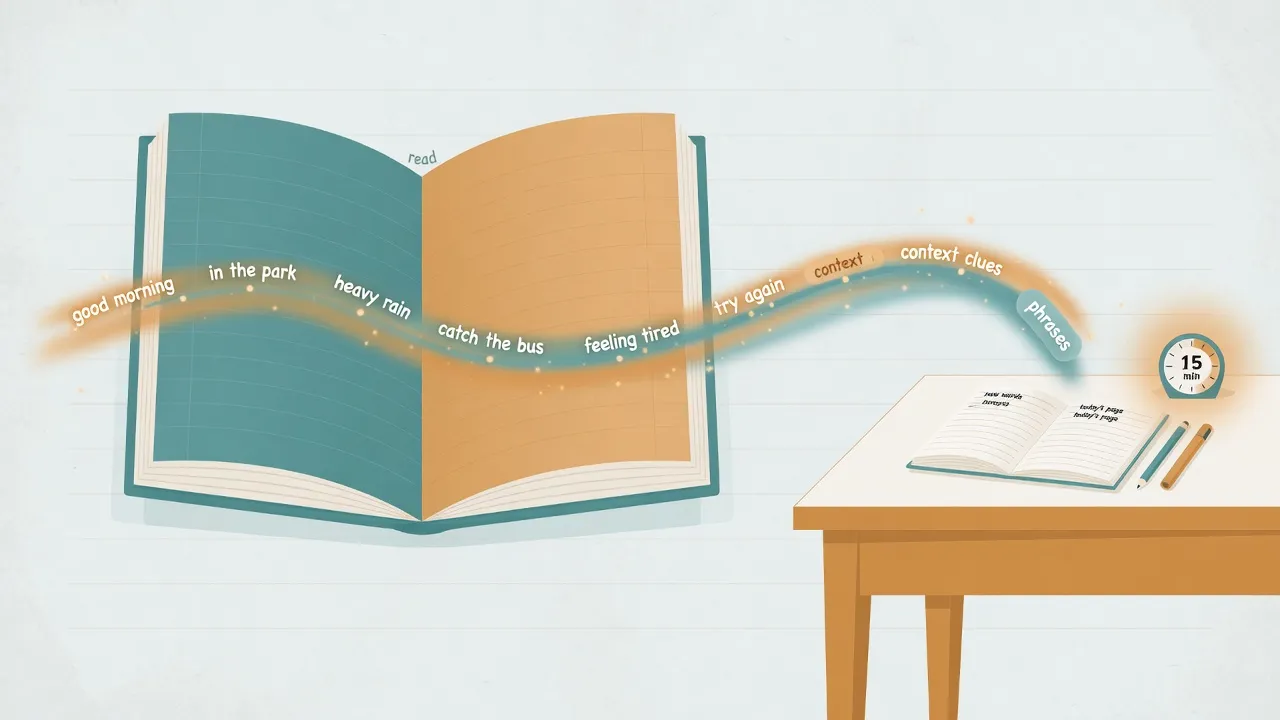
Fifteen to thirty minutes of reading. Short familiar audio. Five to ten of your own sentences or a voice note. Weekday deposits beat weekend guilt marathons.
3. Read what holds attention
Start with graded texts. Move toward simpler originals and materials from your real job or hobbies. Attention is a resource. Boredom kills regularity.
Try the free graded library.
4. Phrases, not only single words
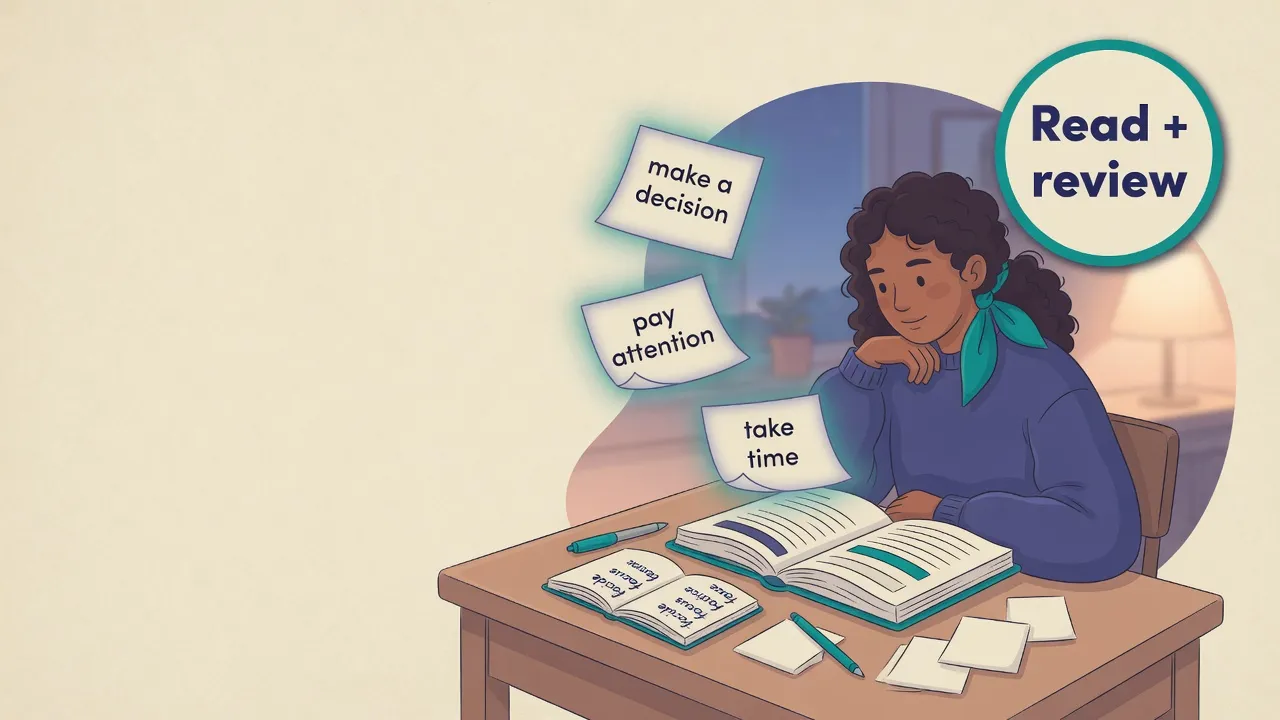
make a decision, look into the issue, on the other hand travel into speech faster than isolated lemmas. Browse phrases if you want ready units to reuse.
5. Repeat a small set often
Ten phrases three times a week beats eighty cards once and forget. The hour bank likes return visits.
A realistic weekly skeleton for busy people
A holdable week beats a heroic weekend. Here is one skeleton many adults can keep.
5 days × 40-50 minutes:
- 20 min reading comprehensible text
- 10 min unpack 3-8 useful phrases
- 10 min speaking or writing (retell, answer 3 questions)
- 1-2× week: longer audio or a partner talk
At about 4 hours per week, a year deposits roughly 200 hours. That is real progress inside the A2-B1 band for many people. It is not "C2 from zero." Realistic yearly math prevents quiet despair when Instagram shows someone "fluent" after a summer course.
If reading is your main deposit, keep texts mostly finishable. The all articles path exists for that.
Where MovaReader fits
MovaReader helps you read more with less friction: free graded library, click a word for translation in context, optional trainers. Graded reading counts toward the quality-hour bank. It does not replace speaking if speaking is the goal. You still bank the hours.
What the free and paid plans include:
| Need | Realistic plan |
|---|---|
| Try reading hours / free graded start | Freemium (~20 word translations/day; listening often unlimited) |
| Daily reading volume with translations | Reader €1/mo |
| Trainers beyond reading | Pro €5/mo |
| A commercial book you already care about | Your legal EPUB/file - not an unlimited hosted bestseller warehouse |
Live terms always live on pricing. Plan names you will see: freemium, Reader, Pro.
A useful path without drama:
- Skim how to use
- Open free graded texts in all articles
- Optional demos: type training, phrase typing
- Upload your own legal EPUB or file when you are ready
- Upgrade to Reader or Pro only when the daily limit actually blocks sessions - see pricing
- Track skills and marked vocab without streak shame: language map
Reading speeds vocabulary and the "feel" of grammar. Speaking still needs speaking. Tool reduces friction; the hour bank is still yours.
Track progress without streak guilt
A green day-streak can lie. Progress is skills you can use plus words and phrases you mark as known - not shame about a missed Tuesday.
Open the language map when you want a compass for vocabulary and phrases. For how the map works in plain language, see language map explained.
FAQ
How long from zero to B2?
Hundreds of hours - often about 500-600+ quality hours of deliberate practice from a true zero. On the calendar that can look like about 10 months intensive (~2 h/day) or about 2+ years at roughly an hour on weekdays. It is a range, not a personal deadline.
Can I learn English in 3 months?
You can raise a level band or a narrow skill (for example strengthen A2, or improve work email). Full B2 from true zero in 3 months is unrealistic for most people. Short sprints work when the goal is small and the hours are real.
How many hours per week is the minimum that still makes sense?
Better 3-5 quality hours steady than 15 once a month. Below about 2 h/week, progress often feels invisible and dropout risk rises. Regular short sessions usually beat rare marathons.
Is Netflix / series enough?
It helps ear and motivation. Without phrase work and your own speaking or writing, many stay passive. Count focused notice plus output. Pure binge-as-background barely fills the hour bank (see the quality filter above).
Why does progress stall at B1?
Survival in familiar topics starts to feel "enough," so harder input and output get avoided. You need denser texts, sharper lexis, and regular speaking. More on that plateau: B1-B2 language plateau.
Does MovaReader guarantee a faster CEFR level?
No. It lowers reading friction and helps collect phrases from graded texts. Speed still equals your hours × quality. Freemium: free library path, about 20 word translations/day, listening often free; Reader €1 for unlimited translations; Pro €5 for trainers. Reading speeds vocab and grammar feel; it does not replace speaking if speaking is the goal. Live terms: pricing.
Next steps
Time to learn English is not a calendar trick. It is quality hours of comprehensible practice toward a named CEFR goal.
Use the CEFR hour ranges as orientation. Pick a tempo you can hold for half a year - intensive, workday, or slow - and protect the deposits that count. Measure skills you care about: a finished article without pain, a short talk, a clear email.
Practical start:
- Bank quality hours: comprehensible reading plus some output
- Open the free article library and one sample text
- Mark phrases and open the language map so progress is skills, not streaks
- Stay freemium while you test; use pricing when translations actually block pages
- If you need a wider start map, read where to start learning English
A tool can cut friction. You still fill the hour bank.
Learning English?
The English version of MovaReader teaches Spanish and Ukrainian. To read English with a translation for every word, open the reader in Ukrainian or Spanish:
Книги англійськоюЦя стаття українськоюLibros en inglésEste artículo en español