Curated Resources
Spanish for Work: Useful Phrases by Job, With Audio
Spanish workplace phrases by job (hospitality, logistics, trades, office and care) with audio lists, a priority ladder and a 20-minute practice loop that fits real shifts.
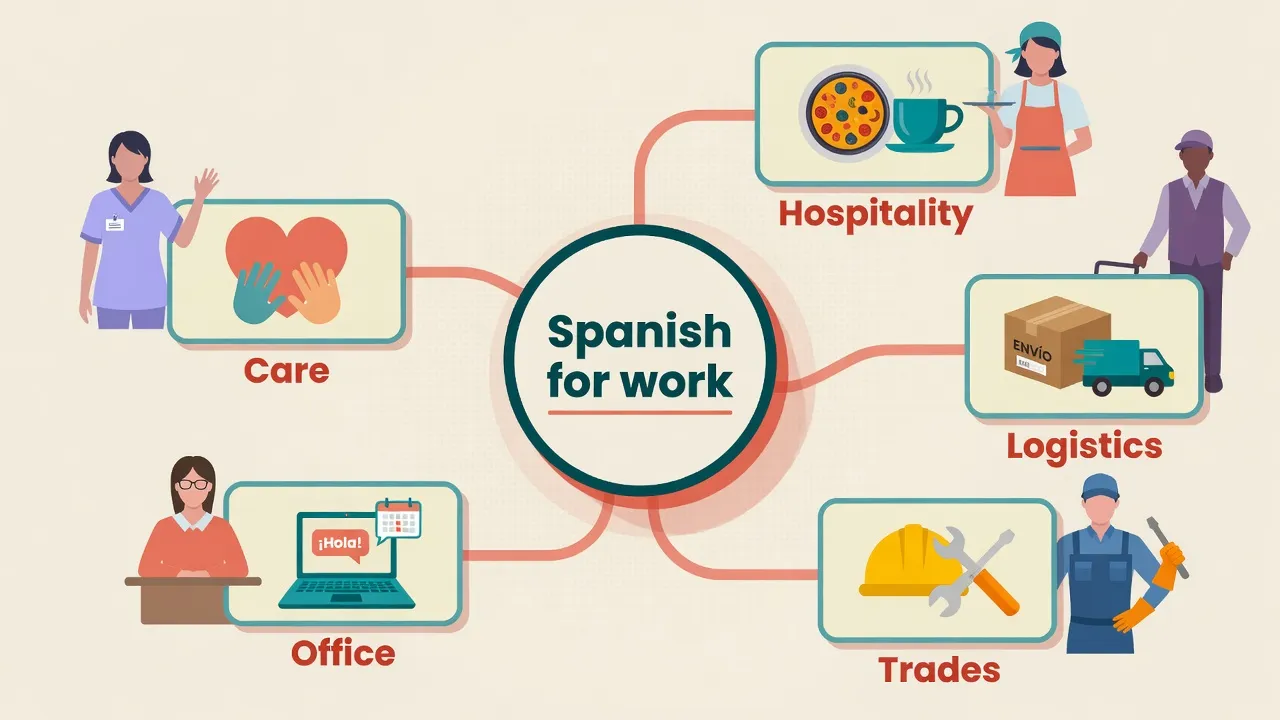
Your shift does not wait for perfect grammar. You need Spanish for orders, tools, deliveries, clients, or a stand-up - real tasks with real people waiting.
Spanish for work is not only boardroom "business Spanish." It is the lines you will actually say on the floor, site, kitchen, road, or desk. Start with those lines, listen, shadow them out loud, and reuse them until they come out without a full mental translation.
If you need Spanish for work, pick the job phrase list that matches your shift. Listen and shadow the lines you will say this week. Run a short 20-minute work-day loop (listen → shadow → use → recall) instead of cramming every list at once. Useful lines for tomorrow matter more than any "fluent in 30 days" claim.
This page maps Spanish workplace phrases by job. You get job clusters with real audio lists, a priority ladder (safety before small talk), a 20-minute practice loop, how to practice in MovaReader, common mistakes, and FAQ.
Browse all work lists: Spanish work and professions phrases
Quick answer: how to learn Spanish for work
Here is the short path if you only have a few minutes to read.
- Pick your job list from this page or the work-professions category.
- Listen first to the phrases you will need this week (greetings, safety, orders, tools, schedule).
- Shadow out loud - say 5-10 lines after the audio before a shift.
- Type or recall the same lines later the same day (the free everyday Spanish phrases practice helps).
- Read a short graded text when you have 10 quiet minutes so workplace Spanish sits next to everyday Spanish.
You do not need a two-hour block after a long shift. You need useful lines for tomorrow, then more lines next week. That is enough to start sounding reliable at work.
Match this week's Spanish to the problem you actually have on site or floor:
| Goal this week | Best focus | Practice loop |
|---|---|---|
| Survive first days on site or floor | Safety, tools, schedule, simple requests | Listen → repeat → use on shift |
| Talk to customers | Service openings, problems, payments, polite refusals | Shadow 10 lines before open |
| Join office meetings | Stand-ups, email openers, reschedule, leave | Read aloud once, type once |
| Grow beyond survival | Related graded reading + more phrase lists | 10 min phrases + 10 min reading |
Why job-specific Spanish beats generic "business Spanish"
Generic business Spanish phrases often teach boardroom vocabulary you may never use on a real shift. Job lists win for a simple reason: they match tasks you already know.
They repeat the daily verbs you need (bring, clean, check, confirm, deliver). They give polite survival lines (sorry, wait, can you repeat). They keep practice short enough to fit before clock-in.
If your role is hybrid - delivery plus customer chat, kitchen plus suppliers - open two lists and keep only the lines you will actually say. Studying every list in the same week is how people remember nothing under noise.
All Spanish work phrase lists in one place
The full set lives in the work and professions category. Below is a map by workplace type. Open only the lists that match your day. Do not try to study every cluster at once.
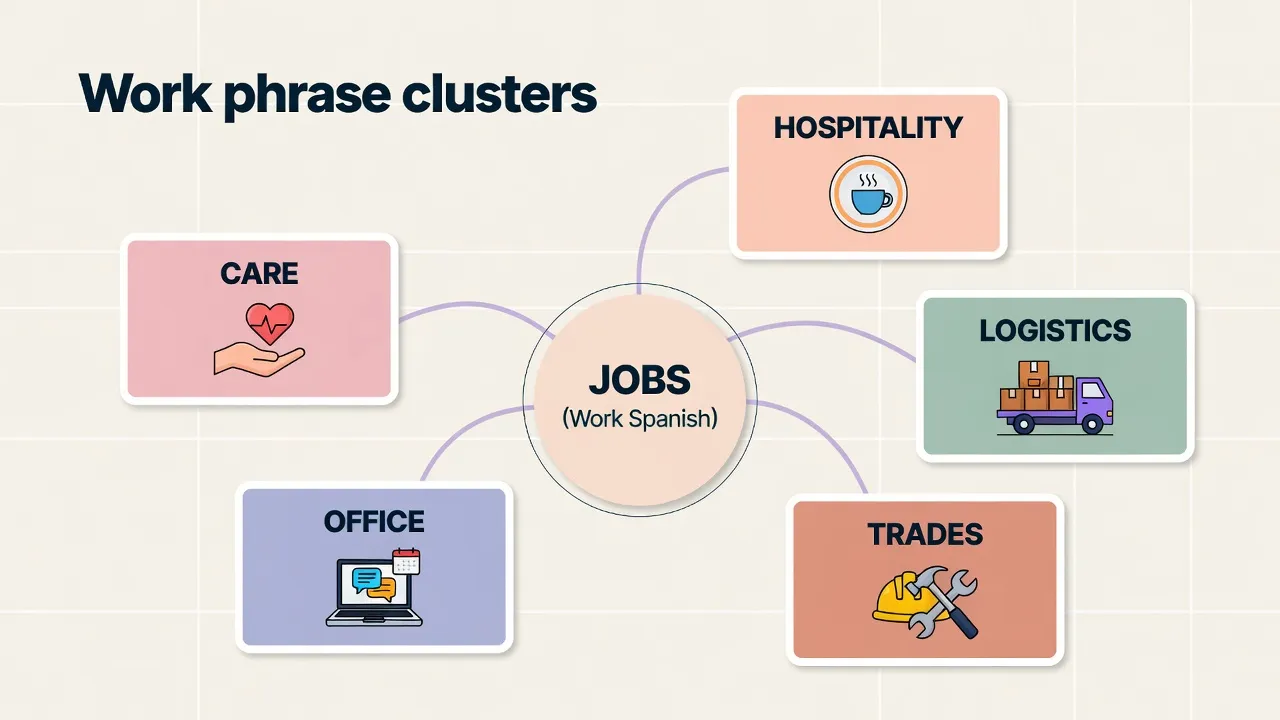
Hospitality and food service
Kitchen, bar, cafe, and hotel Spanish is high-frequency and noisy. Short commands, order checks, and guest care matter more than polished small talk on day one.
- Spanish for chefs and kitchen staff
- Spanish for coffee shop baristas
- Spanish for bartenders and waiters
- Spanish for hotel maids and housekeepers
Shift tip: memorize five "I need / please bring / is ready / allergy / bill" lines before full small talk. Guests forgive accent more easily than order confusion.
Logistics, drivers, warehouse, delivery
Here the language is locations, times, packages, and problems. Numbers and "where is / who signed / it is delayed" beat fancy adjectives every time.
Shift tip: practice phone and radio phrases slowly. If people miss your address or unit number, the rest of the conversation collapses.
Construction and skilled trades
Site Spanish is concrete: materials, tools, measurements, hazards. Learn safety and request language early so you can ask for help without freezing.
Shift tip: pair each tool word with one full sentence ("Pass me the...", "We need more...", "It is broken / leaking"). Nouns alone are hard under pressure and noise.
IT, office, and professional routines
Office Spanish mixes meetings, email, support tickets, hiring, and status updates: blocked, ready, delayed, next step. You do not need every list below - pick the routines you actually live.
- Spanish for programmers and developers
- Spanish for QA testers and bugs
- Spanish for daily stand-up meetings
- Spanish for project and product managers
- Spanish for customer support
- Spanish for business emails
- Spanish for HR managers and recruiters
- Spanish for onboarding new employees
- Spanish job interview phrases (50)
- Spanish for asking for a raise or salary review
- Spanish for rescheduling or canceling a meeting
- Spanish for time off and sick leave
Office tip: keep three reusable templates - short status update, polite delay, clear ask. Most work Spanish reuses the same frames with new nouns.
Care, beauty, fitness, and cleaning service
Client-facing Spanish is about comfort, consent, timing, and money. Learn booking language, step-by-step explanation, and lines like "that hurts / too short / too hot."
- Spanish for cleaners and housekeeping
- Spanish for fitness trainers
- Spanish for massage therapists
- Spanish for manicurists
- Spanish for barbershop and haircuts
- Spanish for booking a manicure with a client
Service tip: practice check-in questions first ("Is this OK?", "Tell me if it hurts", "Shorter or longer?"). Those protect the client relationship more than marketing small talk.
A simple weekly plan for working learners
You do not need a two-hour study block after a long shift. Use a 20-minute loop on work days and a longer loop on one rest day. One primary job list for about seven days is enough. Add a second list only if your role truly mixes tasks and the first set already feels familiar.
Work-day loop (about 20 minutes)
Four short blocks. No heroic marathon. Headphones before clock-in is often enough.
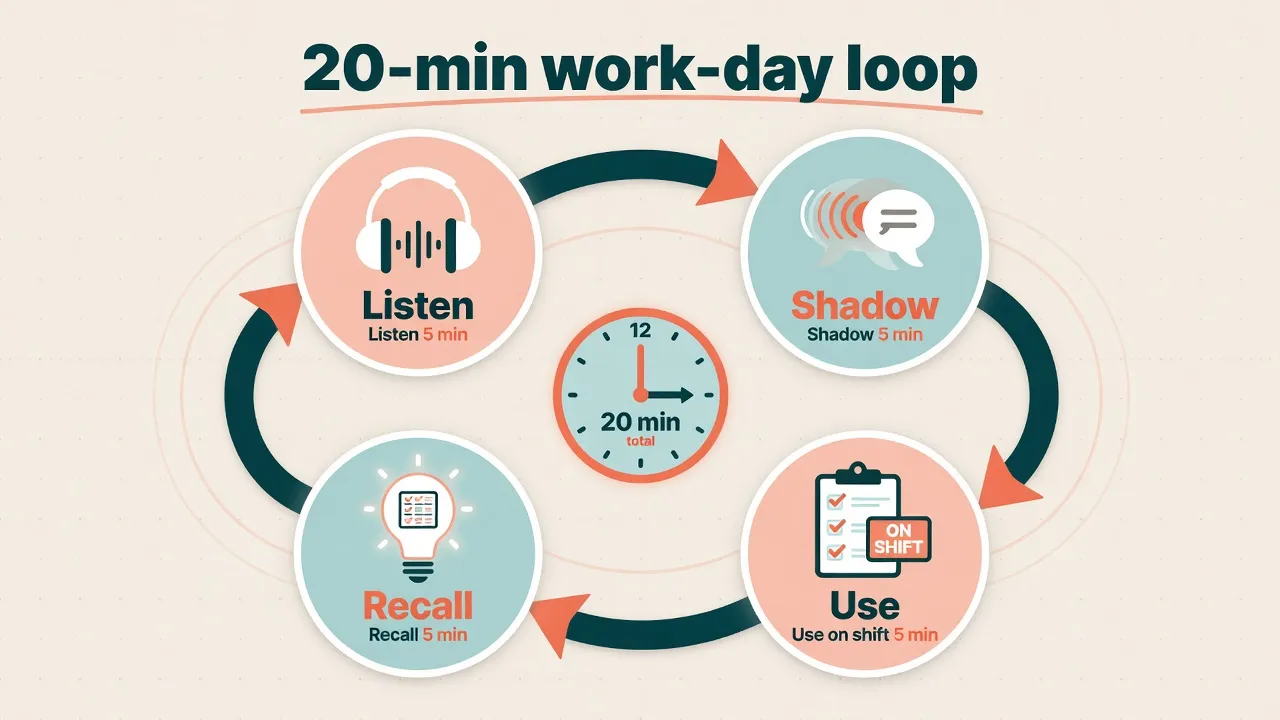
- 5 min listen to 8-12 phrases from your job list.
- 5 min shadow the same lines out loud after the audio.
- 5 min use or simulate before clock-in (or quiet role-play if you are off-site).
- 5 min recall, or use the free phrase typing demo.
Rest-day loop (about 35-40 minutes)
When you have a little more energy, deepen without bloating the list.
- Review last week's phrases once.
- Add up to 10 new lines only if the old ones feel familiar.
- Read one short graded Spanish article for general fluency, not only work jargon.
- Optional: open a second list if your role mixes tasks.
What to prioritize first (any job)
If you reverse this order, you sound friendly but cannot finish the job in Spanish. Teammates notice reliability first.
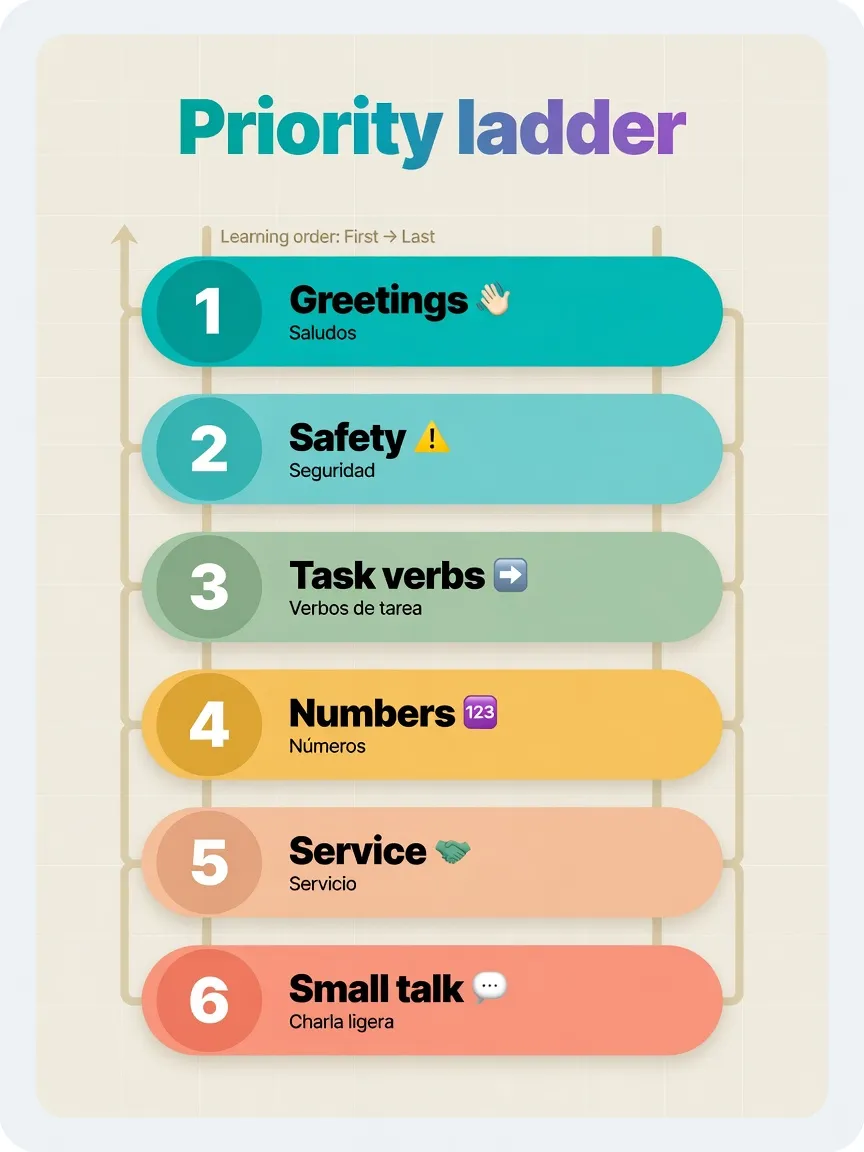
- Greetings and identity - who you are; open the conversation.
- Safety and problems - "Careful", "Broken", "Help", "I do not understand".
- Core task verbs for your role - the work itself.
- Numbers, times, quantities - schedule, counts, money, sizes.
- Polite service or team phrases - teamwork and guest care.
- Only then: small talk - friendly last, not first.
How to practice these phrases inside MovaReader
Phrase audio, shadowing, and short graded reading turn job lists into something you can say when someone is waiting. Use the product for what it actually does: listen free, produce lines, translate only when reading needs it.
Listen free
Open a job phrase list and use the audio. Unlimited listening on freemium helps when your eyes are tired after a shift.
Browse all lists: work and professions phrases.
Practice production with a demo trainer
Recognition is not enough for work. You need to produce the line when someone is waiting.
Try the free phrase typing trainer demo. Type or reconstruct lines after listening. Full trainers are on Pro (€5/mo) - use the demo first. More context: Trainers.
Freemium translations, Reader, and Pro (clear limits)
When you read graded articles or need word help, the limits are simple:
| Path | What you get |
|---|---|
| Freemium | About 20 word translations per day; unlimited listening often |
| Reader (€1) | Unlimited translations |
| Pro (€5/mo) | Full trainers |
| Also free | Graded library; upload EPUB/files you own |
| Does not | Replace on-the-job practice; host licensed commercial novels free by default |
Details: Pricing · How to use.
Listen every day for free. Pay only if you hit the translation ceiling or want deeper trainer practice.
Add graded reading so work Spanish is not isolated
Phrase lists teach high-value lines. Reading builds the grammar glue around them so workplace Spanish does not live in a jargon bubble.
Start with a free Spanish A2 sample: Aprendiendo a reciclar en casa.
Browse more levels: All articles.
For soft orientation of vocabulary ranges, you can also open the language map.
You can upload EPUB or other files you own. MovaReader does not host licensed commercial novels free by default.
Common mistakes when learning Spanish for work
These are the traps that waste a week of shift Spanish. Easy to fix once you see them.
- Studying every job list at once. Choose one primary list for about 7 days.
- Memorizing words without full lines. "Hammer" without "Pass me the hammer, please" fails under noise.
- Ignoring repair language. "Can you repeat?", "Slowly, please", "I am still learning" keep conversations alive.
- Waiting until you feel ready. Use 10 imperfect lines on the job, then fix the two that failed most.
- Skipping listening. Many workplaces are oral and fast; keep audio in the daily loop.
Related reading and next steps
Here is one solid path for today.
- Open your job list or the work-professions category.
- Listen and shadow 10 lines today.
- Try the phrase typing demo.
- Read free sample article 1209 or browse all articles.
- If translations matter daily, check pricing for Reader (€1) or Pro (€5/mo).
One solid phrase list + daily audio + short reading beats a pile of disconnected tip posts.
FAQ
How long does it take to learn Spanish for work?
Enough for basic shift survival can take a few focused weeks if you practice daily with real job phrases. Comfortable, flexible workplace Spanish usually takes months of listening, speaking, and reading. Treat "ready for Monday" and "fully fluent at work" as different goals.
Should I learn Latin American Spanish or Spain Spanish for my job?
Learn the variety used by the people you work with. Phrase lists still help either way because core workplace verbs and objects overlap heavily. Adjust pronunciation and a few local words after you hear your team. Do not wait for a perfect regional choice before you open a job list.
Can I learn Spanish for work without a tutor?
Yes for the first layer: phrase lists, audio, shadowing, and short graded reading. A tutor or coworker feedback becomes valuable when you need role-play, accent correction, or industry jargon your list does not cover. Start alone, then get feedback on the lines you already use.
What is better first: grammar course or phrase lists?
For work, start with phrase lists tied to your tasks, then fill grammar gaps when the same pattern repeats (commands, past events, polite requests). A pure grammar course with no job context is slower if you need Spanish on site next week. Lists first; grammar as glue when patterns repeat.
Should I learn one job list or many at once?
One primary list for about 7 days. Hybrid roles: two lists max, and only the lines you will actually say. Studying every hospitality, trades, and office list in the same week is how people remember nothing under noise. Same rule as the common-mistakes section.
How does MovaReader help with Spanish for work?
MovaReader gives you job phrase lists with audio, free listening, a free phrase typing demo, freemium reading with about 20 word translations a day, Reader at €1 for unlimited translations, and Pro at €5/mo for full trainers, plus a free graded article library and upload of files you own. It does not replace on-the-job practice, and it does not ship licensed commercial novels as free built-in content by default. Details: Pricing.
Keep reading with translations inside the text
With a free account, an unknown word translates with one tap, and the words you are learning wait for you in the trainer.
Free account: 7 days of Pro, then 20 word translations a day or a paid plan.