
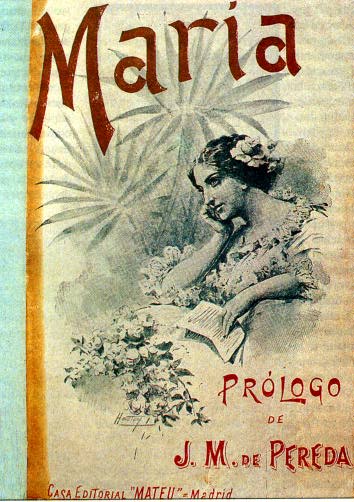
.jpg)
I. Capítulo 1
. ; , , , .
, , . . , , , .
A Colombian romantic novel for B2
Jorge Isaacs
Jorge Isaacs’s complete original novel, first published in 1867, not an adaptation. In the catalog it is B2: about 88,400 words and 29 words per sentence on average. The author’s dedication and 65 chapters about Efraín and his cousin María in the Cauca Valley; the sentences are long, but the story moves at an even pace.
Earlier
At B1 the sentences of about 29 words, full of commas and descriptions of nature, will often lose you, and old forms like volvíme, faltóme and teníale need unpacking.
B1This text
You can manage it at B2: the sentences are long, but the story is told clearly and in order, and the landscape passages can be read slowly, translating single words such as guaridas or hojarasca.
Check this passageWith room to spare
At C1 the novel reads freely; only the rare vocabulary of plants, animals and country life in the Cauca Valley still sends you to the translation.
Start readingThe average sentence has 29 words, longer than in most complete novels at B2: only Lazarillo de Tormes (30), La edad de oro (30) and Bécquer’s Leyendas (32) come out higher, while Pepita Jiménez has 22, and Doña Perfecta and Marianela about 15. One word in twelve has 9 letters or more (8.3%), below the one in ten that marks C1. The difficulty is even: in every stretch of about eight chapters the average stays between 27 and 30 words. Long, comma-laden descriptions of the landscape and the old forms like volvíme and teníale add work, but the story is told in order and without wordplay. Hence B2. This is the catalog’s assessment, not a certificate.
Wikisource. Wikisource
Efraín, a young man from a well-off family in the Cauca Valley, comes home after years of study in Bogotá. At the house he finds his parents, his sisters and María, the girl brought up with them, whom he remembers as a child and now sees grown. Their love grows through the daily rhythm of the hacienda: meals, hunts, songs, evening visits. But a shadow lies from the start over María’s health and over the family’s money, and the happiness of those days is fragile. Whether the two will be together is not revealed here.
I. Capítulo 1
. ; , , , .
, , . . , , , .
XXI. Capítulo 21
, . , , . , .
, , .
Choose an underlined word.
The sentences are long but built from short pieces joined by commas and participles: humedecida por tantas lágrimas, helada por la primera sensación de dolor. Read them as small scenes in a row. The imperfect verbs (esperó, juntó, balbuciendo) are ordinary narration, and the narrator already knows how the story will end, which is why the passage has a gentle sense of foreboding.
Aquél is a pronoun that picks out one of two people named just before: here José, not his nephew Braulio, so aquél me habló means “the former spoke to me”. Also watch the pronoun after the verb in Teníale seguido el rastro: it is the same as Le tenía seguido el rastro, only in the older bookish order.
The book stays free on every plan. Reader, €1 a month, removes the daily limit on words and sentences.
€1 a month
In the long landscape sentences, like the morning of the return, where the clouds look like “las gasas del turbante de una bailarina esparcidas por un aliento amoroso”, translating the whole sentence in Reader keeps the main verb from getting lost among the comparisons.
ReaderIt is the original, not a learner’s abridgement: Jorge Isaacs’s complete novel, first published in Bogotá in 1867, with the author’s dedication A los hermanos de Efraín and all 65 chapters. The text comes from Spanish Wikisource, without the critical introduction and notes.
María has no audiobook on MovaReader: here the novel is read on screen. The translation appears when you tap a word, and you will need it most for rare words of country life such as guaridas or hojarasca.
Yes, with the Reader plan. In this novel it helps most in the long descriptive sentences, for example “Teníale seguido el rastro al animal y descubierta una de sus guaridas en el nacimiento del río”. Without the plan, single words are translated up to the daily limit.
The whole novel takes about 15-25 hours: the pace of someone reading with translation of new words, slower than a native speaker’s. Chapters run from about 300 to 4,300 words, so one or two short ones make an evening, while the longest need a sitting of their own.
It stays even. Every stretch of about eight chapters averages between 27 and 30 words per sentence, and the dedication is only about 110 words. The shortest chapters (II, IX, LXII) are the easiest way in; the last chapter, at about 670 words, rises to 33 words per sentence.
Yes. Once you sign in, the reader keeps your last place and the words you opened, so you can come back to the novel every evening where you left off. Any of the 65 chapters also opens from the contents on this page, for example chapter I, right after the dedication.